
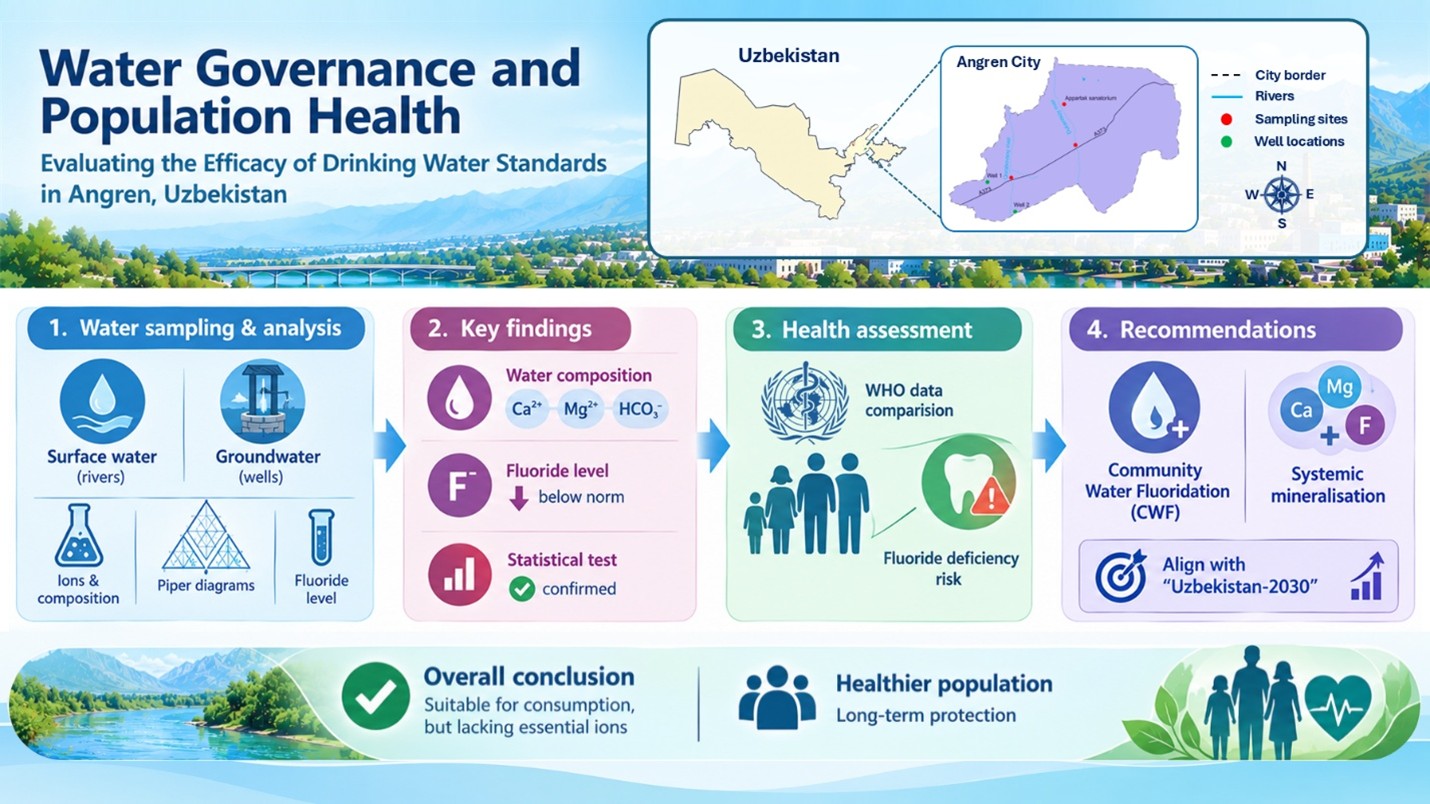
Water governance and population health: Evaluating the efficacy of drinking water standards in Angren, Uzbekistan

Ensuring safe drinking water that meets both hydrochemical and physiological standards remains a key environmental challenge. In industrial regions, evaluating local water sources against international criteria is essential to identifying hidden risks to public health. This study investigates the hydrochemical characteristics of surface and groundwater in Angren, Uzbekistan, and evaluates their specific impact on public health within the framework of national and international safety standards. The salt composition formulas of the water samples were determined, and corresponding Piper diagrams were generated. It was also found that the fluorine content in samples taken from Angren water is much lower than the norm, which may cause several issues for public health. A statistical hypothesis test was conducted to scientifically substantiate the correctness of this idea. The low fluorine content was analyzed in relation to World Health Organization data. Suggestions and recommendations were made to eliminate problems related to the impact of the fluorine element in water below the norm on public health. Although the surface and groundwater in Angren were considered suitable for consumption, some physiological deficiency in essential ions was discovered. The study recommends the adoption of Community Water Fluoridation and systemic mineralization strategies aligned with the “Uzbekistan-2030” strategy to mitigate these long-term public health risks.
- Vörösmarty CJ, McIntyre PB, Gessner MO, et al. Global threats to human water security and river biodiversity. Nature. 2010;467(7315):555-561. doi: 10.1038/nature09440
- Juliev M, Jumaniyazov I, Togaev I, et al. Land degradation in Central Asia: a review of papers from the Scopus database published in English for the period of 2000-2020. E3S Web Conf. 2023;462:03020. doi: 10.1051/e3sconf/202346203020
- Ma L, Abuduwaili J, Li Y, Abdyzhapar uulu S, Mu S. Hydrochemical characteristics and water quality assessment for the upper reaches of Syr Darya River in Aral Sea Basin, Central Asia. Water (Basel). 2019;11(9):1893. doi: 10.3390/w11091893
- Edmunds WM, Smedley PL. Fluoride in natural waters. In: Essentials of Medical Geology. Dordrecht, Netherlands: Springer Netherlands; 2012:311-336. doi: 10.1007/978-94-007-4375-5_13
- Bekturganov Z, Tussupova K, Berndtsson R, Sharapatova N, Aryngazin K, Zhanasova M. Water related health problems in Central Asia—a review. Water (Basel). 2016;8(6):219. doi: 10.3390/w8060219
- Sadeq M, Moe CL, Attarassi B, Cherkaoui I, Elaouad R, Idrissi L. Drinking water nitrate and prevalence of methemoglobinemia among infants and children aged 1-7 years in Moroccan areas. Int J Hyg Environ Health. 2008;211(5-6):546-554. doi: 10.1016/j.ijheh.2007.09.009
- Ibrahim E, Abu Amr SS, Kozhiparambath L. Ammonia level in drinking water and its health effects in Khartoum state, Sudan. Israa Univ J Appl Sci. 2024;7(2). doi: 10.52865/EOOK4744
- Backer LC. Assessing the acute gastrointestinal effects of ingesting naturally occurring, high levels of sulphate in drinking water. Crit Rev Clin Lab Sci. 2000;37(4):389-400. doi: 10.1080/10408360091174259
- Moore J. Water quality monitoring in Canadian aboriginal communities. In: Providing Safe Drinking Water in Small Systems. Boca Raton, FL: CRC Press; 2019:387-393. doi: 10.1201/9780203741726
- Soylak M, Elci L, Saracoglu S, Divrikli U, Dogan M. Chemical analysis of drinking water samples from Yozgat, Turkey. Pol J Environ Stud. 2002;11(2):151-156.
- Oʻzbekiston Respublikasi Prezidentining Farmoni [Decree of the President of the Republic of Uzbekistan]. Mamlakat taraqqiyotining 2030-yilgacha moʻljallangan ustuvor yoʻnalishlari doirasida islohotlarni izchil davom ettirish va yangi bosqichga olib chiqishning qoʻshimcha chora-tadbirlari toʻgʻrisida [On additional measures to consistently continue reforms and bring them to a new stage within the framework of priority directions of the countryʼs development until 2030]. Decree No. PF-21, February 16, 2026. Lex.uz. Accessed October 19, 2026. https://lex.uz/uz/docs/-8050769
- Turaeva S, Sultanova G. Climate change impact on agriculture and water resources: Uzbekistan. In: Leal Filho W, Ng TF, Iyer-Raniga U, Ng A, Sharifi A, eds. SDGs in the Asia and Pacific Region. Cham, Switzerland: Springer; 2024. doi: 10.1007/978-3-031-17463-6_38
- Eshanbabayev AA, Madraximov AM, Islomov SA, Ahmadjonov BT. Scientific approach to scientific and practical research on improving traffic safety on mountainous segments of the A-373 Tashkent-Andijan-Osh highway. Constr Educ. 2025;Spec No 3. https://jurnal.qurilishtalim.uz/dannie/2025-yil%203-maxsus%20son.pdf
- World Health Organization. Guidelines for Drinking-Water Quality: Fourth Edition Incorporating the First and Second Addenda. Geneva, Switzerland: World Health Organization; 2022. Accessed October 26, 2026. https://www.who.int/publications/i/item/9789240045064
- Halder JN, Islam MN. Water pollution and its impact on the human health. J Environ Hum. 2015;2(1):36-46. doi: 10.15764/EH.2015.01005
- Karpova TV. Vliyanie vody kak universal'nogo veshchestva na organizm cheloveka [The influence of water as a universal substance on the human body]. Nauka, Tekhnika i Obrazovanie. 2018;4:45. https://cyberleninka.ru/article/n/vliyanie-vody-kak-universalnogo-veschestva-na-organizm-cheloveka
- Lunegova IV, Tyts VV, Lopatin SA. Water and its importance for human life and health. Pharm Formulas. 2022;4(3):50-57. doi: 10.17816/phf115210
- Rose JB, Örmeci B, Aw TG. Water quality and health: an ecological perspective. Water Ecol. 2025;1(2):100007. doi: 10.1016/j.wateco.2025.100007
- Nyika J, Dinka MO. Water challenges in rural Sub-Saharan Africa. In: Water Challenges in Rural and Urban Sub-Saharan Africa and Their Management. SpringerBriefs in Water Science and Technology. Cham, Switzerland: Springer Nature Switzerland; 2023:39-55. doi: 10.1007/978-3-031-26271-5_3
- Nyika J, Dinka M, eds. Water Challenges in Rural Sub-Saharan Africa. Cham, Switzerland: Springer; 2023. doi: 10.1007/978-3-031-26271-5
- Bose D, Bhattacharya R, Kaur T, et al. Overcoming water, sanitation, and hygiene challenges in critical regions of the global community. Water-Energy Nexus. 2024;7:277-296. doi: 10.1016/j.wen.2024.11.003
- Dery F, Bisung E, Dickin S, Dyer M. Understanding empowerment in water, sanitation, and hygiene (WASH): a scoping review. J Water Sanit Hyg Dev. 2020;10(1):5-15. doi: 10.2166/washdev.2019.077
- Mahala KR. Impact of water pollution on human health and environment and its remedial techniques: a review. Int J Res Rev. 2024;11(12):674-683. doi: 10.52403/ijrr.20241274
- Ward BB. Nitrification. In: Encyclopedia of Ecology. Amsterdam, Netherlands: Elsevier; 2013:351-358. doi: 10.1016/B978-0-12-409548-9.00697-7
- Nawaz R, Nasim I, Irfan A, et al. Water quality index and human health risk assessment of drinking water in selected urban areas of a mega city. Toxics. 2023;11(7):577. doi: 10.3390/toxics11070577
- Dewangan SK, Minj D, Mahant M, Singh A. Physico-chemical properties of water—a comprehensive review of methods, trends, and applications. EPRA Int J Res Dev. 2024;9(12):352-356. https://eprajournals.com/IJSR/article/14704
- Shuvo SD, Zahid MA, Rahman MM, Parvin R. Exploring the impact of soil and water salinity on dietary behavior and health risk of coastal communities in Bangladesh. J Water Health. 2020;18(6):1110-1123. doi: 10.2166/wh.2020.145
- World Health Organization. Calcium and Magnesium in Drinking-Water: Public Health Significance. Geneva, Switzerland: World Health Organization; 2009. Accessed October 26, 2026. https://www.who.int/publications/i/item/9789241563550
- Zohoori FV, Kumah EA, Kronic J, Drinnan M, Morris AJ. Public health impacts of water fluorides: current evidence from a rapid systematic review. Adv Nutr. 2025;16(12):100547. doi: 10.1016/j.advnut.2025.100547
- World Health Organization. Guidelines for Drinking-Water Quality. 4th ed incorporating 1st addendum. Geneva, Switzerland: World Health Organization; 2017. Accessed October 26, 2026. https://www.who.int/publications/i/item/9789241549950
- Fawell J, Bailey K, Chilton J, Dahi E, Fewtrell L, Magara Y. Fluoride in Drinking-Water. London, England: IWA Publishing; 2013. doi: 10.2166/9781780405803
- Ward MH, Jones RR, Brender JD, et al. Drinking water nitrate and human health: an updated review. Int J Environ Res Public Health. 2018;15(7):1557. Published July 23, 2018. doi: 10.3390/ijerph15071557
- World Health Organization. Ammonia in Drinking-Water. Geneva, Switzerland: World Health Organization; 2003.
- Bashir MT, Ali S, Bashir A. Health effects from exposure to sulphates and chlorides in drinking water. Pak J Med Health Sci. 2012;6(3):648-652.
- World Health Organization. pH in Drinking-Water. Geneva, Switzerland: World Health Organization; 2007. Accessed October 26, 2026. https://cdn.who.int/media/docs/default-source/wash-documents/wash-chemicals/ph.pdf
- Raheja H, Goel A, Pal M. An evaluation of groundwater quality and its suitability for drinking and irrigation uses under the GIS framework. Water Pract Technol. 2022;17(11):2259-2277. doi: 10.2166/wpt.2022.134
- Gonzalez-Fernandez O, Margui E, Queralt I. Multielemental analysis of dried residue from metal-bearing waters by wavelength dispersive X-ray fluorescence spectrometry. Spectrochim Acta Part B At Spectrosc. 2009;64(2):184-190. doi: 10.1016/j.sab.2008.11.011
- Chou CH, Selene J. Hydrogen Sulfide: Human Health Aspects. Geneva, Switzerland: World Health Organization; 2003. Accessed October 26, 2026. https://iris.who.int/handle/10665/42638
- Jacqmin H, Commenges D, Letenneur L, Barberger-Gateau P, Dartigues JF. Components of drinking water and risk of cognitive impairment in the elderly. Am J Epidemiol. 1994;139(1):48-57. doi: 10.1093/oxfordjournals.aje.a116934
- Guseva NV, Otakulova YA. Geokhimiya podzemnykh vod Pritashkentskogo artezianskogo basseyna (Respublika Uzbekistan) [Geochemistry of groundwaters in the Tashkent artesian basin (Republic of Uzbekistan)]. Izvestiya Tomskogo Politekhnicheskogo Universiteta. 2014;325(1):127-136. https://earchive.tpu.ru/handle/11683/5298
- Kulmatov R. Problems of sustainable use and management of water and land resources in Uzbekistan. J Water Resour Prot. 2014;6(1):35-42. doi: 10.4236/jwarp.2014.61006
- Lioubimtseva E, Henebry GM. Climate and environmental change in arid Central Asia: impacts, vulnerability, and adaptations. J Arid Environ. 2009;73(11):963-977. doi: 10.1016/j.jaridenv.2009.04.022
- Iheozor-Ejiofor Z, Walsh T, Lewis SR, et al. Water fluoridation for the prevention of dental caries. Cochrane Database Syst Rev. 2024;10(10):CD010856. doi: 10.1002/14651858.CD010856
- O'Mullane DM, Baez RJ, Jones S, et al. Fluoride and oral health. Community Dent Health. 2016;33(2):69-99.
- Pajor K, Pajchel L, Kolmas J. Hydroxyapatite and fluorapatite in conservative dentistry and oral implantology—a review. Materials (Basel). 2019;12(17):2683. doi: 10.3390/ma12172683
- Rugg-Gunn A, Lowry R, Cockcroft B, Walmsley AD. Water fluoridation today: benefits and challenges. Front Oral Health. 2026;7:1745916. doi: 10.3389/froh.2026.1745916
- Goodarzi F, Mahvi AH, Hosseini M, Nodehi RN, Kharazifard MJ, Parvizishad M. Prevalence of dental caries and fluoride concentration of drinking water: a systematic review. Dent Res J (Isfahan). 2017;14(3):163-168. doi: 10.4103/1735-3327.208765
- Tangvoraphonkchai K, Davenport A. Magnesium and cardiovascular disease. Adv Chronic Kidney Dis. 2018;25(3):251-260. doi: 10.1053/j.ackd.2018.02.010
- Rosique-Esteban N, Guasch-Ferré M, Hernández-Alonso P, Salas-Salvadó J. Dietary magnesium and cardiovascular disease: a review with emphasis in epidemiological studies. Nutrients. 2018;10(2):168. doi: 10.3390/nu10020168
- Helte E, Säve-Söderbergh M, Larsson SC, Åkesson A. Calcium and magnesium in drinking water and risk of myocardial infarction and stroke—a population-based cohort study. Am J Clin Nutr. 2022;116(4):1091-1100. doi: 10.1093/ajcn/nqac186
- Bykowska-Derda A, Spychala M, Czlapka-Matyasik M, Sojka M, Bykowski J, Ptak M. The relationship between mortality from cardiovascular diseases and total drinking water hardness: systematic review with meta-analysis. Foods. 2023;12(17):3255. doi: 10.3390/foods12173255