
Environmental fate and ecotoxicological impacts of antibiotic transformation products: Microbial reactivation, resistance selection, and ecosystem risks

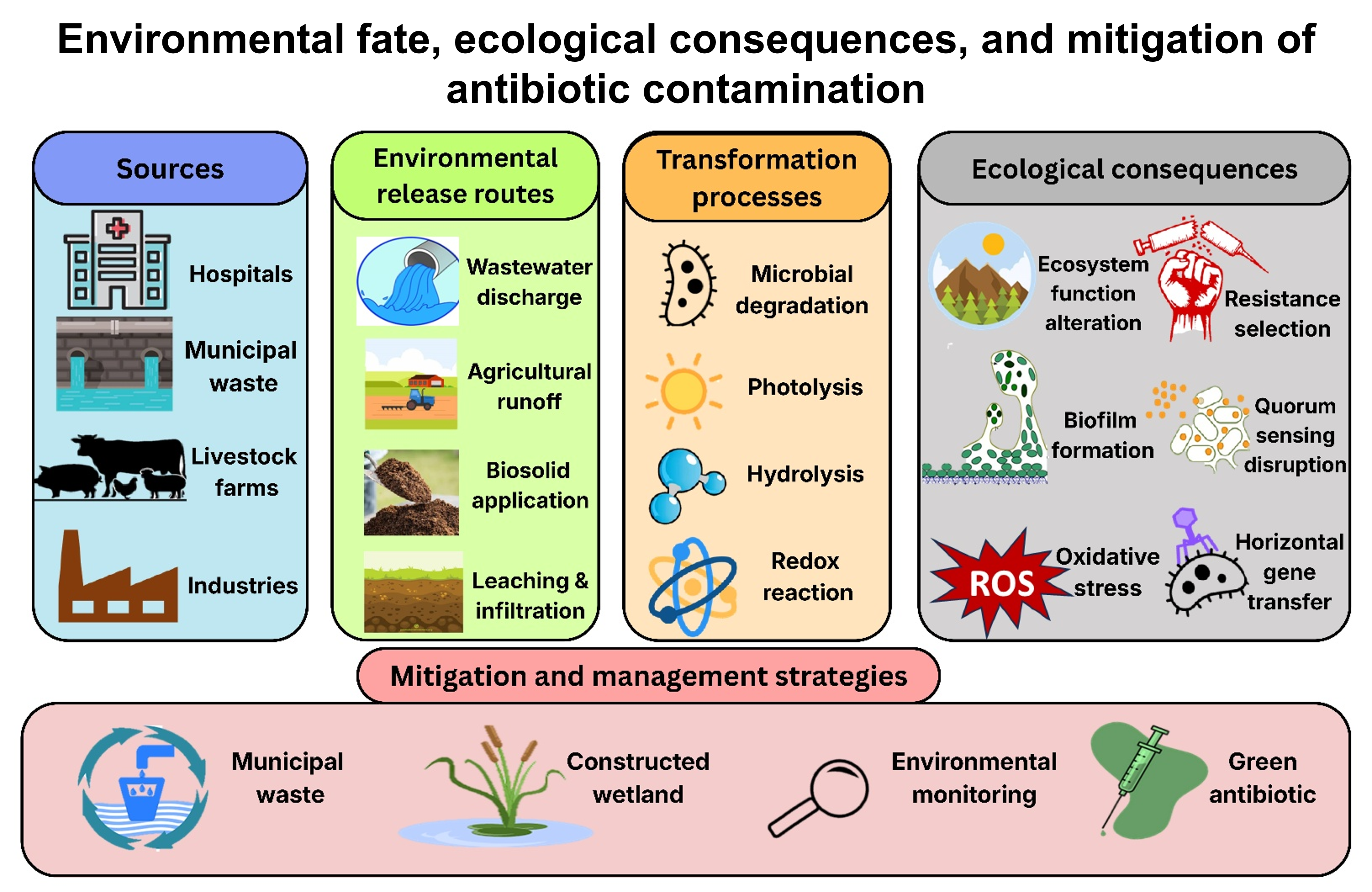
Antibiotics and their transformation products (TPs) make up a critical class of emerging contaminants. While parent compounds are frequently monitored, their metabolic derivatives often bypass detection due to analytical gaps and a lack of systematic risk assessments. This review evaluates the persistence, bioactivity, and ecological impact of antibiotic TPs across ecosystems. Our review illustrates the biotic and abiotic pathways of TP formation, showing that these metabolites often retain or amplify the bioactivity of their parent compounds. We elucidate how subinhibitory concentrations of TPs induce physiological stress, quorum sensing disruption, biofilm formation, and fundamental biogeochemical cycling, and how chronic exposure to trace levels of TPs drives antimicrobial resistance. To address these risks, we advocate for integrating improved wastewater treatment with advanced analytical frameworks, including non-target screening and multiomics approaches. We propose the implementation of TP-specific risk assessments and green antibiotic design to mitigate the global escalation of such risks.
- Klein EY, Impalli I, Poleon S, et al. Global trends in antibiotic consumption during 2016–2023 and future projections through 2030. Proc Natl Acad Sci USA. 2024;121(49):e2411919121. doi: 10.1073/pnas.2411919121
- Wilkinson JL, Boxall ABA, Kolpin DW, et al. Pharmaceutical pollution of the world's rivers. Proc Natl Acad Sci USA. 2022;119(8):e2113947119. doi: 10.1073/pnas.2113947119
- Göbel A, Thomsen A, McArdell CS, Joss A, Giger W. Occurrence and Sorption Behavior of Sulfonamides, Macrolides, and Trimethoprim in Activated Sludge Treatment. Environ Sci Technol. 2005;39(11):3981-3989. doi: 10.1021/es048550a
- Löffler P, Escher BI, Baduel C, Virta MP, Lai FY. Antimicrobial transformation products in the aquatic environment: global occurrence, ecotoxicological risks, and potential of antibiotic resistance. Environ Sci Technol. 2023;57(26):9474-9494. doi: 10.1021/acs.est.2c09854
- Achermann S, Bianco V, Mansfeldt CB, et al. Biotransformation of Sulfonamide Antibiotics in Activated Sludge: The Formation of Pterin-Conjugates Leads to Sustained Risk. Environ Sci Technol. 2018;52(11):6265-6274. doi: 10.1021/acs.est.7b06716
- Polesel F, Andersen HR, Trapp S, Plósz BGy. Removal of Antibiotics in Biological Wastewater Treatment Systems—A Critical Assessment Using the Activated Sludge Modeling Framework for Xenobiotics (ASM-X). Environ Sci Technol. 2016;50(19):10316-10334. doi: 10.1021/acs.est.6b01899
- Haddad T, Baginska E, Kümmerer K. Transformation products of antibiotic and cytostatic drugs in the aquatic cycle that result from effluent treatment and abiotic/biotic reactions in the environment: An increasing challenge calling for higher emphasis on measures at the beginning of the pipe. Water Res. 2015;72:75-126. doi: 10.1016/j.watres.2014.12.042
- Murray AK, Stanton I, Gaze WH, Snape J. Dawning of a new ERA: Environmental Risk Assessment of antibiotics and their potential to select for antimicrobial resistance. Water Res. 2021;200:117233. doi: 10.1016/j.watres.2021.117233
- Lakhey P, Hayes A, Murray AK, et al. Antibiotic transformation products exert selective pressure for antimicrobial resistance comparable to parent compounds. Nat Water. 2026;4(7):871-881. doi: 10.1038/s44221-026-00663-4
- Gillings MR, Gaze WH, Pruden A, Smalla K, Tiedje JM, Zhu YG. Using the class 1 integron-integrase gene as a proxy for anthropogenic pollution. ISME J. 2015;9(6):1269-1279. doi: 10.1038/ismej.2014.226
- Petrovich ML, Zilberman A, Kaplan A, et al. Microbial and viral communities and their antibiotic resistance genes throughout a hospital wastewater treatment system. Front Microbiol. 2020;11:153. doi: 10.3389/fmicb.2020.00153
- Larsson DJ, De Pedro C, Paxeus N. Effluent from drug manufactures contains extremely high levels of pharmaceuticals. J Hazard Mater. 2007;148(3):751-755. doi: 10.1016/j.jhazmat.2007.07.008
- De Liguoro M, Cibin V, Capolongo F, Halling-Sørensen B, Montesissa C. Use of oxytetracycline and tylosin in intensive calf farming: evaluation of transfer to manure and soil. Chemosphere. 2003;52(1):203-212. doi: 10.1016/S0045-6535(03)00284-4
- Le TX, Munekage Y. Residues of selected antibiotics in water and mud from shrimp ponds in mangrove areas in Viet Nam. Mar Pollut Bull. 2004;49(11-12):922-929. doi: 10.1016/j.marpolbul.2004.06.016
- Marano RB, Zolti A, Jurkevitch E, Cytryn E. Antibiotic resistance and class 1 integron gene dynamics along effluent, reclaimed wastewater irrigated soil, crop continua: elucidating potential risks and ecological constraints. Water Res. 2019;164:114906. doi: 10.1016/j.watres.2019.114906
- Montone CM, Giannelli Moneta B, Laganà A, Piovesana S, Taglioni E, Cavaliere C. Transformation products of antibacterial drugs in environmental water: Identification approaches based on liquid chromatography-high resolution mass spectrometry. J Pharm Biomed Anal. 2024;238:115818. doi: 10.1016/j.jpba.2023.115818
- Bergan T, Thorsteinsson SB, Rohwedder R, Scholl H. Elimination of ciprofloxacin and three major metabolites and consequences of reduced renal function. Chemotherapy. 1989;35(6):393-405. doi: 10.1159/000238702
- Fu LX, Jiang ZG, Ding HZ, Liu YH. Population pharmacokinetics of enrofloxacin and its active metabolite ciprofloxacin in ill cows. J Vet Pharmacol Ther. 2008;31(3):240-245. doi: 10.1111/j.1365-2885.2008.00945.x
- Vree TB, Van Der Ven AJAM, Koopmans PP, Van Ewijk-Beneken Kolmer EWJ, Verwey-van Wissen CPWGM. Pharmacokinetics of Sulfamethoxazole with its Hydroxy Metabolites and N4-Acetyl-, N1-Glucuronide Conjugates in Healthy Human Volunteers. Clin Drug Invest. 1995;9(1):43-53. doi: 10.2165/00044011-199509010-00008
- Chu SY, Sennello LT, Bunnell ST, Varga LL, Wilson DS, Sonders RC. Pharmacokinetics of clarithromycin, a new macrolide, after single ascending oral doses. Antimicrob Agents Chemother. 1992;36(11):2447-2453. doi: 10.1128/AAC.36.11.2447
- Smitha MS, Singh S, Singh R. Microbial biotransformation: a process for chemical alterations. J Bacteriol Mycol Open Access. 2017;4(2):47-51. doi: 10.15406/jbmoa.2017.04.00085
- Akay C, Ulrich N, Rocha U, Ding C, Adrian L. Sequential anaerobic–aerobic treatment enhances sulfamethoxazole removal: from batch cultures to observations in a large-scale wastewater treatment plant. Environ Sci Technol. 2024;58(28):12609-12620. doi: 10.1021/acs.est.4c00368
- Zhao K, Si T, Liu S, Liu G, Li D, Li F. Co-metabolism of microorganisms: A study revealing the mechanism of antibiotic removal, progress of biodegradation transformation pathways. Sci Total Environ. 2024;954:176561. doi: 10.1016/j.scitotenv.2024.176561
- Lopez Gordillo AP, Trueba-Santiso A, Lema JM, Schäffer A, Smith KEC. Sulfamethoxazole is Metabolized and Mineralized at Extremely Low Concentrations. Environ Sci Technol. 2024;58(22):9723-9730. doi: 10.1021/acs.est.4c02191
- Reis AC, Kolvenbach BA, Nunes OC, Corvini PF. Biodegradation of antibiotics: The new resistance determinants–part I. N Biotechnol. 2020;54:34-51. doi: 10.1016/j.nbt.2019.08.002
- Baena-Nogueras RM, González-Mazo E, Lara-Martín PA. Photolysis of Antibiotics under Simulated Sunlight Irradiation: Identification of Photoproducts by High-Resolution Mass Spectrometry. Environ Sci Technol. 2017;51(6):3148-3156. doi: 10.1021/acs.est.6b03038
- Hirte K, Seiwert B, Schüürmann G, Reemtsma T. New hydrolysis products of the beta-lactam antibiotic amoxicillin, their pH-dependent formation and search in municipal wastewater. Water Res. 2016;88:880-888. doi: 10.1016/j.watres.2015.11.028
- Kabanov MA, Ivantsova NA, Kuzin EN, Murzina ED, Korobov AYu. Evaluation of the Influence of Drug Complex Formation on the Efficiency of Water Conditioning with Reagents for Tetracycline. Pharm Chem J. 2022;55(11):1245-1249. doi: 10.1007/s11094-022-02565-7
- Yu X, Zhang X, Yang P, Liu B, Liu Z, Li X. Iron oxide-driven antibiotic reduction: From interfacial reactions to multi-system synergistic mechanisms. Agric Environ Sustain. 2026;1(2):100016. doi: 10.1016/j.ages.2026.100016
- Jaén-Gil A, Farré MJ, Sànchez-Melsió A, Serra-Compte A, Barceló D, Rodríguez-Mozaz S. Effect-Based Identification of Hazardous Antibiotic Transformation Products after Water Chlorination. Environ Sci Technol. 2020;54(14):9062-9073. doi: 10.1021/acs.est.0c00944
- Franklin AM, Williams C, Andrews DM, Watson JE. Sorption and desorption behavior of four antibiotics at concentrations simulating wastewater reuse in agricultural and forested soils. Chemosphere. 2022;289:133038. doi: 10.1016/j.chemosphere.2021.133038
- Gbadegesin LA, Tang X, Liu C, Cheng J. Transport of veterinary antibiotics in farmland soil: Effects of dissolved organic matter. Int J Environ Res Public Health. 2022;19(3):1702. doi: 10.3390/ijerph19031702
- Kang DH, Gupta S, Rosen C, et al. Antibiotic Uptake by Vegetable Crops from Manure-Applied Soils. J Agric Food Chem. 2013;61(42):9992-10001. doi: 10.1021/jf404045m
- Zhang Y, Boyd SA, Teppen BJ, Tiedje JM, Li H. Organic acids enhance bioavailability of tetracycline in water to Escherichia coli for uptake and expression of antibiotic resistance. Water Res. 2014;65:98-106. doi: 10.1016/j.watres.2014.07.021
- Watanabe N, Bergamaschi BA, Loftin KA, Meyer MT, Harter T. Use and environmental occurrence of antibiotics in freestall dairy farms with manured forage fields. Environ Sci Technol. 2010;44(17):6591-6600. doi: 10.1021/es100834s
- Wu C, Spongberg AL, Witter JD. Sorption and biodegradation of selected antibiotics in biosolids. J Environ Sci Health A. 2009;44(5):454-461. doi: 10.1080/10934520902719779
- Kasteel R, Mboh CM, Unold M, Groeneweg J, Vanderborght J, Vereecken H. Transformation and Sorption of the Veterinary Antibiotic Sulfadiazine in Two Soils: A Short-Term Batch Study. Environ Sci Technol. 2010;44(12):4651-4657. doi: 10.1021/es100141m
- Tong C, Zhuo X, Guo Y. Occurrence and Risk Assessment of Four Typical Fluoroquinolone Antibiotics in Raw and Treated Sewage and in Receiving Waters in Hangzhou, China. J Agric Food Chem. 2011;59(13):7303-7309. doi: 10.1021/jf2013937
- Liu S, Zhao H, Lehmler HJ, Cai X, Chen J. Antibiotic pollution in marine food webs in Laizhou Bay, North China: trophodynamics and human exposure implication. Environ Sci Technol. 2017;51(4):2392-2400. doi: 10.1021/acs.est.6b04556
- Yang C, Yan S, Zhang B, et al. Spatiotemporal distribution of the planktonic microbiome and antibiotic resistance genes in a typical urban river contaminated by macrolide antibiotics. Environ Res. 2024;262:119808. doi: 10.1016/j.envres.2024.119808
- Ma N, Tong L, Li Y, Yang C, Tan Q, He J. Distribution of antibiotics in lake water-groundwater-Sediment system in Chenhu Lake area. Environ Res. 2022;204:112343. doi: 10.1016/j.envres.2021.112343
- Fick J, Söderström H, Lindberg RH, Phan C, Tysklind M, Larsson DGJ. Contamination of surface, ground, and drinking water from pharmaceutical production. Environ Toxicol Chem. 2009;28(12):2522-2527. doi: 10.1897/09-073.1
- Rutgersson C, Fick J, Marathe N, et al. Fluoroquinolones and qnr Genes in Sediment, Water, Soil, and Human Fecal Flora in an Environment Polluted by Manufacturing Discharges. Environ Sci Technol. 2014;48(14):7825-7832. doi: 10.1021/es501452a
- Watkinson AJ, Murby EJ, Kolpin DW, Costanzo SD. The occurrence of antibiotics in an urban watershed: from wastewater to drinking water. Sci Total Environ. 2009;407(8):2711-2723. doi: 10.1016/j.scitotenv.2008.11.059
- Wang H, Wang N, Wang B, et al. Antibiotics in Drinking Water in Shanghai and Their Contribution to Antibiotic Exposure of School Children. Environ Sci Technol. 2016;50(5):2692-2699. doi: 10.1021/acs.est.5b05749
- Guillouzo A, Guguen-Guillouzo C. Antibiotics-induced oxidative stress. Curr Opin Toxicol. 2020;20-21:23-28. doi: 10.1016/j.cotox.2020.03.004
- Algburi A, Comito N, Kashtanov D, Dicks LM, Chikindas ML. Control of biofilm formation: antibiotics and beyond. Appl Environ Microbiol. 2017;83(3):e02508-16. doi: 10.1128/AEM.02508-16
- Wang Y, Wang M, Jiang Y, Song C, Zhang Y, Liu G. Photolysis triggers multiple microbial responses: New insights of phosphorus compensation for algal blooms. J Hazard Mater. 2025;490:137812. doi: 10.1016/j.jhazmat.2025.137812
- Zhang H, Zhou J, Wang K, Li Y, Niu L. Interaction patterns and keystone taxa of bacterial and eukaryotic communities during sulfamethoxazole mineralization in lake sediment. Sci Total Environ. 2024;924:171597. doi: 10.1016/j.scitotenv.2024.171597
- Wu NN, Liu S, Xu R, et al. New insight into the bioaccumulation and trophic transfer of free and conjugated antibiotics in an estuarine food web based on multimedia fate and model simulation. J Hazard Mater. 2024;465:133088. doi: 10.1016/j.jhazmat.2023.133088
- Qin H, Chen M, Shi Y, Li R, Yan J, Huang Y. Structure-dependent transformation of cephalosporin antibiotics at MnO2 surface mediated by iodide and formation of highly toxic iodinated products. Water Res. 2026;295:125515. doi: 10.1016/j.watres.2026.125515
- DeVries SL, Zhang P. Antibiotics and the Terrestrial Nitrogen Cycle: A Review. Curr Pollut Rep. 2016;2(1):51-67. doi: 10.1007/s40726-016-0027-3
- Ni BJ, Zeng S, Wei W, Dai X, Sun J. Impact of roxithromycin on waste activated sludge anaerobic digestion: methane production, carbon transformation and antibiotic resistance genes. Sci Total Environ. 2020;703:134899. doi: 10.1016/j.scitotenv.2019.134899
- Kim TJ. Bacterial Persister Cells as Evolutionary Catalysts of Antibiotic Resistance: Mechanisms, Clinical Implications, and Therapeutic Strategies. Antibiotics. 2026;15(6):526. doi: 10.3390/antibiotics15060526
- Gullberg E, Cao S, Berg OG, et al. Selection of Resistant Bacteria at Very Low Antibiotic Concentrations. PLoS Pathog. 2011;7(7):e1002158. doi: 10.1371/journal.ppat.1002158
- Huang J, Zhang J, Liang H, et al. Antibiotics or Heavy Metals in Livestock Wastewater: Which One Is the Main Driver for the Development and Spread of Antibiotic Resistance under Coexposure? Environ Sci Technol. 2026;60(8):6510-6524. doi: 10.1021/acs.est.5c06042
- Majewsky M, Wagner D, Delay M, Bräse S, Yargeau V, Horn H. Antibacterial Activity of Sulfamethoxazole Transformation Products (TPs): General Relevance for Sulfonamide TPs Modified at the para Position. Chem Res Toxicol. 2014;27(10):1821-1828. doi: 10.1021/tx500267x
- Zhang Y, Rosado-García FM, Peña YP, et al. Sulfonamide metabolites enhance resistance transmission via conjugative transfer pathways. J Hazard Mater. 2025;491:137932. doi: 10.1016/j.jhazmat.2025.137932
- Geng J, Liu X, Wang J, Li S. Accumulation and risk assessment of antibiotics in edible plants grown in contaminated farmlands: A review. Sci Total Environ. 2022;853:158616. doi: 10.1016/j.scitotenv.2022.158616
- Bhalsod GD, Chuang YH, Jeon S, et al. Uptake and Accumulation of Pharmaceuticals in Overhead- and Surface-Irrigated Greenhouse Lettuce. J Agric Food Chem. 2018;66(4):822-830. doi: 10.1021/acs.jafc.7b04355
- Tang J, Zhang C, Jia Y, Fang J, Mai BX. Phytoplankton Biological Pump Controls the Spatiotemporal Bioaccumulation and Trophic Transfer of Antibiotics in a Large Subtropical River. Environ Sci Technol. 2023;57(37):14002-14014. doi: 10.1021/acs.est.3c03478
- Hu T, Zhang J, Xu X, et al. Bioaccumulation and trophic transfer of antibiotics in the aquatic and terrestrial food webs of the Yellow River Delta. Chemosphere. 2023;323:138211. doi: 10.1016/j.chemosphere.2023.138211
- Zhu M, Wang Z, Chen J, Xie H, Zhao H, Yuan X. Bioaccumulation, Biotransformation, and Multicompartmental Toxicokinetic Model of Antibiotics in Sea Cucumber (Apostichopus japonicus). Environ Sci Technol. 2020;54(20):13175-13185. doi: 10.1021/acs.est.0c04421
- Zhou LJ, Wang WX, Lv YJ, Mao ZG, Chen C, Wu QL. Tissue concentrations, trophic transfer and human risks of antibiotics in freshwater food web in Lake Taihu, China. Ecotoxicol Environ Saf. 2020;197:110626. doi: 10.1016/j.ecoenv.2020.110626
- Zhang YJ, Hu HW, Chen QL, et al. Transfer of antibiotic resistance from manure-amended soils to vegetable microbiomes. Environ Int. 2019;130:104912. doi: 10.1016/j.envint.2019.104912
- Wu Q, Pan CG, Wang YH, Xiao SK, Yu KF. Antibiotics in a subtropical food web from the Beibu Gulf, South China: Occurrence, bioaccumulation and trophic transfer. Sci Total Environ. 2021;751:141718. doi: 10.1016/j.scitotenv.2020.141718
- Feng Y, Zhang X, Lai S, et al. Nontarget screening uncovers the overlooked impact of antibiotic transformation products on riverine resistomes. J Hazard Mater. 2026;505:141425. doi: 10.1016/j.jhazmat.2026.141425
- Hu J, Lyu Y, Chen H, Li S, Sun W. Suspect and Nontarget Screening Reveal the Underestimated Risks of Antibiotic Transformation Products in Wastewater Treatment Plant Effluents. Environ Sci Technol. 2023;57(45):17439-17451. doi: 10.1021/acs.est.3c05008
- Yu N, Deng Y, Wang X, et al. Nontarget Discovery of Antimicrobial Transformation Products in Wastewater Based on Molecular Networks. Environ Sci Technol. 2023;57(22):8335-8346. doi: 10.1021/acs.est.2c07774
- Senta I, Kostanjevecki P, Krizman-Matasic I, Terzic S, Ahel M. Occurrence and Behavior of Macrolide Antibiotics in Municipal Wastewater Treatment: Possible Importance of Metabolites, Synthesis Byproducts, and Transformation Products. Environ Sci Technol. 2019;53(13):7463-7472. doi: 10.1021/acs.est.9b01420
- Schymanski EL, Jeon J, Gulde R, et al. Identifying Small Molecules via High Resolution Mass Spectrometry: Communicating Confidence. Environ Sci Technol. 2014;48(4):2097-2098. doi: 10.1021/es5002105
- Oka M, Miyoshi S, Isshiki T. Quantitative deviations arising from internal standards other than stable-isotope-labeled internal standards in LC–MS/MS. Talanta Open. 2026;13:100637. doi: 10.1016/j.talo.2026.100637
- Moreno-González D, Lupión-Enríquez I, García-Campaña AM. Trace determination of tetracyclines in water samples by capillary zone electrophoresis combining off-line and on-line sample preconcentration. Electrophoresis. 2016;37(9):1212-1219. doi: 10.1002/elps.201500440
- Kumar K, Thompson A, Singh AK, Chander Y, Gupta SC. Enzyme‐Linked Immunosorbent Assay for Ultratrace Determination of Antibiotics in Aqueous Samples. J Environ Qual. 2004;33(1):250-256. doi: 10.2134/jeq2004.2500
- Li B, Yang Y, Ma L, et al. Metagenomic and network analysis reveal wide distribution and co-occurrence of environmental antibiotic resistance genes. ISME J. 2015;9(11):2490-2502. doi: 10.1038/ismej.2015.59
- Liu Z, Klümper U, Liu Y, et al. Metagenomic and metatranscriptomic analyses reveal activity and hosts of antibiotic resistance genes in activated sludge. Environ Int. 2019;129:208-220. doi: 10.1016/j.envint.2019.05.036
- Rowe WPM, Baker-Austin C, Verner-Jeffreys DW, et al. Overexpression of antibiotic resistance genes in hospital effluents over time. J Antimicrob Chemother. 2017;72(6):1617-1623. doi: 10.1093/jac/dkx017
- Xie M, Wang J, Wang F, et al. A Review of Genomic, Transcriptomic, and Proteomic Applications in Edible Fungi Biology: Current Status and Future Directions. J Fungi. 2025;11(6):422. doi: 10.3390/jof11060422
- Zhang AN, Gaston JM, Dai CL, et al. An omics-based framework for assessing the health risk of antimicrobial resistance genes. Nat Commun. 2021;12(1):4765. doi: 10.1038/s41467-021-25096-3
- Bengtsson-Palme J, Larsson DGJ. Concentrations of antibiotics predicted to select for resistant bacteria: Proposed limits for environmental regulation. Environ Int. 2016;86:140-149. doi: 10.1016/j.envint.2015.10.015
- Zhu G, Su JQ, Lv M, et al. Tackling pharmaceutical pollution under the One Health framework. Innovation. Published online July 14, 2026:101507. doi: 10.1016/j.xinn.2026.101507
- Puhlmann N, Mols R, Olsson O, Slootweg JC, Kümmerer K. Towards the design of active pharmaceutical ingredients mineralizing readily in the environment. Green Chem. 2021;23(14):5006-5023. doi: 10.1039/d1gc01048d
- Leder C, Rastogi T, Kümmerer K. Putting benign by design into practice-novel concepts for green and sustainable pharmacy: Designing green drug derivatives by non-targeted synthesis and screening for biodegradability. Sustain Chem Pharm. 2015;2:31-36. doi: 10.1016/j.scp.2015.07.001
- Liu X, Guo X, Liu Y, et al. A review on removing antibiotics and antibiotic resistance genes from wastewater by constructed wetlands: Performance and microbial response. Environ Pollut. 2019;254:112996. doi: 10.1016/j.envpol.2019.112996
- Jia S, Gao X, Zhang Y, et al. Tertiary Wastewater Treatment Processes Can Be a Double-Edged Sword for Water Quality Improvement in View of Mitigating Antimicrobial Resistance and Pathogenicity. Environ Sci Technol. 2023;57(1):509-519. doi: 10.1021/acs.est.2c06168
- Chen QL, Fan XT, Zhu D, An XL, Su JQ, Cui L. Effect of biochar amendment on the alleviation of antibiotic resistance in soil and phyllosphere of Brassica chinensis L. Soil Biol Biochem. 2018;119:74-82. doi: 10.1016/j.soilbio.2018.01.015
- Zhang X, Gong Z, Allinson G, Li X, Jia C. Joint effects of bacterium and biochar in remediation of antibiotic-heavy metal contaminated soil and responses of resistance gene and microbial community. Chemosphere. 2022;299:134333. doi: 10.1016/j.chemosphere.2022.134333
- Sharma A, Ahmad J, Flora SJS. Application of advanced oxidation processes and toxicity assessment of transformation products. Environ Res. 2018;167:223-233. doi: 10.1016/j.envres.2018.07.010
- Park JA, Pineda M, Peyot ML, Yargeau V. Degradation of oxytetracycline and doxycycline by ozonation: Degradation pathways and toxicity assessment. Sci Total Environ. 2023;856:159076. doi: 10.1016/j.scitotenv.2022.159076
- Wang F, Wang Z, Zhao Y, Zhang J. Performance of Traditional and Emerging Water-Treatment Technologies in the Removal of Tetracycline Antibiotics. Catalysts. 2024;14(4):269. doi: 10.3390/catal14040269
- Michael-Kordatou I, Iacovou M, Frontistis Z, Hapeshi E, Dionysiou DD, Fatta-Kassinos D. Erythromycin oxidation and ERY-resistant Escherichia coli inactivation in urban wastewater by sulfate radical-based oxidation process under UV-C irradiation. Water Res. 2015;85:346-358. doi: 10.1016/j.watres.2015.08.050
- Ågerstrand M, Berg C, Björlenius B, et al. Improving Environmental Risk Assessment of Human Pharmaceuticals. Environ Sci Technol. 2015;49(9):5336-5345. doi: 10.1021/acs.est.5b00302
- Backhaus T. Medicines, shaken and stirred: a critical review on the ecotoxicology of pharmaceutical mixtures. Philos Trans R Soc Lond B Biol Sci. 2014;369(1656):20130585. doi: 10.1098/rstb.2013.0585
- Marx C, Mühlbauer V, Krebs P, Kuehn V. Environmental risk assessment of antibiotics including synergistic and antagonistic combination effects. Sci Total Environ. 2015;524-525:269-279. doi: 10.1016/j.scitotenv.2015.04.051