

Carbon transition risk, green debt pricing, and environmental governance: Evidence from Chinese high-energy-consuming firms

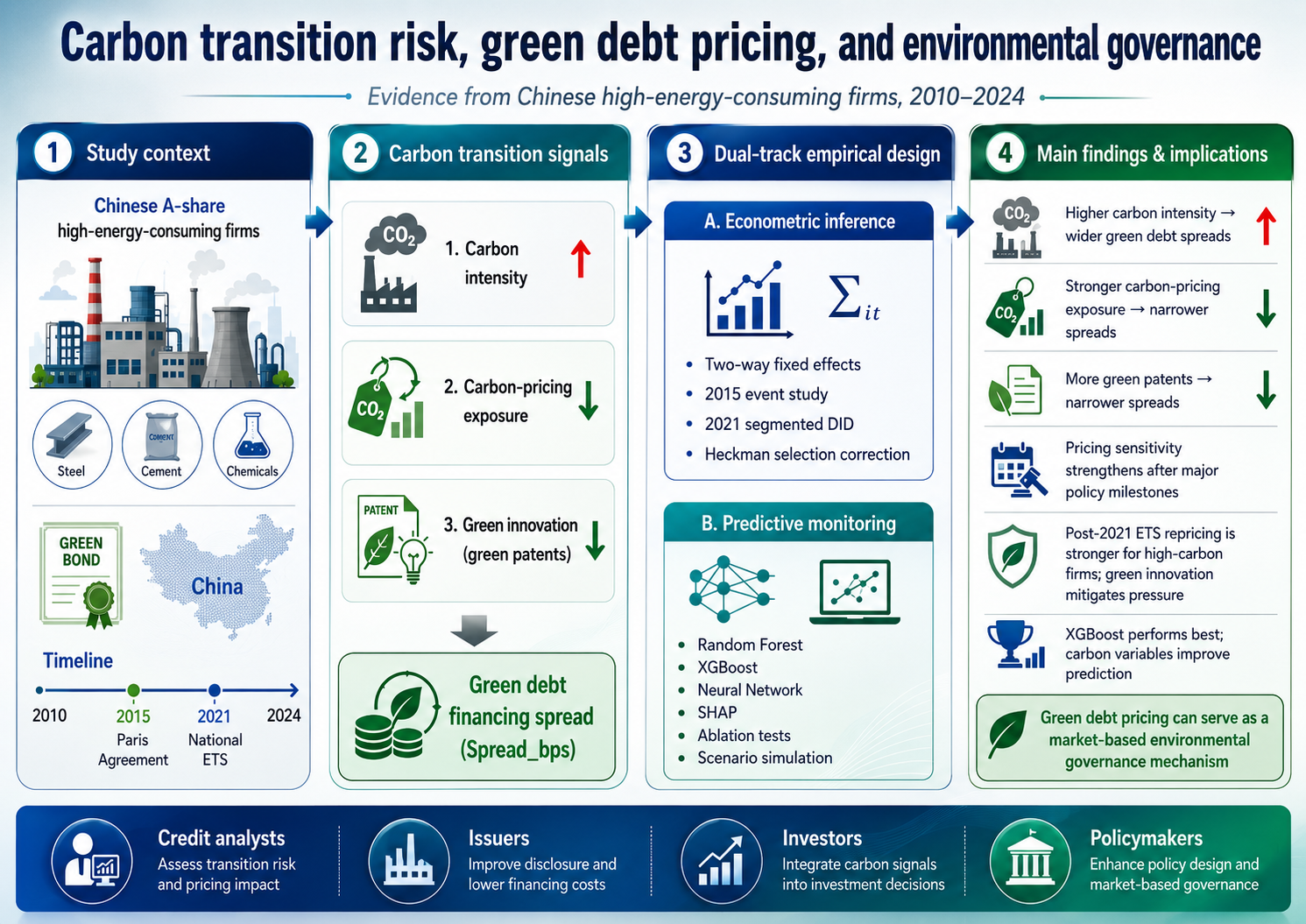
Carbon transition risk increasingly affects the financing conditions of firms in high-energy-consuming industries, yet debt-side evidence remains fragmented and often mixes policy inference with predictive monitoring. This study examines how carbon-related transition signals are associated with green debt financing spreads for Chinese A-share listed firms in high-energy-consuming industries during 2010–2024. The dependent variable is the green debt financing spread measured in basis points (Spread_bps). To preserve evidentiary boundaries, the study adopts a dual-track design: panel fixed-effects models, an event-study analysis around the 2015 Paris Agreement, and a segmented difference-in-differences design around China’s national emissions trading system in 2021 are used for policy-timing evidence, while random forest, extreme gradient boosting (XGBoost), and neural network models are used for out-of-sample prediction, ablation tests, Shapley additive explanations interpretation, and conditional scenario simulation. The econometric results show that higher carbon intensity is associated with wider green debt spreads, whereas stronger carbon-pricing exposure and greater green patent output are associated with narrower spreads. Pricing sensitivity to carbon-related factors increases after major policy milestones, and green innovation partly mitigates post-emission-trading-system financing pressure on high-carbon issuers. The predictive results show that XGBoost performs best and that removing carbon variables reduces forecasting accuracy, confirming the incremental monitoring value of carbon information. These findings suggest that green debt pricing can complement environmental regulation by translating carbon intensity, carbon-market exposure, and transition capacity into financing signals useful for credit analysts, issuers, investors, and policymakers.
- Ehlers T, Packer F, de Greiff K. The pricing of carbon risk in syndicated loans: which risks are priced and why? J Bank Financ. 2022;136:106180. doi: 10.1016/j.jbankfin.2021.106180
- Zhu B, Zhao Y. Carbon risk and the cost of bank loans: evidence from China. Technol Forecast Soc Change. 2022;180:121741. doi: 10.1016/j.techfore.2022.121741
- Dimitras AI, Mitsi CC, Zopounidis C. Does firm carbon risk matter to banks? Evidence from the US syndicated loan market. J Environ Manage. 2024;368:122249. doi: 10.1016/j.jenvman.2024.122249
- Kacperczyk MT, Peydro JL. Carbon emissions and the bank-lending channel. SSRN. Preprint posted 2021. doi: 10.2139/ssrn.3915486
- Altavilla C, Boucinha M, Pagano M, Polo A. Climate risk, bank lending and monetary policy. SSRN. Preprint posted 2024. doi: 10.2139/ssrn.4918451
- Ren X, Li W, Duan K, Urquhart A. Carbon risk and debt financing: an international perspective. J Int Money Financ. 2025;153:103294. doi: 10.1016/j.jimonfin.2025.103294
- Cang Y, Li Z. Corporate climate risk and bond credit spreads. Finance Res Lett. 2024;67:105741. doi: 10.1016/j.frl.2024.105741
- He F, Ren X, Wang Y, Lei X. Climate risk and corporate bond credit spreads. J Int Money Financ. 2025;154:103297. doi: 10.1016/j.jimonfin.2025.103297
- Bouchet V, Crifo P. Climate transition risk and debt capital costs: empirical evidence from the energy and utilities sectors. Green Low-Carbon Econ. 2025;3(2):1-11. doi: 10.47852/bonviewGLCE52025463
- Lu X, Zeng Q, Huang Y, Wu H. Management climate risk concern and corporate bond credit spread. J Int Money Financ. 2025;153:103293. doi: 10.1016/j.jimonfin.2025.103293
- Bolton P, Kacperczyk M. Global pricing of carbon-transition risk. J Finance. 2023;78(6):3677-3754. doi: 10.1111/jofi.13272
- Seltzer L, Starks LT, Zhu Q. Climate regulatory risk and corporate bonds. SSRN. Preprint posted 2022. doi: 10.2139/ssrn.4098316
- Collin-Dufresne P, Goldstein RS, Martin JS. The determinants of credit spread changes. J Finance. 2001;56(6):2177-2207. doi: 10.1111/0022-1082.00402
- Zhou P, Li X, Shi X, Jiang K. Spillover of the carbon risk along the supply chain: evidence from the U.S. corporate bond market. J Bus Res. 2025;201:115742. doi: 10.1016/j.jbusres.2025.115742
- Zhou P, Mo L, Tan C, Wu H. Carbon regulatory risk exposure in the bond market: a quasi-natural experiment in China. China Econ Rev. 2025;92:102423. doi: 10.1016/j.chieco.2025.102423
- Wang J, Qiang H, Liang Y, Huang X, Zhong W. How carbon risk affects corporate debt defaults: evidence from Paris agreement. Energy Econ. 2024;129:107275. doi: 10.1016/j.eneco.2023.107275
- Löschenbrand S, Maier M, Millischer L, Resch F. Credit risk where it is due: carbon pricing and firm defaults. IMF Working Paper. 2025;2025(62). doi: 10.5089/9798229005777.001
- Duong HN, Kalev PS, Kalimipalli M, Trivedi S. Do firms benefit from carbon risk management? Evidence from the credit default swaps market. J Corp Financ. 2025;94:102843. doi: 10.1016/j.jcorpfin.2025.102843
- Ben-Nasr H, Basha SA, Shams S. The influence of carbon risk on debt structure. Int Rev Financ Anal. 2025;107:104591. doi: 10.1016/j.irfa.2025.104591
- Ben-Nasr H, Masry S, Masum AA, Ouni Z. Carbon risk and trade credit. Int Rev Econ Finance. 2025;103:104425. doi: 10.1016/j.iref.2025.104425
- Khanchel I, Lassoued N, Khiari C. Switch to pollution control bonds, else carbon risk will switch us. Heliyon. 2024;10(12):e32487. doi: 10.1016/j.heliyon.2024.e32487
- Liu Z, Feng J. Climate shocks and corporate default risk: Evidence from China. Energy. 2025;323:135786. doi: 10.1016/j.energy.2025.135786
- Yan J, Guo Y, Wen F. Carbon risk and the cost of equity capital: evidence from China. Int Rev Econ Finance. 2025;99:103975. doi: 10.1016/j.iref.2025.103975
- Bose S, Lim EKY, Minnick K, Schorno PJ, Shams S. Does carbon risk influence stock price crash risk? International evidence. J Bus Finance Account. 2025;52(5):2111-2144. doi: 10.1111/jbfa.12851
- Hoang K, Pham L, Ha OK, Nghiem HX. Firm-level climate change exposure and firm efficiency. Int Rev Econ Finance. 2025;101:104220. doi: 10.1016/j.iref.2025.104220
- Owolabi A, Mousavi MM, Gozgor G, Li J. The impact of carbon risk on the cost of debt in the listed firms in G7 economies: the role of the Paris agreement. Energy Econ. 2024;139:107925. doi: 10.1016/j.eneco.2024.107925
- Nguyen JH, Truong C, Zhang B. The price of carbon risk: evidence from the Kyoto Protocol ratification. J Environ Econ Manage. 2025;130:103118. doi: 10.1016/j.jeem.2025.103118
- Wang S, Xu B. Environmental protection tax policy and corporate risk-taking: evidence from China. Int Rev Financ Anal. 2024;96:103591. doi: 10.1016/j.irfa.2024.103591
- Huang J, He R, Luo L, Shen H. Carbon emission trading scheme and firm debt financing. J Contemp Account Econ. 2024;20(1):100384. doi: 10.1016/j.jcae.2023.100384
- Arian A, Naeem MA. Climate risk and corporate investment behavior in emerging economies. Emerg Mark Rev. 2025;65:101257. doi: 10.1016/j.ememar.2025.101257
- Ren YS, Derouiche I, Hassan M, Liu PZ. Do creditors price climate transition risks? A natural experiment based on China’s carbon emission trading scheme. Int Rev Econ Finance. 2024;91:138-155. doi: 10.1016/j.iref.2024.01.006
- Stechemesser A, Koch N, Mark E, et al. Climate policies that achieved major emission reductions: global evidence from two decades. Science. 2024;385(6711):884-892. doi: 10.1126/science.adl6547
- Mengesha I, Roy D. Carbon pricing drives critical transition to green growth. Nat Commun. 2025;16:1321. doi: 10.1038/s41467-025-56540-3
- Li C, Wu Q, Wang F. Carbon reduction pressure and internal capital transfer within business groups: evidence from China’s carbon emission trading. Account Finance. 2025;65:1-20. doi: 10.1111/acfi.70138
- Ali K, Nadeem M, Pandey R, Bhabra GS. Do capital markets reward corporate climate change actions? Evidence from the cost of debt. Bus Strategy Environ. 2023;32(6):3417-3431. doi: 10.1002/bse.3308
- Bingler JA, Kraus M, Leippold M, Webersinke N. How cheap talk in climate disclosures relates to climate initiatives, corporate emissions, and reputation risk. J Bank Financ. 2024;164:107191. doi: 10.1016/j.jbankfin.2024.107191
- Sun M, Chen M, Ding X, Cai Z, Imran M. The financial cost of the net-zero transition: green-premium effects of corporate transition-risk disclosure. Energy Rep. 2025;14:3878-3887. doi: 10.1016/j.egyr.2025.11.007
- Nguyen JH, Phan HV. Carbon risk and corporate capital structure. J Corp Financ. 2020;64:101713. doi: 10.1016/j.jcorpfin.2020.101713
- Cumming D, Duppati G, Fernando R, Singh SP, Tiwari AK. Dynamics of carbon risk, cost of debt and leverage adjustments. Br Account Rev. 2025;57(2):101353. doi: 10.1016/j.bar.2024.101353
- Dallocchio M, D’Ercole F, Frascati D, Mariani M. Climate transition and the speed of leverage adjustment. Int Rev Financ Anal. 2025;102:104026. doi: 10.1016/j.irfa.2025.104026
- Wu Z, Shih Y, Wang Y, Zhong R. The effects of decarbonization on corporate cash holdings. Emerg Mark Rev. 2025;69:101356. doi: 10.1016/j.ememar.2025.101356
- Zhai J, Zhang Y, Wang K. Can green finance innovation promote supply chain decarbonization? Evidence from Chinese firms. Emerg Mark Finance Trade. 2025;61(13):3951- 3972. doi: 10.1080/1540496X.2025.2508881
- Lee CC, Li M, Li X, Song H. More green digital finance with less energy poverty? The key role of climate risk. Energy Econ. 2025;141:108144. doi: 10.1016/j.eneco.2024.108144
- Moro A, Zaghini A. The green sin: how exchange rate volatility and financial openness affect green premia. Rev Finance. 2025;29(4):1189-1217. doi: 10.1093/rof/rfaf024
- Lundberg SM, Lee SI. A unified approach to interpreting model predictions. In: Proceedings of the 31st International Conference on Neural Information Processing Systems. Curran Associates; 2017:4768-4777. Accessed May 15, 2026. https://papers.nips.cc/paper_files/paper/2017/ hash/8a20a8621978632d76c43dfd28b67767-Abstract.html
- Chan CP, Tang FK, Tsai CH, Yang JH. A SHAP-based comparative analysis of machine learning model interpretability in financial classification tasks. J Appl Econ Sci. 2025;20(16):385-400. doi: 10.57017/jaes.v20.3(89).03
- Lin L, Wang Y. SHAP stability in credit risk management: a case study in credit card default model. Risks. 2025;13(12):238. doi: 10.3390/risks13120238
- Chen T, Guestrin C. XGBoost: a scalable tree boosting system. In: Proceedings of the 22nd ACM SIGKDD International Conference on Knowledge Discovery and Data Mining. Association for Computing Machinery; 2016:785- 794. doi: 10.1145/2939672.2939785
- Barredo Arrieta A, Díaz-Rodríguez N, Del Ser J, et al. Explainable artificial intelligence (XAI): concepts, taxonomies, opportunities and challenges toward responsible AI. Inf Fusion. 2020;58:82-115. doi: 10.1016/j.inffus.2019.12.012
- Chen Q. Explore the use of prompt-based LLM for credit risk classification. J Comput Commun. 2025;13(6):33-46. doi: 10.4236/jcc.2025.136003