

Adaptive bias correction for subseasonal temperature forecasting in East Asia

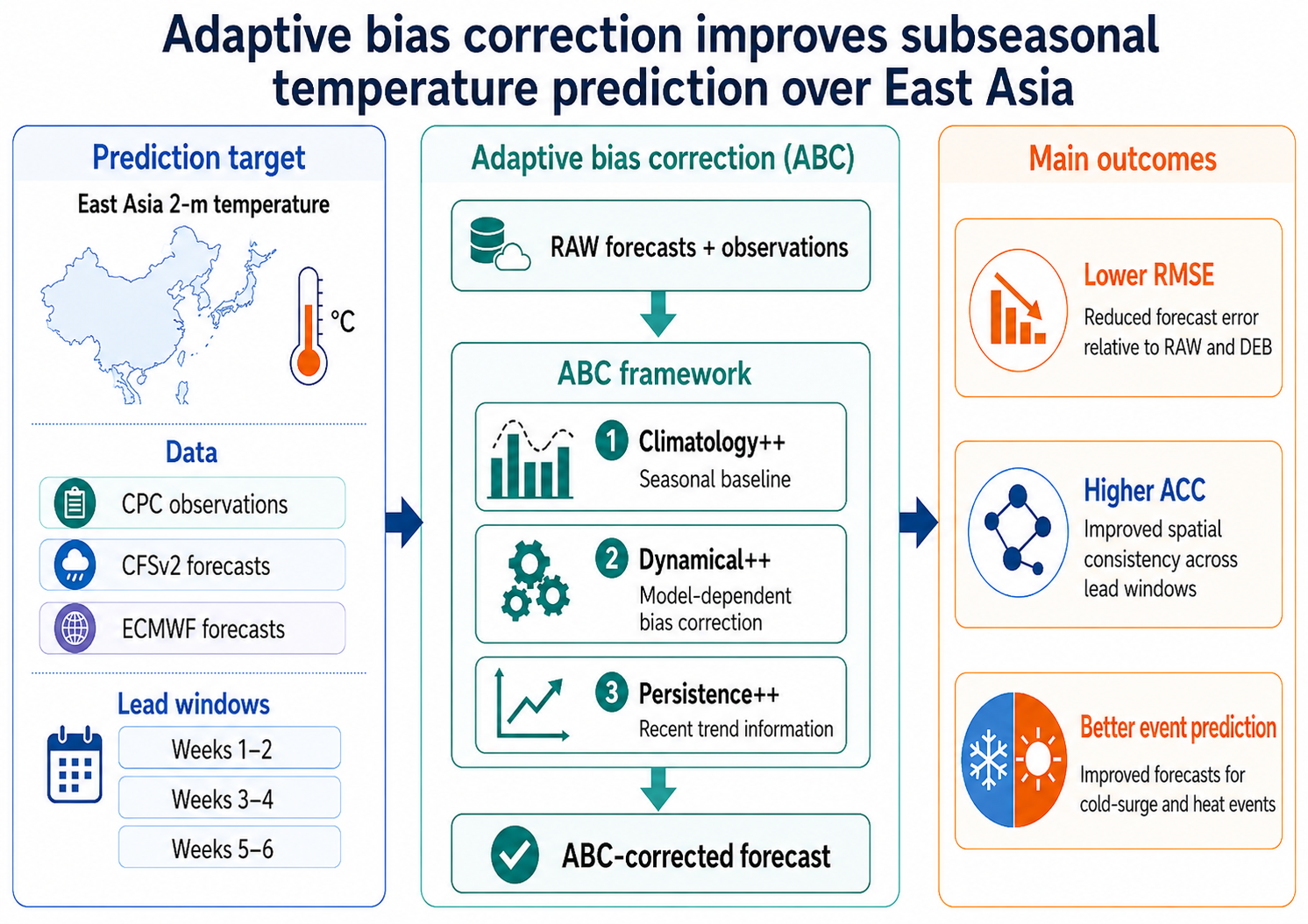
Subseasonal (2–6-week) temperature prediction is important for climate-risk management, energy dispatch, and early warning of high-impact weather over East Asia. However, operational dynamical forecast systems often exhibit substantial lead-dependent biases in this region. In this study, we evaluate an adaptive bias correction (ABC) framework for East Asian subseasonal 2-m temperature forecasts based on Climate Forecast System Version 2 and European Centre for Medium-Range Weather Forecasts data, and compare its performance with raw forecasts and conventional debiasing. Results show that ABC consistently reduced forecast errors and improved spatial consistency across lead times, with particularly clear benefits during winter cold-surge conditions and summer high-temperature periods. The improvements arise from the complementary integration of climatological, dynamical, and persistence-based information, which helps address the spatiotemporal heterogeneity of forecast errors. These results suggest that adaptive post-processing offers a practical approach to improving operational subseasonal temperature prediction over East Asia.
- Vitart F, Ardilouze C, Bonet A, et al. The Subseasonal to Seasonal (S2S) Prediction Project Database. Bull Am Meteorol Soc. 2017;98(1):163-173. doi: 10.1175/BAMS-D-16-0017.1
- Vitart F, Robertson AW, Anderson DLT. Subseasonal to Seasonal Prediction Project: Bridging the Gap between Weather and Climate. WMO Bull. 2012;61(2):23-28. Available from: https://wmo.int/media/magazine-article/ subseasonal-seasonal-prediction-project-bridging-gap-between-weather-and-climate [Last accessed on March 3, 2026].
- Vitart F, Robertson AW, Brookshaw A, et al. The WWRP/ WCRP S2S project and its achievements. Bull Am Meteorol Soc. 2025;106(5):E791-E808. doi: 10.1175/BAMS-D-24-0047.1
- Vitart F, Robertson AW, Spring A, et al. Outcomes of the WMO prize challenge to improve subseasonal to seasonal predictions using artificial intelligence. Bull Am Meteorol Soc. 2022;103(12):E2878-E2886. doi: 10.1175/BAMS-D-22-0046.1
- Pegion K, Sardeshmukh PD. Prospects for improving subseasonal predictions. Mon Weather Rev. 2011;139(11):3648-3666. doi: 10.1175/MWR-D-11-00004.1
- von Neumann J. Some remarks on the problem of forecasting climatic fluctuations. In: Pfeffer RL, ed. Dynamics of Climate. Oxford, England: Pergamon Press; 1960:9-11. doi: 10.1016/B978-1-4831-9890-3.50009-8
- Xiang B, Harris L, Delworth TL, et al. S2S prediction in GFDL SPEAR: MJO diversity and teleconnections. Bull Am Meteorol Soc. 2022;103(2):E463-E484. doi: 10.1175/BAMS-D-21-0124.1
- Waliser DE, Jones C, Schemm JKE, Graham NE. A statistical extended-range tropical forecast model based on the slow evolution of the Madden-Julian oscillation. J Clim. 1999;12(7):1918-1939. doi: 10.1175/1520-0442(1999)012<1918:ASERTF>2.0.CO;2
- Stan C, Zheng C, Chang EKM, et al. Advances in the prediction of MJO teleconnections in the S2S forecast systems. Bull Am Meteorol Soc. 2022;103(6):E1426-E1447. doi: 10.1175/BAMS-D-21-0130.1
- Tseng KC, Barnes EA, Maloney E. The importance of past MJO activity in determining the future state of the midlatitude circulation. J Clim. 2020;33(6):2131-2147. doi: 10.1175/JCLI-D-19-0512.1
- Zhou Y, Thompson KR, Lu Y. Mapping the relationship between Northern Hemisphere winter surface air temperature and the Madden-Julian oscillation. Mon Weather Rev. 2011;139(8):2439-2454. doi: 10.1175/2011MWR3587.1
- Wang L, Zhou X, Hsu,PC. Preceding MJO enhances the subseasonal predictability of East Asian cold events via two dynamic pathways. Sci China Earth Sci. 2026;69(4):1259-1272. doi: 10.1007/s11430-025-1832-2
- Zhou X, Wang L, Hsu PC, Li T, Xiang B. Understanding the factors controlling MJO prediction skill across events. J Clim. 2024;37(20):5323-5336. doi: 10.1175/JCLI-D-23-0635.1
- Weyn JA, Durran DR, Caruana R. Can machines learn to predict weather? Using deep learning to predict gridded 500-hPa geopotential height from historical weather data. J Adv Model Earth Syst. 2019;11(8):2680-2693. doi: 10.1029/2019MS001705
- Saha S, Moorthi S, Wu X, et al. The NCEP Climate Forecast System Version 2. J Clim. 2014;27(6):2185-2208. doi: 10.1175/JCLI-D-12-00823.1
- Pegion K, Kirtman BP, Becker E, et al. The Subseasonal Experiment (SubX): A multimodel subseasonal prediction experiment. Bull Am Meteorol Soc. 2019;100(10):2043-2060. doi: 10.1175/BAMS-D-18-0270.1
- Tang S, Qiao S, Feng T, et al. Predictability of the mid-summer surface air temperature over the Yangtze River valley in the NCEP Climate Forecast System. Int J Climatol. 2021;41(2):811-829. doi: 10.1002/joc.6670
- Liu L, Bai H, Feng G, et al. Evaluation and correction of sub-seasonal dynamic model forecast of precipitation in eastern China. Clim Dyn. 2023;61(9-10):4643-4659. doi: 10.1007/s00382-023-06788-6
- Kang IS, Shukla J. Dynamic seasonal prediction and predictability of the monsoon. In: Wang B, ed. The Asian Monsoon. Berlin, Germany: Springer; 2006:585-612. doi: 10.1007/3-540-37722-0_15
- Cleveland WS, Devlin SJ. Locally weighted regression: an approach to regression analysis by local fitting. J Am Stat Assoc. 1988;83(403):596-610. doi: 10.1080/01621459.1988.10478639
- Lyu Y, Zhi X, Zhu S, et al. Statistical calibrations of surface air temperature forecasts over East Asia using pattern projection methods. Weather Forecast. 2021;36(5):1661- 1674. doi: 10.1175/WAF-D-21-0043.1
- Zhu S, Zhang L, Jiang H, et al. Pattern projection calibrations on subseasonal forecasts of surface air temperature over East Asia. Weather Forecast. 2023;38(6):865-878. doi: 10.1175/WAF-D-22-0046.1
- Huang Z, Zhao T, Xu W, et al. A seven-parameter Bernoulli- Gamma-Gaussian model to calibrate subseasonal to seasonal precipitation forecasts. J Hydrol. 2022;610(1):127896. doi: 10.1016/j.jhydrol.2022.127896
- Scher S. Toward data-driven weather and climate forecasting: approximating a simple general circulation model with deep learning. Geophys Res Lett. 2018;45(22):12616-12622. doi: 10.1029/2018GL080704
- Rasp S, Lerch S. Neural networks for postprocessing ensemble weather forecasts. Mon Weather Rev. 2018;146(11):3885- 3900. doi: 10.1175/MWR-D-18-0187.1
- Bonavita M, Laloyaux P. Machine learning for model error inference and correction. J Adv Model Earth Syst. 2020;12(12):e2020MS002232. doi: 10.1029/2020MS002232
- Kim H, Ham YG, Joo YS, Son SW. Deep learning for bias correction of MJO prediction. Nat Commun. 2021;12(1):3087. doi: 10.1038/s41467-021-23406-3
- Jin W, Zhang W, Hu J, et al. Using the residual network module to correct the sub-seasonal high temperature forecast. Front Earth Sci. 2022;9:760766. doi: 10.3389/feart.2021.760766
- Ling F, Li Y, Luo JJ, et al. Two deep learning-based bias-correction pathways improve summer precipitation prediction over China. Environ Res Lett. 2022;17(12):124025. doi: 10.1088/1748-9326/aca68a
- Xie J, Hsu PC, Hu Y, et al. Skillful extended-range forecast of rainfall and extreme events in East China based on deep learning. Weather Forecast. 2023;38(3):467-486. doi: 10.1175/WAF-D-22-0132.1
- Lyu Y, Zhu SP, Zhi XF, et al. Improving subseasonal-to-seasonal prediction of summer extreme precipitation over southern China based on a deep learning method. Geophys Res Lett. 2023;50(24):e2023GL106245. doi: 10.1029/2023GL106245
- Weyn JA, Durran DR, Caruana R, Cresswell-Clay N. Sub-seasonal forecasting with a large ensemble of deep-learning weather prediction models. J Adv Model Earth Syst. 2021;13(7):e2021MS002502. doi: 10.1029/2021MS002502
- Schultz MG, Betancourt C, Gong B, et al. Can deep learning beat numerical weather prediction? Philos Trans A Math Phys Eng Sci. 2021;379(2194):20200097. doi: 10.1098/rsta.2020.0097
- Kashinath K, Mustafa M, Albert A, et al. Physics-informed machine learning: case studies for weather and climate modelling. Philos Trans A Math Phys Eng Sci. 2021;379(2194):20200093. doi: 10.1098/rsta.2020.0093
- Mouatadid S, Orenstein P, Flaspohler G, et al. Adaptive bias correction for improved subseasonal forecasting. Nat Commun. 2023;14(1):3482. doi: 10.1038/s41467-023-38874-y
- Risbey JS, Squire DT, Black AS, et al. Standard assessments of climate forecast skill can be misleading. Nat Commun. 2021;12(1):4346. doi: 10.1038/s41467-021-23771-z
- Fan Y, van den Dool H. A global monthly land surface air temperature analysis for 1948-present. J Geophys Res Atmos. 2008;113(D1):D01103. doi: 10.1029/2007JD008470
- Kirtman BP, Pegion K, DelSole T, et al. The Subseasonal Experiment (SubX) dataset. IRI Data Library. Published 2017. doi: 10.7916/D8PG249H
- European Centre for Medium-Range Weather Forecasts. Operational archive (ENS extended): re-forecast products. Available from: https://www.ecmwf.int/en/forecasts/ dataset/operational-archive [Last accessed on March 3, 2026].
- Raff D, Nowak K, Cifelli R, Brekke LD, Webb RS. Sub-seasonal climate forecast rodeo. Presented at: AGU Fall Meeting; December 11-15, 2017; New Orleans, LA. Available from: https://ui.adsabs.harvard.edu/abs/2018AGUFM. A41L3155R/abstract [Last accessed on March 3, 2026].
41. Cheng Y, Wang L, Zhou X, Wang L. Quasi-biweekly and quasi-monthly intraseasonal oscillations in North American winter atmospheric circulation. Clim Dyn. 2025;63(12):457. doi: 10.1007/s00382-025-07942-y