

Formation and effects of biodiversity: A brief history, underlying mechanisms, and future research directions

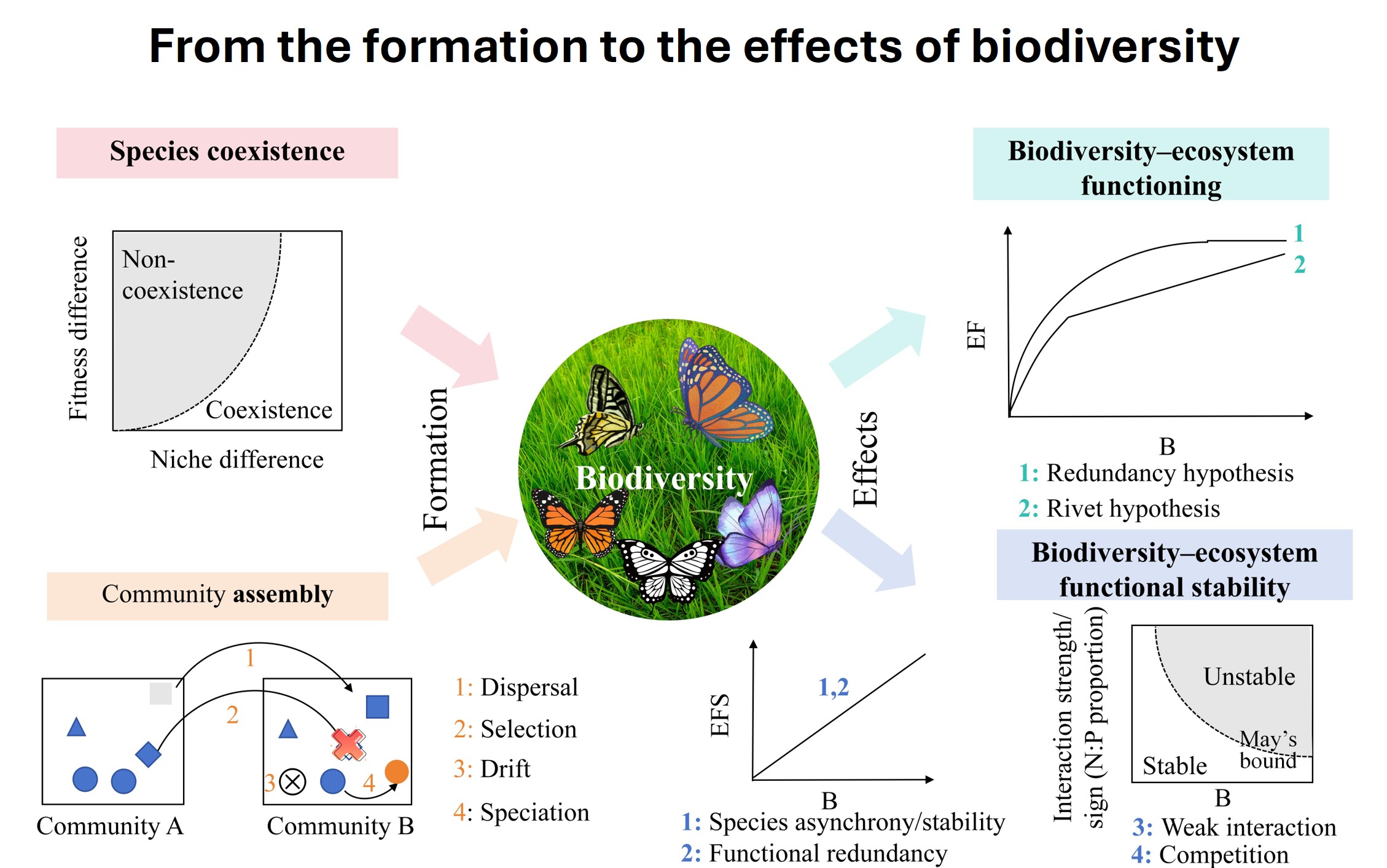
Losses and gains in species diversity profoundly affect ecosystem functioning and its stability. Understanding the mechanisms underlying the formation and effects of biodiversity has long been a central scientific question in ecological research. While extensive studies have shown that biodiversity is governed by various ecological processes and is closely associated with ecosystem functioning and its stability, the mechanisms underlying diversity formation, as well as the explanatory mechanisms for the biodiversity–ecosystem functioning and biodiversity–ecosystem functional stability relationships, remain fragmented and lack a systematic integration. In this review, we explore recent advances in theoretical studies on the formation and effects of biodiversity along three aspects. First, we briefly introduce the history of research on biodiversity formation and effects. Second, we synthesize observed patterns in the relationships between biodiversity and ecosystem functioning, as well as between biodiversity and ecosystem functional stability. Third, we classify and discuss the mechanisms driving both biodiversity formation (community assembly and species coexistence) and its effects (biodiversity–ecosystem functioning and biodiversity–ecosystem functional stability). We then discuss future directions for research on the causes and consequences of biodiversity. Future research should integrate high-order interactions into species coexistence theory and quantitatively predict biodiversity responses to environmental changes. Meanwhile, it should consider a broader range of ecosystem functions beyond species biomass or abundance, and establish a multiscale theory of biodiversity effects based on long-term and large-scale spatial experiments. This review provides an integrated theoretical framework for the mechanisms driving diversity formation and its effects, which will deepen our understanding of the causes and consequences of biodiversity.
- Hong P, Schmid B, De Laender F, et al. Biodiversity promotes ecosystem functioning despite environmental change. Ecol Lett. 2021;25(2):555-569. doi: 10.1111/ele.13936
- Weiskopf SR, Lerman SB, Isbell F, et al. Biodiversity promotes urban ecosystem functioning. Ecography. 2024;2024(9). doi: 10.1111/ecog.07366
- Gilbert JA, Scholz AH, Dominguez Bello MG, et al. Safeguarding microbial biodiversity: microbial conservation specialist group within the species survival commission of the International Union for Conservation of Nature. mSystems. 2025;10(12):e0150525. doi: 10.1128/msystems.01505-25
- Wang B, Wang S, Wu L, et al. Temporal asynchrony of plant and soil biota determines ecosystem multifunctional stability. Glob Chang Biol. 2024;30(8). doi: 10.1111/gcb.17483
- Song A, Liang S, Li H, et al. Effects of biodiversity on functional stability of freshwater wetlands: A systematic review. Front Microbiol. 2024;15. doi: 10.3389/fmicb.2024.1397683
- Kinzig AP, Pacala SW, Tilman D, eds. Functional Consequences of Biodiversity: Empirical Progress and Theoretical Extensions. Princeton: Princeton University Press. 2002.
- Díaz S, Settele J, Brondízio ES, et al. Pervasive human-driven decline of life on Earth points to the need for transformative change. Science. 2019;366(6471). doi: 10.1126/science.aax3100
- Wang S, Hong P, Adler PB, et al. Towards mechanistic integration of the causes and consequences of biodiversity. Trends Ecol Evol. 2024;39(7):689-700. doi: 10.1016/j.tree.2024.02.008
- Winfree R, Reilly JR, Genung MA. Biodiversity–ecosystem function research must consider abundance and not just diversity. Nat Rev Biodivers. 2025;1(6):347-348. doi: 10.1038/s44358-025-00040-1
- Zhou J, Ning D. stochastic community assembly: Does it matter in microbial ecology? Microbiol Mol Biol Rev. 2017;81(4). doi: 10.1128/mmbr.00002-17
- Chesson P. Mechanisms of maintenance of species diversity. Annu Rev Ecol Evol Syst. 2000;31(1):343-366. doi: 10.1146/annurev.ecolsys.31.1.343
- Barabás G, D’Andrea R, Stump SM. Chesson’s coexistence theory. Ecol Monogr. 2018;88(3):277-303. doi: 10.1002/ecm.1302
- Ives AR, Carpenter SR. Stability and diversity of ecosystems. Science. 2007;317(5834):58-62. doi: 10.1126/science.1133258
- van der Plas F. Biodiversity and ecosystem functioning in naturally assembled communities. Biol Rev. 2019;94(4):1220-1245. doi: 10.1111/brv.12499
- Maestre FT, Biancari L, Chen N, et al. Research needs on the biodiversity-ecosystem functioning relationship in drylands. NPJ Biodivers. 2024;3(1). doi: 10.1038/s44185-024-00046-6
- Runnel K, Tedersoo L, Krah FS, et al. Toward harnessing biodiversity-ecosystem function relationships in fungi. Trends Ecol Evol. 2025;40(2):180-190. doi: 10.1016/j.tree.2024.10.004
- Bertness MD, Leonard GH. The role of positive interactions in communities: Lessons from intertidal habitats. Ecology. 1997;78(7):1976-1989. doi: 10.1890/0012-9658(1997)078[1976:TROPII]2.0.CO;2
- Tilman D, Lehman CL, Thomson KT. Plant diversity and ecosystem productivity: Theoretical considerations. Proc Natl Acad Sci USA. 1997;94(5):1857-1861. doi: 10.1073/pnas.94.5.1857
- Loreau M, Naeem S, Inchausti P, et al. Biodiversity and ecosystem functioning: Current knowledge and future challenges. Science. 2001;294(5543):804-808. doi: 10.1126/science.1064088
- McCann KS. The diversity-stability debate. Nature. 2000;405(6783):228-233. doi: 10.1038/35012234
- Loreau M, de Mazancourt C. Biodiversity and ecosystem stability: A synthesis of underlying mechanisms. Ecol Lett. 2013;16(s1):106-115. doi: 10.1111/ele.12073
- Grinnell J. The niche-relationships of the California Thrasher. Auk. 1917;34(4):427-433. doi: 10.2307/4072271
- Gause GF, ed. The struggle for existence. Baltimore: Williams & Wilkins; 1934.
- Elton CS, ed. Animal ecology. London: Sidgwick&Jackson. 1927.
- Levins R, ed. Evolutionary Ecology. Princeton: Princeton University Press; 1968.
- Grubb PJ. The maintenance of species niches in plant communities: The importance of the regeneration niche. Biol Rev. 1977;52(1):107-145. doi: 10.1111/j.1469-185X.1977.tb01347.x
- Tilman D, ed. Resource Competition and Community Structure. Princeton: Princeton University Press; 1982.
- Hubbell SP, ed. The Unified Neutral Theory of Biogeography and Biodiversity. Princeton: Princeton University Press; 2001.
- Sloan WT, Lunn M, Woodcock S, et al. Quantifying the roles of immigration and chance in shaping prokaryote community structure. Environ Microbiol. 2006;8(4):732-740. doi: 10.1111/j.1462-2920.2005.00956.x
- Vellend M. Conceptual synthesis in community ecology. Q Rev Biol. 2010;85(2):183-206. doi: 10.1086/652373
- Stegen JC, Lin X, Fredrickson JK, et al. Estimating and mapping ecological processes influencing microbial community assembly. Front Microbiol. 2015;6. doi: 10.3389/fmicb.2015.00370
- Sinclair G, ed. Hortus Gramineus Woburnensis: Or, an Account of the Results of Experiments on the Produce and Nutritive Qualities of Different Grasses and Other Plants Used as the Food of the More Valuable Domestic Animals. London: James Ridgeway; 1826.
- Goodman D. The theory of diversity-stability relationships in ecology. Q Rev Biol. 1975;50(3):237-266. doi: 10.1086/408563
- Schulze ED, Mooney HA, eds. Biodiversity and Ecosystem Function. Berlin: Springer-Verlag; 1993.
- Naeem S, Thompson LJ, Lawler SP, et al. Declining biodiversity can affect the performance of ecosystems. Nature. 1994;368(6473):734–737. doi: 10.1038/368734a0
- Tilman D, Downing JA. Biodiversity and stability in grasslands. Nature. 1994;367(6461):363-365. doi: 10.1038/367363a0
- Naeem S, Li S. Biodiversity enhances ecosystem reliability. Nature. 1997;390(6659):507-509. doi: 10.1038/37348
- Huston MA. Hidden treatments in ecological experiments: re-evaluating the ecosystem function of biodiversity. Oecologia. 1997;110(4):449-460. doi: 10.1007/s004420050180
- Grime JP. Benefits of plant diversity to ecosystems: Immediate, filter and founder effects. J Ecol. 1998;86(6):902- 910. doi: 10.1046/j.1365-2745.1998.00306.x
- Cardinale BJ, Duffy JE, Gonzalez A, et al. Biodiversity loss and its impact on humanity. Nature. 2012;486(7401):59-67. doi: 10.1038/nature11148
- MacArthur R. Fluctuations of animal populations and a measure of community stability. Ecology. 1955;36(3):533- 536. doi: 10.2307/1929601
- Elton CS, ed. The Ecology of Invasions by Animals and Pants. London: Methuen; 1958. doi: 10.1007/978-1-4899-7214-9
- Gardner MR, Ashby WR. Connectance of large dynamic (cybernetic) systems: Critical values for stability. Nature. 1970;228(5273):784. doi: 10.1038/228784a0
- May RM, ed. Stability and Complexity in Model Ecosystems. Princeton: Princeton University Press. 1973.
- Cottingham KL, Brown BL, Lennon JT. Biodiversity may regulate the temporal variability of ecological systems. Ecol Lett. 2001;4(1):72-85. doi: 10.1046/j.1461-0248.2001.00189.x
- Tilman D. The ecological consequences of changes in biodiversity: a search for general principles. Ecology. 1999;80(5):1455-1474. doi: 10.1890/0012-9658(1999)080[1455:TECOCI]2.0.CO;2
- Liang M, Baiser B, Hallett LM, et al. Consistent stabilizing effects of plant diversity across spatial scales and climatic gradients. Nat Ecol Evol. 2022;6(11):1669-1675. doi: 10.1038/s41559-022-01868-y
- Meng B, Luo M, Loreau M, et al. Stabilizing effects of biodiversity arise from species-specific dynamics rather than interspecific interactions in grasslands. Nat Ecol Evol. 2025;9(10):1837-1847. doi: 10.1038/s41559-025-02787-4
- Jayaramaiah RH, Egidi E, Macdonald CA, et al. Linking biodiversity and biotic interactions to ecosystem functioning. J Sustain Agric Environ. 2024;3(3). doi: 10.1002/sae2.12119
- Saleem M, Hu J, Jousset A. More than the sum of its parts: Microbiome biodiversity as a driver of plant growth and soil health. Annu Rev Ecol Evol Syst. 2019;50(1):145-168. doi: 10.1146/annurev-ecolsys-110617-062605
- Pennekamp F, Pontarp M, Tabi A, et al. Biodiversity increases and decreases ecosystem stability. Nature. 2018;563(7729):109-112. doi: 10.1038/s41586-018-0627-8
- Isbell F, Craven D, Connolly J, et al. Biodiversity increases the resistance of ecosystem productivity to climate extremes. Nature. 2015;526(7574):574-577. doi: 10.1038/nature15374
- Tilman D, Isbell F, Cowles JM. Biodiversity and ecosystem functioning. Annu Rev Ecol Evol Syst. 2014;45(1):471-493. doi: 10.1146/annurev-ecolsys-120213-091917
- Tilman D, Reich PB, Knops JM. Biodiversity and ecosystem stability in a decade-long grassland experiment. Nature. 2006;441(7093):629-632. doi: 10.1038/nature04742
- Grainger TN, Letten AD, Gilbert B, et al. Applying modern coexistence theory to priority effects. Proc Natl Acad Sci USA. 2019;116(13):6205-6210. doi: 10.1073/pnas.1803122116
- Wang SP, Luo MY, Feng YH, et al. Theoretical advances in biodiversity research. Biodiver Sci. 2022;30(10):22410. doi: 10.17520/biods.2022410
- Grainger TN, Levine JM, Gilbert B. The invasion criterion: A common currency for ecological research. Trends Ecol Evol. 2019;34(10):925-935. doi: 10.1016/j.tree.2019.05.007
- Buche L, Spaak JW, Jarillo J, et al. Niche differences, not fitness differences, explain predicted coexistence across ecological groups. J Ecol. 2022;110(11):2785-2796. doi: 10.1111/1365-2745.13992
- Mack RN, Simberloff D, Mark Lonsdale W, et al. Biotic invasions: Causes, epidemiology, global consequences, and control. Ecol Appl. 2000;10(3):689-710. doi: 10.1890/1051-0761(2000)010[0689:BICEGC]2.0.CO;2
- Li SP, Tan J, Yang X, et al. Niche and fitness differences determine invasion success and impact in laboratory bacterial communities. ISME J. 2019;13(2):402-412. doi: 10.1038/s41396-018-0283-x
- Blackburn TM, Pyšek P, Bacher S, et al. A proposed unified framework for biological invasions. Trends Ecol Evol. 2011;26(7):333-339. doi: 10.1016/j.tree.2011.03.023
- MacDougall AS, Gilbert B, Levine JM. Plant invasions and the niche. J Ecol. 2009;97(4):609-615. doi: 10.1111/j.1365-2745.2009.01514.x
- Vilà M, Espinar JL, Hejda M, et al. Ecological impacts of invasive alien plants: a meta-analysis of their effects on species, communities and ecosystems. Ecol Lett. 2011;14(7):702-708. doi: 10.1111/j.1461-0248.2011.01628.x
- Chai Y, Yue M, Liu X, et al. Patterns of taxonomic, phylogenetic diversity during a long-term succession of forest on the Loess Plateau, China: insights into assembly process. Sci Rep. 2016;6(1). doi: 10.1038/srep27087
- Nemergut DR, Schmidt SK, Fukami T, et al. Patterns and processes of microbial community assembly. Microbiol Mol Biol Rev. 2013;77(3):342-356. doi: 10.1128/MMBR.00051-12
- Hanson CA, Fuhrman JA, Horner-Devine MC, et al. Beyond biogeographic patterns: Processes shaping the microbial landscape. Nat Rev Microbiol. 2012;10(7):497-506. doi: 10.1038/nrmicro2795
- Ortiz de Ora L, Wiles ET, Zünd M, et al. Phollow reveals in situ phage transmission dynamics in the zebrafish gut microbiome at single-virion resolution. Nat Microbiol. 2025;10(5):1067-1083. doi: 10.1038/s41564-025-01981-1
- Walters KE, Barbour KM, Powers JM, et al. Microbial dispersal into surface soil is limited on a meter scale. ISME J. 2025;19(1):wraf169. doi: 10.1093/ismejo/wraf169
- Li J, Li X, Guo L. Research progress on community assembly. Mycosystema. 2022;42:13-25. doi: 10.13346/j.mycosystema.220434
- Vellend M, Srivastava DS, Anderson KM, et al. Assessing the relative importance of neutral stochasticity in ecological communities. Oikos. 2014;123(12):1420-1430. doi: 10.1111/oik.01493
- Chase JM, Myers JA. Disentangling the importance of ecological niches from stochastic processes across scales. Philos Trans R Soc Lond B Biol Sci. 2011;366(1576):2351- 2363. doi: 10.1098/rstb.2011.0063
- Ofiteru ID, Lunn M, Curtis TP, et al. Combined niche and neutral effects in a microbial wastewater treatment community. Proc Natl Acad Sci USA. 2010;107(35):15345-15350. doi: 10.1073/pnas.1000604107
- Ning D, Deng Y, Tiedje JM, et al. A general framework for quantitatively assessing ecological stochasticity. Proc Natl Acad Sci USA. 2019;116(34):16892-16898. doi: 10.1073/pnas.1904623116
- Ning D, Yuan M, Wu L, et al. A quantitative framework reveals ecological drivers of grassland microbial community assembly in response to warming. Nat Commun. 2020;11(1). doi: 10.1038/s41467-020-18560-z
- Elzhov TV, Mullen KM, Spiess AN, et al. Minpack.lm: R interface to the Levenberg-Marquardt nonlinear least-squares algorithm found in MINPACK, plus support for bounds. R package version 1.1-8. 2015. Available from: http://CRAN.Rproject.org/package=minpack.lm
- Chen W, Ren K, Isabwe A, et al. Stochastic processes shape microeukaryotic community assembly in a subtropical river across wet and dry seasons. Microbiome. 2019;7(1). doi: 10.1186/s40168-019-0749-8
- Stegen J, Lin X, Fredrickson J, et al. Quantifying community assembly processes and identifying features that impose them. ISME J. 2013;7(11):2069-2079. doi: 10.1038/ismej.2013.93
- Wang W, Li MY, Zhang W, et al. Soil moisture drives the shift from selection to complementarity effect in the rainfed maize/faba bean intercropping system. Plant Soil. 2024;499(1-2):313-328. doi: 10.1007/s11104-023-06037-z
- Chen C, Xiao W, Chen HYH. Meta-analysis reveals global variations in plant diversity effects on productivity. Nature. 2025;638(8050):435-440. doi: 10.1038/s41586-024-08407-8
- Barry KE, Mommer L, van Ruijven J, et al. The Future of Complementarity: Disentangling Causes from Consequences. Trends Ecol Evol. 2019;34(2):167-180. doi: 10.1016/j.tree.2018.10.013
- Reich PB, Tilman D, Isbell F, et al. Impacts of biodiversity loss escalate through time as redundancy fades. Science. 2012;336(6081):589-592. doi: 10.1126/science.1217909
- Pacala S, Tilman D. The transition from sampling to complementarity. In: Kinzig A, Pacala S, Tilman D, eds. The Functional Consequences of Biodiversity: Empirical Progress and Theoretical Ex tensions. Princeton, USA: Princeton University Press; 2002:151-166.
- Huang Y, Chen Y, Castro-Izaguirre N, et al. Impacts of species richness on productivity in a large-scale subtropical forest experiment. Science. 2018;362(6410):80-83. doi: 10.1126/science.aat6405
- Loreau M, Hector A. Partitioning selection and complementarity in biodiversity experiments. Nature. 2001;412(6842):72-76. doi: 10.1038/35083573
- Pearl Mizrahi S, Lee H, Goyal A, et al. Structured interactions explain the absence of keystone species in synthetic microcosms. ISME J. 2025;19(1). doi: 10.1093/ismejo/wraf211
- Fetzer I, Johst K, Schäwe R, et al. The extent of functional redundancy changes as species’ roles shift in different environments. Proc Natl Acad Sci USA. 2015;112(48):14888- 14893. doi: 10.1073/pnas.1505587112
- Cardinale B, Palmer M, Collins S. Species diversity enhances ecosystem functioning through interspecific facilitation. Nature. 2002;415(6870):426-429. doi: 10.1038/415426a
- Eisenhauer N, Bonkowski M, Brose U, et al. Biotic interactions, community assembly, and eco-evolutionary dynamics as drivers of long-term biodiversity–ecosystem functioning relationships. Res Ideas Outcomes. 2019;5. doi: 10.3897/rio.5.e47042
- Mulder CP, Uliassi DD, Doak DF. Physical stress and diversity-productivity relationships: the role of positive interactions. Proc Natl Acad Sci USA. 2001;98(12):6704- 6708. doi: 10.1073/pnas.111055298
- Yachi S, Loreau M. Biodiversity and ecosystem productivity in a fluctuating environment: the insurance hypothesis. Proc Natl Acad Sci USA. 1999;96(4):1463-1468. doi: 10.1073/pnas.96.4.1463
- Naeem S, Li S. Consumer species richness and autotrophic biomass. Ecology. 1998;79(8):2603-2615. doi: 10.2307/176504
- Zhang QG, Zhang DY. Biodiversity and ecosystem functioning: Recent advances and controversies. Biodivers Sci. 2002;10(1):49-60. doi: 10.17520/biods.2002008
- Walker B. Biodiversity and Ecological Redundancy. Conserv Biol. 1992;6(1):18-23. doi: 10.1046/J.1523-1739.1992.610018.X
- Tilman D, Reich PB, Knops J, et al. Diversity and productivity in a long-term grassland experiment. Science. 2001;294(5543):843-845. doi: 10.1126/science.1060391
- Thibaut LM, Connolly SR. Understanding diversity-stability relationships: towards a unified model of portfolio effects. Ecol Lett. 2012;16(2):140-150. doi: 10.1111/ele.12019
- Zhang JH, Huang YM. Biodiversity and stability mechanisms: understanding and future research. Acta Ecol Sin. 2016;36(13):3859-3870. doi: 10.5846/stxb201411062196
- Gonzalez A, Loreau M. The causes and consequences of compensatory dynamics in ecological communities. Annu Rev Ecol Evol Syst. 2009;40(1):393-414. doi: 10.1146/annurev.ecolsys.39.110707.173349
- Zhao L, Wang S, Shen R, et al. Biodiversity stabilizes plant communities through statistical-averaging effects rather than compensatory dynamics. Nat Commun. 2022;13(1). doi: 10.1038/s41467-022-35514-9
- Wilcox KR, Tredennick AT, Koerner SE, et al. Asynchrony among local communities stabilises ecosystem function of metacommunities. Ecol Lett. 2017;20(12):1534-1545. doi: 10.1111/ele.12861
- Tian L, Wang XW, Wu AK, et al. Deciphering functional redundancy in the human microbiome. Nat Commun. 2020;11(1). doi: 10.1038/s41467-020-19940-1
- Li ZY, Ye XZ, Wang SP. Ecosystem stability and its relationship with biodiversity. Chin J Plant Ecol. 2021;45(10):1127-1139. doi: 10.17521/cjpe.2020.0116
- Bello F, Lepš J, Lavorel S, Moretti M. Importance of species abundance for assessment of trait composition: an example based on pollinator communities. Community Ecol. 2007;8(2):163-170. doi: 10.1556/ComEc.8.2007.2.3
- Pillar VD, Blanco CC, Müller SC, et al. Functional redundancy and stability in plant communities. J Veg Sci. 2013;24(5):963-974. doi: 10.1111/jvs.12047
- Kang S, Ma W, Li FY, et al. Functional redundancy instead of species redundancy determines community stability in a typical steppe of Inner Mongolia. PLoS ONE. 2015;10(12):e0145605. doi: 10.1371/journal.pone.0145605
- Chamberlain SA, Bronstein JL, Rudgers JA. How context dependent are species interactions?. Ecol Lett. 2014;17(7):881-890. doi: 10.1111/ele.12279
- Kadoya T, McCann KS. Weak Interactions and Instability Cascades. Sci Rep. 2015;5(1). doi: 10.1038/srep12652
- Qiao X, Hautier Y, Geng Y, et al. Biodiversity contributes to stabilizing ecosystem productivity across spatial scales as much as environmental heterogeneity in a large temperate forest region. For Ecol Manage. 2023;529:120695. doi: 10.1016/j.foreco.2022.120695
- May RM. Will a large complex system be stable? Nature. 1972;238(5364):413-414. doi: 10.1038/238413a0
- Allesina S, Tang S. Stability criteria for complex ecosystems. Nature. 2012;483(7388):205-208. doi: 10.1038/nature10832
- Allesina S, Tang S. The stability-complexity relationship at age 40: A random matrix perspective. Popul Ecol. 2015;57(1):63-75. doi: 10.1007/s10144-014-0471-0
- Schwarzmüller F, Eisenhauer N, Brose U. ‘Trophic whales’ as biotic buffers: weak interactions stabilize ecosystems against nutrient enrichment. J Anim Ecol. 2015;84(3):680-691. doi: 10.1111/1365-2656.12324
- Yonatan Y, Amit G, Friedman J, et al. Complexity–stability trade-off in empirical microbial ecosystems. Nat Ecol Evol. 2022;6(6):693-700. doi: 10.1038/s41559-022-01745-8
- Sörenson E. Functional and structural characterizations of phytoplankton-bacteria interactions in response to environmental challenges. Doctoral Dissertation. Linnaeus University. 2020.
- Yuan MM, Guo X, Wu L, et al. Climate warming enhances microbial network complexity and stability. Nat Clim Chang. 2021;11(4):343-348. doi: 10.1038/s41558-021-00989-9
- Hernandez DJ, David AS, Menges ES, et al. Environmental stress destabilizes microbial networks. ISME J. 2021;15(6):1722-1734. doi: 10.1038/s41396-020-00882-x
- Liu S, Yu H, Yu Y, et al. Ecological stability of microbial communities in Lake Donghu regulated by keystone taxa. Ecol Indic. 2022;136:108695. doi: 10.1016/j.ecolind.2022.108695
- Liu M, Wang C, Zhu B. Drought alleviates the negative effects of microplastics on soil micro-food web complexity and stability. Environ Sci Technol. 2023;57(30):11206-11217. doi: 10.1021/acs.est.3c01538
- Wang Q, Chen J, Qi W, et al. Dam construction alters planktonic microbial predator-prey communities in the urban reaches of the Yangtze River. Water Res. 2023;230:119575. doi: 10.1016/j.watres.2023.119575
- Luo F, Li Z, Wang D, et al. Autochthonous particulate organic carbon drives extreme carbon fluxes in river-reservoir systems: Potential role of interactions between picophytoplankton and heterotrophic bacteria. Water Res. 2026;291:125156. doi: 10.1016/j.watres.2025.125156
- Bairey E, Kelsic ED, Kishony R. High-order species interactions shape ecosystem diversity. Nat Commun. 2016;7(1). doi: 10.1038/ncomms12285
- Buche L, Bartomeus I, Godoy O. Multitrophic higher-order interactions modulate species persistence. Am Nat. 2024;203(4):458-472. doi: 10.1086/729222
- Zou HX, Yan X, Rudolf VHW. Time-dependent interaction modification generated from plant–soil feedback. Ecol Lett. 2024;27(5). doi: 10.1111/ele.14432
- Loreau M. Biodiversity and ecosystem functioning: A mechanistic model. Proc Natl Acad Sci USA. 1998;95(10):5632-5636. doi: 10.1073/pnas.95.10.5632
- Loreau M. Microbial diversity, producer-decomposer interactions and ecosystem processes: a theoretical model. Proc Biol Sci. 2001;268(1464):303-309. doi: 10.1098/rspb.2000.1366
- Jactel H, Gritti ES, Drössler L, et al. Positive biodiversity– productivity relationships in forests: Climate matters. Biol Lett. 2018;14(4):20170747. doi: 10.1098/rsbl.2017.0747
- Cardinale BJ, Matulich KL, Hooper DU, et al. The functional role of producer diversity in ecosystems. Am J Bot. 2011;98(3):572-592. doi: 10.3732/ajb.1000364
- Handa IT, Aerts R, Berendse F, et al. Consequences of biodiversity loss for litter decomposition across biomes. Nature. 2014;509(7499):218-221. doi: 10.1038/nature13247
128. Lefcheck JS, Byrnes JEK, Isbell F, et al. Biodiversity enhances ecosystem multifunctionality across trophic levels and habitats. Nat Commun. 2015;6(1). doi: 10.1038/ncomms7936