
Inhibitory effects of total flavonoids from Solidago canadensis on growth, oxidative stress, and microcystin production in Microcystis aeruginosa

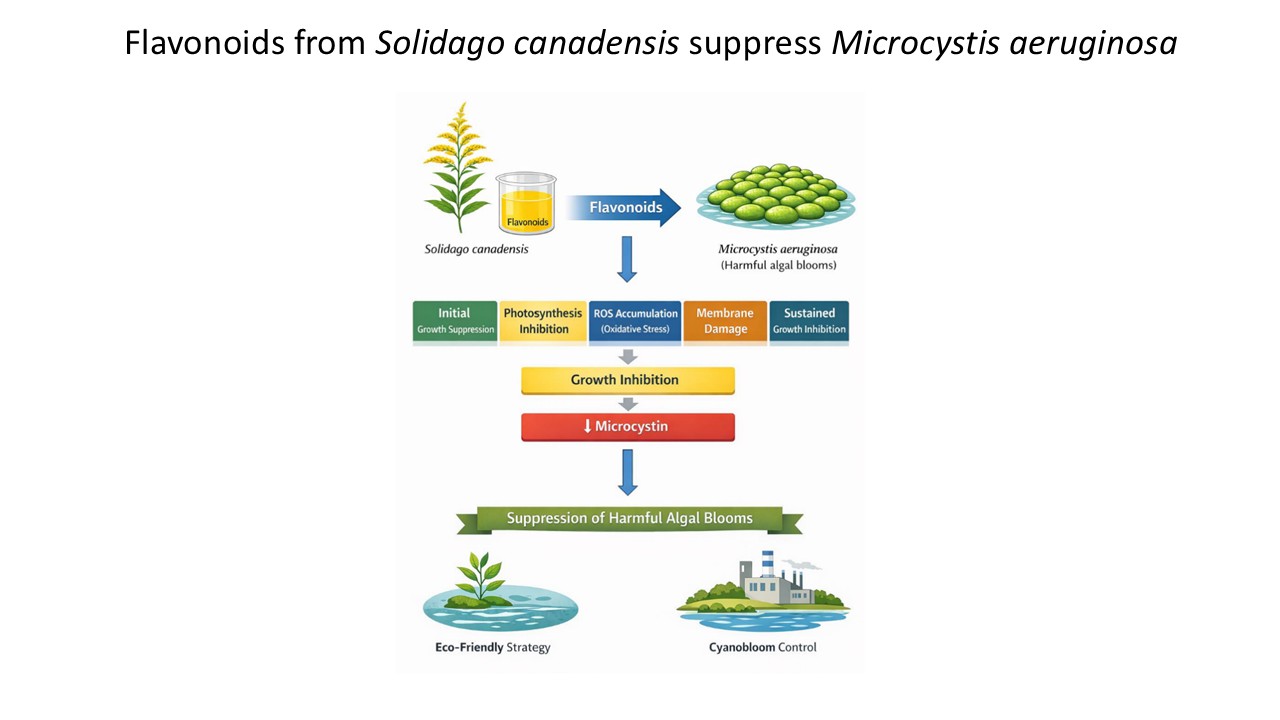
Cyanobacterium blooms caused by Microcystis aeruginosa eutrophication present a major threat to water resources protection. Plant-derived allelochemicals have attracted increasing attention as environmentally friendly alternatives for controlling harmful algal blooms. Here, we evaluated the inhibitory effects of total flavonoids extracted from the invasive plant Solidago canadensis on the growth and physiological and biochemical responses of M. aeruginosa. Algal cell density, photosynthesis-related pigments, oxidative stress indicators, antioxidant enzyme activities, and extracellular microcystin content were analyzed under different flavonoid concentrations (0–100 mg/L). Flavonoid treatment (20–100 mg/L) significantly suppressed algal growth in a concentration- and time-dependent manner, with algal density in the 100 mg/L group decreasing by nearly 50% compared with the control at day 12. Photosynthetic pigment contents, including chlorophyll a, carotenoids, and phycocyanin, were markedly reduced under flavonoid exposure, indicating impairment of the photosynthetic system. Meanwhile, hydrogen peroxide content increased significantly (more than 2 times), accompanied by enhanced antioxidant enzyme activities, suggesting the induction of oxidative stress. Malondialdehyde accumulation further confirmed membrane lipid peroxidation and cellular damage. In addition, extracellular microcystin content decreased with increasing flavonoid concentration. These results indicate that S. canadensis total flavonoids inhibit M. aeruginosa primarily by disrupting photosynthesis and inducing oxidative stress, supporting their potential as environmentally friendly algicidal agents for the management of cyanobacterial blooms.
- Ho JC, Michalak AM, Pahlevan N. Widespread global increase in intense lake phytoplankton blooms since the 1980s. Nature. 2019;574(7780):667-670. doi:10.1038/s41586-019-1648-7
- Sun ZW, Qiu LH, Cao YC, et al. Lanzao shuihua dui shuichan yangzhiye yingxiang de yanjiu jinzhan [Research progress on the effect of cyanbacteria bloom on aquaculture]. Ecol Sci. 2017;36(1):231-235. [In Chinese] doi:10.14108/j.cnki.1008-8873.2017.01.032
- Larsson ME, Ajani PA, Rubio AM, et al. Long-term perspective on the relationship between phytoplankton and butrient concentrations in a southeastern Australian Estuaty. Mar Pollut Bull. 2017;114(1):227-238. doi:10.1016/j.marpolbul.2016.09.011
- Shi WQ, Qin BQ. Cyanobacterial blooms in lakes and reservoirs under climate change: future trend and control strategy. J Hydraul Eng. 2023;54(8):987-996. doi:10.13243/j.cnki.slxb.20221001
- Zhang S, Arhonditsis GB, Ji YL, et al. Climate change promotes harmful algal blooms in China’s lakes and reservoirs despite significant nutrient control efforts. Water Res. 2025;277:123307. doi:10.1016/j.watres.2025.123307
- Wang JH, He LQS, Yang C, et al. Comparison of algal bloom related meteorological and water quality factors and algal bloom conditions among Lakes Taihu, Chaohu, and Dianchi (1981-2015). J Lake Sci. 2018;30(4):897-906. doi:10.18307/2018.0403
- Song T, Xu C, Yan F, Zhnag JY. Spatiotemporal dynamics monitoring of lake cyanobacterial blooms based on sentinel-2 data. Environ Monit China. 2025;41(1):214-224. doi:10.19316/j.issn.1002-6002.2025.01.23
- Gu XH, Li HM, Mao ZG, Chen HH, Shen RJ, Zeng QF. Ecological interaction between cyanobacterial blooms and freshwater fish. Chin Sci Bull. 2021;66(21):2649-2662. doi:10.1360/TB-2020-0905
- Qiu Y, Ma ZL, Zhang ZY, et al. Research advance in the distribution and ecotoxicological effects of microcystins in aquatic ecosystem. Chin J Appl Ecol. 2023;34(1): 277-288. doi:10.13287/j.1001-9332.202212.033
- Zurawell RW, Chen HR, Burke JM, Prepas EE. Hepatotoxic cyanobacteria: a review of the biological importance of microcystins in freshwater environments. J Toxicol Env Heal B. 2005;8(1):1–37. doi:10.1080/10937400590889412
- Zhou XD, Yang Y, Feng SD, Yang F. Research progress on intestinal toxicity of microcystins. Sci Sin Vitae. 2023;53(10):1479-1489. doi:10.1360/SSV-2023-0106
- Li T, Fan XT, Cai MH, et al. Advances in investigating microcystin-induced liver toxicity and underlying mechanisms. Sci Total Environ. 2023;905:167167. doi:10.1016/j.scitotenv.2023.167167
- Wang YQ, Zhou XD, Yang Y, Liu J, Yang F. Research progress of microcystin-LR toxicity to the intestine, liver, and kidney and its mechanism. Environ Int. 2025;201:109547. doi:10.1016/j.envint.2025.109547
- Cao J, Yuan J, Zhao L, et al. Huku lanzao shuihua kongzhi jishu fazhan yingyong ji zhanwang [Development, application and prospect of cyanobacteria blooms control technology in lakes and reservoirs]. J Environ Eng Technol. 2024;14(2):487-500. [In Chinese] doi:10.12153/j.issn.1674-991X.20230453
- Zhang XR, Li XD, Chen Y, et al. Changes of climate niche of Solidago canadensis during its invasion in China. Chin J Appl Ecol. 2024;35(10):2707-2714. doi:10.13287/j.1001-9332.202410.001
- Lin HY, Chen LX, Li JM. Multiple introductions and distinct genetic groups of Canada goldenrod (Solidago canadensis) in China revealed by genomic single-nucleotide polymorphisms. Plants. 2023;12(9):1734. doi:10.3390/plants12091734
- Czotek P, Królak E, Borkowska L, Bielecka A. Effects of surrounding landscape on the performance of Solidago canadensis L. and plant functional diversity on heavily invaded post-agricultural wastelands. Biol Invasions. 2023;25(8):2477-2494. doi:10.1007/s10530-023-03050-2
- Wang S, Wei M, Wu BD, Jiang K, Du DL, Wang CY. Degree of invasion of Canada goldenrod (Solidago canadensis L.) plays an important role in the variation of plant taxonomic diversity and community stability in eastern China. Ecol Res. 2019;34(6):782-789. doi:10.1111/1440-1703.12049
- Quinty V, Nasreddine R, Colas C, et al. Antioxidant and anti-lipase capacities from the extracts obtained from two invasive plants: Ambrosia artemisiifolia and Solidago canadensis. Food Biosci. 2023;55:103069. doi:10.1016/j.fbio.2023.103069
- Poljuha D, Sladonja B, Uzelac Božac M, Šola I, Damijanić D, Weber T. The invasive alien plant Solidago canadensis: phytochemical composition, ecosystem service potential, and application in bioeconomy. Plants. 2024;13(13):1745. doi:10.3390/plants13131745
- Qin Y, Chen JP, Li CY, et al. Flavonoid glycosides from the fruits of Embelia ribes and their anti-oxidant and α-glucosidase inhibitory activities. J Asian Nat Prod Res. 2021;23(8):724-730. doi:10.1080/10286020.2020.1776266
- Hughes SD, Ketheesan N, Haleagrahara N. The therapeutic potential of plant flavonoids on rheumatoid arthritis. Crit Rev Food Sci Nutr. 2017;57(17):3601-3613. doi:10.1080/10408398.2016.1246413
- Jin K, Cong LQ, Mu DQ, Cao Y, Zhang A, Xue Y. Impact of drought stress on the growth, physiological indices, and pharmacodynamic substance content of Artemisia frigida Willd. Jiangsu J of Agr Sci. 2025;41(3):493-500. doi:10.3969/j.issn.1000-4440.2025.03.008
- Zhao L, Zhang Y, Li C, Wu DH, Yu XH. Jinshajuanmaoju de huaxue chengfen yanjiu [Studies on the chemical constituents of Soroseris gillii (S. Moore) Stebb]. Lishizhen Med Mater Med Res. 2010;21(3):595-596. [In Chinese] doi:10.3969/j.issn.1008-0805.2010.03.041
- Tang X, Qiu CP, Jia J, Lin W, Pan F, Yang YZ. Jianadayizhihuanghua huangtong chengfen de dongtai fenxi [Dynamic analysis of total flavonoids in Solidago canadensis L]. Acta Agric Zhejiangensis. 2011;23(5):961-966. [In Chinese] doi:10.3969/j.issn.1004-1524.2011.05.019
- Shen X, Zou ZR. Review on research progress of chemical constituents and bioactivities of Solidago. Chin J Chin Mat Med. 2016;41(23):4303-4313. doi:10.4268/cjcmm20162303
- Perez-Vizcaino, F. & Fraga, CG. Research trends in flavonoids and health. Arch of biochem biophys. 2018;646:107-112. doi:10.1016/j.abb.2018.03.022.
- Li C, Wang EP, Elshikh MS, et al. Extraction and purification of total flavonoids from Gnaphalium affine D. Don and their evaluation for free radicals’ scavenging and oxidative damage inhabitation potential in mice liver. Arab J Chem. 2021;14(3):103006. doi:10.1016/j.arabjc.2021.103006
- Zou J, Sui DY, Fu WW, et al. Total flavonoids extracted from the leaves of Murraya paniculata (L.) Jack alleviate oxidative stress, inflammation and apoptosis in a rat model of diabetic cardiomyopathy. J Funct Foods. 2021;76:104319. doi:10.1016/j.jff.2020.104319
- Ganai SA, Sheikh FA, Baba ZA, Mir MA, Mantoo MA, Yatoo MA. Anticancer activity of the plant flavonoid luteolin against preclinical models of various cancers and insights on different signalling mechanisms modulated. Phytother Res. 2021;35(7):3509-3532. doi:10.1002/ptr.7044.
- Huang R, Wu WY, Shen SY, et al. Evaluation of colorimetric methods for quantification of citrus flavonoids to avoid misuse. Anal Methods. 2018;10(22):2575-2587. doi:10.1039/C8AY00661J
- Zhang XW, Kai ZP, Song WG, Chen SS. Ecotoxicological effects of 50 kinds of fragrance materials on Microcystis aeruginosa. Chin Environ Sci 2021;41(3):1429-1435. doi:10.19674/j.cnki.issn1000-6923.20201026.001
- Jayakumar S, Bhuyar P, Pugazhendhi A, Rahim MHA, Maniam GP, Govindan N. Effects of light intensity and nutrients on the lipid content of marine microalga (diatom) Amphiprora sp. for promising biodiesel production. Sci Total Environ. 2021;768:145471. doi:10.1016/j.scitotenv.2021.145471
- Wang B, Zhang Y, Qin YY, Li HJ. Removal of Microcystis aeruginosa and control of algal organic matter by Fe (II)/ peroxymonosulfate pre-oxidation enhanced coagulation. Chem Eng J. 2021;403:126381. doi:10.1016/j.cej.2020.126381.
- Zhang DJ, Zhang SL, Wang ZB, Li PY. Effects of nitrogen recovery on the growth of nitrogen starved Microcystis aeruginosa. J South Agric. 2019;50(11):2592-2598. doi:10.3969/j.issn.2095-1191.2019.11.29.
- Li JM, Hu JQ, Cao LR, Yuan Y. Growth, physiological responses and microcystin-production/-release dynamics of Microcystis aeruginosa exposed to various luteolin doses. Ecotox Env. Safe. 2020;196:110540. doi:10.1016/j.ecoenv.2020.110540
- Li N, Zeng ZT, Zhang YF, et al. Higher toxicity induced by co-exposure of polystyrene microplastics and chloramphenicol to Microcystis aeruginosa: Experimental study and molecular dunamics simulation. Sci Total Environ. 2023;866:161375. doi:10.1016/j.scitotenv.2022.161375
- Velikova V, Yordanov I, Edreva A. Oxidative stress and some antioxidant systems in acid rain-treated bean plants: Protective role of exogenous polyamines. Plant Sci. 2000;151(1):59-66. doi:10.1016/S0168-9452(99)00197-1
- Zhao QM, Zhong JJ, He PM, Shao L. Study on allelopathic inhibition of flavonoids on Microcystis aeruginosa. Environ Sci Technol. 2022;45(2):1-7. doi:10.19672/j.cnki.1003-6504.1837.21.338
- Mecina GF, Chia MA, Cordeiro-Araújo MK, et al. Effect of flavonoids isolated from Tridax procumbens on the growth and toxin production of Microcystis aeruginos. Aquat Toxicol. 2019;211:81-91. doi:10.1016/j.aquatox.2019.03.011
- Kong FC, Zhao QM, Wen WK, Shao L. Allelopathic effects and mechanism of kaempferol on controlling Microcystis aeruginosa blooms. Mar Pollut Bull. 2025;217:118116. doi:10.1016/j.marpolbul.2025.118116
- Huang HM, Xiao Xi, Ghadouani A, et al. Effects of Natural Flavonoids on Photosynthetic Activity and Cell Integrity in Microcystis aeruginosa. Toxins. 2015;7(1):66-80. doi:10.3390/toxins7010066
- Zhang C, Yi YL, Hao K, Liu GL, Wang GX. Algicidal activity of Salvia miltiorrhiza Bung on Microcystis aeruginosa -towards identification of algicidal substance and determination of inhibition mechanism. Chemosphere. 2013;93(6):997-1004. doi:10.1016/j.chemosphere.2013.05.068
- Cao JG, Dong ZZ, Zhao HY et al. Allelopathic effect of rhubarb extracts on the growth of Microcystis aeruginosa. Water Sci Technol. 2020;82(6):1092–1101. doi:10.2166/wst.2020.225
- Lahlali M, Manaut N, Loudiki M, Douma M. First assessment of the anti-cyanobacterial potentialities of the invasive weed Verbesina encelioides against Microcystis aeruginosa growth. Desalin Water Treat. 2023;310:150-156. doi:10.5004/dwt.2023.29936
- Page LE, Liberton M, Pakrasi HB. Redution of photoautotrophic productivity in the cyanobacterium synechocystis sp. strain PCC 6803 by phycobilisome antenna truncation. Appl Environ Microb. 2012;78(17):6349-6351. doi:10.1128/AEM.00499-12
- Tiwari S, Patel A, Prasad SM. Phytohormone up-regulates the biochemical constituent, exopolysaccharide and nitrogen metabolism in paddy-field cyanobacteria exposed to chromium stress. BMC Microbiol. 2020;20(1):206. doi:10.1186/s12866-020-01799-3
- Li X, Hou WW, Lei JX, Chen H, Wang Q. The unique light-harvesting system of the algal phycobilisome: structure, assembly components, and functions. Int J Molr Sci. 2023;24(11):9733. doi:10.3390/ijms24119733
- Li WJ, Su HN, Pu Y, et al. Phycobiliproteins: Molecular structure, production, applications, and prospects. Biotechnol Adv. 2019;37(2):340-353. doi:10.1016/j.biotechadv.2019.01.008
- Zheng XW, Liu XL, Zhang LL, et al. Toxicity mechanism of nylon microplastics on Microcystis aeruginosa through three pathways: photosynthesis, oxidative stress and energy metabolism. J Hazard Mater. 2022;426:128094. doi:10.1016/j.jhazmat.2021.128094
- Mittler R, Vanderauwera S, Suzuki N, et al. ROS signaling: the new wave?. Trends Plant Sci. 2011;16(6):300-309. doi:10.1016/j.tplants.2011.03.007
- Finkel T. Signal transduction by reactive oxygen species. J Cell Biol. 2011;194(1):7-15. doi:10.1083/jcb.201102095
- Zhao QM, Jiang RT, Shi YX, Shen AL, He PM, Shao L. Allelopathic inhibition and mechanism of quercetin on Microcystis aeruginosa. Plants. 2023;12(9):1808. doi:10.3390/plants12091808
- Wu LG, Jiang QF, Zhang Y, Du MH, Ma L, Ma Y. Peroxidase activity in tomato leaf cells under salt stress based on micro-hyperspectral imaging technique. Horticulturae. 2022;8(9):813. doi:10.3390/horticulturae8090813
- Zhu ZL, Wang SC, Zhao FF, Wang SG, Liu FF, Liu GZ. Joint toxicity of microplastics with triclosan to marine microalgae Skeletonema costatum. Environ Pollut. 2019;246: 509-517. doi:10.1016/j.envpol.2018.12.044
- Fan HY, Liu HJ, Dong Y, et al. Growth inhibition and oxidative stress caused by four ionic liquids in Scenedesmus obliquus: role of cations and anions. Sci Total Environ. 2019;651:570-579. doi:10.1016/j.scitotenv.2018.09.106
- Fan GD, Zhou JJ, Zheng XM, Chen W. Growth inhibition of Microcystis aeruginosa by copper-based MOFs: performance and physiological effect on algal cells. Appl Organomet Chem. 2018;32(12):e4600. doi:10.1002/aoc.4600
- Hong Y, Hu HY, Xie X, Sakoda A, Sagehashi M, Li FM. Gramine-induced growth inhibition, oxidative damage and antioxidant responses in freshwater cyanobacterium Microcystis aeruginosa. Aquat Toxicol. 2009;91(3): 262-269. doi:10.1016/j.aquatox.2008.11.014
- Luo L, Li JM, Zhang Z, Yuan Y. Phosphorus influences the interaction between toxigenic Microcystis and chloramphenicol. B Environ Contam Tox. 2019;102(3):391- 398. doi:10.1007/s00128-018-2505-3
- Wang J, Liu Q, Feng J, Lv JP, Xie SL. Effect of high-dose pyrogallol on oxidative damage, transcriptional responses and microcystins synthesis in Microcystis aeruginosa TY0001 (Cyanobacteria). Ecotox Environ Safe. 2016;134:273-279. doi:10.1016/j.ecoenv.2016.09.010
- Bailly C, Benamar A, Corbineau F, Côme D. Changes in malondialdehyde content and in superoxide dismutase, catalase and glutathione reductase activities in sunflower seeds as related to deterioration during accelerated aging. Physiol Plantarum. 1996;97(1):104-110. doi:10.1034/j.1399-3054.1996.970116.x
- Zhang TT, Hu CX, Chen B. Daocao jiegan fajiaoye dui tonglvweinangzao shenghua canshu yingxiang [Effects of rice straw fermentation liquid on the biochemical parameters of Microcystis aeruginosa]. China Environ Sci. 2021;41(11):5345-5352. [In Chinese] doi:10.19674/j.cnki.issn1000-6923.2021.0373
- Lavoie M, Faucheur SL, Boullemant A, Fortin C, Campbell PGC. The influence of pH on algal cell membrane permeability and its implications for the uptake of lipophilic metal complexes. J Phycol. 2012;48(2):293–302. doi:10.1111/j.1529-8817.2012.01126.x
- Yu SM, Li C, Xu CC, Effiong K, Xiao X. Understanding the inhibitory mechanism of antialgal allelochemical flavonoids from genetic variations: photosynthesis, toxin synthesis and nutrient utility. Ecotox Environ Safe. 2019;177:18-24. doi:10.1016/j.ecoenv.2019.03.097
- Meng PP, Pei HY, Hu WR, Liu ZD, Li XQ, Xu HZ. Allelopathic effect of Ailanthus altissima extracts on Microcystis aeruginosa growth, physiological changes and miocrocystins release. Chemosphere. 2015;141:219-226. doi:10.1016/j.chemosphere.2015.07.057
- Barchewitz T, Guljamow A, Meissner S, et al. Non-canonical localization of RubisCO under high-light conditions in the toxic cyanobacterium Microcystis aeruginosa PCC7806. Environ Microbiol. 2019;21(12):4836–4851. doi:10.1111/1462-2920.14837
- Zilliges Y, Kehr JC, Meissner S, et al. The cyanobacterial hepatotoxin microcystin binds to proteins and increases the fitness of Microcystis under oxidative stress conditions. PLoS ONE. 2011;6(3):e17615. doi:10.1371/journal.pone.0017615
- Wan QR, Li JM, Chen YR. Comparative growth and cellular responses of toxigenic Microcystis exposed to different types of microplastics at various doses. Environ Pollut. 2021;290:117950. doi:10.1016/j.envpol.2021.117950
- Hou XY, Huang J, Tang JH, et al. Allelopathic inhibition of juglone (5-hydroxy-1, 4-naphthoquinone) on the growth and physiological performance in Microcystis aeruginosa. J Environ Manage. 2019;232:382-386. doi:10.1016/j.jenvman.2018.11.105