

Energy efficiency and environmental impacts of road infrastructure construction

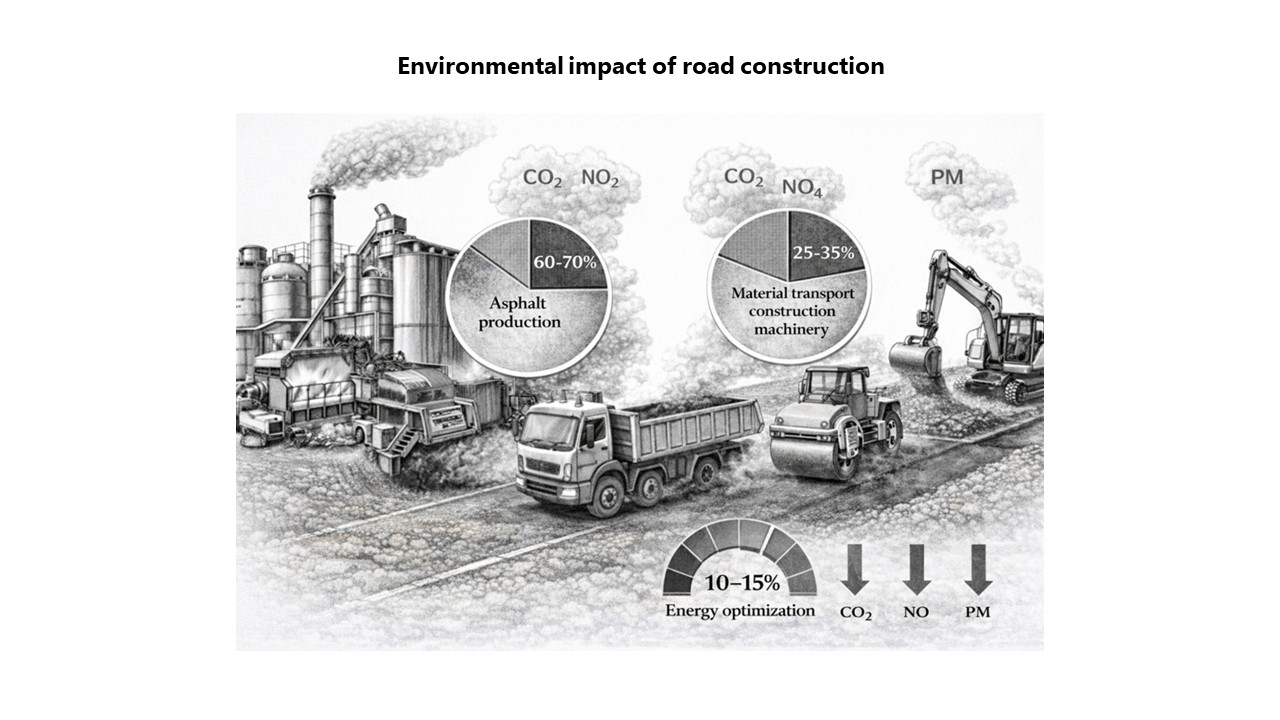
Road infrastructure construction is an energy- and emission-intensive activity; however, process-level quantification of fuel use and associated pollutants across material production, transportation, and construction machinery operation remains insufficiently systematic to guide targeted optimization measures. This paper analyzes energy consumption and pollutant emissions during the construction phase of road infrastructure, with particular emphasis on asphalt mixture production (MJ), material transportation, and construction machinery operation. The analysis was conducted using a process-oriented approach and standardized calculation models to estimate fuel consumption and emissions of CO2, NOx, and particulate matter. The results indicate that asphalt MJ accounts for approximately 60–70% of total energy consumption, while transportation and construction machinery together contribute about 25–35%. The implementation of energy optimization measures enables a 10–15% reduction in total energy consumption, accompanied by proportional reductions in pollutant emissions. The findings confirm that targeting the most energy-intensive construction processes represents a key step toward improving the sustainability of road construction projects.
- Akkan Çavdar A, Vural N. Analysis of the embodied and operational energy of wood-based prefabricated panels produced with different design concepts according to vernacular. Politeknik Derg. 2024;27(4):1491-1503. doi: 10.2339/politeknik.1239942
- Du M, Wu F, Luo L, Wang Q, Liao L. Spatial effects of the market-based energy allocation on energy efficiency: A quasi-natural experiment of energy quota trading. Energy. 2025;318:134902. doi: 10.1016/j.energy.2025.134902
- Hong B, Lü L. Assessment of emissions and energy consumption for construction machinery in earthwork activities by incorporating real-world measurement and discrete-event simulation. Sustainability. 2022;14(9):5326. doi:10.3390/su14095326
- Stripple H. Life Cycle Assessment of Road: A Pilot Study for Inventory Analysis. IVL Swedish Environmental Research Institute. IVL Report B1210; 2001.
- European Environment Agency. EMEP/EEA Air Pollutant Emission Inventory Guidebook 2019. Denmark: European Environment Agency; 2019.
- PIARC – World Road Association. Pavement Design and Management. France: PIARC; 2019.
- Abanda FH, Tah JHM, Cheung FKT. Mathematical modelling of embodied energy, greenhouse gases, waste, time–cost parameters of building projects: A review. Build Environ. 2013;59:23-37. doi: 10.1016/j.buildenv.2012.07.014
- United States Army Corps of Engineers. Construction Equipment Ownership and Operating Expense Schedule. United States: USACE; 2017.
- Caterpillar Inc. Fuel Consumption and Efficiency Guide for Construction Equipment. United States: Caterpillar Inc.; 2020.
- Volvo Construction Equipment. Engine Specifications and Fuel Efficiency Manual. Sweden: Volvo Construction Equipment; 2019.
- Roberts FL, Kandhal PS, Brown ER, Lee DY, Kennedy TW. Hot Mix Asphalt Materials, Mixture Design, and Construction. 3rd ed. National Asphalt Pavement Association; 2017.
- Wang F, Xie J, Wu S, Li J, Barbieri DM, Zhang L. Life cycle energy consumption by roads and associated interpretative analysis of sustainable policies. Renew Sustain Energy Rev. 2021;141:110779. doi: 10.1016/j.rser.2021.110823
- Muench ST, Lin YY, Katara S, Armstrong A. Roadprint: Practical Pavement Life Cycle Assessment (LCA) Using Generally Available Data. In: Proceedings of the International Symposium on Pavement Life Cycle Assessment. Davis, CA; 2014. p. 249-262.
- Hong B, Xu H, Wang X, Wang X. Assessment of emissions and energy consumption for construction machinery in earthwork activities by incorporating real-world measurement and discrete-event simulation. Sustainability. 2022;14(9):5326. doi: 10.3390/su14095326
- Subotić P. Priručnik Za Asfalt [Handbook for Asphalt]. Beograd, Serbia: Institut za Puteve a.d; 1997.
- Abou-Qudais S. Evaluation of aggregate types and sizes in asphalt mixtures. Constr Build Mater. 2007;21(3):428-437. doi: 10.1016/j.conbuildmat.2005.08.015
- Aurangzeb Q, Al-Qadi IL, Ozer H, Yang R. Hybrid life cycle assessment for asphalt mixtures with high RAP content. Resour Conserv Recycl. 2014;83:77-86. doi: 10.1016/j.resconrec.2013.12.004
- Kovačević-Lepotić B, Kovačević A. Vodič Kroz EU Politike - Energetika [Guide through EU Policies– Energy]. Beograd, Serbia: Evropski Pokret u Srbiji; 2010.
- Liu Q, Xu S. Assessment of operational fuel efficiency in construction machinery. Energy Build. 2019;198:45-56. doi: 10.1016/j.enbuild.2019.109412
- European Commission, Joint Research Centre. Life Cycle Assessment of Road Construction and Use. Belgium: Joint Research Centre, Publications Office of the European Union; 2012.
- Wu B, Wang W, Yao Z, et al. Multi-pollutant emission characteristics of non-road construction equipment based on real-world measurement. Sci Total Environ. 2022;853:158601. doi: 10.1016/j.scitotenv.2022.158601
- Frey HC, Rasdorf W, Kim K, Pang SH, Lewis P, Abolhassani S. Real-World Duty Cycles and Utilization for Construction Equipment in North Carolina. Raleigh, NC: North Carolina Department of Transportation. FHWA/NC 2006-55; 2008. Available from: https://www. lib.ncsu.edu/resolver/1840.2/2352 [Last accessed on 2026 Feb 04].
- Masih-Tehrani M, Ebrahimi-Nejad S, Dahmardeh M. Combined fuel consumption and emission optimization model for heavy construction equipment. Automat Constr. 2020;110:103007. doi: 10.1016/j.autcon.2019.103007
- Kusiak A, Li M, Tang F. Modeling and optimization of HVAC energy consumption. Appl Energy. 2010;87(10):3092-3102. doi: 10.1016/j.apenergy.2010.04.008.
- Amasyali K, El-Gohary NM. A review of data-driven building energy consumption prediction studies. Renew Sustain Energy Rev. 2018;81:1192-1205. doi: 10.1016/j.rser.2017.04.095