

Artificial intelligence-based approaches for Pb2+ detection in agricultural soils: A review

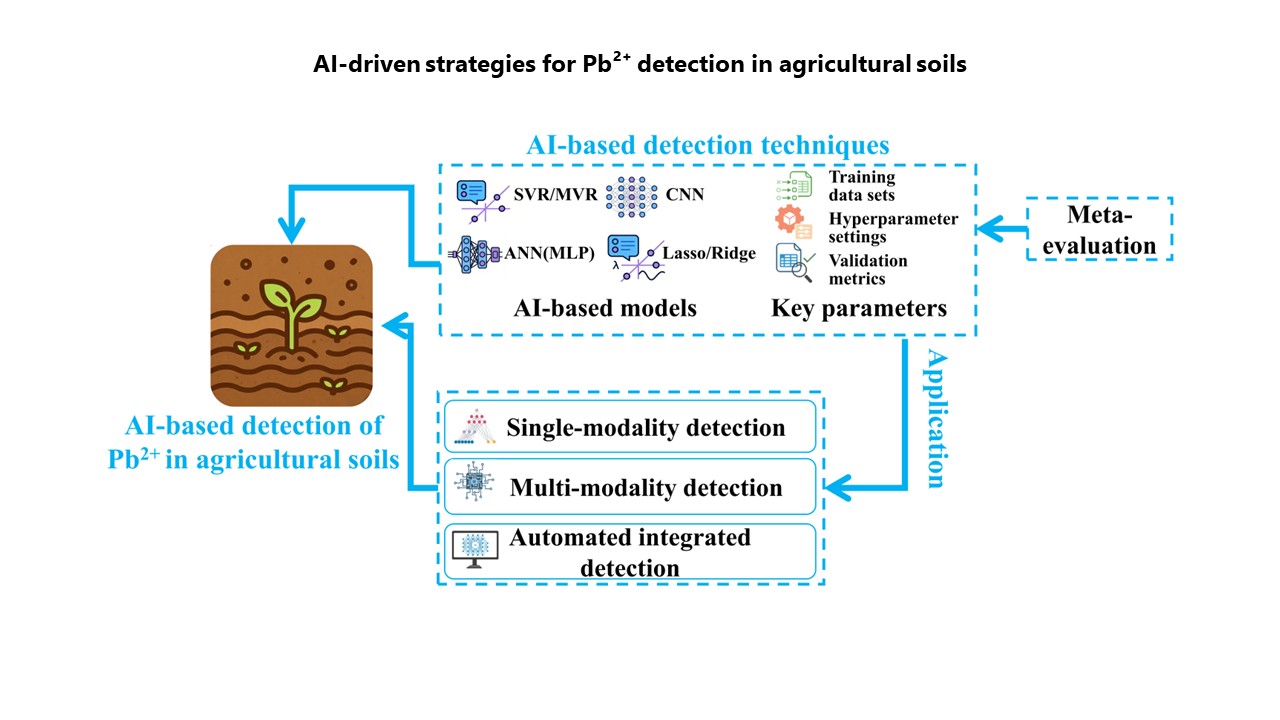
Lead ion (Pb2+) contamination in agricultural soils poses serious risks to ecosystem stability and human health due to its persistence and bioaccumulative toxicity. Traditional detection techniques are constrained by complex sample preparation, matrix interference, long analysis cycles, and limited in situ applicability. To overcome these limitations, artificial intelligence (AI)-based approaches have been increasingly adopted. Given the heterogeneity of agricultural soils and sensing signals, model selection is inherently scenario-specific: Support vector machine/support vector regression are suitable for complex matrices and multi-ion interference; artificial neural networks are preferred for low-concentration or multi-ion detection; convolutional neural networks are effective for high-dimensional, weak, or multi-modal signals; and least absolute shrinkage and selection operator/Ridge methods enable rapid, low-cost field screening. The performance of AI models depends on key factors—such as training dataset, hyperparameter optimization, and validation metrics. Coordinated optimization of these parameters enables robust, precise, and interpretable Pb2+ quantification. AI applications in soil Pb2+ detection are categorized into three main approaches: (i) single-modality approaches enhance sensitivity and specificity to address Pb2+ alloying and weak signal issues; (ii) multi-modal fusion strategies effectively mitigate interferences from complex soil matrices; and (iii) automated integrated platforms enable fast, field-deployable analyses while minimizing manual intervention. The approaches form a coherent technical chain that progressively addresses key bottlenecks in agricultural soil Pb2+ detection. Nevertheless, research in this area still faces challenges, including field adaptability, chemical speciation decoupling, and interference under variable soil conditions. Future research should focus on synergistic strategies that integrate materials, AI, and field applications. This review provides a targeted reference for the accurate tracking and control of Pb2+ contamination in farmland soils.
- Banwart SA, Nikolaidis NP, Zhu YG, Peacock CL, Sparks DL. Soil functions: Connecting earth’s critical zone. Annu Rev Earth Planet Sci. 2019;47(1):333-359. doi: 10.1146/annurev-earth-063016-020544
- Kafle G. Abiotic and biotic factors affecting formation of soil in the Earth. J Agric Nat Resour. 2023;6(1):20-31. doi: 10.3126/janr.v6i1.71850
- Spiridonov V, Ćurić M, Novkovski N. Biosphere: Ecosystem diversity and environmental change. In: Atmospheric Perspectives: Unveiling Earth’s Environmental Challenges. Berlin: Springer; 2025. p. 51-81. doi: 10.1007/978-3-031-86757-6_4
- Padhiary M, Kumar R. Assessing the environmental impacts of agriculture, industrial operations, and mining on agro-ecosystems. In: Smart Internet of Things for Environment and Healthcare. Berlin: Springer; 2024. p. 107-126. doi: 10.1007/978-3-031-70102-3_8
- Sodango TH, Li X, Sha J, Bao Z. Review of the spatial distribution, source and extent of heavy metal pollution of soil in China: Impacts and mitigation approaches. J Health Pollut. 2018;8(17):53. doi: 10.5696/2156-9614-8.17.53
- Rakshith BL, Gautam S, Asirvatham LG, et al. Biofilm-associated microplastic contamination in rural soil and water: Emerging hazards to ecosystems. Sci Total Environ. 2025;1004:180806. doi: 10.1016/j.scitotenv.2025.180806
- Rashmi I, Roy T, Kartika K, et al. Organic and inorganic fertilizer contaminants in agriculture: Impact on soil and water resources. In: Contaminants in Agriculture: Sources, Impacts and Management. Berlin: Springer; 2020. p. 3-41. doi: 10.1007/978-3-030-41552-5_1
- Lu D, Zhang C, Zhou Z, et al. Pollution characteristics and source identification of farmland soils in Pb-Zn mining areas through an integrated approach. Environ Geochem Health. 2023;45(5):2533-2547. doi: 10.1007/s10653-022-01355-0
- Rathikannu S, Gautam S, Joshi SK, et al. FTIR based assessment of microplastic contamination in soil water and insect ecosystems reveals environmental and ecological risks. Sci Rep. 2025;15(1):28615. doi: 10.1038/s41598-025-14507-w
- Huang Y, Wang L, Wang W, Li T, He Z, Yang X. Current status of agricultural soil pollution by heavy metals in China: A meta-analysis. Sci Total Environ. 2019;651:3034-3042. doi: 10.1016/j.scitotenv.2018.10.185
- Jomova K, Alomar SY, Nepovimova E, Kuca K, Valko M. Heavy metals: Toxicity and human health effects. Arch Toxicol. 2025;99(1):153-209. doi: 10.1007/s00204-024-03903-2
- Xie Y, Zhou G, Huang X, et al. Study on the physicochemical properties changes of field aging biochar and its effects on the immobilization mechanism for Cd2+ and Pb2+. Ecotoxicol Environ Saf. 2022;230:113107. doi: 10.1016/j.ecoenv.2021.113107
- Huihui Z, Xin L, Zisong X, et al. Toxic effects of heavy metals Pb and Cd on mulberry (Morus alba L.) seedling leaves: Photosynthetic function and reactive oxygen species (ROS) metabolism responses. Ecotoxicol Environ Saf. 2020;195:110469. doi: 10.1016/j.ecoenv.2020.110469
- Collin MS, Venkatraman SK, Vijayakumar N, et al. Bioaccumulation of lead (Pb) and its effects on human: A review. J Hazard Mater Adv. 2022;7:100094. doi: 10.1016/j.hazadv.2022.100094
- Kumar A, Kumar A, Cabral-Pinto MMS, et al. Lead toxicity: Health hazards, influence on food chain, and sustainable remediation approaches. Int J Environ Res Public Health. 2020;17(7):2179. doi: 10.3390/ijerph17072179
- Meena V, Dotaniya ML, Saha JK, Das H, Patra AK. Impact of lead contamination on agroecosystem and human health. In: Lead in Plants and the Environment. Berlin: Springer; 2019. p. 67-82. doi: 10.1007/978-3-030-21638-2_4
- Tawfik W, El-Saeed M, Khalil A, Fikry M. Detection of heavy metal elements by using advanced optical techniques. J Egypt Soc Basic Sci Phys. 2024;1(1):99-127. doi: 10.21608/jesbsp.2024.255191.1002
- Yan P, Lin K, Wang Y, et al. Spatial interpolation of red bed soil moisture in Nanxiong basin, South China. J Contam Hydrol. 2021;242:103860. doi: 10.1016/j.jconhyd.2021.103860
- Murugasridevi K, Mageshen V, Poornima R, Ramya A. The role of robotics in sustainable agriculture and waste management. In: Addressing Environmental Challenges with AI, Robotics, and Augmented Reality. United States: IGI Global Scientific Publishing; 2025. p. 47-82. doi: 10.4018/979-8-3373-1892-9.ch003
- Baydarashvili M, Shrednik N, Spasovskaia A. Detection method of pollution with heavy metals ions of the soil. Procedia Eng. 2017;189:630-636. doi: 10.1016/j.proeng.2017.05.100
- Chinnaiyan B, Balasubaramanian S, Jeyabalu M, Warrier GS. AI applications-computer vision and natural language processing. In: Model Optimization Methods for Efficient and Edge AI: Federated Learning Architectures, Frameworks and Applications. New Jersey: Wiley; 2025. p. 25-41. doi: 10.1002/9781394219230.ch2
- Ranjith J. Enhancing stock market trend prediction using explainable artificial intelligence and multi-source data. Fusion Pract Appl. 2024;16(2):178-189. doi: 10.54216/FPA.160211
- Sharafat MS, Kabya ND, Emu RI, et al. An IoT-enabled AI system for real-time crop prediction using soil and weather data in precision agriculture. Smart Agric Technol. 2025;12:101263. doi: 10.1016/j.atech.2025.101263
- Misra NN, Dixit Y, Al-Mallahi A, Bhullar MS, Upadhyay R, Martynenko A. IoT, big data, and artificial intelligence in agriculture and food industry. IEEE Internet Things J. 2020;9(9):6305-6324. doi: 10.1109/JIOT.2020.2998584
- Tavares TR, Minasny B, McBratney A, et al. Estimating plant-available nutrients with XRF sensors: Towards a versatile analysis tool for soil condition assessment. Geoderma. 2023;439:116701. doi: 10.1016/j.geoderma.2023.116701
- Tan K, Ma W, Wu F, Du Q. Random forest-based estimation of heavy metal concentration in agricultural soils with hyperspectral sensor data. Environ Monit Assess. 2019;191(7):446. doi: 10.1007/s10661-019-7510-4
- Derakhshan Nejad Z, Jung MC, Kim KH. Remediation of soils contaminated with heavy metals with an emphasis on immobilization technology. Environ Geochem Health. 2018;40(3):927-953. doi: 10.1007/s10653-017-9964-z
- Liu G, Liao B, Lu T, et al. Insight into immobilization of Pb2+ in aqueous solution and contaminated soil using hydroxyapatite/attapulgite composite. Colloids Surf A Physicochem Eng Asp. 2020;603:125290. doi: 10.1016/j.colsurfa.2020.125290
- Bian H, Ma Y, Ji P, et al. Effect of enzyme-induced carbonate precipitation (EICP) combined with biochar on lead-contaminated soil solidification and plant growth. J Environ Chem Eng. 2025;13:116977. doi: 10.1016/j.jece.2025.116977
- Huang S, Yamaji N, Ma JF. Metal transport systems in plants. Annu Rev Plant Biol. 2024;75:1-25. doi: 10.1146/annurev-arplant-062923-021424
- Rashid A, Schutte BJ, Ulery A, et al. Heavy metal contamination in agricultural soil: Environmental pollutants affecting crop health. Agronomy. 2023;13(6):1521. doi: 10.3390/agronomy13061521
- Hou D, O’Connor D, Igalavithana AD, et al. Metal contamination and bioremediation of agricultural soils for food safety and sustainability. Nat Rev Earth Environ. 2020;1(7):366-381. doi: 10.1038/s43017-020-0061-y
- Silva KN, Paiva SS, Souza FL, Silva D, Martínez- Huitle CA, Santos EV. Applicability of electrochemical technologies for removing and monitoring Pb2+ from soil and water. J Electroanal Chem. 2018;816:171-178. doi: 10.1016/j.jelechem.2018.03.051
- Fayiga AO, Nwoke O. Phosphate rock: Origin, importance, environmental impacts, and future roles. Environ Rev. 2016;24(4):403-415. doi: 10.1139/er-2016-0003
- Yang Q, Li Z, Lu X, Duan Q, Huang L, Bi J. A review of soil heavy metal pollution from industrial and agricultural regions in China: Pollution and risk assessment. Sci Total Environ. 2018;642:690-700. doi: 10.1016/j.scitotenv.2018.06.068
- Zwolak A, Sarzyńska M, Szpyrka E, Stawarczyk K. Sources of soil pollution by heavy metals and their accumulation in vegetables: A review. Water Air Soil Pollut. 2019;230(7):164. doi: 10.1007/s11270-019-4221-y
- Xia F, Zhao Z, Niu X, Wang Z. Integrated pollution analysis, pollution area identification and source apportionment of heavy metal contamination in agricultural soil. J Hazard Mater. 2024;465:133215. doi: 10.1016/j.jhazmat.2023.133215
- Tóth G, Hermann T, Da Silva MR, Montanarella L. Heavy metals in agricultural soils of the European Union with implications for food safety. Environ Int. 2016;88:299-309. doi: 10.1016/j.envint.2015.12.017
- Hwang HM, Fiala MJ, Park D, Wade TL. Review of pollutants in urban road dust and stormwater runoff: Part 1. Heavy metals released from vehicles. Int J Urban Sci. 2016;20(3):334-360. doi: 10.1080/12265934.2016.1193041
- Andrunik M, Wołowiec M, Wojnarski D, Zelek- Pogudz S, Bajda T. Transformation of Pb, Cd, and Zn minerals using phosphates. Minerals. 2020;10(4):342. doi: 10.3390/min10040342
- Szwalec A, Mundała P, Kędzior R, Pawlik J. Monitoring and assessment of cadmium, lead, zinc and copper concentrations in arable roadside soils in terms of different traffic conditions. Environ Monit Assess. 2020;192(3):155. doi: 10.1007/s10661-020-8120-x
- Yan P, Li G, Wang W, Zhao Y, Wang J, Wen Z. Qualitative and quantitative detection of microplastics in soil based on LIF technology combined with OOA-ELM/SPA-PLS. Microchem J. 2024;201:110632. doi: 10.1016/j.microc.2024.110632
- Sandroni V, Smith C. Microwave digestion of sludge, soil and sediment samples for metal analysis by inductively coupled plasma-atomic emission spectrometry. Anal Chim Acta. 2002;468:335-344. doi: 10.1016/S0003-2670(02)00655-4
- Jurić M, Golub N, Galić E, Radić K, Maslov Bandić L, Vitali Čepo D. Microwave-assisted extraction of bioactive compounds from mandarin peel: A comprehensive biorefinery strategy. Antioxidants (Basel). 2025;14(6):722. doi: 10.3390/antiox14060722
- Pan F, Yu Y, Yu L, et al. Quantitative assessment on soil concentration of heavy metal-contaminated soil with various sample pretreatment techniques and detection methods. Environ Monit Assess. 2020;192(12):800. doi: 10.1007/s10661-020-08775-4
- Perring L, Alonso MI, Andrey D, Bourqui B, Zbinden P. An evaluation of analytical techniques for determination of lead, cadmium, chromium, and mercury in food-packaging materials. Fresenius J Anal Chem. 2001;370(1):76-81. doi: 10.1007/s002160100716
- Patriarca M, Barlow N, Cross A, Hill S, Milde D, Tyson J. Atomic spectrometry update: Review of advances in the analysis of clinical and biological materials, foods and beverages. J Anal Atomic Spectrom. 2025;40:541-664. doi: 10.1039/D5JA90008E
- Li W, Niu N, Guo N, Zhou H, Bu J, Ding A. Comparative Study on the Determination of Heavy Metals in Soil by XRF and ICP-MS. England: IOP Publishing; 2021. p. 012075. doi: 10.1088/1742-6596/2009/1/012075
- Mengtian H, Li X. Quantitative detection of toxic elements in food samples by inductively coupled plasma mass spectrometry (ICP-MS). Processes. 2025;13(10):3361. doi: 10.3390/pr13103361
- Adesina KE, Burgos CJ, Grier TR, Sayam AS, Specht AJ. Ways to measure metals: From ICP-MS to XRF. Curr Environ Health Rep. 2025;12(1):7. doi: 10.1007/s40572-025-00473-y
- Katakam LN, Aboul-Enein HY. Elemental impurities determination by ICP-AES/ICP-MS: A review of theory, interpretation of concentration limits, analytical method development challenges and validation criterion for pharmaceutical dosage forms. Curr Pharm Anal. 2020;16(4):392-403. doi: 10.2174/1573412915666190225160512
- Jin M, Yuan H, Liu B, Peng J, Xu L, Yang D. Review of the distribution and detection methods of heavy metals in the environment. Anal Methods. 2020;12(48):5747-5766. doi: 10.1039/D0AY01577F
- Li Q, Zhang W, Guo Y, Chen H, Ding Q, Zhang L. Oxygenated carbon nanotubes cages coated solid-phase microextraction fiber for selective extraction of migrated aromatic amines from food contact materials. J Chromatogr A. 2021;1646:462031. doi: 10.1016/j.chroma.2021.462031
- Malik LA, Bashir A, Qureashi A, Pandith AH. Detection and removal of heavy metal ions: A review. Environ Chem Lett. 2019;17(4):1495-1521. doi: 10.1007/s10311-019-00891-z
- Wang L, Lamb D, Dong Z, Sanderson P, Du J, Naidu R. Integrating portable X-ray fluorescence site survey and ArcGIS models for rapid risk assessment and mitigation strategies at an abandoned arsenic mine site: A case study. Environ Technol. 2025;46(2):266-278. doi: 10.1080/09593330.2024.2354121
- Hassan MH, Khan R, Andreescu S. Advances in electrochemical detection methods for measuring contaminants of emerging concerns. Electrochem Sci Adv. 2022;2(6):e2100184. doi: 10.1002/elsa.202100184
- Abbruzzini TF, Silva CA, Andrade DA, Carneiro WJO. Influence of digestion methods on the recovery of iron, zinc, nickel, chromium, cadmium and lead contents in 11 organic residues. Rev Bras Ciên Solo. 2014;38:166-176. doi: 10.1590/S0100-06832014000100016
- Mohammed E, Mohammed T, Mohammed A. Optimization of an acid digestion procedure for the determination of Hg, As, Sb, Pb and Cd in fish muscle tissue. MethodsX. 2017;4:513-523. doi: 10.1016/j.mex.2017.11.006
- Wang J, Wang X, Li G, et al. Speciation analysis method of heavy metals in organic fertilizers: A review. Sustainability. 2022;14(24):16789. doi: 10.3390/su142416789
- Ratoiu LC, Serafima S, Cortea IM, Duliu OG. A multi-analytical study of a 17th-century wallachian icon depicting the “mother of god with child”. Heritage. 2023;6(10):6931-6948. doi: 10.3390/heritage6100362
- Molognoni L, Zarpelon J, de Sá Ploêncio LA, Santos JN, Daguer H. Different approaches for digestion, performance assessment and measurement uncertainty for the analysis of cadmium and lead in feeds. Food Anal Methods. 2017;10(6):1787-1799. doi: 10.1007/s12161-016-0718-9
- Jahanban L, Ebrahimi E, Moradi S, Fallah M, Arani LG, Mohajer R. Estimation of soil specific surface area using some mechanical properties of soil by artificial neural networks. Environ Monit Assess. 2018;190(10):614. doi: 10.1007/s10661-018-6980-0
- Shahare Y, Singh MP, Singh P, et al. A comprehensive analysis of machine learning-based assessment and prediction of soil enzyme activity. Agriculture. 2023;13(7):1323. doi: 10.3390/agriculture13071323
- Yang J, Wang X, Wang R, Wang H. Combination of convolutional neural networks and recurrent neural networks for predicting soil properties using Vis-NIR spectroscopy. Geoderma. 2020;380:114616. doi: 10.1016/j.geoderma.2020.114616
- Sharma K, Shivandu SK. Integrating artificial intelligence and Internet of Things (IoT) for enhanced crop monitoring and management in precision agriculture. Sens Int. 2024;5:100292. doi: 10.1016/j.sintl.2024.100292
- Harani P, Gautam S, Joshi SK, Asirvatham LG, Rakshith BL. Advancements in soil moisture estimation through integration of remote sensing and artificial intelligence techniques. Sci Total Environ. 2025;1001:180503. doi: 10.1016/j.scitotenv.2025.180503
- Pyo J, Hong SM, Kwon YS, Kim MS, Cho KH. Estimation of heavy metals using deep neural network with visible and infrared spectroscopy of soil. Sci Total Environ. 2020;741:140162. doi: 10.1016/j.scitotenv.2020.140162
- Shi Y, Zhang S, Zhou H, et al. Recent developments in heavy metals detection: Modified electrodes, pretreatment methods, prediction models and algorithms. Metals. 2025;15(1):80. doi: 10.3390/met15010080
- Proshad R, Chandra K, Islam M, et al. Evaluation of machine learning models for accurate prediction of heavy metals in coal mining region soils in Bangladesh. Environ Geochem Health. 2025;47(5):181. doi: 10.1007/s10653-025-02489-7
- Barkhordari MS, Zhou N, Li K, Qi C. Interpretable machine learning for predicting heavy metal removal efficiency in electrokinetic soil remediation. J Environ Chem Eng. 2024;12(6):114330. doi: 10.1016/j.jece.2024.114330
- Hu T, Chen Q, Lin Z, Qi C, Chai L. Machine learning enables low-cost determination of soil heavy metal concentrations. ACS ES&T Eng. 2025;5:3085-3095. doi: 10.1021/acsestengg.5c00463
- Mishra A, Kushwaha A, Verma R. Machine learning enabled colorimetric paper strip sensor for the detection of ultra-low concentrations of heavy metal ions. Sens Actuat A Phys. 2025:117380. doi: 10.1016/j.sna.2025.117380
- Sajed S, Kolahdouz M, Sadeghi MA, Razavi SF. High-performance estimation of lead ion concentration using smartphone-based colorimetric analysis and a machine learning approach. ACS Omega. 2020;5(42):27675-27684. doi: 10.1021/acsomega.0c04255
- Yu L, Bai L, Liu J, et al. Machine learning-assisted fluorescence/smartphone dual-mode platform for lead ion detection using the novel polyimide covalent organic framework. Talanta. 2025;295:128346. doi: 10.1016/j.talanta.2025.128346
- Liu N, Ye W, Liu G, Zhao G. Improving the accuracy of stripping voltammetry detection of Cd2+ and Pb2+ in the presence of Cu2+ and Zn2+ by machine learning: Understanding and inhibiting the interactive interference among multiple heavy metals. Anal Chim Acta. 2022;1213:339956. doi: 10.1016/j.aca.2022.339956
- Park S, Lee J, Khan S, Wahab A, Kim M. Machine learning-based heavy metal ion detection using surface-enhanced raman spectroscopy. Sensors (Basel). 2022;22(2):596. doi: 10.3390/s22020596
- Kudr J, Nguyen HV, Gumulec J, et al. Simultaneous automatic electrochemical detection of zinc, cadmium, copper and lead ions in environmental samples using a thin-film mercury electrode and an artificial neural network. Sensors (Basel). 2015;15(1):592-610. doi: 10.3390/s150100592
- Wang X, Lin W, Chen C, et al. Neural networks based fluorescence and electrochemistry dual-modal sensor for sensitive and precise detection of cadmium and lead simultaneously. Sens Actuat B Chem. 2022;366:131922. doi: 10.1016/j.snb.2022.131922
- Song K, Li H, Cheng G, et al. Learning Compact Discriminant Representation Via Low-Rank Bilinear Pooling. In: IEEE Transactions on Pattern Analysis and Machine Intelligence; 2025. doi: 10.1109/TPAMI.2025.3601355
- Ghosh S, Dissanayake K, Asokan S, Sun T, Rahman BMA, Grattan KTV. Lead (Pb2+) ion sensor development using optical fiber gratings and nanocomposite materials. Sens Actuat B Chem. 2022;364:131818. doi: 10.1016/j.snb.2022.131818
- Wilson D, Gutiérrez JM, Alegret S, Del Valle M. Simultaneous determination of Zn (II), Cu (II), Cd (II) and Pb (II) in soil samples employing an array of potentiometric sensors and an artificial neural network model. Electroanalysis. 2012;24(12):2249-2256. doi: 10.1002/elan.201200440
- Liu Y, Pu H, Sun DW. Efficient extraction of deep image features using convolutional neural network (CNN) for applications in detecting and analysing complex food matrices. Trends Food Sci Technol. 2021;113:193-204. doi: 10.1016/j.tifs.2021.04.042
- Guodong W, Lanxiang S, Wei W, Tong C, Meiting G. A feature selection method combined with ridge regression and recursive feature elimination in quantitative analysis of laser induced breakdown spectroscopy. Plasma Sci Technol. 2020;22(7):074002. doi: 10.1088/2058-6272/ab76b4
- Mantena S, Mahammood V, Rao KN. Prediction of soil salinity in the Upputeru river estuary catchment, India, using machine learning techniques. Environ Monit Assess. 2023;195(8):1006. doi: 10.1007/s10661-023-11613-y
- Meng H, Zhang J, Chang Y, Zheng Z. A new method for predicting chlorophyll-a concentration in a reservoir: Coupling EFDC hydrodynamic and water quality model with ConvLSTM-MLP network. J Hydrol. 2025;660:133485. doi: 10.1016/j.jhydrol.2025.133485
- Wang B, Liu T, Liu J, et al. A novel strategy of anti-interference for solid dilution in elemental analysis using spontaneous surface dispersion theory. At Spectrosc. 2020;41:119-126. doi: 10.46770/AS.2020.03.004
- Wang Y, Meng X, Shi W, et al. Single-Atom Cu anchored on a UiO-66 surface-enhanced raman scattering sensor for trace and rapid detection of volatile organic compounds. Research. 2025;8:0841. doi: 10.34133/research.0841
- Liu N, Ye W, Zhao G, Liu G. Development of smartphone-controlled and machine-learning-powered integrated equipment for automated detection of bioavailable heavy metals in soils. J Hazard Mater. 2024;465:133140. doi: 10.1016/j.jhazmat.2023.133140
- Ye W, Liu N, Zhao G, Liu G. Accurate detection of Cd2+ and Pb2+ concentrations in soils by stripping voltammetry peak areas under the mutual interference of multiple heavy metals. Metals. 2023;13(2):270. doi: 10.3390/met13020270
- Yao H, Wu R, Zou J, et al. A machine learning strategy-incorporated BiFeO3/Ti3C2 MXene electrochemical platform for simple, rapid detection of Pb2+ with high sensitivity. Chemosphere. 2023;340:139728. doi: 10.1016/j.chemosphere.2023.139728
- Chakraborty TK, Rahman MS, Islam KR, et al. Application of machine learning and statistical approaches for optimization of heavy metals (Cd2+, Pb2+, Cu2+, and Zn2+) adsorption onto carbonized char prepared from PET plastic bottle waste. AQUA Water Infrastructure Ecosyst Soc. 2024;73(6):1097-1112. doi: 10.2166/aqua.2024.222
- Aftab RA, Zaidi S, Danish M, Ansari KB, Danish M. Novel machine learning (ML) models for predicting the performance of multi-metal binding green adsorbent for the removal of Cd (II), Cu (II), Pb (II) and Zn (II) ions. Environ Adv. 2022;9:100256. doi: 10.1016/j.envadv.2022.100256
- Ren Y, Yang W, Tan Z, Zhang L, Pan R. Highly sensitive detection of Pb2+ with a non-contact, near-infrared responsive hydrogel-functionalized optical fiber sensor. J Hazard Mater. 2024;480:136344. doi: 10.1016/j.jhazmat.2024.136344
- Hegde RS. Deep learning: A new tool for photonic nanostructure design. NanoscaleAdv. 2020;2(3):1007-1023. doi: 10.1039/c9na00656g
- Chugh S, Gulistan A, Ghosh S, Rahman BMA. Machine learning approach for computing optical properties of a photonic crystal fiber. Opt Express. 2019;27(25):36414-36425. doi: 10.1364/OE.27.036414
- Bodelón G, Pastoriza-Santos I. Recent progress in surface-enhanced raman scattering for the detection of chemical contaminants in water. Front Chem. 2020;8:478. doi: 10.3389/fchem.2020.00478
- Narayan A, Berger B, Cho H. Assessing single-cell transcriptomic variability through density-preserving data visualization. Nat Biotechnol. 2021;39(6):765-774. doi: 10.1038/s41587-020-00801-7
- Tao Q, Liu T, Si M, Zhang T, Jin Q, Wang X. Ratiometric electrochemical aptasensor with magnetic separation-assisted entropy driven catalyst for dual detection of Pb²⁺ and Hg²⁺ in aquatic products: A high-amplification strategy for food safety monitoring. J Environ Chem Eng. 2025;13(5):118165. doi: 10.1016/j.jece.2025.118165
- Bao Z, Al T, Couillard M, et al. A cross scale investigation of galena oxidation and controls on mobilization of lead in mine waste rock. J Hazard Mater. 2021;412:125130. doi: 10.1016/j.jhazmat.2021.125130
- Abdel-Moneim AM, El-Toweissy MY, Ali AM, Awad Allah AAM, Darwish HS, Sadek IA. Curcumin ameliorates lead (Pb2+)-induced hemato-biochemical alterations and renal oxidative damage in a rat model. Biol Trace Elem Res. 2015;168(1):206-220. doi: 10.1007/s12011-015-0360-1
- Braem DS, Parrott N, Hutchinson L, Steiert B. Introduction of an artificial neural network-based method for concentration‐time predictions. CPT Pharmacometrics Syst Pharmacol. 2022;11(6):745-754. doi: 10.1002/psp4.12786
- Yu J, Du M, Zhang Y, Chen X, Yang Z. Research progress on micro/nanopore flow behavior. Molecules. 2025;30(8):1807. doi: 10.3390/molecules30081807