
Toxicity effects of microplastics and lead(II) ion co-exposure on Chlorella: Protein- and enzyme-level responses

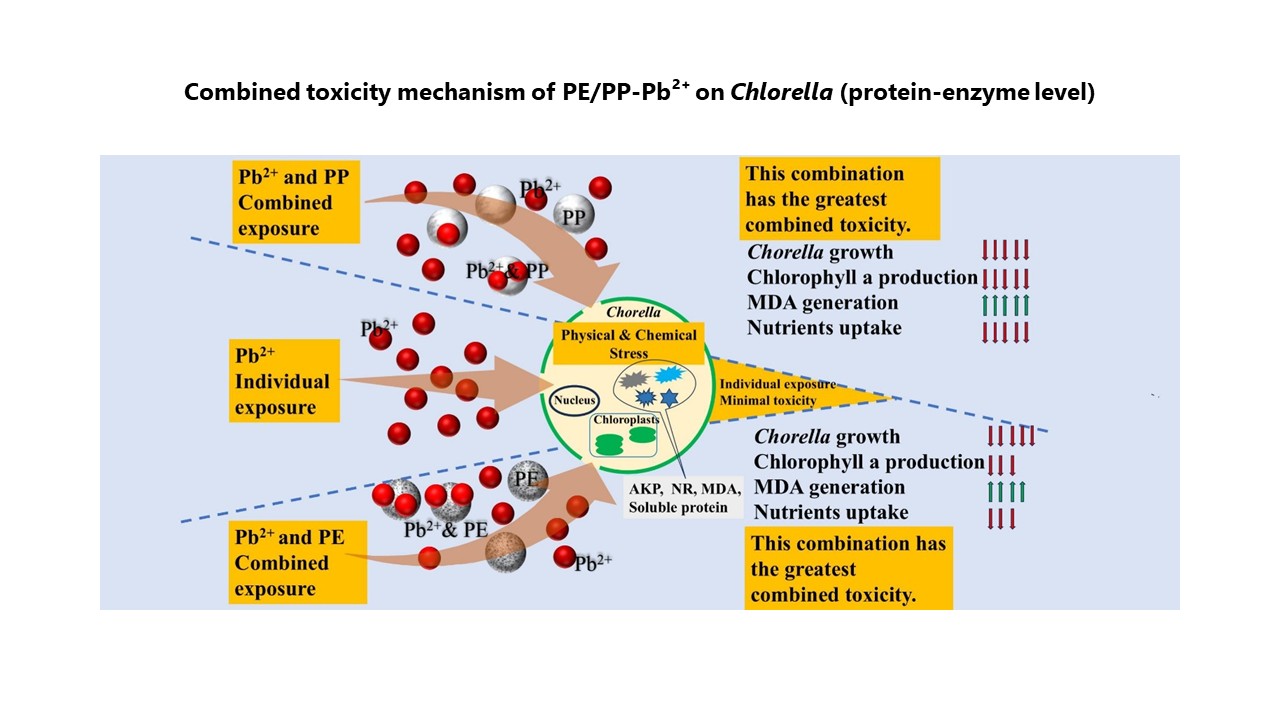
Microplastics (MPs) synergistically interact with heavy metal contaminants, posing substantial ecological threats to biota. Hydrodynamic regimes and water-level fluctuations within the Three Gorges Reservoir (TGR) critically influence contaminant dynamics. Nevertheless, biomolecular responses to MP and heavy metal co-exposure at protein and enzymatic levels remain inadequately characterized. This study selected polyethylene (PE), polypropylene (PP), and lead(II) ions (Pb2+) to examine the freshwater microalgae Chlorella vulgaris within the TGR. After 96 h of exposure, the half-maximal effective concentrations for PE and PP against C. vulgaris were determined to be 334 mg/L and 295.29 mg/L, respectively. PE, PP, and Pb2+ significantly reduced the accumulation of C. vulgaris biomass, deteriorated algal cell growth, and caused the algal cells to undergo membrane lipid peroxidation. Nitrate and phosphate assimilation were considerably inhibited across all treatments, with heightened suppression under co-exposure. MPs’ addition significantly increased malondialdehyde levels. MP adsorption of Pb2+ appeared to attenuate Pb2+-associated changes in nitrate reductase (NR) and alkaline phosphatase activities. This study provides a theoretical foundation for evaluating MP and heavy metal ecological risks in reservoir ecosystems.
- Cao Q, Sun W, Yang T, et al. The toxic effects of polystyrene microplastics on freshwater algae Chlorella pyrenoidosa depends on the different size of polystyrene microplastics. Chemosphere. 2022;308(1):136135. doi: 10.1016/j.chemosphere.2022.136135
- Guo J, Liu N, Xie Q, Zhu L, Ge F. Polystyrene microplastics facilitate the biotoxicity and biomagnification of ZnO nanoparticles in the food chain from algae to daphnia. Environ Pollut. 2023;324:121181. doi: 10.1016/j.envpol.2023.121181
- Saud S, Yang A, Jiang Z, Ning D, Fahad S. New insights into the environmental behavior and ecological toxicity of microplastics. J Hazard Mater Adv. 2023;10:100298. doi: 10.1016/j.hazadv.2023.100298
- Niu Z, Curto M, Le Gall M, et al. Accelerated fragmentation of two thermoplastics (polylactic acid and polypropylene) into microplastics after UV radiation and seawater immersion. Ecotoxicol Environ Saf. 2024;271:115981. doi: 10.1016/j.ecoenv.2024.115981
- Li YY, Gao B, Xu DY, Lu J, Zhou HD, Gao L. Heavy metals in the water-level-fluctuation zone soil of the three gorges reservoir, China: Remobilization and catchment-wide transportation. J Hydrol. 2022;612:128108. doi: 10.1016/j.jhydrol.2022.128108
- Yang R, Han X, Wang Y, et al. The three gorges dam alters the spatial distribution and flux of microplastics in the Yangtze River. Environ Res. 2025;275:121440. doi: 10.1016/j.envres.2025.121440
- Kumar M, Chen H, Sarsaiya S, et al. Current research trends on micro- and nano-plastics as an emerging threat to global environment: A review. J Hazard Mater. 2021;409:124967. doi: 10.1016/j.jhazmat.2020.124967
- Kumar M, Xiong X, He M, et al. Microplastics as pollutants in agricultural soils. Environ Pollut. 2020;265(1):114980. doi: 10.1016/j.envpol.2020.114980
- Di M, Wang J. Microplastics in surface waters and sediments of the three gorges reservoir, China. Sci Total Environ. 2018;616-617:1620-1627. doi: 10.1016/j.scitotenv.2017.10.150
- Xia F, Yang W, Zhao H, Cai Y, Tan Q. Occurrence characteristics and transport processes of riverine microplastics in different connectivity contexts. NPJ Clean Water. 2025;8(1):20. doi: 10.1038/s41545-024-00424-4
- Kumar R, Sharma P, Manna C, Jain M. Abundance, interaction, ingestion, ecological concerns, and mitigation policies of microplastic pollution in riverine ecosystem: A review. Sci Total Environ. 2021;782:146695. doi: 10.1016/j.scitotenv.2021.146695
- Bao Y, Gao P, He X. The water-level fluctuation zone of three gorges reservoir-a unique geomorphological unit. Earth Sci Rev. 2015;150:14-24. doi: 10.1016/j.earscirev.2015.07.005
- Bing H, Zhou J, Wu Y, Wang X, Sun H, Li R. Current state, sources, and potential risk of heavy metals in sediments of three gorges reservoir, China. Environ Pollut. 2016;214:485-496. doi: 10.1016/j.envpol.2016.04.062
- Deng M, Yang X, Dai X, Zhang Q, Malik A, Sadeghpour A. Heavy metal pollution risk assessments and their transportation in sediment and overlay water for the typical Chinese reservoirs. Ecol Indic. 2020;112:106166. doi: 10.1016/j.ecolind.2020.106166
- Xu K, Milliman JD. Seasonal variations of sediment discharge from the Yangtze river before and after impoundment of the three gorges dam. Geomorphology. 2009;104(3-4):276-283. doi: 10.1016/j.geomorph.2008.09.004
- Zhao X, Li TY, Zhang TT, Luo WJ, Li JY. Distribution and health risk assessment of dissolved heavy metals in the three gorges reservoir, China (section in the main Urban area of Chongqing). Environ Sci Pollut Res. 2017;24(3):2697-2710. doi: 10.1007/s11356-016-8046-6
- Sang C, Zheng Y, Zhou Q, Li D, Liang G, Gao Y. Effects of water impoundment and water-level manipulation on the bioaccumulation pattern, trophic transfer and health risk of heavy metals in the food web of three gorges reservoir (China). Chemosphere. 2019;232:403-414. doi: 10.1016/j.chemosphere.2019.04.216
- Tunali M, Uzoefuna EN, Tunali MM, Yenigun O. Effect of microplastics and microplastic-metal combinations on growth and chlorophyll a concentration of Chlorella vulgaris. Sci Total Environ. 2020;743:140479. doi: 10.1016/j.scitotenv.2020.140479
- Wang S, Li Q, Huang S, Zhao W, Zheng Z. Single and combined effects of microplastics and lead on the freshwater algae Microcystis aeruginosa. Ecotoxicol Environ Saf. 2021;208:111664. doi: 10.1016/j.ecoenv.2020.111664
- Gao G, Zhao X, Jin P, Gao K, Beardall J. Current understanding and challenges for aquatic primary producers in a world with rising micro- and nano-plastic levels. J Hazard Mater. 2021;406:124685. doi: 10.1016/j.jhazmat.2020.124685
- Prata JC, Lavorante BRBO, Montenegro M, Guilhermino L. Influence of microplastics on the toxicity of the pharmaceuticals procainamide and doxycycline on the marine microalgae Tetraselmis chuii. Aquat Toxicol. 2018;197:143-152. doi: 10.1016/j.aquatox.2018.02.015
- Venâncio C, Ferreira I, Martins MA, Soares AMVM, Lopes I, Oliveira M. The effects of nanoplastics on marine plankton: A case study with polymethylmethacrylate. Ecotoxicol Environ Saf. 2019;184:109632. doi: 10.1016/j.ecoenv.2019.109632
- González-Fernández C, Toullec J, Lambert C, et al. Do transparent exopolymeric particles (TEP) affect the toxicity of nanoplastics on Chaetoceros neogracile? Environ Pollut. 2019;250:873-882. doi: 10.1016/j.envpol.2019.04.093
- Silva De Oliveira TT, Andreu I, Machado MC, Vimbela G, Tripathi A, Bose A. Interaction of cyanobacteria with nanometer and micron sized polystyrene particles in marine and fresh water. Langmuir. 2020;36(14):3963-3969. doi: 10.1021/acs.langmuir.9b03644
- Lin W, Su F, Lin M, et al. Effect of microplastics PAN polymer and/or Cu2+ pollution on the growth of Chlorella pyrenoidosa. Environ Pollut. 2020;265(1):114985. doi: 10.1016/j.envpol.2020.114985
- Yu Y, Liu J, Zhu J, et al. The interfacial interaction between typical microplastics and Pb2+ and their combined toxicity to Chlorella pyrenoidosa. Sci Total Environ. 2024;918:170591. doi: 10.1016/j.scitotenv.2024.170591
- Arreguin-Rebolledo U, Páez-Osuna F, Velázquez- Yezca A, Valencia-Castañeda G, Osuna-Martínez CC, Capparelli MV. Polyethylene microplastics enhance metal(loid)s toxicity and accumulation in the marine rotifer Proales similis. Environ Pollut. 2025;382:126788. doi: 10.1016/j.envpol.2025.126788
- Zeng H, Song L, Yu Z, Chen H. Distribution of phytoplankton in the three-gorge reservoir during rainy and dry seasons. Sci Total Environ. 2006;367(2-3):999-1009. doi: 10.1016/j.scitotenv.2006.03.001
- Xu C, Li X, Chen Y. Comparison of methods for determination of phytoplankton chlorophyll-a. J Ecol Rural Environ. 2013;29(4):438-442.
- Ministry of Ecology and Environment of the People’s Republic of China. Water quality-Determination of Nitrate Nitrogen-Gas-Phase Molecular Absorption Spectrometry [HJ 198-2024]. Ministry of Ecology and Environment of the People’s Republic of China; 2025. Available from: https://www.mee.gov.cn/ywgz/fgbz/bz/ bzwb/jcffbz/202501/t20250126_1101538.shtml [Last accessed on 2026 Jan 14].
- Ministry of Environmental Protection of the People’s Republic of China. Water Quality-Determination of Orthophosphate and Total Phosphorus-Continuous Flow Analysis (CFA) and Ammonium Molybdate Spectrophotometry [HJ 670-2013]. Ministry of Environmental Protection of the People’s Republic of China; 2014. Available from: https://www.mee.gov.cn/ ywgz/fgbz/bz/bzwb/jcffbz/201311/t20131106_262958. shtml [Last accessed on 2026 Jan 14].
- Organisation for Economic Co-operation and Development (OECD). Test No. 201: Freshwater Alga and Cyanobacteria, Growth Inhibition Test. OECD Guidelines for the Testing of Chemicals. Sec. 2. United States: OECD Publishing; 2011. doi: 10.1787/9789264069923-en
- El-Agawany NI, Kaamoush MIA. Role of zinc as an essential microelement for algal growth and concerns about its potential environmental risks. Environ Sci Pollut Res. 2022;30(28):71900-71911. doi: 10.1007/s11356-022-20536-z
- Wang J, Yan B, Zhang H, et al. Heavy metals exacerbate the effect of temperature on the growth of Chlorella sp.: Implications on algal blooms and management. Processes. 2022;10(12):2638. doi: 10.3390/pr10122638
- Box A, Sureda A, Terrados J, Pons A, Deudero S. Antioxidant response and caulerpenyne production of the alien Caulerpa taxifolia (Vahl) epiphytized by the invasive algae Lophocladia lallemandii (Montagne). J Exp Mar Biol Ecol. 2008;364(1):24-28. doi: 10.1016/j.jembe.2008.06.029
- Zhang Y, Wang JX, Liu Y, Zhang JT, Wang JH, Chi ZY. Effects of environmental microplastic exposure on Chlorella sp. Biofilm characteristics and its interaction with nitric oxide signaling. Sci Total Environ. 2024;912:169659. doi: 10.1016/j.scitotenv.2023.169659
- Sherman TD, Funkhouser EA. Induction and synthesis of nitrate reductase in Chlorella vulgaris. Arch Biochem Biophys. 1989;274(2):525-531. doi: 10.1016/0003-9861(89)90466-9