
How corporate social responsibility improves green transformation technologies inventory output: Evidence from Japanese companies

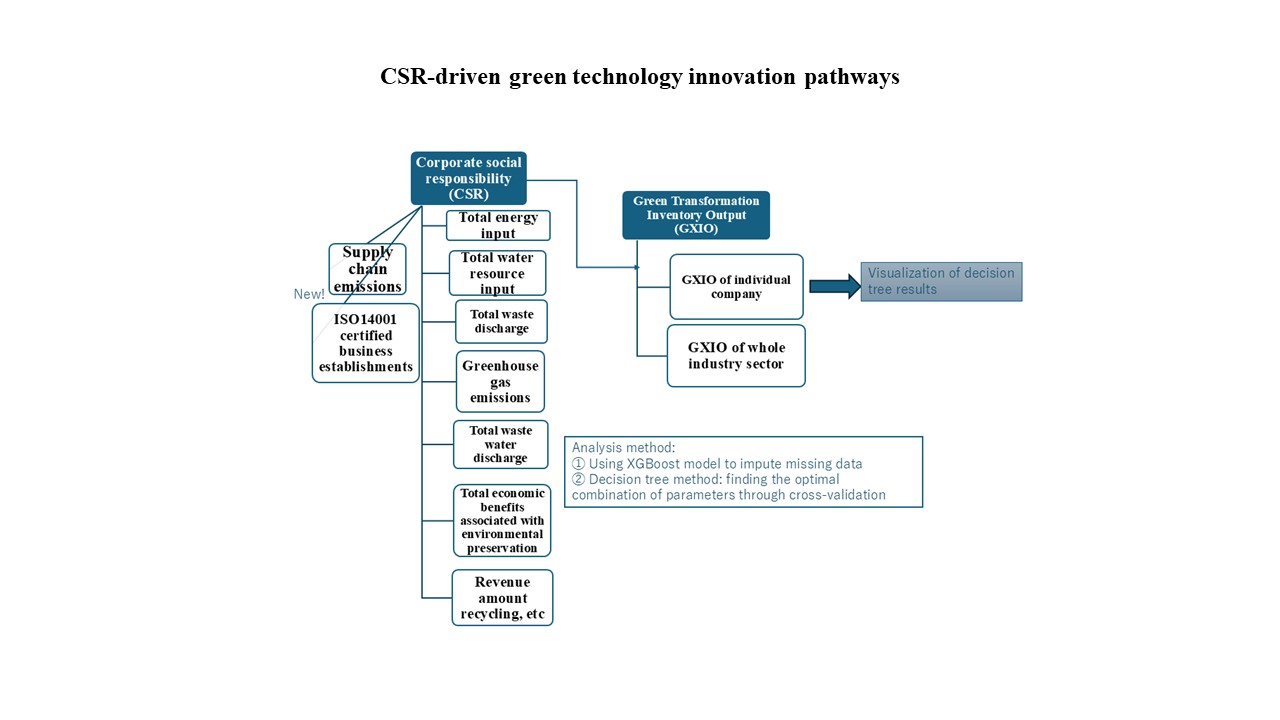
Corporate social responsibility (CSR) refers to businesses’ contributions to sustainable development. Today, it is expected that economic, social, and industrial structures that have long depended on fossil fuels will ultimately transition to clean energy-driven structures, and that green transformation (GX) will be achieved through an overall transformation of economic and social systems. To the best of our knowledge, this study is the first to examine the relationship between the CSR of Japanese companies and their GX inventory output (GXIO). Using machine learning algorithms, we tested the hypothesis that CSR activities influence GXIO at both the individual company and the overall industry levels. The results of our empirical analysis show that CSR not only affects GXIO but also has significant effects at the individual company and overall industry levels. These results are used to provide decision makers with useful guidelines for integrating social sustainability into procurement procedures.
- Takeishi A, Aoshima Y, Karube M. Reasons for innovation: Legitimizing resource mobilization for innovation in the cases of the Okochi Memorial Prize winners. In: Dynamics of Knowledge, Corporate Systems and Innovation. Germany: Springer Science and Business Media; 2009. p. 165-189. doi: 10.1007/978-3-642-04480-9_7
- Sueyoshi T, Goto M. DEA non-radial approach for resource allocation and energy usage to enhance corporate sustainability in Japanese manufacturing industries. Energies. 2019;12(9):1785. doi: 10.3390/en12091785
- Dobele AR, Westberg K, Steel M, Flowers K. An examination of corporate social responsibility implementation and stakeholder engagement: A case study in the Australian mining industry. Bus Strat Environ. 2014;23(3):145-159. doi: 10.1002/bse.1775
- Epstein MJ, Roy MJ. Implementing a corporate environmental strategy: Establishing coordination and control within multinational companies. Bus Strat Environ. 2007;16(6):389-403. doi: 10.1002/bse.545
- Santos-Jaén JM, Madrid-Guijarro A, García-Pérez-de- Lema D. The impact of corporate social responsibility on innovation in SMEs: The mediating role of debt terms and human capital. Corp Soc Responsib Environ Manag. 2021;28(4):1200-1215. doi: 10.1002/csr.2125
- European Commission. Promoting a European Framework for Corporate Social Responsibility. COM Final. p. 366; 2001. p. 6. Available from: https://eur-lex. europa.eu/legal-content/en/txt/?uri=celex:52001dc0366 Last accessed on 2026 Jan 13].
- Suto M, Takehara H. Employee-oriented corporate social responsibility, innovation, and firm value. Corp Soc Responsib Environ Manag. 2022;29(4):765-778. doi: 10.1002/csr.2232
- Goto M, Sueyoshi T. Sustainable development and corporate social responsibility in Japanese manufacturing companies. Sustain Dev. 2019;28(4):844-856.doi: 10.1002/sd.2035
- Montalbán-Domingo L, García-Segura T, Sanz- Benlloch A, Pellicer E, Torres-Machi C, Molenaar K. Assessing social performance of construction companies in public-works procurement: Data envelopment analysis based on the benefit of the doubt approach. Environ Impact Assess Rev. 2022;96:106844. doi: 10.1016/j.eiar.2022.106844
- Ratajczak P, Szutowski D. Exploring the relationship between CSR and innovation. Sustain Account Manag Policy J. 2016;7(2):295-318. doi: 10.1108/sampj-07-2015-0058
- Margolis JD, Walsh JP. Misery loves companies: Rethinking social initiatives by business. Adm Sci Q. 2003;48(2):268-305. doi: 10.2307/3556659
- Smith, NC. ‘Consumers as drivers of corporate social responsibility’. In: Crane A, editors. The Oxford Handbook of Corporate Social Responsibility. Oxford: OUP Oxford; 2008. p. 181-302. doi: 10.1093/oxfordhb/9780199211593.003.0012
- Bocquet R, Le Bas C, Mothe C, Poussing N. CSR, innovation, and firm performance in sluggish growth contexts: A firm-level empirical analysis. J Bus Ethics. 2017;146:241-254. doi: 10.1007/s10551-015-2959-8
- Eweje G, Sakaki M. CSR in Japanese companies: Perspectives from managers. Bus Strat Environ. 2015;24(7):678-687. doi: 10.1002/bse.1894
- Dögl C, Behnam M. Environmentally sustainable development through stakeholder engagement in developed and emerging countries. Bus Strat Environ. 2015;24(6):583-600. doi: 10.1002/bse.1839
- Li J, Lin B. The sustainability of remarkable growth in emerging economies. Resour Conserv Recycl. 2019;145:349-358. doi: 10.1016/j.resconrec.2019.01.036
- Chkir I, El Haj Hassan B, Rjiba H, Saadi S. Does corporate social responsibility influence corporate innovation? International evidence. Emerg Mark Rev. 2021;46:100746. doi: 10.1016/j.ememar.2020.100746
- Wagner M. Innovation and competitive advantages from the integration of strategic aspects with social and environmental management in European firms. Bus Strat Environ. 2009;18(5):291-306. doi: 10.1002/bse.585
- Mishra DR. Post-innovation CSR performance and firm value. J Bus Ethics. 2017;140(2):285-306. doi: 10.1007/s10551-015-2676-3
- Gürler HE. The impact of corporate social responsibility on green innovation: Do industry, data type and region matter? A meta-analysis. In: Environment, Development and Sustainability. Germany: Springer; 2024. doi: 10.1007/s10668-024-05277-y
- Padilla-Lozano CP, Collazzo P. Corporate social responsibility, green innovation and competitiveness: Causality in manufacturing. Compet Rev. 2022;32(7):21-39. doi: 10.1108/CR-12-2020-0160
- Le TT. How do corporate social responsibility and green innovation transform corporate green strategy into sustainable firm performance? J Clean Prod. 2022;362:132228. doi: 10.1016/j.jclepro.2022.132228
- Doi M. Legitimacy of corporate social innovation: Legitimizing resource mobilization for corporate social innovation in the case studies in Japan. J Innov Manag. 2020;17:101-117. doi: 10.24677/riim.17.0_101
- Genba K. Environmental innovation for sustainable corporate growth. Res Technol Plann. (玄場公規. 持続可能な企業成長を実現する環境イノベーション (< 特集> イノベーションとサステイナビリティ). 研究 技術 計画). 2009;23(3):220-226. doi: 10.20801/jsrpim.23.3_220
- Cai H, Rueckert D, Passerat-Palmbach J. 2CP: Decentralized Protocols to Transparently Evaluate Contributivity in Federated Learning Environments. [arXiv. Preprint]; 2020. doi: 10.48550/arXiv.2011.07516
- Schams S, Hauffa J, Groh G. Analyzing a user’s contributive social capital based on activities in online social networks and media. In: Companion Proceedings of the the Web Conference 2018 (WWW’18 Companion); 2018. p. 1457-1464. doi: 10.1145/3184558.3191593
- Xia Y, Liu C, Li Y, Liu N. A boosted decision tree approach using Bayesian hyper-parameter optimization for credit scoring. Expert Syst Appl. 2017;78:225-241. doi: 10.1016/j.eswa.2017.02.017
- Chang YC, Chang KH, Wu GJ. Application of extreme gradient boosting trees in credit risk assessment models for financial institutions. Appl Soft Comput. 2018;73:914-920. doi: 10.1016/j.asoc.2018.09.029
- Deng Y, Lumley T. Multiple imputation through XGBoost. J Comput Graph Stat. 2023;33(2):352-363. doi: 10.1080/10618600.2023.2252501
- Jiang J, Zhao Y, Feng J. A dataset of Japanese corporates’ green transformation technology patents. F1000Res. 2024;13:288. doi: 10.12688/f1000research.147798.1
- Salim HK, Padfield R, Hansen SB, et al. Global trends in environmental management system and ISO 14001 research. J Clean Prod. 2018;170:645-653. doi: 10.1016/j.jclepro.2017.09.017
- Darnall N, Carmin J. Greener and cleaner? The signaling accuracy of U.S. voluntary environmental programs. Policy Sci. 2005;38(2-3):71-90. doi: 10.1007/s11077-005-6591-9
- Rosecká N, Machek O, Stasa M, Kubíček A. Long-term orientation and corporate social responsibility in small and medium-sized enterprises: The role of strategy formation mode. Soc Responsib J. 2024;20(4):825-842. doi: 10.1108/SRJ-07-2023-036
- Porter ME, Van der Linde C. Toward a new conception of the environment-competitiveness relationship. J Econ Perspect. 1995;9(4):97-118. doi: 10.1257/jep.9.4.97
- Lindgreen A, Swaen V, Johnston WJ. Corporate social responsibility: An empirical investigation of U.S. organizations. J Bus Ethics. 2009;85(S2):303-323. doi: 10.1007/s10551-008-9738-8
- Rondinelli DA, Berry MA. Environmental citizenship in multinational corporations: Social responsibility and sustainable development. Eur Manage J. 2000;18(1):70-84. doi: 10.1016/S0263-2373(99)00070-5
- Lichtenstein DR, Drumwright ME, Braig BM. The effect of corporate social responsibility on customer donations to corporate-supported nonprofits. J Mark. 2004;68(4):16-32. doi: 10.1509/jmkg.68.4.16.42726
- Cohen WM, Levinthal DA. Absorptive capacity: A new perspective on learning and innovation. Adm Sci Q. 1990;35(1):128-152. doi: 10.2307/2393553
- Freeman RE. The stakeholder approach. In: Strategic Management: A Stakeholder Approach. Cambridge: Cambridge University Press; 2010.
- Jiang J, Goel RK, Zhang X. IPR policies and determinants of membership in standard setting organizations: A social network analysis. Netnomics. 2020;21:129-154. doi: 10.1007/s11066-020-09144-6
- Jiang J. Review of recent development in empirical literature on technological standards. J Humanit Soc Sci Okayama Univ. 2018;46:185-206.
- Jiang J, Zhang X. Essential patents and knowledge position: A network analysis on the basis of patent citations. Standards. 2021;1(2):90-104. doi: 10.3390/standards1020009
- Lee MP. A review of the theories of corporate social responsibility: Its evolutionary path and the road ahead. Int J Manag Rev. 2008;10(1):53-73. doi: 10.1111/j.1468-2370.2007.00226.x