
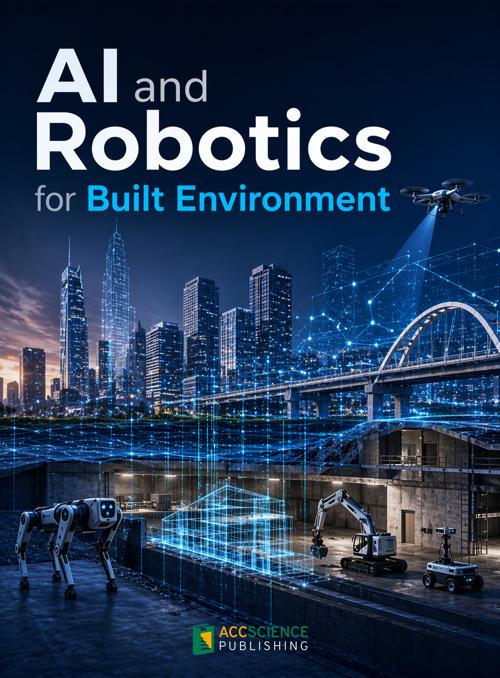
AI and Robotics for Built Environment (AIR-BE) aims to serve as a leading platform for scholarly exchange in artificial intelligence and robotics as applied across diverse domains of the built environment and related physical systems. By publishing cutting-edge research and review articles, the journal seeks to advance both theory and practice, foster new methodologies, and inspire innovative applications.
The journal welcomes contributions that focus solely on robotics, solely on artificial intelligence, or on integrative approaches combining the two within a multidisciplinary perspective. Submissions that address built environment systems, including buildings, infrastructure, and urban-scale physical environments, are particularly encouraged. These studies may draw from robotics, computer science, artificial intelligence, engineering, architecture, and related disciplines. Topics include but are not limited to:
- Built environment systems and smart infrastructure: intelligent buildings, urban systems, infrastructure networks, and physical environment management enabled by AI and robotics.
- Robotics: construction robotics, inspection and maintenance robots, cleaning robots, service robots, and robotic systems for diverse applications.
- Artificial intelligence: intelligent decision-making, planning and scheduling, machine learning, and AI-driven design and simulation.
- Human–robot interaction: safety, collaboration, ergonomics, and usability across various operational contexts.
- Autonomous systems and mobility: indoor/outdoor navigation, multi-robot coordination, aerial and ground systems for infrastructure and facility applications.
- Sensing, perception, and digital twins: LiDAR, computer vision, IoT integration, environment mapping, and digital twin technologies for monitoring and control of built environments.
- Sustainability and resilience: AI and robotics for energy efficiency, disaster response, and climate-resilient built environment systems.
- Smart infrastructure and facilities management: predictive maintenance, robotics-enabled operations, and AI for lifecycle management of physical assets.
- Methodologies and theoretical advances: algorithmic frameworks, control systems, optimization methods, and computational intelligence approaches relevant to AI and robotics.
- Application case studies: practical demonstrations of AI and robotics technologies in real-world built environment scenarios.