

Endogenous inspection reliability and secondary market pricing in a smart production system with speed-dependent defect generation under carbon-regulated energy use

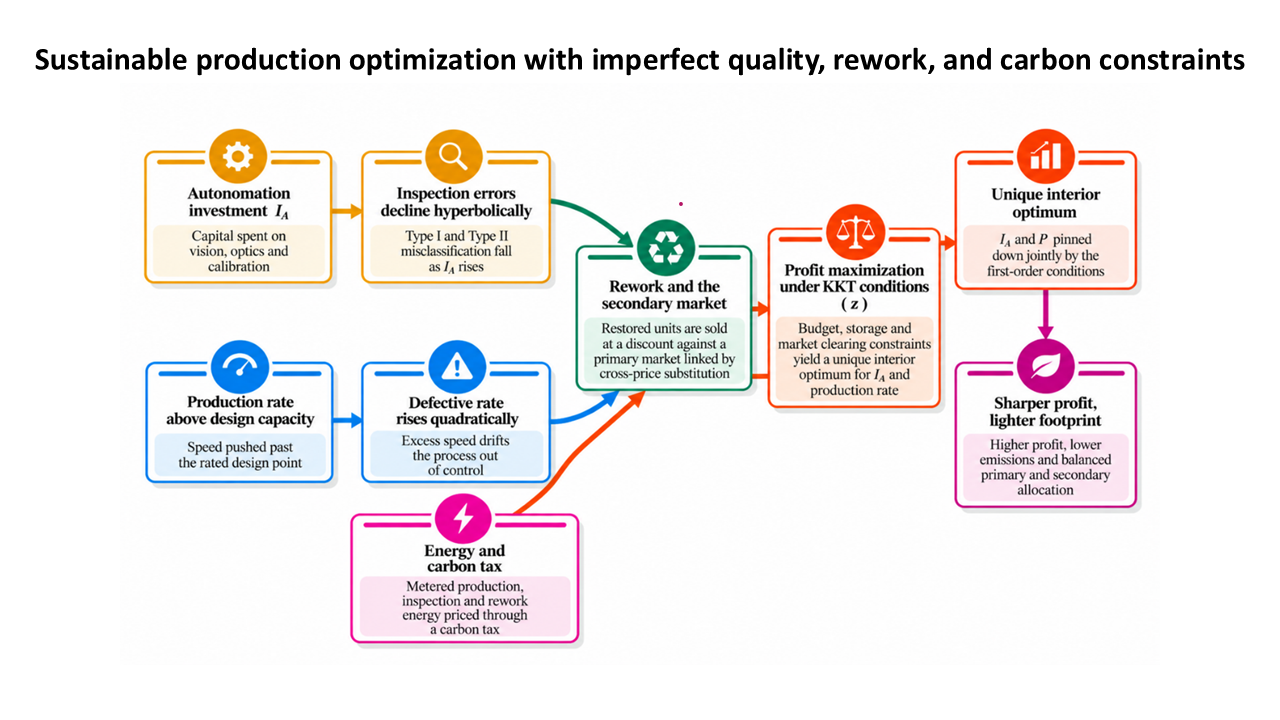
Machine-based inspection is often modeled as either imperfect manual inspection or perfect automated inspection, with automation investment treated as a linear cost that leads to boundary solutions. Such assumptions overlook the realities of smart manufacturing, where inspection accuracy improves gradually with investment, production beyond design capacity increases defect generation, and inspection systems consume energy that contributes to carbon emissions. This paper develops a single-stage smart production model in which Type I and Type II inspection errors decrease hyperbolically with autonomation investment, while the defective rate increases quadratically when production exceeds design capacity. Defective items are reworked and sold through a secondary market that competes with the primary market via cross-price substitution. Energy consumption from production, inspection, and rework is converted into carbon emissions and taxed. The resulting profit maximization problem, subject to budget, storage, and market-clearing constraints, is solved using Karush–Kuhn–Tucker conditions, establishing the existence of a unique interior optimum for automation investment. Numerical experiments based on an electronics manufacturing case, supported by multiple defective-rate distributions, scenario analysis, sensitivity experiments, robustness checks, and Monte Carlo demand simulations, demonstrate that realistic inspection modeling substantially improves operational decisions and profitability while highlighting the economic value of optimal automation investment under carbon-aware manufacturing environments.
- Ghosh SK, Sarkar B, Goswami P, Sarkar M, Guchhait R, Dem H. Quality control with autonomation for market segmentation in a service-based smart complex production system. Ain Shams Eng J. 2026;17(7):104229. doi: 10.1016/j.asej.2026.104229
- Porteus EL. Optimal lot sizing, process quality improvement and setup cost reduction. Oper Res. 1986;34(1):137-144. doi: 10.1287/opre.34.1.137
- Rosenblatt MJ, Lee HL. Economic production cycles with imperfect production processes. IIE Trans. 1986;18(1):48-55. doi: 10.1080/07408178608975329
- Salameh MK, Jaber MY. Economic production quantity model for items with imperfect quality. Int J Prod Econ. 2000;64(1-3):59-64. doi: 10.1016/S0925-5273(99)00044-4
- Giri BC, Dohi T. Exact formulation of stochastic EMQ model for an unreliable production system. J Oper Res Soc. 2005;56(5):563-575. doi: 10.1057/palgrave.jors.2601840
- Sana SS, Goyal SK, Chaudhuri K. An imperfect production process in a volume flexible inventory model. Int J Prod Econ. 2007;105(2):548-559. doi: 10.1016/j.ijpe.2006.05.005
- Sana SS. An economic production lot size model in an imperfect production system. Eur J Oper Res. 2010;201(1):158-170. doi: 10.1016/j.ejor.2009.02.027
- Glock CH. Batch sizing with controllable production rates. Int J Prod Res. 2010;48(20):5925-5942. doi: 10.1080/00207540903170906
- Khouja M, Mehrez A. Economic production lot size model with variable production rate and imperfect quality. J Oper Res Soc. 1994;45(12):1405-1417. doi: 10.1057/jors.1994.217
- Inman RR, Blumenfeld DE, Huang N, Li J, Li J. Survey of recent advances on the interface between production system design and quality. IISE Trans. 2013;45(6):557-574. doi: 10.1080/0740817X.2012.757680
- Colledani M, Tolio T. Integrated analysis of quality and production logistics performance in manufacturing lines. Int J Prod Res. 2011;49(2):485-518. doi: 10.1080/00207540903443246
- Pal B, Sana SS, Chaudhuri K. A mathematical model on EPQ for stochastic demand in an imperfect production system. J Manuf Syst. 2013;32(1):260-270. doi: 10.1016/j.jmsy.2012.11.009
- Moon I, Yun WY, Sarkar B. Effects of variable setup cost, reliability, and production costs under controlled carbon emissions in a reliable production system. Eur J Ind Eng. 2022;16(4):371-397. doi: 10.1504/EJIE.2022.123748
- Duffuaa SO, Khan M. Impact of inspection errors on the performance measures of a general repeat inspection plan. Int J Prod Res. 2005;43(23):4945-4967. doi: 10.1080/00207540412331325413
- Khan M, Jaber MY, Bonney M. An economic order quantity (EOQ) for items with imperfect quality and inspection errors. Int J Prod Econ. 2011;133(1):113-118. doi: 10.1016/j.ijpe.2010.01.023
- Yoo SH, Kim D, Park MS. Economic production quantity model with imperfect-quality items, two-way imperfect inspection and sales return. Int J Prod Econ. 2009;121(1):255-265. doi: 10.1016/j.ijpe.2009.05.008
- Hsu JT, Hsu LF. An EOQ model with imperfect quality items, inspection errors, shortage backordering, and sales returns. Int J Prod Econ. 2013;143(1):162-170. doi: 10.1016/j.ijpe.2012.12.025
- Dey BK, Pareek S, Tayyab M, Sarkar B. Autonomation policy to control work-in-process inventory in a smart production system. Int J Prod Res. 2021;59(4):1258-1280. doi: 10.1080/00207543.2020.1722325
- Jamal AMM, Sarker BR, Mondal S. Optimal manufacturing batch size with rework process at a single-stage production system. Comput Ind Eng. 2004;47(1):77-89. doi: 10.1016/j.cie.2004.03.001
- Chiu YP. Determining the optimal lot size for the finite production model with random defective rate, the rework process, and backlogging. Eng Optim. 2003;35(4):427-437. doi: 10.1080/03052150310001597783
- Wee HM, Wang WT, Yang PC. A production quantity model for imperfect quality items with shortage and screening constraint. Int J Prod Res. 2013;51(6):1869-1884. doi: 10.1080/00207543.2012.718453
- Taleizadeh AA, Wee HM, Jalali-Naini SG. Economic production quantity model with repair failure and limited capacity. Appl Math Model. 2013;37(5):2765-2774. doi: 10.1016/j.apm.2012.06.006
- Sarkar B, Cárdenas-Barrón LE, Sarkar M, Singgih ML. An economic production quantity model with random defective rate, rework process and backorders for a single stage production system. J Manuf Syst. 2014;33(3):423-435. doi: 10.1016/j.jmsy.2014.02.001
- Tayyab M, Sarkar B. Optimal batch quantity in a cleaner multi-stage lean production system with random defective rate. J Clean Prod. 2016;139:922-934. doi: 10.1016/j.jclepro.2016.08.062
- Debo LG, Toktay LB, Van Wassenhove LN. Market segmentation and product technology selection for remanufacturable products. Manage Sci. 2005;51(8):1193-1205. doi: 10.1287/mnsc.1050.0369
- Ferguson ME, Toktay LB. The effect of competition on recovery strategies. Prod Oper Manag. 2006;15(3):351-368. doi: 10.1111/j.1937-5956.2006.tb00250.x
- Atasu A, Sarvary M, Van Wassenhove LN. Remanufacturing as a marketing strategy. Manage Sci. 2008;54(10):1731-1746. doi: 10.1287/mnsc.1080.0893
- Guide VDR Jr, Li J. The potential for cannibalization of new products sales by remanufactured products. Decis Sci. 2010;41(3):547-572. doi: 10.1111/j.1540-5915.2010.00280.x
- Ovchinnikov A. Revenue and cost management for remanufactured products. Prod Oper Manag. 2011;20(6):824-840. doi: 10.1111/j.1937-5956.2010.01214.x
- Agrawal VV, Atasu A, van Ittersum K. Remanufacturing, third-party competition, and consumers’ perceived value of new products. Manage Sci. 2015;61(1):60-72. doi: 10.1287/mnsc.2014.2099
- Gutowski T, Dahmus J, Thiriez A. Electrical energy requirements for manufacturing processes. In: Proceedings of the 13th CIRP International Conference on Life Cycle Engineering; 2006:623-628.
- Mouzon G, Yildirim MB, Twomey J. Operational methods for minimization of energy consumption of manufacturing equipment. Int J Prod Res. 2007;45(18-19):4247-4271. doi: 10.1080/00207540701450013
- Hua G, Cheng TCE, Wang S. Managing carbon footprints in inventory management. Int J Prod Econ. 2011;132(2):178-185. doi: 10.1016/j.ijpe.2011.03.024
- Benjaafar S, Li Y, Daskin MS. Carbon footprint and the management of supply chains: insights from simple models. IEEE Trans Autom Sci Eng. 2013;10(1):99-116. doi: 10.1109/TASE.2012.2203304
- Chen X, Benjaafar S, Elomri A. The carbon-constrained EOQ. Oper Res Lett. 2013;41(2):172-179. doi: 10.1016/j.orl.2012.12.003
- Bouchery Y, Ghaffari A, Jemai Z, Dallery Y. Including sustainability criteria into inventory models. Eur J Oper Res. 2012;222(2):229-240. doi: 10.1016/j.ejor.2012.05.004
- Toptal A, Özlü H, Konur D. Joint decisions on inventory replenishment and emission reduction investment under different emission regulations. Int J Prod Res. 2014;52(1):243-269. doi: 10.1080/00207543.2013.836615
- Dye CY, Yang CT. Sustainable trade credit and replenishment decisions with credit-linked demand under carbon emission constraints. Eur J Oper Res. 2015;244(1):187-200. doi: 10.1016/j.ejor.2015.01.026
- Murthy DNP, Djamaludin I. New product warranty: A literature review. Int J Prod Econ. 2002;79(3):231-260. doi: 10.1016/S0925-5273(02)00153-6
- Sarkar B, Kar S, Basu K, Guchhait R. A sustainable managerial decision-making problem for a substitutable product in a dual-channel under carbon tax policy. Comput Ind Eng. 2022;172:108635. doi: 10.1016/j.cie.2022.108635
- Ben-Daya M. The economic production lot-sizing problem with imperfect production processes and imperfect maintenance. Int J Prod Econ. 2002;76(3):257-264. doi: 10.1016/S0925-5273(01)00168-2
- Cárdenas-Barrón LE. Economic production quantity with rework process at a single-stage manufacturing system with planned backorders. Comput Ind Eng. 2009;57(3):1105-1113. doi: 10.1016/j.cie.2009.04.020