
Carbon regulation heterogeneity drives operational carbon leakage through endogenous reject channel inspection reliability

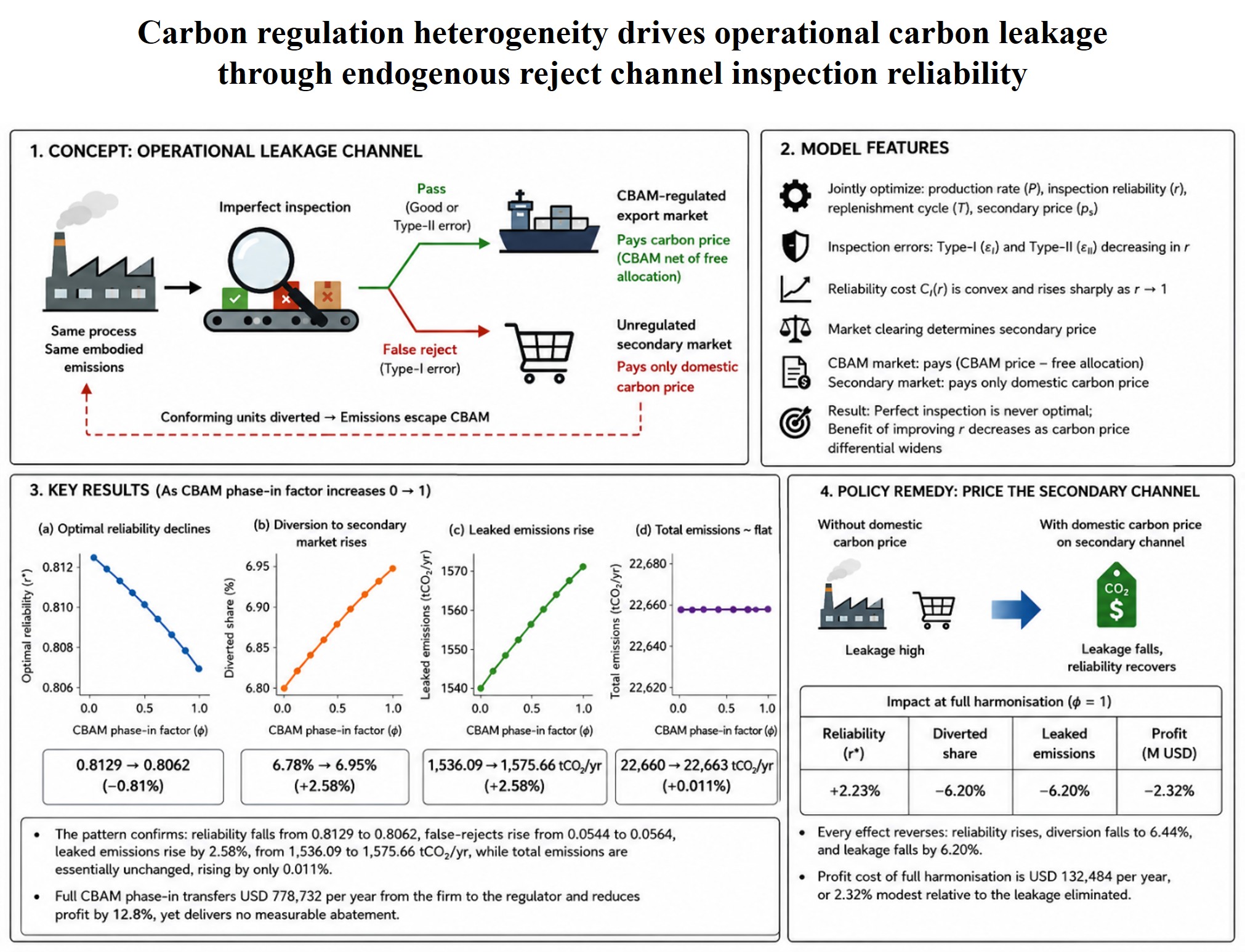
The European Union’s Carbon Border Adjustment Mechanism (CBAM) entered its definitive phase on January 1, 2026, pricing emissions embodied in imported goods. Existing leakage research examines production relocation across jurisdictions but overlooks leakage within a firm’s own operations. This paper identifies a previously unmodelled operational leakage mechanism arising from endogenous quality inspection. When a manufacturer simultaneously supplies a CBAM-regulated export market and an unregulated secondary market, imperfect inspection diverts conforming products to the secondary channel through Type-I errors, allowing their embodied emissions to escape border adjustment. We developed an integrated production-inspection pricing model, in which production rate, inspection reliability, replenishment cycle, and secondary market price are jointly optimised. Defect generation depends on production speed, inspection reliability is endogenous with a convex investment cost that rises sharply as reliability approaches unity, and market clearing determines the secondary price. Export-bound products incur the CBAM certificate price net of the free allocation benchmark, whereas secondary products face only the domestic carbon price. We established joint concavity of the profit function, proved that perfect inspection is never optimal, and derived the optimality condition governing inspection reliability. A key result shows that the marginal benefit of improving reliability decreased as the carbon price differential between regulated and unregulated markets widened. Numerical experiments parameterised to represent an Indian aluminium extrusion setting using published, engineering-estimated, and internally calibrated inputs showed that increasing CBAM stringency reduced optimal reliability, increased diversion of conforming output, and raised leaked emissions while leaving total emissions essentially unchanged. Benchmark comparisons with conventional carbon-aware inventory models showed that single-jurisdiction formulations predicted no operational leakage. Extending destination-based carbon pricing to the secondary market substantially restored inspection incentives and reduced leakage. We distinguished the baseline unpriced secondary-channel emissions under any regime from the smaller, policy-induced increment attributable specifically to CBAM stringency, and reported both.
- European Commission. Regulation (EU) 2023/956 of the European Parliament and of the Council of 10 May 2023 establishing a carbon border adjustment mechanism. Off J Eur Union. 2023;L130:52-104. Accessed July 13, 2026. https://data.europa.eu/eli/reg/2023/956/oj
- European Commission. Regulation (EU) 2025/2083 amending Regulation (EU) 2023/956 as regards simplification of the carbon border adjustment mechanism. Off J Eur Union. 2025. Accessed June 28, 2026. https://data.europa.eu/eli/reg/2025/2083/oj
- Böhringer C, Fischer C, Rosendahl KE, Rutherford TF. Potential impacts and challenges of border carbon adjustments. Nat Clim Chang. 2022;12(1):22-29. doi: 10.1038/s41558-021-01250-z
- Fowlie ML, Reguant M. Mitigating emissions leakage in incomplete carbon markets. J Assoc Environ Resour Econ. 2022;9(2):307-343. doi: 10.1086/716765
- Khan M, Jaber MY, Bonney M. An economic order quantity (EOQ) for items with imperfect quality and inspection errors. Int J Prod Econ. 2011;133(1):113-118. doi: 10.1016/j.ijpe.2010.01.023
- Hsu JT, Hsu LF. An EOQ model with imperfect quality items, inspection errors, shortage backordering, and sales returns. Int J Prod Econ. 2013;143(1):162-170. doi: 10.1016/j.ijpe.2012.12.025
- Hua G, Cheng TCE, Wang S. Managing carbon footprints in inventory management. Int J Prod Econ. 2011;132(2):178-185. doi: 10.1016/j.ijpe.2011.03.024
- Chen X, Benjaafar S, Elomri A. The carbon-constrained EOQ. Oper Res Lett. 2013;41(2):172-179. doi: 10.1016/j.orl.2012.12.003
- Salameh MK, Jaber MY. Economic production quantity model for items with imperfect quality. Int J Prod Econ. 2000;64(1-3):59-64. doi: 10.1016/S0925-5273(99)00044-4
- Sepehri A, Mishra U, Sarkar B. A sustainable production inventory model with imperfect quality under preservation technology and quality improvement investment. J Clean Prod. 2021;310:127332. doi: 10.1016/j.jclepro.2021.127332
- Mishra U, Wu JZ, Sarkar B. A sustainable production-inventory model for a controllable carbon emissions rate under shortages. J Clean Prod. 2020;256:120268. doi: 10.1016/j.jclepro.2020.120268
- Dey O, Giri BC. A new approach to deal with learning in inspection in an integrated vendor-buyer model with imperfect production process. Comput Ind Eng. 2019;131:515-523. doi: 10.1016/j.cie.2018.12.028
- Khouja M, Mehrez A. Economic production lot size model with variable production rate and imperfect quality. J Oper Res Soc. 1994;45(12):1405-1417. doi: 10.1057/jors.1994.217
- Taleizadeh AA, Soleymanfar VR, Govindan K. Sustainable economic production quantity models for inventory systems with shortage. J Clean Prod. 2018;174:1011-1020. doi: 10.1016/j.jclepro.2017.10.222
- Sarkar B, Ganguly B, Pareek S, Cárdenas-Barrón LE. A three-echelon green supply chain management for biodegradable products with three transportation modes. Comput Ind Eng. 2022;174:108727. doi: 10.1016/j.cie.2022.108727
- Benjaafar S, Li Y, Daskin M. Carbon footprint and the management of supply chains: insights from simple models. IEEE Trans Autom Sci Eng. 2013;10(1):99-116. doi: 10.1109/TASE.2012.2203304
- Hovelaque V, Bironneau L. The carbon-constrained EOQ model with carbon emission dependent demand. Int J Prod Econ. 2015;164:285-291. doi: 10.1016/j.ijpe.2014.11.022
- Dye CY, Yang CT. Sustainable trade credit and replenishment decisions with credit-linked demand under carbon emission constraints. Eur J Oper Res. 2015;244(1):187-200. doi: 10.1016/j.ejor.2015.01.026
- Hammami R, Nouira I, Frein Y. Carbon emissions in a multi-echelon production inventory model with lead time constraints. Int J Prod Econ. 2015;164:292-307. doi: 10.1016/j.ijpe.2014.12.017
- Glock CH, Jaber MY, Searcy C. Sustainability strategies in an EPQ model with price- and quality-sensitive demand. Int J Logist Manag. 2012;23(3):340-359. doi: 10.1108/09574091211289219
- Bazan E, Jaber MY, Zanoni S. Supply chain models with greenhouse gases emissions, energy usage and different coordination decisions. Appl Math Model. 2015;39(17):5131-5151. doi: 10.1016/j.apm.2015.03.044
- Hua J, Wang K, Lin J, Qian Y. Carbon tax vs. carbon cap and trade: implementation of carbon border tax in cross-regional production. Int J Prod Econ. 2024;274:109317. doi: 10.1016/j.ijpe.2024.109317
- Fowlie ML, Reguant M. Challenges in the measurement of leakage risk. AEA Pap Proc. 2018;108:124-129. doi: 10.1257/pandp.20181087
- Clausing KA, Wolfram C. Carbon border adjustments, climate clubs, and subsidy races when climate policies vary. J Econ Perspect. 2023;37(3):137-162. doi: 10.1257/jep.37.3.137
- Huang X, Tan T, Toktay LB. Carbon leakage: the impact of asymmetric regulation on carbon-emitting production. Prod Oper Manag. 2021;30(6):1886-1903. doi: 10.1111/poms.13181
- Zhou X, Zhu Q, Xu L, Wang K, Yin X, Mangla SK. The effect of carbon tariffs and the associated coping strategies: a global supply chain perspective. Omega. 2024;122:102960. doi: 10.1016/j.omega.2023.102960
- Atasu A, Sarvary M, Van Wassenhove LN. Remanufacturing as a marketing strategy. Manage Sci. 2008;54(10):1731-1746. doi: 10.1287/mnsc.1080.0893
- Ferguson ME, Guide VDR Jr, Souza GC. Supply chain coordination for false failure returns. Manuf Serv Oper Manag. 2006;8(4):376-393. doi: 10.1287/msom.1060.0112
- Ferguson ME, Guide VDR Jr, Koca E, Souza GC. The value of quality grading in remanufacturing. Prod Oper Manag. 2009;18(3):300-314. doi: 10.1111/j.1937-5956.2009.01033.x
- Hu M, Pavlin JM, Shi M. When gray markets have silver linings: all unit discounts, gray markets, and channel management. Manuf Serv Oper Manag. 2013;15(2):250-262. doi: 10.1287/msom.1120.0416
- Maddah B, Jaber MY. Economic order quantity for items with imperfect quality: revisited. Int J Prod Econ. 2008;112(2):808-815. doi: 10.1016/j.ijpe.2007.07.003
- Ahmadi R, Iravani F, Mamani H. Coping with gray markets: the impact of market conditions and product characteristics. Prod Oper Manag. 2015;24(5):762-777. doi: 10.1111/poms.12319