

Microgel-mediated organoid engineering: Biomaterial design, microenvironmental regulation, and biofabrication strategies

Organoids are organ-like structures formed by the self-organization of stem cells, progenitor cells, or patient-derived cells within a three-dimensional (3D) microenvironment. They are capable of mimicking the cellular composition, spatial structure, and functional characteristics of in situ tissues. Organoids have become an important platform for developmental biology, disease modeling, drug screening, and regenerative medicine. However, current organoid culture remains highly dependent on animal-derived matrices. The poorly defined composition, substantial batch-to-batch variability, and limited tunability of the mechanical and degradation properties of these matrices hinder the clinical translation of organoid models. Microgels typically refer to micrometer-scale hydrogel particles (1–1,000 μm) formed by the crosslinking of natural or synthetic polymers. Compared to traditional bulk hydrogels, microgels combine the design flexibility of individual particles with their collective ability to assemble into larger structures. By adjusting the size, stiffness, porosity, surface ligands, degradation rates, and factor release behavior of microgels, they can provide cells with a more controllable local microenvironment. This review focuses on the fundamental material properties, structural characteristics, fabrication techniques, and functional mechanisms of microgels in organoid engineering. It discusses their applications as cell-encapsulation units, scaffold templates, self-assembling building blocks, and bioactive-factor delivery platforms and evaluates their potential for standardized and scalable organoid manufacturing. Finally, we summarize the key challenges facing the field and outline the future directions for stimuli-responsive microgels, cellular microgelation, pure-cell building blocks, and smart biomanufacturing in next-generation organoid engineering.
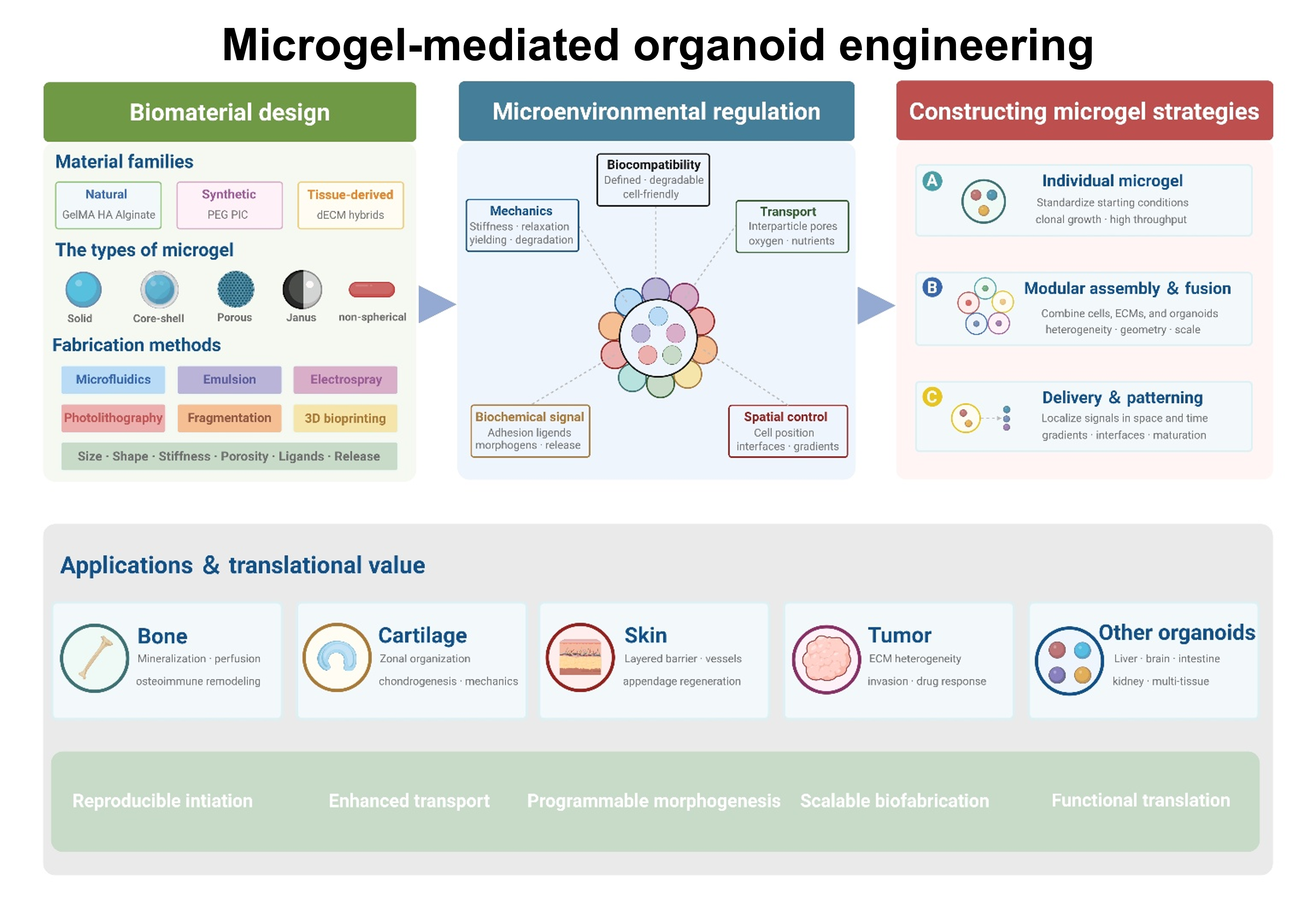
- Lancaster MA, Knoblich JA. Organogenesis in a dish: modeling development and disease using organoid technologies. Science. 2014;345(6194):1247125. doi: 10.1126/science.1247125
- Takebe T, Wells JM. Organoids by design. Science. 2019;364(6444):956-959. doi: 10.1126/science.aaw7567
- Lancaster MA, Renner M, Martin CA, et al. Cerebral organoids model human brain development and microcephaly. Nature. 2013;501(7467):373-379. doi: 10.1038/nature12517
- Takasato M, Er PX, Chiu HS, et al. Kidney organoids from human iPS cells contain multiple lineages and model human nephrogenesis. Nature. 2015;526(7574):564-568. doi: 10.1038/nature15695
- Takebe T, Sekine K, Enomura M, et al. Vascularized and functional human liver from an iPSC-derived organ bud transplant. Nature. 2013;499(7459):481-484. doi: 10.1038/nature12271
- Sachs N, Papaspyropoulos A, Zomer-van Ommen DD, et al. Long-term expanding human airway organoids for disease modeling. EMBO J. 2019;38(4):e100300. doi: 10.15252/embj.2018100300
- Lee J, Rabbani CC, Gao H, et al. Hair-bearing human skin generated entirely from pluripotent stem cells. Nature. 2020;582(7812):399-404. doi: 10.1038/s41586-020-2352-3
- Sato T, Vries RG, Snippert HJ, et al. Single Lgr5 stem cells build crypt-villus structures in vitro without a mesenchymal niche. Nature. 2009;459(7244):262-265. doi: 10.1038/nature07935
- Salewskij K, Penninger JM. Blood Vessel Organoids for Development and Disease. Circ Res. 2023;132(4):498-510. doi: 10.1161/CIRCRESAHA.122.321768
- Nwokoye PN, Abilez OJ. Bioengineering methods for vascularizing organoids. Cell Rep Methods. 2024;4(6):100779. doi: 10.1016/j.crmeth.2024.100779
- Ahn Y, An JH, Yang HJ, et al. Human Blood Vessel Organoids Penetrate Human Cerebral Organoids and Form a Vessel-Like System. Cells. 2021;10(8):2036. doi: 10.3390/cells10082036
- Hong ZX, Zhu ST, Li H, et al. Bioengineered skin organoids: from development to applications. Mil Med Res. 2023;10(1):40. doi: 10.1186/s40779-023-00475-7
- Wimmer RA, Leopoldi A, Aichinger M, et al. Human blood vessel organoids as a model of diabetic vasculopathy. Nature. 2019;565(7740):505-510. doi: 10.1038/s41586-018-0858-8
- Nikolova MT, He Z, Seimiya M, et al. Fate and state transitions during human blood vessel organoid development. Cell. 2025;188(12):3329-3348.e31. doi: 10.1016/j.cell.2025.03.037
- Aisenbrey EA, Murphy WL. Synthetic alternatives to Matrigel. Nat Rev Mater. 2020;5(7):539-551. doi: 10.1038/s41578-020-0199-8
- Fang Y, Sun W, Zhang T, Xiong Z. Recent advances on bioengineering approaches for fabrication of functional engineered cardiac pumps: A review. Biomaterials. 2022;280:121298. doi: 10.1016/j.biomaterials.2021.121298
- Gjorevski N, Sachs N, Manfrin A, et al. Designer matrices for intestinal stem cell and organoid culture. Nature. 2016;539(7630):560-564. doi: 10.1038/nature20168
- Brown JW, Mills JC. Implantable synthetic organoid matrices for intestinal regeneration. Nat Cell Biol. 2017;19(11):1307-1308. doi: 10.1038/ncb3635
- Hernandez-Gordillo V, Kassis T, Lampejo A, et al. Fully synthetic matrices for in vitro culture of primary human intestinal enteroids and endometrial organoids. Biomaterials. 2020;254:120125. doi: 10.1016/j.biomaterials.2020.120125
- Broguiere N, Isenmann L, Hirt C, et al. Growth of Epithelial Organoids in a Defined Hydrogel. Adv Mater. 2018;30(43):e1801621. doi: 10.1002/adma.201801621
- Xuan LY, Hou YY, Liang L, et al. Microgels for Cell Delivery in Tissue Engineering and Regenerative Medicine. Nano-Micro Letters. 2024;16(1):218. doi: 10.1007/s40820-024-01421-5
- Mahdieh Z, Cherne MD, Fredrikson JP, et al. Granular Matrigel: restructuring a trusted extracellular matrix material for improved permeability. Biomed Mater. 2022;17(4). doi: 10.1088/1748-605X/ac7306
- Graham AJ, Khoo MWL, Srivastava V, et al. Stress-relaxing granular bioprinting materials enable complex and uniform organoid self-organization. Nat Mater. 2026;25(7):1239-1251. doi: 10.1038/s41563-026-02519-4
- Jin H, Xue Z, Liu J, Ma B, Yang J, Lei L. Advancing Organoid Engineering for Tissue Regeneration and Biofunctional Reconstruction. Biomater Res. 2024;28:0016. doi: 10.34133/bmr.0016
- Shao Y, Wang J, Jin A, Jiang S, Lei L, Liu L. Biomaterial-assisted organoid technology for disease modeling and drug screening. Mater Today Bio. 2025;30:101438. doi: 10.1016/j.mtbio.2024.101438
- Hsiung N, Ju Y, Yang K, et al. Organoid-based tissue engineering for advanced tissue repair and reconstruction. Mater Today Bio. 2025;33:102093. doi: 10.1016/j.mtbio.2025.102093
- Du YA, Lo E, Ali S, Khademhosseini A. Directed assembly of cell-laden microgels for fabrication of 3D tissue constructs. Proc Natl Acad Sci USA. 2008;105(28):9522-9527. doi: 10.1073/pnas.0801866105
- Griffin DR, Weaver WM, Scumpia PO, Di Carlo D, Segura T. Accelerated wound healing by injectable microporous gel scaffolds assembled from annealed building blocks. Nat Mater. 2015;14(7):737-744. doi: 10.1038/nmat4294
- Mealy JE, Chung JJ, Jeong HH, et al. Injectable Granular Hydrogels with Multifunctional Properties for Biomedical Applications. Adv Mater. 2018;30(20):e1705912. doi: 10.1002/adma.201705912
- Daly AC, Riley L, Segura T, Burdick JA. Hydrogel microparticles for biomedical applications. Nat Rev Mater. 2020;5(1):20-43. doi: 10.1038/s41578-019-0148-6
- Asadikorayem M, Surman F, Weber P, Weber D, Zenobi-Wong M. Zwitterionic Granular Hydrogel for Cartilage Tissue Engineering. Adv Healthc Mater. 2024;13(25):e2301831. doi: 10.1002/adhm.202301831
- Tang G, Xiong R, Lv D, et al. Gas-Shearing Fabrication of Multicompartmental Microspheres: A One-Step and Oil-Free Approach. Adv Sci. 2019;6(9):1802342. doi: 10.1002/advs.201802342
- Ribezzi D, Gueye M, Florczak S, et al. Shaping Synthetic Multicellular and Complex Multimaterial Tissues via Embedded Extrusion-Volumetric Printing of Microgels. Adv Mater. 2023;35(36):e2301673. doi: 10.1002/adma.202301673
- Daly AC. Granular Hydrogels in Biofabrication: Recent Advances and Future Perspectives. Adv Healthc Mater. 2024;13(25):e2301388. doi: 10.1002/adhm.202301388
- Zhang S, Lin A, Tao Z, et al. Microsphere-containing hydrogel scaffolds for tissue engineering. Chem Asian J. 2022;17(20):e202200630. doi: 10.1002/asia.202200630
- Scalia S, Young PM, Traini D. Solid lipid microparticles as an approach to drug delivery. Expert Opin Drug Delivery. 2015;12(4):583-599. doi: 10.1517/17425247.2015.980812
- Liu Z, Xu Z, Wang X, et al. Preparation and biocompatibility of core-shell microspheres for sequential, sustained release of BMP-2 and VEGF. Biomed Res Int. 2022;2022:4072975. doi: 10.1155/2022/4072975
- Ding Z, Liang Z, Rong X, et al. Janus-Structured Microgel Barrier with Tissue Adhesive and Hemostatic Characteristics for Efficient Prevention of Postoperative Adhesion. Small. 2024;20(50):e2403753. doi: 10.1002/smll.202403753
- Wu J, Li G, Ye T, et al. Stem cell-laden injectable hydrogel microspheres for cancellous bone regeneration. Chem Eng J. 2020;393:124715. doi: 10.1016/j.cej.2020.124715
- Gegg C, Yang F. Spatially patterned microribbon-based hydrogels induce zonally-organized cartilage regeneration by stem cells in 3D. Acta Biomater. 2020;101:196-205. doi: 10.1016/j.actbio.2019.10.025
- Zhang X, Li Y, Ma Z, He D, Li H. Modulating degradation of sodium alginate/bioglass hydrogel for improving tissue infiltration and promoting wound healing. Bioact Mater. 2021;6(11):3692-3704. doi: 10.1016/j.bioactmat.2021.03.038
- Conrad B, Han LH, Yang F. Gelatin-based microribbon hydrogels accelerate cartilage formation by mesenchymal stem cells in three dimensions. Tissue Eng Part A. 2018;24(21-22):1631-1640. doi: 10.1089/ten.TEA.2018.0011
- Wu MM, Zhao Y, Zhao RQ, et al. Chemical Design for Both Molecular and Morphology Optimization toward High-Performance Lithium-Ion Batteries Cathode Material Based on Covalent Organic Framework. Adv Funct Mater. 2022;32(11). doi: 10.1002/adfm.202107703
- Kessel B, Lee M, Bonato A, Tinguely Y, Tosoratti E, Zenobi-Wong M. 3D bioprinting of macroporous materials based on entangled hydrogel microstrands. Adv Sci (Weinh). 2020;7(18):2001419. doi: 10.1002/advs.202001419
- Headen DM, Aubry G, Lu H, García AJ. Microfluidic-based generation of size-controlled, biofunctionalized synthetic polymer microgels for cell encapsulation. Adv Mater. 2014;26(19):3003-3008. doi: 10.1002/adma.201304880
- Xin S, Chimene D, Garza JE, Gaharwar AK, Alge DL. Clickable PEG hydrogel microspheres as building blocks for 3D bioprinting. Biomater Sci. 2019;7(3):1179-1187. doi: 10.1039/c8bm01286e
- Barati D, Watkins K, Wang Z, Yang F. Injectable and Crosslinkable PLGA-Based Microribbons as 3D Macroporous Stem Cell Niche. Small. 2020;16(22):e1905820. doi: 10.1002/smll.201905820
- Munger C, Kohler TN, Slatery E, et al. Microgel culture and spatial identity mapping elucidate the signalling requirements for primate epiblast and amnion formation. Development. 2022;149(20):dev200263. doi: 10.1242/dev.200263
- Liu H, Tao T, Gan Z, et al. Organoid in droplet: Production of uniform pancreatic cancer organoids from single cells. Mater Today Bio. 2025;32:101765. doi: 10.1016/j.mtbio.2025.101765
- Qin X, Gan Z, Liu H, et al. A Pump-Free Strategy for the Controllable Generation of Alginate Microgels as Cellular Microcarriers. ACS Biomater Sci Eng. 2024;10(6):3958-3967. doi: 10.1021/acsbiomaterials.4c00375
- Rosas JM, Campanale JP, Harwood JL, et al. Differential Effects of Confinement on the Dynamics of Normal and Tumor-Derived Pancreatic Ductal Organoids. ACS Appl Bio Mater. 2024;7(12):8489-8502. doi: 10.1021/acsabm.4c01301
- Xu X, Li H, Chen J, et al. A Universal Strategy to Construct High-Performance Homo- and Heterogeneous Microgel Assembly Bioinks. Small Methods. 2024;8(12):e2400223. doi: 10.1002/smtd.202400223
- Roth JG, Brunel LG, Huang MS, et al. Spatially controlled construction of assembloids using bioprinting. Nat Commun. 2023;14(1):4346. doi: 10.1038/s41467-023-40006-5
- Ayan B, Heo DN, Zhang Z, et al. Aspiration-assisted bioprinting for precise positioning of biologics. Sci Adv. 2020;6(10):eaaw5111. doi: 10.1126/sciadv.aaw5111
- Kühn S, Magno V, Zimmermann R, et al. Microgels With Electrostatically Controlled Molecular Affinity to Direct Morphogenesis. Adv Mater. 2025;37(3):e2409731. doi: 10.1002/adma.202409731
- Birgul Akolpoglu M, Inceoglu Y, Kizilel S. An all-aqueous approach for physical immobilization of PEG-lipid microgels on organoid surfaces. Colloids Surf B Biointerfaces. 2020;186:110708. doi: 10.1016/j.colsurfb.2019.110708
- Chen J, Liu Z, Wang Z, et al. One-step biofabrication of liquid core-GelMa shell microbeads for in situ hollow cell ball self-assembly. Regen Biomater. 2024;11:rbae021. doi: 10.1093/rb/rbae021
- Zhang X, Wang Z, Chen J, Xu T. A high-throughput microfluidic platform for functional hiPSC-derived liver organoids with bile duct- and lobule-like structures. Lab Chip. 2025;25(10):2475-2490. doi: 10.1039/d5lc00154d
- Joshi S, Maan M, Barman P, et al. Advances in biomaterials for wound care management: Insights from recent developments. Adv Colloid Interface Sci. 2025;343:103563. doi: 10.1016/j.cis.2025.103563
- Chaudhuri O, Cooper-White J, Janmey PA, Mooney DJ, Shenoy VB. Effects of extracellular matrix viscoelasticity on cellular behaviour. Nature. 2020;584(7822):535-546. doi: 10.1038/s41586-020-2612-2
- Yang X, Xu Y, Zhu D, Mi X. GelMA Core-Shell Microgel Preparation Based on a Droplet Microfluidic Device for Three-Dimensional Tumor Ball Culture and Its Drug Testing. Molecules. 2025;30(15):3305. doi: 10.3390/molecules30153305
- Huch M, Dorrell C, Boj SF, et al. In vitro expansion of single Lgr5+ liver stem cells induced by Wnt-driven regeneration. Nature. 2013;494(7436):247-250. doi: 10.1038/nature11826
- Han K, Cheng Y, Han Q, Chen J. Extraction of type I collagen and development of collagen methacryloyl (ColMA)/PEGDA ink for digital light processing printing. Int J Biol Macromol. 2024;282(Pt 6):137253. doi: 10.1016/j.ijbiomac.2024.137253
- Fredrikson JP, Roth DM, Cosgrove JA, et al. Engineering neuronal networks in granular microgels to innervate bioprinted cancer organoids on-a-chip. Lab Chip. 2025;25(14):3467-3481. doi: 10.1039/d5lc00134j
- Zhang T, Zhang H, Zhou W, et al. One-Step Generation and Purification of Cell-Encapsulated Hydrogel Microsphere With an Easily Assembled Microfluidic Device. Front Bioeng Biotechnol. 2021;9:816089. doi: 10.3389/fbioe.2021.816089
- Pittermannová A, Ruberová Z, Lizoňová D, et al. Functionalized hydrogel microparticles prepared by microfluidics and their interaction with tumour marker carbonic anhydrase IX. Soft matter. 2020;16(37):8702-8709. doi: 10.1039/d0sm01018a
- Tan S, Zhong C, Langrish T. Microencapsulation of pepsin in the spray-dried WPI (whey protein isolates) matrices for controlled release. J Food Eng. 2019;263:147-154. doi: 10.1016/j.jfoodeng.2019.06.005
- Lee KY, Mooney DJ. Alginate: properties and biomedical applications. Prog Polym Sci. 2012;37(1):106-126. doi: 10.1016/j.progpolymsci.2011.06.003
- Yue K, Trujillo-de Santiago G, Alvarez MM, Tamayol A, Annabi N, Khademhosseini A. Synthesis, properties, and biomedical applications of gelatin methacryloyl (GelMA) hydrogels. Biomaterials. 2015;73:254-271. doi: 10.1016/j.biomaterials.2015.08.045
- Cho AN, Jin Y, An Y, et al. Microfluidic device with brain extracellular matrix promotes structural and functional maturation of human brain organoids. Nat Commun. 2021;12(1):4730. doi: 10.1038/s41467-021-24775-5
- Giobbe GG, Crowley C, Luni C, et al. Extracellular matrix hydrogel derived from decellularized tissues enables endodermal organoid culture. Nat Commun. 2019;10(1):5658. doi: 10.1038/s41467-019-13605-4
- Shen C, Wang J, Li G, et al. Boosting cartilage repair with silk fibroin-DNA hydrogel-based cartilage organoid precursor. Bioact Mater. 2024;35:429-444. doi: 10.1016/j.bioactmat.2024.02.016
- Deng A, Zhang H, Hu Y, et al. Microsphere Strategy to Generate Conformal Bone Organoid Units with Osteoimmunomodulation and Sustainable Oxygen Supply for Bone Regeneration. Adv Sci (Weinh). 2025;12(32):e01437. doi: 10.1002/advs.202501437
- Feng Q, Li D, Li Q, Cao X, Dong H. Microgel assembly: Fabrication, characteristics and application in tissue engineering and regenerative medicine. Bioact Mater. 2022;9:105-119. doi: 10.1016/j.bioactmat.2021.07.020
- Luo Y, Wang Q. Recent development of chitosan-based polyelectrolyte complexes with natural polysaccharides for drug delivery. Int J Biol Macromol. 2014;64:353-367. doi: 10.1016/j.ijbiomac.2013.12.017
- Highley CB, Song KH, Daly AC, Burdick JA. Jammed microgel inks for 3D printing applications. Adv Sci (Weinh). 2019;6(1):1801076. doi: 10.1002/advs.201801076
- Muir VG, Qazi TH, Shan J, Groll J, Burdick JA. Influence of microgel fabrication technique on granular hydrogel properties. ACS Biomater Sci Eng. 2021;7(9):4269-4281. doi: 10.1021/acsbiomaterials.0c01612
- Liu T, Huang X, Luo C, Wang D. The formation mechanism of the double gas layer in gas-assisted extrusion and its influence on plastic micro-tube formation. Polymers (Basel). 2020;12(2):355. doi: 10.3390/polym12020355
- Kubota T, Kurashina Y, Zhao J, Ando K, Onoe H. Ultrasound-triggered on-demand drug delivery using hydrogel microbeads with release enhancer. Mater Des. 2021;203:109580. doi: 10.1016/j.matdes.2021.109580
- Umbanhowar PB, Prasad V, Weitz DA. Monodisperse emulsion generation via drop break off in a coflowing stream. Langmuir ACS J Surf Colloids. 2000;16(2):347-351. doi: 10.1021/la990101e
- Alzanbaki H, Moretti M, Hauser CAE. Engineered microgels-their manufacturing and biomedical applications. Micromachines (Basel). 2021;12(1):45. doi: 10.3390/mi12010045
- Darling NJ, Sideris E, Hamada N, Carmichael ST, Segura T. Injectable and spatially patterned microporous annealed particle (MAP) hydrogels for tissue repair applications. Adv Sci (Weinh). 2018;5(11):1801046. doi: 10.1002/advs.201801046
- Toprakcioglu Z, Challa PK, Morse DB, Knowles T. Attoliter protein nanogels from droplet nanofluidics for intracellular delivery. Sci Adv. 2020;6(6):eaay7952. doi: 10.1126/sciadv.aay7952
- Naqvi SM, Vedicherla S, Gansau J, McIntyre T, Doherty M, Buckley CT. Living cell factories - electrosprayed microcapsules and microcarriers for minimally invasive delivery. Adv Mater. 2016;28(27):5662-5671. doi: 10.1002/adma.201503598
- Lüken A, Stüwe L, Rauer SB, Oelker J, Linkhorst J, Wessling M. Fabrication, Flow Assembly, and Permeation of Microscopic Any-Shape Particles. Small. 2022;18(15):e2107508. doi: 10.1002/smll.202107508
- Xie J, Marijnissen JCM, Wang CH. Microparticles developed by electrohydrodynamic atomization for the local delivery of anticancer drug to treat C6 glioma in vitro. Biomaterials. 2006;27(17):3321-3332. doi: 10.1016/j.biomaterials.2006.01.034
- Qayyum AS, Jain E, Kolar G, Kim Y, Sell SA, Zustiak SP. Design of electrohydrodynamic sprayed polyethylene glycol hydrogel microspheres for cell encapsulation. Biofabrication. 2017;9(2):025019. doi: 10.1088/1758-5090/aa703c
- Gansau J, Kelly L, Buckley CT. Influence of key processing parameters and seeding density effects of microencapsulated chondrocytes fabricated using electrohydrodynamic spraying. Biofabrication. 2018;10(3):035011. doi: 10.1088/1758-5090/aacb95
- Wang H, Zhao Z, Liu Y, Shao C, Bian F, Zhao Y. Biomimetic enzyme cascade reaction system in microfluidic electrospray microcapsules. Sci Adv. 2018;4(6):eaat2816. doi: 10.1126/sciadv.aat2816
- John JV, McCarthy A, Wang H, et al. Engineering biomimetic nanofiber microspheres with tailored size, predesigned structure, and desired composition via gas bubble-mediated coaxial electrospray. Small. 2020;16(19):e1907393. doi: 10.1002/smll.201907393
- Song T, Zhang H, Luo Z, Shang L, Zhao Y. Primary human pancreatic cancer cells cultivation in microfluidic hydrogel microcapsules for drug evaluation. Adv Sci (Weinh). 2023;10(12):e2206004. doi: 10.1002/advs.202206004
- Sun LL, Li TB, Zhang BJ, Zhang M, Xu J, Wang JY. An off-the-shelf microfluidic device for the controllable fabrication of multiple-holed hollow particles and their cell culture applications. Mater Chem Front. 2021;5(7):3149-3158. doi: 10.1039/d0qm01014f
- Qazi TH, Wu JY, Muir VG, et al. Anisotropic Rod-Shaped Particles Influence Injectable Granular Hydrogel Properties and Cell Invasion. Adv Mater. 2022;34(12). doi: 10.1002/adma.202109194
- Park SY, Lee S, Yang J, Kang MS. Patterning Quantum Dots via Photolithography: A Review. Adv Mater. 2023;35(41):2300546. doi: 10.1002/adma.202300546
- Martino C, Vigolo D, Solvas XCI, Stavrakis S, deMello AJ. Real-Time PEGDA-Based Microgel Generation and Encapsulation in Microdroplets. Adv Mater Technol. 2016;1(2). doi: 10.1002/admt.201600028
- Stornello DE, Kim J, Chen Z, Heaton K, Qazi TH. Controlling microparticle aspect ratio via photolithography for injectable granular hydrogel formation and cell delivery. ACS Biomater Sci Eng. 2025;11(2):1242-1252. doi: 10.1021/acsbiomaterials.4c02102
- Sadeghi D, Solouk A, Samadikuchaksaraei A, Seifalian AM. Preparation of internally-crosslinked alginate microspheres: Optimization of process parameters and study of pH-responsive behaviors. Carbohydr Polym. 2021;255:117336. doi: 10.1016/j.carbpol.2020.117336
- Zarzar LD, Sresht V, Sletten EM, Kalow JA, Blankschtein D, Swager TM. Dynamically reconfigurable complex emulsions via tunable interfacial tensions. Nature. 2015;518(7540):520-524. doi: 10.1038/nature14168
- Miras J, Vílchez S, Bouju C, et al. Formation of water-in-water emulsions and microgels in nonionic surfactant + gelatin aqueous mixtures. J Colloid Interface Sci. 2025;684(Pt 1):319-330. doi: 10.1016/j.jcis.2024.12.240
- Pan Z, Bui L, Yadav V, Fan F, Chang HC, Hanjaya-Putra D. Conformal single cell hydrogel coating with electrically induced tip streaming of an AC cone. Biomater Sci. 2021;9(9):3284-3292. doi: 10.1039/d0bm02100h
- Jaberi A, Kedzierski A, Kheirabadi S, et al. Engineering microgel packing to tailor the physical and biological properties of gelatin methacryloyl granular hydrogel scaffolds. Adv Healthcare Mater. 2024;13(25):e2402489. doi: 10.1002/adhm.202402489
- Wang Z, Xiang L, Lin F, Tang Y, Cui W. 3D bioprinting of emulating homeostasis regulation for regenerative medicine applications. J Control Release. 2023;353:147-165. doi: 10.1016/j.jconrel.2022.11.035
- Wang X, Liu X, Li K, et al. A Microgel-Hydrogel Hybrid for Functional Compensation and Mechanical Stability in 3D Printed Cell-Dense Vascularized Liver Tissue. Adv Mater. 2025;37(28):e2413940. doi: 10.1002/adma.202413940
- Flégeau K, Puiggali-Jou A, Zenobi-Wong M. Cartilage tissue engineering by extrusion bioprinting utilizing porous hyaluronic acid microgel bioinks. Biofabrication. 2022;14(3). doi: 10.1088/1758-5090/ac6b58
- Xie C, Liang R, Ye J, et al. High-efficient engineering of osteo-callus organoids for rapid bone regeneration within one month. Biomaterials. 2022;288:121741. doi: 10.1016/j.biomaterials.2022.121741
- Zhao H, Chen Y, Shao L, et al. Airflow-assisted 3D bioprinting of human heterogeneous microspheroidal organoids with microfluidic nozzle. Small. 2018;14(39):e1802630. doi: 10.1002/smll.201802630
- Bernal PN, Bouwmeester M, Madrid-Wolff J, et al. Volumetric bioprinting of organoids and optically tuned hydrogels to build liver-like metabolic biofactories. Adv Mater. 2022;34(15):e2110054. doi: 10.1002/adma.202110054
- Muir VG, Prendergast ME, Burdick JA. Fragmenting Bulk Hydrogels and Processing into Granular Hydrogels for Biomedical Applications. Jove-J Vis Exp. 2022;(183). doi: 10.3791/63867
- Sinclair A, O’Kelly MB, Bai T, Hung HC, Jain P, Jiang S. Self-healing zwitterionic microgels as a versatile platform for malleable cell constructs and injectable therapies. Adv Mater. 2018;30(39):e1803087. doi: 10.1002/adma.201803087
- Caldwell AS, Campbell GT, Shekiro KMT, Anseth KS. Clickable microgel scaffolds as platforms for 3D cell encapsulation. Adv Healthcare Mater. 2017;6(15):1700254. doi: 10.1002/adhm.201700254
- Guo J, Zhou Q, Liu YC, et al. Preparation of soy protein-based microgel particles using a hydrogel homogenizing strategy and their interfacial properties. Food Hydrocoll. 2016;58:324-334. doi: 10.1016/j.foodhyd.2016.03.008
- Sarkar A, Murray B, Holmes M, Ettelaie R, Abdalla A, Yang X. In vitro digestion of pickering emulsions stabilized by soft whey protein microgel particles: Influence of thermal treatment. Soft Matter. 2016;12(15):3558-3569. doi: 10.1039/c5sm02998h
- Zhang B, Wei B, Hu X, Jin Z, Xu X, Tian Y. Preparation and characterization of carboxymethyl starch microgel with different crosslinking densities. Carbohydr Polym. 2015;124:245-253. doi: 10.1016/j.carbpol.2015.01.075
- Cui Z, Wang W, Obeng M, et al. Using intra-microgel crosslinking to control the mechanical properties of doubly crosslinked microgels. Soft Matter. 2016;12(33):6985-6994. doi: 10.1039/c6sm01337f
- Lavickova B, Kronabitter H, Cervera-Negueruela M, et al. Integrated Microfluidic Platform for High-Throughput Generation of Intestinal Organoids in Hydrogel Droplets. Adv Sci (Weinh). 2026;13(13):e16507. doi: 10.1002/advs.202516507
- Pal V, Singh YP, Gupta D, et al. High-throughput microgel biofabrication via air-assisted co-axial jetting for cell encapsulation, 3D bioprinting, and scaffolding applications. Biofabrication. 2023;15(3):035001. doi: 10.1088/1758-5090/acc4eb
- Panda P, Ali S, Lo E, et al. Stop-flow lithography to generate cell-laden microgel particles. Lab Chip. 2008;8(7):1056-1061. doi: 10.1039/b804234a
- Kang SM, Lee GW, Huh YS. Centrifugal Force-Driven Modular Micronozzle System: Generation of Engineered Alginate Microspheres. Sci Rep. 2019;9(1):12776. doi: 10.1038/s41598-019-49244-4
- Wu J, Chen L, Xiao C, et al. Scalable and oil-free fabrication of monodisperse microgels via all-aqueous microfluidics. Cell Rep Phys Sci. 2026;7(4):103253. doi: 10.1016/j.xcrp.2026.103253
- An C, Zhou R, Zhang H, et al. Microfluidic-templated cell-laden microgels fabricated using phototriggered imine-crosslinking as injectable and adaptable granular gels for bone regeneration. Acta Biomater. 2023;157:91-107. doi: 10.1016/j.actbio.2022.11.034
- Bhatt A, Dhiman N, Giri PS, Kasinathan GN, Pati F, Rath SN. Biocompatibility-on-a-chip: Characterization and evaluation of decellularized tendon extracellular matrix (tdECM) hydrogel for 3D stem cell culture in a microfluidic device. Int J Biol Macromol. 2022;213:768-779. doi: 10.1016/j.ijbiomac.2022.06.010
- Ali-Jerman H, Al-Quraishi Z, Muglikar A, et al. Enhancing transfection efficacy in glioma cells: A comparison of microfluidic versus manual polypropylenimine dendriplex formation. Int J Nanomed. 2024;19:12189-12203. doi: 10.2147/IJN.S490936
- Ferrante M, Gallo MB, Gende LB, Consolo VF, Álvarez VA, González JS. Synthesis and characterization of gelatin/chondroitin sulfate microgels with NaCl: Preliminary research toward wound healing applications. Int J Biol Macromol. 2025;290:138953. doi: 10.1016/j.ijbiomac.2024.138953
- Reineke B, Paulus I, Löffelsend S, et al. On-chip fabrication and in-flow 3D-printing of microgel constructs: from chip to scaffold materials in one integral process. Biofabrication. 2024;16(2):025038. doi: 10.1088/1758-5090/ad3318
- Schlosser CS, Morris CJ, Brocchini S, Williams GR. Hydrophobic ion pairing as a novel approach to co-axial electrospraying of peptide-PLGA particles. Int J Pharm. 2024;667(Pt B):124885. doi: 10.1016/j.ijpharm.2024.124885
- Sun Z, Zhou J, Sheng L, et al. Microfluidic engineering of microgels: Fabrication methods, structural design, assembly strategies, and biomedical applications. Acta Biomater. 2025;207:142-173. doi: 10.1016/j.actbio.2025.10.017
- Del Giudice F, Curtis DJ, Aufderhorst-Roberts A. A new approach for on-chip production of biological microgels using photochemical cross-linking. Anal Chem. 2024;96(25):10140-10144. doi: 10.1021/acs.analchem.4c01574
- Li Y, Chen R. Photolithographic patterning of organic semiconductors for organic field-effect transistors. Chem Rev. 2025;125(10):4933-4973. doi: 10.1021/acs.chemrev.4c00446
- Ling SD, Liu Z, Ma W, Chen Z, Du Y, Xu J. A novel step-T-junction microchannel for the cell encapsulation in monodisperse alginate-gelatin microspheres of varying mechanical properties at high throughput. Biosensors. 2022;12(8):659. doi: 10.3390/bios12080659
- Buritica S, Gutteriez J, Lapeyre V, et al. Inter cross-linking microgels by superchaotropic nano-ions at interface: Controlled stabilization of emulsions. J Colloid Interface Sci. 2025;699(Pt 2):138257. doi: 10.1016/j.jcis.2025.138257
- Jiang W, Wang J, Yuan D, et al. Fabrication, characterization and emulsifying properties of agarose microgel. Int J Biol Macromol. 2023;241:124565. doi: 10.1016/j.ijbiomac.2023.124565
- Wang K, Lan X, Chen J, et al. One-Step Coaxial 3D Printing of Pre-Vascularized Skin Organoid Models with ADSC Microspheres for Enhanced Wound Healing. Adv Sci (Weinh). 2026;13(9):e17409. doi: 10.1002/advs.202517409
- Kim W, Gwon Y, Park S, Kim H, Kim J. Therapeutic strategies of three-dimensional stem cell spheroids and organoids for tissue repair and regeneration. Bioact Mater. 2023;19:50-74. doi: 10.1016/j.bioactmat.2022.03.039
- Fumadó Navarro J, Crilly S, Chan WK, et al. Cerebral Organoids with Integrated Endothelial Networks Emulate the Neurovascular Unit and Mitigate Core Necrosis. Adv Sci. 2025;12(43):e07256. doi: 10.1002/advs.202507256
- Abeta S, Masuda A, Hioki A, Hirayama-Shoji K, Onoe H. Cell-Encapsulating Hollow Collagen Microgel Beads for the Construction of Hollow Organ Tissue Model in Vitro. Annu Int Conf IEEE Eng Med Biol Soc. 2025;2025:1-4. doi: 10.1109/EMBC58623.2025.11253712
- Ju J, Fang H, Jie J, et al. Modular living assembly of bone organoids with in situ guided vascularization. Bioact Mater. 2026;64:510-528. doi: 10.1016/j.bioactmat.2026.04.020
- Zhu M, Zhang H, Zhou Q, et al. Dynamic GelMA/DNA Dual-Network Hydrogels Promote Woven Bone Organoid Formation and Enhance Bone Regeneration. Adv Mater. 2025;37(24):e2501254. doi: 10.1002/adma.202501254
- Shen CY, Zhou QR, Wu X, et al. Accelerating cartilage regeneration with DNA-SF hydrogel sustained release system-based cartilage organoids. Military Med Res. 2025;12(1):39. doi: 10.1186/s40779-025-00625-z
- Lee SJ, Jeon O, Lee YB, et al. In situ cell condensation-based cartilage tissue engineering via immediately implantable high-density stem cell core and rapidly degradable shell microgels. Adv Compos Hybrid Mater. 2025;8(4):330. doi: 10.1007/s42114-025-01406-x
- Lin Z, Li Q, Han X, et al. An injectable and degradable heterogeneous microgel assembly capable of forming a “micro-nest group” for cell condensation and cartilage regeneration. Mater Horiz. 2024;11(21):5438-5450. doi: 10.1039/D4MH00724G
- Gao Y, Li Q, Du Z, et al. HAMA-SBMA hydrogel with anti-inflammatory properties delivers cartilage organoids, boosting cartilage regeneration. J Nanobiotechnol. 2025;23(1):401. doi: 10.1186/s12951-025-03475-y
- Xiong M, Yang X, Shi Z, et al. Programmable Artificial Skins Accomplish Antiscar Healing with Multiple Appendage Regeneration. Adv Mater. 2024;36(50):2407322. doi: 10.1002/adma.202407322
- Xie J, Yang Q, Zhang Y, Zheng K, Geng H, Wu Y. The Bioengineering of Microspheric Skin Organoids and Their Application in Drug Screening. Adv Sci. 2025;12(22):2416863. doi: 10.1002/advs.202416863
- Kim S, Yeop Baek S, Cha C. Bioactive Microgels with Tunable Microenvironment as a 3D Platform to Guide the Complex Physiology of Hepatocellular Carcinoma Spheroids. ChemBioChem. 2024;25(23):e202400482. doi: 10.1002/cbic.202400482
- Song H, Jiang H, Hu W, et al. Cervical extracellular matrix hydrogel optimizes tumor heterogeneity of cervical squamous cell carcinoma organoids. Sci Adv. 2024;10(20):eadl3511. doi: 10.1126/sciadv.adl3511
- Wang L, Riediger L, Rao Q, et al. Tunable Synthetic Hydrogel Modulates Hepatic Lineage Specification of Human Liver Organoid. Adv Funct Mater. 2026;36(7):e08430. doi: 10.1002/adfm.202508430
- Gnecco JS, Brown A, Buttrey K, et al. Organoid co-culture model of the human endometrium in a fully synthetic extracellular matrix enables the study of epithelial-stromal crosstalk. Med. 2023;4(8):554-579.e9. doi: 10.1016/j.medj.2023.07.004
- Andersson-Rolf A, Clevers H. New developments and applications of human organoids. Nat Rev Mol Cell Biol. 2026;27(7):543-558. doi: 10.1038/s41580-026-00974-0
- Wang D, Villenave R, Stokar-Regenscheit N, Clevers H. Human organoids as 3D in vitro platforms for drug discovery: opportunities and challenges. Nat Rev Drug Discov. 2026;25(3):204-226. doi: 10.1038/s41573-025-01317-y
- Sljukic A, Green Jenkinson J, Niksic A, Prior N, Huch M. Advances in liver and pancreas organoids: how far we have come and where we go next. Nat Rev Gastroenterol Hepatol. 2026;23(1):44-64. doi: 10.1038/s41575-025-01116-1
- Hushka EA, Blatchley MR, Macdougall LJ, et al. Fully Synthetic Hydrogels Promote Robust Crypt Formation in Intestinal Organoids. Adv Mater. 2025;37(43):e09672. doi: 10.1002/adma.202509672