

Advances in hydrogels with biomimetic mechanical properties for dental and periodontal tissue engineering and organoid applications

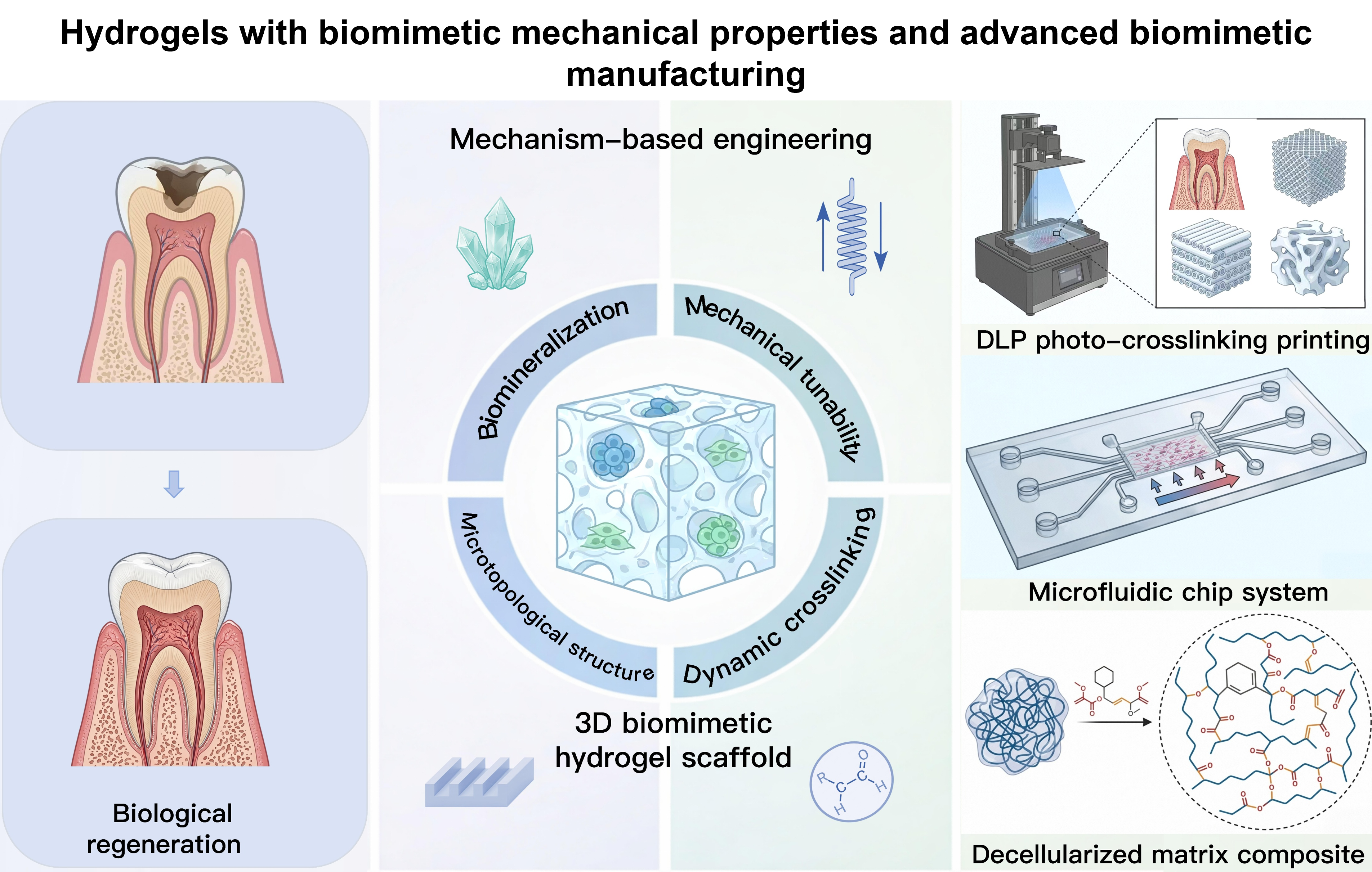
Mechanically biomimetic hydrogels have emerged as promising extracellular matrix-mimicking platforms for dental and periodontal tissue engineering because of their capacity to reproduce the mechanical, structural, and biochemical characteristics of native tissue microenvironments. By providing controllable matrix stiffness, viscoelasticity, stress relaxation, fluid shear stress, and three-dimensional topographical cues, these materials can regulate stem cell fate, coordinate epithelial–mesenchymal interactions, guide tissue morphogenesis, and promote the functional maturation and mineralization of regenerating tissues. This review summarizes recent advances in the design and application of mechanically biomimetic hydrogels for the regeneration of dentin–pulp complexes, tooth germs, periodontal ligament, alveolar bone, and other craniofacial tissues, with particular emphasis on their emerging applications in dental and periodontal organoid engineering. Key material and design parameters, including biomimetic mineralization, mechanical tunability, three-dimensional architectural organization, and dynamic crosslinking, are systematically discussed. The mechanotransductive mechanisms by which hydrogel-derived cues regulate odontogenic, osteogenic, and periodontal differentiation are further examined. In addition, advanced fabrication strategies, including microfluidics, photocrosslinking, three-dimensional bioprinting, and decellularized extracellular matrix-based composites, are reviewed in relation to multicellular organization, vascular network formation, and reconstruction of tissue-specific interfaces. Despite substantial progress, challenges remain, including the attenuation of mechanical signals during long-term culture, insufficient spatiotemporal control of multicellular organization, limited vascularization and innervation, and discrepancies between engineered mineralized tissues and native dental hard tissues. Future developments in intelligent mechanoresponsive hydrogels, high-resolution developmental mechanobiological atlases, organoid-based multiscale validation systems, and automated biomanufacturing may facilitate the transition from empirical tissue repair toward mechanically programmed dental and periodontal regeneration.
- Wen B, Dai Y, Han X, et al. Biomineralization-inspired mineralized hydrogel promotes the repair and regeneration of dentin/bone hard tissue. npj Regen Med. 2023;8(1):11. doi: 10.1038/s41536-023-00286-3
- Mina M, Kollar EJ. The induction of odontogenesis in non-dental mesenchyme combined with early murine mandibular arch epithelium. Arch Oral Biol. 1987;32(2):123-127. doi: 10.1016/0003-9969(87)90055-0
- Kollar EJ, Baird GR. Tissue interactions in embryonic mouse tooth germs. II. The inductive role of the dental papilla. J Embryol Exp Morphol. 1970;24(1):173-186.
- Thesleff I, Sharpe P. Signalling networks regulating dental development. Mech Dev. 1997;67(2):111-123. doi: 10.1016/S0925-4773(97)00115-9
- Zhong C, Wang S, Yan K, Zhao Y, Yang H, Yu J. Integrating organoids and organ-on-a-chip in dental research. Biomaterials. 2026;330:124065. doi: 10.1016/j.biomaterials.2026.124065
- Wang J, Li Q, Lin X, et al. LAMB3 regulates extracellular matrix stiffness and promotes odontoblast differentiation in dental papilla. Chem Eng J. 2025;518:164595. doi: 10.1016/j.cej.2025.164595
- Engler AJ, Sen S, Sweeney HL, Discher DE. Matrix elasticity directs stem cell lineage specification. Cell. 2006;126(4):677-689. doi: 10.1016/j.cell.2006.06.044
- Discher DE, Mooney DJ, Zandstra PW. Growth factors, matrices, and forces combine and control stem cells. Science. 2009;324(5935):1673-1677. doi: 10.1126/science.1171643
- Liu N, Zhou M, Zhang Q, et al. Stiffness regulates the proliferation and osteogenic/odontogenic differentiation of human dental pulp stem cells via the WNT signalling pathway. Cell Prolif. 2018;51(2):e12435. doi: 10.1111/cpr.12435
- Zhang X, Contessi Negrini N, Correia R, Sharpe PT, Celiz AD, Angelova Volponi A. Generating tooth organoids using defined bioorthogonally cross-linked hydrogels. ACS Macro Lett. 2024;13(12):1620-1626. doi: 10.1021/acsmacrolett.4c00520
- Hemeryck L, Hermans F, Chappell J, et al. Organoids from human tooth showing epithelial stemness phenotype and differentiation potential. Cell Mol Life Sci. 2022;79(3):153. doi: 10.1007/s00018-022-04183-8
- Hermans F, Hemeryck L, Bueds C, et al. Organoids from mouse molar and incisor as new tools to study tooth-specific biology and development. Stem Cell Rep. 2023;18(5):1166-1181. doi: 10.1016/j.stemcr.2023.03.011
- Han B, Cao C, Wang A, et al. Injectable Double-Network Hydrogel-Based Three-Dimensional Cell Culture Systems for Regenerating Dental Pulp. ACS Appl Mater Interfaces. 2023;15(6):7821-7832. doi: 10.1021/acsami.2c20848
- Zhang Z, Li C, Guo J, et al. “Young-Mechanical Niche” biomimetic hydrogel promotes dental pulp regeneration through YAP-dependent mechanotransduction. Chem Eng J. 2024;501:157483. doi: 10.1016/j.cej.2024.157483
- Xu X, Li Z, Ai X, Tang Y, Yang D, Dou L. Human three-dimensional dental pulp organoid model for toxicity screening of dental materials on dental pulp cells and tissue. Int Endod J. 2022;55(1):79-88. doi: 10.1111/iej.13641
- Zhang JJ, Li X, Tian Y, et al. Harnessing Mechanical Stress with Viscoelastic Biomaterials for Periodontal Ligament Regeneration. Adv Sci. 2024;11(18):e2309562. doi: 10.1002/advs.202309562
- Gao B, Yao J, Wang Y, et al. Periodontal ligament stem cells-loaded photocrosslinking GelMA/PEGDA scaffolds for periodontal bone regeneration. BMC Biotechnol. 2026;26(1):56. doi: 10.1186/s12896-026-01127-z
- Li X, Xia Y, Wang Z, et al. Three-dimensional matrix stiffness-based stem cell soil: Tri-phase biomechanical structure promoted human dental pulp stem cells to achieve pulpodentin regeneration. Mater Today Bio. 2025;31:101591. doi: 10.1016/j.mtbio.2025.101591
- Zhang R, Shen Z, Zhao Z, et al. Integrated multi-omics profiling characterizes the crucial role of human dental epithelium during tooth development. Cell Rep. 2025;44(4):115437. doi: 10.1016/j.celrep.2025.115437
- Huang Y, Zhao Z, Yang Y, et al. Synergistic peptide-organic matrix enhances mineralization of biomimetic scaffolds for bone regeneration. Mater Horiz. 2025;12(20):8631-8653. doi: 10.1039/d5mh00969c
- Kim HY, Cooley V, Kim EJ, et al. Adult dental epithelial stem cell-derived organoids deposit hydroxylapatite biomineral. Int J Oral Sci. 2023;15(1):55. doi: 10.1038/s41368-023-00257-w
- Jeong SY, Lee S, Choi WH, Jee JH, Kim HR, Yoo J. Fabrication of dentin-pulp-like organoids using dental-pulp stem cells. Cells. 2020;9(3):642. doi: 10.3390/cells9030642
- Zhang C, Shen Y, Huang M, et al. Dynamic hydrogel mechanics in organoid engineering: From matrix design to translational paradigms. Bioact Mater. 2026;55:144-170. doi: 10.1016/j.bioactmat.2025.09.021
- Yilmaz-Dagdeviren HD, Arslan YE. Beyond traditional dentistry: How organoids and next-gen hydrogels are redesigning dental tissue regeneration. Biomater Adv. 2026;179:214494. doi: 10.1016/j.bioadv.2025.214494
- Luo P, Cheng Y, Luo Y, et al. Hydrogel enhanced organoid multidirectional differentiation via Yap/Tead4 mechanotransduction for accelerated tissue regeneration. ACS Appl Mater Interfaces. 2025;17(26):37601-37616. doi: 10.1021/acsami.5c06161
- Shi S, Qiu J, Fu Z, et al. Dynamic hydrogels with independently tunable stress relaxation for stem cell fate regulation and regenerative engineering. Sci China Mater. 2026:1-14. doi: 10.1007/s40843-025-3749-3
- Liang C, Wu S, Huang Z, et al. Harnessing Oxidized Alginate Microgels for Rapid and Self-Assembling Dental Tissue Organogenesis In Vitro and In Vivo. Small Sci. 2025;5(12):e202500053. doi: 10.1002/smsc.202500053
- Peng YH, Hsiao SK, Gupta K, et al. Dynamic matrices with DNA-encoded viscoelasticity for cell and organoid culture. Nat Nanotechnol. 2023;18(12):1463-1473. doi: 10.1038/s41565-023-01483-3
- Elnawam H, Thabet A, Mobarak A, Abdallah A, Elbackly R. Preparation and characterization of bovine dental pulp-derived extracellular matrix hydrogel for regenerative endodontic applications: an in vitro study. BMC Oral Health. 2024;24(1):1281.doi: 10.1186/s12903-024-05004-z
- Nugraheni VI, Asrianti Bagio D, Margono A, Julianto I. The Effect of Hydrogel Hyaluronic Acid on Dentine Sialophosphoprotein Expression of Human Dental Pulp Stem Cells. Eur Endod J. 2023;8(4):280-285. doi: 10.14744/eej.2023.59672
- Yuan S, Yang X, Wang X, Chen J, Tian W, Yang B. Injectable Xenogeneic Dental Pulp Decellularized Extracellular Matrix Hydrogel Promotes Functional Dental Pulp Regeneration. Int J Mol Sci. 2023;24(24):17483. doi: 10.3390/ijms242417483
- Zhang Y, Ding N, Zhang T, Sun Q, Han B, Yu T. A tetra-PEG hydrogel based aspirin sustained release system exerts beneficial effects on periodontal ligament stem cells mediated bone regeneration. Front Chem. 2019;7:682. doi: 10.3389/fchem.2019.00682
- Cui J, Xu R, Dong W, Kaneko T, Chen M, Shi D. Skin-inspired patterned hydrogel with strain-stiffening capability for strain sensors. ACS Appl Mater Interfaces. 2023;15(41):48736-48743. doi: 10.1021/acsami.3c12127
- Cordiale A, Stanco D, Visone R, et al. An innovative “tooth-on-chip” microfluidic device emulating the structure and physiology of the dental pulp tissue. Adv Healthc Mater. 2026;15(1):e2502080. doi: 10.1002/adhm.202502080
- Ha M, Athirasala A, Tahayeri A, Menezes PP, Bertassoni LE. Micropatterned hydrogels and cell alignment enhance the odontogenic potential of stem cells from apical papilla in-vitro. Dent Mater. 2020;36(1):88-96. doi: 10.1016/j.dental.2019.10.013
- Kilic Bektas C, Zhang W, Mao Y, Wu X, Kohn J, Yelick PC. Self-assembled hydrogel microparticle-based tooth-germ organoids. Bioengineering. 2022;9(5):215.doi: 10.3390/bioengineering9050215
- Carvalho LAM, Stuani VT, Silva ISPD, et al. Hydrogel microarchitecture as a regulatory cue for in vitro odontogenic differentiation. J Appl Oral Sci. 2026;34:e20250607. doi: 10.1590/1678-7765-2025-0607
- Bai M, Zhang Z, Chen H, Liu X, Xie J. Paxillin tunes the relationship between cell-matrix and cell-cell adhesions to regulate stiffness-dependent dentinogenesis. Regen Biomater. 2022;10:rbac100. doi: 10.1093/rb/rbac100
- Pankajakshan D, Voytik-Harbin SL, Nör JE, Bottino MC. Injectable highly tunable oligomeric collagen matrices for dental tissue regeneration. ACS Appl Bio Mater. 2020;3(2):859-868. doi: 10.1021/acsabm.9b00944
- Lwin HY, Tiskratok W, Kyawsoewin M, et al. Shear Stress Regulates Osteogenic Differentiation of Human Dental Pulp Stem Cells via the p38 Pathway. Int J Mol Sci. 2025;26(12):5667. doi: 10.3390/ijms26125667
- Wang X, Dong S, Dong Q, Sun X. Piezo1 Promotes Odontogenic Differentiation of Dental Pulp Stem Cells Under Stress Conditions. Int Dent J. 2025;75(3):1885-1896. doi: 10.1016/j.identj.2025.01.018
- Dong J, Li R, Chen Y, Zhu G, Liang X. Mechanosensitive Piezo channels in mineralized tissues: emerging roles in osteodental adaptation and disease. Front Cell Dev Biol. 2025;13:1607337. doi: 10.3389/fcell.2025.1607337
- Xu X, Guo Y, Liu P, et al. Piezo Mediates the Mechanosensation and Injury-Repair of Pulpo-Dentinal Complex. Int Dent J. 2024;74(1):71-80. doi: 10.1016/j.identj.2023.07.002
- Holland EN, Fernández-Yagüe MA, Zhou DW, et al. FAK, vinculin, and talin control mechanosensitive YAP nuclear localization. Biomaterials. 2024;308:122542. doi: 10.1016/j.biomaterials.2024.122542
- Hassan N, Greve B, Götte M. The role of ECM mechanics in cancer mechanotransduction through unraveling the molecular machinery of integrins, FAK, and YAP signaling. Cell Mol Biol Lett. 2026;31(1):86. doi: 10.1186/s11658-026-00905-z
- Rosowski J, Bräunig J, Amler AK, Strietzel FP, Lauster R, Rosowski M. Emulating the early phases of human tooth development in vitro. Sci Rep. 2019;9(1):7057. doi: 10.1038/s41598-019-43468-0
- Kim GH, Park YD, Lee SY, et al. Odontogenic stimulation of human dental pulp cells with bioactive nanocomposite fiber. J Biomate Appl. 2015;29(6):854-866. doi: 10.1177/0885328214546884
- Pierfelice TV, D’Amico E, Petrini M, et al. A Systematic Review on Organ-on-a-Chip in PDMS or Hydrogel in Dentistry: An Update of the Literature. Gels. 2024;10(2):102. doi: 10.3390/gels10020102
- Phan TV, Pimpakan T, Suwanchaikasem P, et al. Decellularized matrix-hyaluronic acid-alginate hybrid hydrogels to enable a multi-layered full-thickness oral mucosa-on-a-chip. J Dent. 2025;163:106115. doi: 10.1016/j.jdent.2025.106115
- Liang X, Xie L, Zhang Q, et al. Gelatin methacryloyl-alginate core-shell microcapsules as efficient delivery platforms for prevascularized microtissues in endodontic regeneration. Acta Biomater. 2022;144:242-257. doi: 10.1016/j.actbio.2022.03.045
- Qian Y, Gong J, Lu K, et al. DLP printed hDPSC-loaded GelMA microsphere regenerates dental pulp and repairs spinal cord. Biomaterials. 2023;299:122137. doi: 10.1016/j.biomaterials.2023.122137
- Cunha D, Souza N, Moreira M, et al. 3D-printed microgels supplemented with dentin matrix molecules as a novel biomaterial for direct pulp capping. Clin Oral Investig. 2023;27(3):1215-1225. doi: 10.1007/s00784-022-04735-z
- Chen J, Gui X, Qiu T, et al. DLP 3D printing of high-resolution root scaffold with bionic bioactivity and biomechanics for personalized bio-root regeneration. Biomater Adv. 2023;151:213475. doi: 10.1016/j.bioadv.2023.213475
- Zhu S, Liao X, Xu Y, et al. 3D bioprinting of high-performance hydrogel with in-situ birth of stem cell spheroids. Bioact Mater. 2024;43:392-405. doi: 10.1016/j.bioactmat.2024.09.033
- Jackson A, Bektas C, Mao Y. Optimization of gelatin-based cell carriers for tooth-germ organoids. Global Transl Med. 2025;4(1):67-79. doi: 10.36922/gtm.5897
- Yang Y, Zhao J, Qin B, et al. Bioactive photo-crosslinkable hydrogel based on decellularized dental pulp matrix for functional pulp regeneration. BMC Oral Health. 2026;26(1):654. doi: 10.1186/s12903-026-08001-6
- Sadeghian A, Kharaziha M, Khoroushi M. Dentin extracellular matrix loaded bioactive glass/GelMA support rapid bone mineralization for potential pulp regeneration. Int J Biol Macromol. 2023;234:123771. doi: 10.1016/j.ijbiomac.2023.123771
- Ioannidis K, Dimopoulos A, Decoene I, et al. 4D Biofabrication of Magnetically Augmented Callus Assembloid Implants Enables Rapid Endochondral Ossification via Activation of Mechanosensitive Pathways. Adv Sci. 2025;12(15):e2413680. doi: 10.1002/advs.202413680
- Chakraborty J, Fernandez-Perez J, Takhsha Ghahfarokhi M, et al. Development of 4D-bioprinted shape-morphing magnetic constructs for cartilage regeneration using a silk fibroin-gelatin bioink. Cell Rep Phys Sci. 2024;5(3):101819. doi: 10.1016/j.xcrp.2024.101819
- Yin Y, Wei Z, Lu B, et al. 4D-printed smart hydrogels in oral medicine: Current applications and future perspectives. J Mech Behav Biomed Mater. 2026;173:107233. doi: 10.1016/j.jmbbm.2025.107233
- Menzani B, De Gea P, Gidrol X, Tubbs E. Vascularizing organoids-on-chip for perfused and personalized models. Lab Chip. 2026;26(6):1798-1819. doi: 10.1039/d5lc00890e
- Wu Y, Li X, Liu H, et al. Organoids in the oral and maxillofacial region: present and future. Int J Oral Sci. 2024;16(1):61. doi: 10.1038/s41368-024-00324-w
- Zhang S, Yu M, Li M, et al. Notch Signaling Hydrogels Enable Rapid Vascularization and Promote Dental Pulp Tissue Regeneration. Adv Sci. 2024;11(35):e2310285. doi: 10.1002/advs.202310285
- Wang W, Li J, Zhou Y, et al. EphrinB2 in dental pulp stem cells promotes endothelial cells forming capillary-like cords in a 3D bioprinted hydrogel construct. BMC Mol Cell Biol. 2025;26(1):33. doi: 10.1186/s12860-025-00558-4
- Liu J, Li P, Chen Y, et al. Pre-vascularized hydrogel co-encapsulating SHEDs and HUVECs for dental pulp regeneration. Biomater Adv. 2026;180:214539. doi: 10.1016/j.bioadv.2025.214539
- Liu F, Xiao J, Chen LH, et al. Self-assembly of differentiated dental pulp stem cells facilitates spheroid human dental organoid formation and prevascularization. World J Stem Cells.2024;16(3):287-304. doi: 10.4252/wjsc.v16.i3.287
- Seo EJ, Park JK, Jeong H, Kang JS, Kim HR, Jang IH. Differentiation of CD31-Positive Vascular Endothelial Cells from Organoid Culture of Dental Pulp Stem Cells. Int J Oral Biol. 2018;43(2):77-82. doi: 10.11620/IJOB.2018.43.2.077
- Gruenhagen GW, Mubeen T, Patil C, Stockert J, Streelman JT. Single Cell RNA Sequencing Reveals Deep Homology of Dental Cell Types Across Vertebrates. Front Dent Med. 2022;3:845449. doi: 10.3389/fdmed.2022.845449
- Al Thamin S, Chiba Y, Yoshizaki K, et al. Transcriptional regulation of the basic helix-loop-helix factor AmeloD during tooth development. J Cell Physiol. 2021;236(11):7533-7543. doi: 10.1002/jcp.30389
- Ma X, Ma Y, Lin Z, Ji M. The role of the TGF-β1 signaling pathway in the process of amelogenesis. Front Physiol. 2025;16:1586769. doi: 10.3389/fphys.2025.1586769
- de Paiva Narciso N, Christakopoulos F, Huang MS, et al. Tuning viscoelasticity of dynamic covalent hydrogels for human tissue modeling. bioRxiv. Preprint posted online October 17, 2025. doi: 10.1101/2025.10.16.682916
- Wu S, Wu X, Wang X, Su J. Hydrogels for bone organoid construction: From a materiobiological perspective. J Mater Sci Technol. 2023;136:21-31. doi: 10.1016/j.jmst.2022.07.008
- Dissanayaka WL, Zhu L, Hargreaves KM, Jin L, Zhang C. In vitro analysis of scaffold-free prevascularized microtissue spheroids containing human dental pulp cells and endothelial cells. J Endod. 2015;41(5):663-670. doi: 10.1016/j.joen.2014.12.017
- Shi Y, Yu Y, Li J, et al. Spatiotemporal cell landscape of human embryonic tooth development. Cell Prolif. 2024;57(9):e13653. doi: 10.1111/cpr.13653
- Huang C, Sanaei F, Verdurmen WPR, Yang F, Ji W, Walboomers XF. The Application of Organs-on-a-Chip in Dental, Oral, and Craniofacial Research. J Dent Res. 2023;102(4):364-375. doi: 10.1177/00220345221145555
- Wu X, Yang H, Liu G, et al. Osteomimix: A Multidimensional Biomimetic Cascade Strategy for Bone Defect Repair. Adv Mater. 2025;37(11):e2416715. doi: 10.1002/adma.202416715
- Wang X, Yang X, Xiao X, Li X, Chen C, Sun D. Biomimetic design of platelet-rich plasma controlled release bacterial cellulose/hydroxyapatite composite hydrogel for bone tissue engineering. Int J Biol Macromol. 2024;269(Pt 2):132124. doi: 10.1016/j.ijbiomac.2024.132124
- Wang Y, Zhang N, Zhang J, Yao R, He J, Wu F. Reinforced enzyme mineralized chitosan hydrogels with superior mechanical and osteogenic properties. Carbohydr Polym. 2025;349(Pt B):123032. doi: 10.1016/j.carbpol.2024.123032
- Khetan S, Guvendiren M, Legant WR, Cohen DM, Chen CS, Burdick JA. Degradation-mediated cellular traction directs stem cell fate in covalently crosslinked three-dimensional hydrogels. Nat Mater. 2013;12(5):458-465. doi: 10.1038/nmat3586
- Cui Z, Liu Z, Zhang Z, et al. On-demand amorphous calcium phosphate-mediated regeneration of dentin and enamel using ion-regulated hydroxypropyl methylcellulose and carboxymethyl chitosan hydrogels. Carbohydr Polym. 2026;381:125170. doi: 10.1016/j.carbpol.2026.125170
- Clerkin S, Singh K, Davis JL, et al. Tuneable gelatin methacryloyl (GelMA) hydrogels for the directed specification of renal cell types for hiPSC-derived kidney organoid maturation. Biomaterials. 2025;322:123349. doi: 10.1016/j.biomaterials.2025.123349
- Sojdeh S, Panjipour A, Castillo M, Arabpour Z, Djalilian AR. Emerging Smart and Adaptive Hydrogels for Next-Generation Tissue Engineering. Bioengineering. 2025;13(1):50. doi: 10.3390/bioengineering13010050
- Liu Z, Fu J, Yuan H, et al. Polyisocyanide hydrogels with tunable nonlinear elasticity mediate liver carcinoma cell functional response. Acta Biomater. 2022;148:152-162. doi: 10.1016/j.actbio.2022.06.022
- Ollier RC, Webber MJ. Strain-Stiffening Mechanoresponse in Dynamic-Covalent Cellulose Hydrogels. Biomacromolecules. 2024;25(7):4406-4419. doi: 10.1021/acs.biomac.4c00450
- Ohnsorg ML, Mash KM, Khang A, et al. Nonlinear Elastic Bottlebrush Polymer Hydrogels Modulate Actomyosin Mediated Protrusion Formation in Mesenchymal Stromal Cells. Adv Mater. 2024;36(28):e2403198. doi: 10.1002/adma.202403198
- Zhang K, Zhou Y, Zhang J, et al. Shape morphing of hydrogels by harnessing enzyme enabled mechanoresponse. Nat Commun. 2024;15(1):249. doi: 10.1038/s41467-023-44607-y
- Gross BJ, Soltwedel JR, Shelton E, Gomez C, Campàs O. STRESS, an automated geometrical characterization of deformable particles for in vivo measurements of cell and tissue mechanical stresses. Sci Rep. 2025;15(1):28599. doi: 10.1038/s41598-025-13419-z
- Liao L, Feng Q, Xiaofeng X, Cai Z, Xie S. Advances in biomanufacturing and medical applications of three-dimensional-printed organoids: A review. Int J Bioprint. 2025;11(4):66-98. doi: 10.36922/IJB025190184
- Cadamuro F, Piazzoni M, Gamba E, et al. Artificial Intelligence tool for prediction of ECM mimics hydrogel formulations via click chemistry. Biomater Adv. 2025;175:214323. doi: 10.1016/j.bioadv.2025.214323
- Bai L, Su J. Artificial Intelligence Virtual Organoids (AIVOs). Bioact Mater. 2025;59:45-68. doi: 10.1016/j.bioactmat.2025.12.030
- Shi Y, Wang L, Jia H, et al. Artificial intelligence unlocks the future of oral organoid research. Transl Dent Res. 2025;1:100035. doi: 10.1016/j.tdr.2025.100035
- Yang J, Fischer NG, Ye Z. Revolutionising oral organoids with artificial intelligence. Biomater Transl. 2024;5(4):372-389. doi: 10.12336/biomatertransl.2024.04.004
- Mohammad S, Hossain MS, Sarver SL. Integrating AI with Cellular and Mechanobiology: Trends and Perspectives. Biophysica. 2025;5(4):62. doi: 10.3390/biophysica5040062
- Machla F, Monou PK, Artemiou P, et al. Design, additive manufacturing, and characterization of an organ-on-chip microfluidic device for oral mucosa analogue growth. J Mech Behav Biomed Mater. 2025;163:106877. doi: 10.1016/j.jmbbm.2024.106877
- Zhang H, Li L, Wang S, Sun X, Luo C, Hou B. Construction of dentin-on-a-chip based on microfluidic technology and tissue engineering. J Dent. 2024;148:105028. doi: 10.1016/j.jdent.2024.105028
- Li Y, Huang D, Zhang Y, Xiao Y, Zhang X. Microfluidic-assisted engineering of hydrogels with microscale complexity. Acta Biomater. 2025;199:1-17. doi: 10.1016/j.actbio.2025.05.023
- Lai W, Hu G, Xu B, Wang W. Effects of hydrogel stiffness and viscoelasticity on organoid culture: a comprehensive review. Mol Med. 2025;31:83. doi: 10.1186/s10020-025-01131-7
- Xiu J, Xue R, Duan X, et al. Mechanical characterization of nonlinear elasticity of growing intestinal organoids with a microinjection method. Acta Biomater. 2025;196:271-280. doi: 10.1016/j.actbio.2025.02.054
- Yan J, Ye Z, Lu Y, et al. 3D bioprinting lobule-like hepatorganoids with induced vascularization for orthotopic implantation. Mater Today Bio. 2025;31:101515. doi: 10.1016/j.mtbio.2025.101515
- Schot M, Becker M, Paggi CA, et al. Photoannealing of Microtissues Creates High-Density Capillary Network Containing Living Matter in a Volumetric-Independent Manner. Adv Mater. 2024;36(28):e2308949. doi: 10.1002/adma.202308949
- Rizzo R, Sampon T, Wilt JK, Stankey PP, Lewis JA. Embedding Perfusable Microchannel Networks in Photoclickable Bioresins via High-Resolution Digital Light Processing. bioRxiv. Preprint posted online October 30, 2025. doi: 10.1101/2025.10.29.685256
- Abbasalizadeh S, Babaee S, Kowsari-Esfahan R, et al. Continuous Production of Highly Functional Vascularized Hepatobiliary Organoids from Human Pluripotent Stem Cells using a Scalable Microfluidic Platform. Adv Funct Mater. 2023;33(49):2210233. doi: 10.1002/adfm.202210233
- Gusarova E, Ahmadi F, Cruickshank J, et al. A Biomimetic Buffering Hydrogel Scaffold for Long-Term Culture of Patient-Derived Tumor Organoids. Adv Healthc Mater. 2026;15(11):e04669. doi: 10.1002/adhm.202504669
- Liang L, Cui R, Zhong S, et al. Analysis of the potential role of photocurable hydrogel in patient-derived glioblastoma organoid culture through RNA sequencing. Biomater Sci. 2022;10(17):4902-4914. doi: 10.1039/d2bm00589a
- Li Y, Wang JL, Liang LG. Multiplexed tumor-mimetic dECM-chip platform for colorectal cancer: Interrogating pharmacological synergy and NK cell immunosurveillance dynamics. Talanta. 2026;298:129012. doi: 10.1016/j.talanta.2025.129012
- Wimmer RA, Leopoldi A, Aichinger M, et al. Human blood vessel organoids as a model of diabetic vasculopathy. Nature. 2019;565(7740):505-510. doi: 10.1038/s41586-018-0858-8
- Pagella P, Jiménez-Rojo L, Mitsiadis TA. Roles of innervation in developing and regenerating orofacial tissues. Cell Mol Life Sci. 2014;71(12):2241-2251. doi: 10.1007/s00018-013-1549-0
- Park CH, Rios HF, Jin Q, et al. Tissue engineering bone-ligament complexes using fiber-guiding scaffolds. Biomaterials. 2012;33(1):137-145. doi: 10.1016/j.biomaterials.2011.09.057
- Ingber DE. Human organs-on-chips for disease modelling, drug development and personalized medicine. Nature Reviews Genetics. 2022;23(8):467-491. doi: 10.1038/s41576-022-00466-9
- Iglesias-Lopez C, Agustí A, Obach M, Vallano A. Regulatory framework for advanced therapy medicinal products in Europe and United States. Front Pharmacol. 2019;10:921. doi: 10.3389/fphar.2019.00921
- Detela G, Lodge A. EU regulatory pathways for ATMPs: standard, accelerated and adaptive pathways to marketing authorisation. Mol Ther Methods Clin Dev. 2019;13:205-232. doi: 10.1016/j.omtm.2019.01.012
- Crapo PM, Gilbert TW, Badylak SF. An overview of tissue and whole organ decellularization processes. Biomaterials. 2011;32(12):3233-3243. doi: 10.1016/j.biomaterials.2011.01.057
- Aamodt JM, Grainger DW. Extracellular matrix-based biomaterial scaffolds and the host response. Biomaterials. 2016;86:68-82. doi: 10.1016/j.biomaterials.2016.02.003
- Caliari SR, Burdick JA. A practical guide to hydrogels for cell culture. Nat Methods. 2016;13(5):405-414. doi: 10.1038/nmeth.3839
- Yue K, Trujillo-de Santiago G, Alvarez MM, Tamayol A, Annabi N, Khademhosseini A. Synthesis, properties, and biomedical applications of gelatin methacryloyl (GelMA) hydrogels. Biomaterials. 2015;73:254-271. doi: 10.1016/j.biomaterials.2015.08.045
- Madl CM, Heilshorn SC. Engineering hydrogel microenvironments to recapitulate the stem cell niche. Annu Rev Biomed Eng. 2018;20:21-47. doi: 10.1146/annurev-bioeng-062117-120954
- Sadtler K, Singh A, Wolf MT, Wang X, Pardoll DM, Elisseeff JH. Design, clinical translation and immunological response of biomaterials in regenerative medicine. Nat Rev Mater. 2016;1:16040. doi: 10.1038/natrevmats.2016.40
- Rouwkema J, Khademhosseini A. Vascularization and angiogenesis in tissue engineering: beyond creating static networks. Trends Biotechnol. 2016;34(9):733-745. doi: 10.1016/j.tibtech.2016.03.002
- Saberianpour S, Heidarzadeh M, Geranmayeh MH, Hosseinkhani H, Rahbarghazi R, Nouri M. Tissue engineering strategies for the induction of angiogenesis using biomaterials. J Biol Eng. 2018;12:36. doi: 10.1186/s13036-018-0133-4
- Beniash E. Biominerals—hierarchical nanocomposites: the example of bone. Wiley Interdiscip Rev Nanomed Nanobiotechnol. 2011;3(1):47-69. doi: 10.1002/wnan.105