

Hydrogel microsphere-mediated treatment of intervertebral disc degeneration and organoid construction

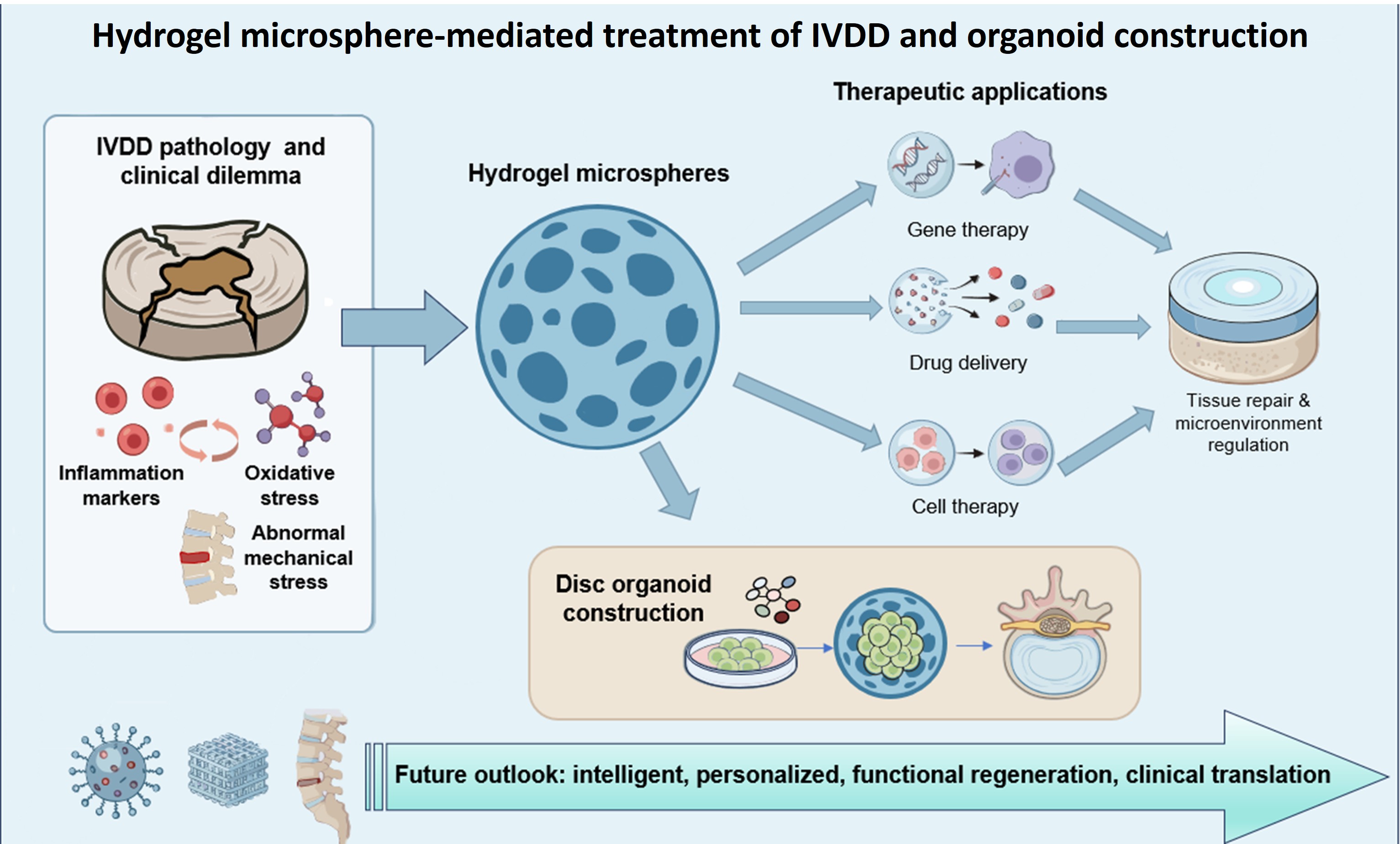
Intervertebral disc degeneration is a complex pathological process driven by multiple factors, involving cellular pathological changes, an imbalance in the inflammatory microenvironment, and oxidative stress mechanisms, and significantly impacts patients’ quality of life. Current treatments lack therapeutic strategies targeting tissue regeneration and repair. With excellent biocompatibility, injectability, tunable mechanical properties, and smart responsive capabilities, hydrogel microspheres serve as ideal carriers for drug, gene, and cell therapies in intervertebral disc degeneration. This paper systematically reviews the preparation techniques and properties of hydrogel microspheres, focusing on their key mechanisms and advantages in gene delivery, drug delivery, and cell-scaffold applications. Subsequently, it summarizes cutting-edge advances in the construction of disc organoids, highlighting the advantages of hydrogel microspheres in mimicking extracellular matrices, constructing 3D biomimetic microenvironments, supporting cell proliferation and differentiation, and recapitulating degenerative microenvironments, thus providing a new platform for disease modeling and personalized therapy. Finally, future directions for hydrogel microsphere-based therapies for disc degeneration are envisioned, including multimodal smart-response design, personalized manufacturing, integrated organoid applications, and non-invasive, precise delivery technologies. This review aims to advance the management of disc degeneration from symptom relief toward functional restoration, thereby promoting clinical translation and the development of precision regenerative medicine.
- Cheng M, Xue Y, Cui M, et al. Global, regional, and national burden of low back pain: Findings from the Global Burden of Disease Study 2021 and Projections to 2050. Spine. 2025;50(7):E128-E139. doi: 10.1097/BRS.0000000000005265
- Xia Q, Zhao Y, Dong H, et al. Progress in the study of molecular mechanisms of intervertebral disc degeneration. Biomed Pharmacother. 2024;174:116593. doi: 10.1016/j.biopha.2024.116593
- Kaneda G, Zila L, Wechsler JT, et al. What a pain in the back: etiology, diagnosis and future treatment directions for discogenic low back pain. Bone Res. 2025;13(1):89. doi: 10.1038/s41413-025-00472-7
- Chen ZX, Xu B, Huang ZL, et al. Causal relationship between systemic circulatory inflammatory regulators and intervertebral disc degeneration: A bidirectional 2-sample Mendelian randomization study. Medicine. 2024;103(36):e39521. doi: 10.1097/MD.0000000000039521
- Kamali A, Ziadlou R, Lang G, et al. Small molecule-based treatment approaches for intervertebral disc degeneration: Current options and future directions. Theranostics. 2021;11(1):27-47. doi: 10.7150/thno.48987
- Keshavarz S, Alavi CE, Aghayan H, Jafari-Shakib R, Vojoudi E. Advancements in degenerative disc disease treatment: A regenerative medicine approach. Stem Cell Rev Rep. 2025;21(5):1252-1282. doi: 10.1007/s12015-025-10882-z
- Gu Z, He Y, Xiang H, et al. Self-healing injectable multifunctional hydrogels for intervertebral disc disease. Mater Today Bio. 2025;32:101655. doi: 10.1016/j.mtbio.2025.101655
- Xia Y, Wang H, Yang R, et al. Biomaterials delivery strategies to repair degenerated intervertebral discs by regulating the inflammatory microenvironment. Front Immunol. 2023;14:1051606. doi: 10.3389/fimmu.2023.1051606
- Wang Z, Li X, Jiang Y, Wu T, Guo S, Li T. Preparation of hydrogel microsphere and its application in articular cartilage injury. Mater Today Bio. 2025;31:101641. doi: 10.1016/j.mtbio.2025.101641
- Song H, Guo C, Wu Y, Liu Y, Kong Q, Wang Y. Therapeutic factors and biomaterial-based delivery tools for degenerative intervertebral disc repair. Front Cell Dev Biol. 2024;12:1286222. doi: 10.3389/fcell.2024.1286222
- Wang W, Cheng Z, Yu M, et al. Injectable ECM-mimetic dynamic hydrogels abolish ferroptosis-induced post-discectomy herniation through delivering nucleus pulposus progenitor cell-derived exosomes. Nat Commun. 2025;16(1):3131. doi: 10.1038/s41467-025-58447-5
- Lu P, Ruan D, Huang M, et al. Harnessing the potential of hydrogels for advanced therapeutic applications: current achievements and future directions. Signal Transduct Target Ther. 2024;9(1):166. doi: 10.1038/s41392-024-01852-x
- Gan Z, Qin X, Liu H, Liu J, Qin J. Recent advances in defined hydrogels in organoid research. Bioact Mater. 2023;28:386- 401. doi: 10.1016/j.bioactmat.2023.06.004
- Jiang S, Li H, Zhang L, et al. Generic Diagramming Platform (GDP): a comprehensive database of high-quality biomedical graphics. Nucleic Acids Res. 2025;53(D1):D1670-D1676. doi: 10.1093/nar/gkae973
- Huang YC, Urban JP, Luk KD. Intervertebral disc regeneration: do nutrients lead the way? Nat Rev Rheumatol. 2014;10(9):561-566. doi: 10.1038/nrrheum.2014.91
- Liu Y, Zhao Z, Guo C, et al. Application and development of hydrogel biomaterials for the treatment of intervertebral disc degeneration: a literature review. Front Cell Dev Biol. 2023;11:1286223. doi: 10.3389/fcell.2023.1286223
- Whatley BR, Wen X. Intervertebral disc (IVD): Structure, degeneration, repair and regeneration. Mater Sci Eng C. 2012;32(2):61–77. doi: 10.1016/j.msec.2011.10.011
- Song C, Hu P, Peng R, Li F, Fang Z, Xu Y. Bioenergetic dysfunction in the pathogenesis of intervertebral disc degeneration. Pharmacol Res. 2024;202:107119. doi: 10.1016/j.phrs.2024.107119
- Desai SU, Srinivasan SS, Kumbar SG, Moss IL. Hydrogel-based strategies for intervertebral disc regeneration: Advances, challenges and clinical prospects. Gels. 2024;10(1):62. doi: 10.3390/gels10010062
- Zhang X, Zhang Z, Zou X, et al. Unraveling the mechanisms of intervertebral disc degeneration: an exploration of the p38 MAPK signaling pathway. Front Cell Dev Biol. 2024;11:1324561. doi: 10.3389/fcell.2023.1324561
- Sudo H. Intervertebral disc degeneration and regeneration: New molecular mechanisms and therapeutics. Cells. 2024;13(2):153. doi: 10.3390/cells13020153
- Zhang W, Li G, Zhou X, et al. Disassembly of the TRIM56- ATR complex promotes cytoDNA/cGAS/STING axis-dependent intervertebral disc inflammatory degeneration. J Clin Invest. 2024;134(6):e165140. doi: 10.1172/JCI165140
- Zhao R, Liu W, Xia T, Yang L. Disordered mechanical stress and tissue engineering therapies in intervertebral disc degeneration. Polymers. 2019;11(7):1151. doi: 10.3390/polym11071151
- Zhu D, Liang H, Du Z, et al. Altered metabolism and inflammation driven by post-translational modifications in intervertebral disc degeneration. Research. 2024;7:0350. doi: 10.34133/research.0350
- Crump KB, Alminnawi A, Bermudez-Lekerika P, et al. Cartilaginous endplates: A comprehensive review on a neglected structure in intervertebral disc research. JOR Spine. 2023;6(4):e1294. doi: 10.1002/jsp2.1294
- Habib M, Hussien S, Jeon O, et al. Intradiscal treatment of the cartilage endplate for improving solute transport and disc nutrition. Front Bioeng Biotechnol. 2023;11:1111356. doi: 10.3389/fbioe.2023.1111356
- Cassidy JJ, Hiltner A, Baer E. Hierarchical structure of the intervertebral disc. Connect Tissue Res. 1989;23(1):75-88. doi: 10.3109/03008208909103905
- Vergroesen PP, Kingma I, Emanuel KS, et al. Mechanics and biology in intervertebral disc degeneration: a vicious circle. Osteoarthr. Cartil. 2015;23(7):1057-1070. doi: 10.1016/j.joca.2015.03.028
- Ogaili RH, Alassal A, Za’aba NF, Zulkiflee I, Mohd Isa IL. Regenerative strategies for intervertebral disc degeneration. J Orthop Translat. 2025;53:286-308. doi: 10.1016/j.jot.2025.06.003
- Park S, Cho SW. Bioengineering toolkits for potentiating organoid therapeutics. Adv Drug Deliv Rev. 2024;208:115238. doi: 10.1016/j.addr.2024.115238
- Kang L, Zhang H, Jia C, Zhang R, Shen C. Epigenetic modifications of inflammation in intervertebral disc degeneration. Ageing Res Rev. 2023;87:101902. doi: 10.1016/j.arr.2023.101902
- Qiao H, Chen T, Yu J, et al. Decoding intervertebral disc degeneration pathomechanics: from mechanisms to therapeutic horizons. J Adv Res. 2026. doi: 10.1016/j.jare.2026.01.045
- Gao R, Zhang Y, Deng B, et al. GM@mTG-V microspheres promote NP regeneration by reconstructing IVD biomechanics and inflammatory microenvironment. Mater Today Bio. 2025;32:101897. doi: 10.1016/j.mtbio.2025.101897
- Tian X, Miao Y, Liu H, et al. Bioinspired hydrogel microspheres enhance nucleus pulposus regeneration through N-cadherin interaction with extracellular matrix mimicry. J Control Release. 2025;383:113771. doi: 10.1016/j.jconrel.2025.113771
- Zhou L, Cai F, Zhu H, et al. Immune-defensive microspheres promote regeneration of the nucleus pulposus by targeted entrapment of the inflammatory cascade during intervertebral disc degeneration. Bioact Mater. 2024;37:132- 152. doi: 10.1016/j.bioactmat.2024.03.020
- Zhang J, Li C, Liu H, et al. Hydrogel delivery systems in intervertebral disc degeneration: Current status and future perspectives. J Control Release. 2025;386:114066. doi: 10.1016/j.jconrel.2025.114066
- Hu X, Tian X, Yang C, et al. Melatonin-loaded self-healing hydrogel targets mitochondrial energy metabolism and promotes annulus fibrosus regeneration. Mater Today Bio. 2023;23:100811. doi: 10.1016/j.mtbio.2023.100811
- Li Y, Zhang Y, Wang S, et al. Synergistic reversal of inflammation-mediated degeneration in intervertebral discs: Phenylboric acid-grafted hyaluronic acid hydrogel as an anti-oxidative vehicle for Timp-3 delivery and promotion of extracellular matrix synthesis. Acta Biomater. 2025;201:156- 170. doi: 10.1016/j.actbio.2025.06.011
- Wang S, Zhai Y, Liu M, et al. A hydrogel-based drug delivery system reduces inflammation and oxidative stress to alleviate intervertebral disc degeneration. Acta Biomater. 2025;203:229-244. doi: 10.1016/j.actbio.2025.07.033
- Zhang J, Li Y, Ding R, et al. ROS-degradable hydrogel delivering LOXL2-LNPs rescues disc degeneration by synchronously suppressing cellular senescence and oxidative damage. J Nanobiotechnol. 2025;23(1):652. doi: 10.1186/s12951-025-03718-y
- Xue P, Wang Y, Lv L, Wang D, Wang Y. Roles of Chemokines in Intervertebral Disk Degeneration. Curr Pain Headache Rep. 2024;28(3):95-108. doi: 10.1007/s11916-023-01188-1
- Xiang H, Zhao W, Jiang K, et al. Progress in regulating inflammatory biomaterials for intervertebral disc regeneration. Bioact Mater. 2023;33:506-531. doi: 10.1016/j.bioactmat.2023.11.021
- Wu W, Cheng Z, Chen X, et al. Pyroptosis: mechanism and therapeutic strategies with intervertebral disc degeneration. Exp Mol Med. 2026;58(1):99-109. doi: 10.1038/s12276-025-01630-x
- Song C, Zhou Y, Cheng K, et al. Cellular senescence - Molecular mechanisms of intervertebral disc degeneration from an immune perspective. Biomed Pharmacother. 2023;162:114711. doi: 10.1016/j.biopha.2023.114711
- Yang X, Cao X, Wang X, et al. Palladium nanoparticles degrade advanced glycation end products via valosin-containing protein mediated autophagy to attenuate high-glucose/high-fat-induced intervertebral disc degeneration. Exploration. 2025;5(2):20230174. doi: 10.1002/EXP.20230174
- Ren Q, Chen L, Ma Y, Huang Y, Wang S. Immune microenvironment in intervertebral disc degeneration: pathophysiology and therapeutic potential. Front Immunol. 2025;16:1563635. doi: 10.3389/fimmu.2025.1563635
- Ding Y, Cai Y, Pan W, et al. One-stone-three-birds biomimetic oral targeting delivery strategy for on-demand controlled drug release and intervertebral disc degeneration therapy. Exploration. 2026;6(1):20250061. doi: 10.1002/EXP.20250061
- Desmoulin GT, Pradhan V, Milner TE. Mechanical Aspects of Intervertebral Disc Injury and Implications on Biomechanics. Spine. 2020;45(8):E457-E464. doi: 10.1097/brs.0000000000003291
- Shen J, Chen A, Cai Z, et al. Exhausted local lactate accumulation via injectable nanozyme-functionalized hydrogel microsphere for inflammation relief and tissue regeneration. Bioact Mater. 2021;12:153-168. doi: 10.1016/j.bioactmat.2021.10.013
- Wu J, Chen Y, Liao Z, et al. Self-amplifying loop of NF-κB and periostin initiated by PIEZO1 accelerates mechano-induced senescence of nucleus pulposus cells and intervertebral disc degeneration. Mol Ther. 2022;30(10):3241-3256. doi: 10.1016/j.ymthe.2022.05.021
- Zhang M, Jia J, Deng L, et al. Risk factors associated with low-grade virulent infection in intervertebral disc degeneration: a systematic review and meta-analysis. Spine J. 2024;24(6):1034-1045. doi: 10.1016/j.spinee.2024.02.001
- Guan Y, Bai X, Li C, et al. The role and potential therapeutic intervention of cellular senescence in intervertebral disc degeneration. Genes Dis. 2025;13(4):101871. doi: 10.1016/j.gendis.2025.101871
- Chen W, Zheng D, Chen H, et al. Circadian clock regulation via biomaterials for nucleus pulposus. Adv Mater. 2023;35(32):e2301037. doi: 10.1002/adma.202301037
- Zhang TW, Li ZF, Dong J, Jiang LB. The circadian rhythm in intervertebral disc degeneration: an autophagy connection. Exp Mol Med. 2020;52(1):31-40. doi: 10.1038/s12276-019-0372-6
- Aging Biomarker Consortium, Suo J, Gan Y, et al. A framework of biomarkers for skeletal aging: a consensus statement by the Aging Biomarker Consortium. Life Med. 2023;2(6):lnad045. doi: 10.1093/lifemedi/lnad045
- Zhao L, Liang K, Cheng W, et al. A multifaceted strategy for intra- and extracellular nucleic acid regulation to alleviate intervertebral disc degeneration. Nat Commun. 2025;16(1):7936. doi: 10.1038/s41467-025-63194-8
- Briggs AM, Sumi Y, Banerjee A. The World Health Organization guideline for non-surgical management of chronic primary low back pain in adults: implications for equitable care and strengthening health systems globally. Glob Health Res Policy. 2025;10(1):26. doi: 10.1186/s41256-025-00426-w
- Zàaba NF, Ogaili RH, Ahmad F, Mohd Isa IL. Neuroinflammation and nociception in intervertebral disc degeneration: a review of precision medicine perspective. Spine J. 2025;25(6):1139-1153. doi: 10.1016/j.spinee.2024.12.033
- Studnicki R, Szymczyk P, Adamczewski T, et al. Manual traction is effective in alleviating lumbosacral spine pain: Evidence from a randomized controlled trial. Heliyon. 2024;10(10):e31013. doi: 10.1016/j.heliyon.2024.e31013
- Eisenstein SM, Balain B, Roberts S. Current treatment options for intervertebral disc pathologies. Cartilage. 2020;11(2):143-151. doi: 10.1177/1947603520907665
- Jokeit M, Tsagkaris C, Altorfer FCS, et al. Impact of iatrogenic alterations on adjacent segment degeneration after lumbar fusion surgery: a systematic review. J Orthop Surg Res. 2025;20(1):425. doi: 10.1186/s13018-025-05561-1
- Zhang P, Jin Y, Zhu B, Zheng M, Ying X, Zheng Q. Unilateral biportal endoscopic foraminotomy and diskectomy combined with piezosurgery for treating cervical spondylotic radiculopathy with neuropathic radicular pain. Front Neurol. 2023;14:1100641. doi: 10.3389/fneur.2023.1100641
- Moghib K, Altalab G, Jader A, et al. Comparison between spinal fusion vs. nonoperative treatment for lumbar degenerative pathology: a systematic review and meta-analysis. Neurosurg Rev. 2025;48(1):502. doi: 10.1007/s10143-025-03671-2
- Wang Z, Yang H, Xu X, et al. Ion elemental-optimized layered double hydroxide nanoparticles promote chondrogenic differentiation and intervertebral disc regeneration of mesenchymal stem cells through focal adhesion signaling pathway. Bioact Mater. 2022;22:75-90. doi: 10.1016/j.bioactmat.2022.08.023
- Sigurdarson H, Joshi A, Mohebi A, Hassanzadeh H. Applications and quality assurance of artificial intelligence in adult spinal deformity surgery. Art Int Surg. 2025;5(2):283- 297. doi: 10.20517/ais.2024.35
- Ambati VS, Saggi S, Dada A, Alan N. Has artificial intelligence in spine surgery lived up to the hype? A narrative review of recent approaches, current challenges, and the path forward. Art Int Surg. 2025;5(1):53-64. doi: 10.20517/ais.2024.45
- Ma L, Zhao X, Hou J, et al. Droplet microfluidics for biomedical applications: emerging trends and future developments. Microsyst Nanoeng. 2026;12(1):53. doi: 10.1038/s41378-026-01175-7
- Yang M, Shi Y, Wang F, et al. Hydrogel microspheres as versatile platforms for biomedical research: Design, properties, and applications. MedComm. 2025;6(10):e70423. doi: 10.1002/mco2.70423
- Liu Y, Chen Z, Xu J. Recent advances in the microfluidic generation of shape-controllable hydrogel microparticles and their applications. Green Chem Eng. 2024;5(1):16–30. doi: 10.1016/j.gce.2023.02.002
- Velasco V, Shariati SA, Esfandyarpour R. Microtechnology-based methods for organoid models. Microsyst Nanoeng. 2020;6:76. doi: 10.1038/s41378-020-00185-3
- Chen Z, Lv Z, Zhang Z, et al. Advanced microfluidic devices for fabricating multi-structural hydrogel microsphere. Exploration. 2021;1(3):20210036. doi: 10.1002/EXP.20210036
- Yue J, Liu Z, Wang L, Wang M, Pan G. Recent advances in bioactive hydrogel microspheres: Material engineering strategies and biomedical prospects. Mater Today Bio. 2025;31:101614. doi: 10.1016/j.mtbio.2025.101614
- Lin CH, Srioudom JR, Sun W, et al. The use of hydrogel microspheres as cell and drug delivery carriers for bone, cartilage, and soft tissue regeneration. Biomater Transl. 2024;5(3):236-256. doi: 10.12336/biomatertransl.2024.03.003
- Li H, Yu L, Li Z, et al. A narrative review of bioactive hydrogel microspheres: Ingredients, modifications, fabrications, biological functions, and applications. Small. 2025;21(25):e2500426. doi: 10.1002/smll.202500426
- Malik SA, Ng WH, Bowen J, et al. Electrospray synthesis and properties of hierarchically structured PLGA TIPS microspheres for use as controlled release technologies. J Colloid Interface Sci. 2016;467:220-229. doi: 10.1016/j.jcis.2016.01.021
- Yang S, Wang F, Han H, et al. Fabricated technology of biomedical micro-nano hydrogel. Biomed Technol. 2023;2:31–48. doi: 10.1016/j.bmt.2022.11.012
- Zhao Z, Wang Z, Li G, et al. Injectable microfluidic hydrogel microspheres for cell and drug delivery. Adv Funct Mater. 2021;31(31):2103339. doi: 10.1002/adfm.202103339
- Zhang C, Grossier R, Candoni N, Veesler S. Preparation of alginate hydrogel microparticles by gelation introducing cross-linkers using droplet-based microfluidics: a review of methods. Biomater Res. 2021;25(1):41. doi: 10.1186/s40824-021-00243-5
- Kim HU, Lim YJ, Lee HJ, Lee NJ, Bong KW. Degassed micromolding lithography for rapid fabrication of anisotropic hydrogel microparticles with high-resolution and high uniformity. Lab Chip. 2020;20(1):74-83. doi: 10.1039/c9lc00828d
- Yin P, Su W, Li T, et al. A modular hydrogel bioink containing microsphere-embedded chondrocytes for 3D-printed multiscale composite scaffolds for cartilage repair. iScience. 2023;26(8):107349. doi: 10.1016/j.isci.2023.107349
- Koltsov SI, Statsenko TG, Morozova SM. Modification of commercial 3D Fused deposition modeling printer for extrusion printing of hydrogels. Polymers. 2022;14(24):5539. doi: 10.3390/polym14245539
- El Kadib A. Green and functional aerogels by macromolecular and textural engineering of chitosan microspheres. Chem Rec. 2020;20(8):753-772. doi: 10.1002/tcr.201900089
- Liu L, Wang W, Huang L, et al. Injectable pathological microenvironment-responsive anti-inflammatory hydrogels for ameliorating intervertebral disc degeneration. Biomaterials. 2024;306:122509. doi: 10.1016/j.biomaterials.2024.122509
- Cheng H, A C, Shu Z, et al. Microenvironment-targeted strontium delivery system reshapes redox homeostasis to halt degenerative cascades in intervertebral discs. J Control Release. 2026;389:114449. doi: 10.1016/j.jconrel.2025.114449
- Jiang S, Jing H, Zhuang Y, et al. BMSCs-laden mechanically reinforced bioactive sodium alginate composite hydrogel microspheres for minimally invasive bone repair. Carbohydr Polym. 2024;332:121933. doi: 10.1016/j.carbpol.2024.121933
- Xiao P, Liu J, Du C, et al. Injectable mineralized hydrogel microspheres for accelerated osteocyte network reconstruction and intelligent bone regeneration. J Control Release. 2025;380:240-255. doi: 10.1016/j.jconrel.2025.02.002
- Sapuła P, Bialik-Wąs K, Malarz K. Are Natural Compounds a Promising Alternative to Synthetic Cross-Linking Agents in the Preparation of Hydrogels? Pharmaceutics. 2023;15(1):253. doi: 10.3390/pharmaceutics15010253
- Meseberg T, Kurz S, Spohn J. Foreign body reaction: towards a macrophage-centered adverse outcome pathway for fibrotic encapsulation. Front Toxicol. 2026;8:1735871. doi: 10.3389/ftox.2026.1735871
- Hou Y, Wu R, Zhou Y, et al. Macrophage membrane-coated nanoparticles in inflammatory diseases: from bioinspired design to translational potential. J Nanobiotechnol. 2025;24(1):37. doi: 10.1186/s12951-025-03921-x
- Wang J, Wu Y, Li G, et al. Engineering Large-Scale Self-Mineralizing Bone Organoids with Bone Matrix- Inspired Hydroxyapatite Hybrid Bioinks. Adv Mater. 2024;36(30):e2309875. doi: 10.1002/adma.202309875
- Guo T, Zhang X, Hu Y, et al. New hope for treating intervertebral disc degeneration: Microsphere-based delivery system. Front Bioeng Biotechnol. 2022;10:933901. doi: 10.3389/fbioe.2022.933901
- Wang Y, Deng M, Wu Y, et al. A multifunctional mitochondria-protective gene delivery platform promote intervertebral disc regeneration. Biomaterials. 2025;317:123067. doi: 10.1016/j.biomaterials.2024.123067
- Qingxin S, Kai J, Dandan Z, et al. Programmable DNA hydrogel provides suitable microenvironment for enhancing autophagy-based therapies in intervertebral disc degeneration treatment. J Nanobiotechnol. 2023;21(1):350. doi: 10.1186/s12951-023-02109-5
- Guo C, Liu Y, Zhao Z, Wu Y, Kong Q, Wang Y. Regulating inflammation and apoptosis: A smart microgel gene delivery system for repairing degenerative nucleus pulposus. J Control Release. 2024;365:1004-1018. doi: 10.1016/j.jconrel.2023.12.029
- Zheng J, Zhang X, Zhang F, et al. Hydrogels targeting mechanical-biological signaling transitions of interleukin-33 alleviates intervertebral-disc degeneration. Mater Today Bio. 2025;36:102726. doi: 10.1016/j.mtbio.2025.102726
- Chen J, Zhu H, Xia J, et al. High-performance multi-dynamic bond cross-linked hydrogel with spatiotemporal siRNA delivery for gene-cell combination therapy of intervertebral disc degeneration. Adv Sci. 2023;10(17):e2206306. doi: 10.1002/advs.202206306
- Gong Y, Shi W, Liu X, et al. Brachyury-activated fucoidan hydrogel microspheres rejuvenate degenerative intervertebral discs microenvironment. Adv Sci. 2025;12(34):e04195. doi: 10.1002/advs.202504195
- Ma L, Pan J, Zhang J, Liu F. Innovative strategies in combating intervertebral disc degeneration: pathological mechanisms and biomaterial advancements. Front Bioeng Biotechnol. 2025;13:1643222. doi: 10.3389/fbioe.2025.1643222
- Ding Y, Li F, Wang Y, Pan W, Fu X, Tan S. Nanomedicine approaches for intervertebral disc regeneration: from bench to bedside. Pharmaceutics. 2025;17(3):313. doi: 10.3390/pharmaceutics17030313
- Wang Y, Tan L, Yang Y, et al. Targeting the ROS-ferroptosis-inflammation cycle with a nanozyme-functionalized hydrogel for intervertebral disc repair. Nat Commun. 2025;16(1):11253. doi: 10.1038/s41467-025-66116-w
- Lv J, Shen Y, Zhou Q, et al. Selenium-functionalized hydrogel microspheres promote nucleus pulposus reconstruction by activating selenoprotein-mediated mitochondrial redox homeostasis and energy metabolism. Biomaterials. 2026;328:123826. doi: 10.1016/j.biomaterials.2025.123826
- Jin C, Chen J, Miao Y, et al. Cuttlefish ink nanoparticle-engineered hydrogel microspheres synergistically attenuate disc degeneration via antioxidant defense and matrix synthesis activation. Mater Today Bio. 2025;34:102244. doi: 10.1016/j.mtbio.2025.102244
- Li Z, Cai F, Tang J, et al. Oxygen metabolism-balanced engineered hydrogel microspheres promote the regeneration of the nucleus pulposus by inhibiting acid-sensitive complexes. Bioact Mater. 2022;24:346-360. doi: 10.1016/j.bioactmat.2022.12.025
- Li Y, Tian X, He W, et al. Fucoidan-functionalized gelatin methacryloyl microspheres ameliorate intervertebral disc degeneration by restoring redox and matrix homeostasis of nucleus pulposus. Int J Biol Macromol. 2023;250:126166. doi: 10.1016/j.ijbiomac.2023.126166
- Wang D, Zhang L, He D, et al. A natural hydrogel complex improves intervertebral disc degeneration by correcting fatty acid metabolism and inhibiting nucleus pulposus cell pyroptosis. Mater Today Bio. 2024;26:101081. doi: 10.1016/j.mtbio.2024.101081
- Hong Y, Duan Y, Zhu Z, et al. IL-1ra loaded chondroitin sulfate-functionalized microspheres for minimally invasive treatment of intervertebral disc degeneration. Acta Biomater. 2024;185:336-349. doi: 10.1016/j.actbio.2024.06.048
- Cheng H, Guo Q, Zhao H, et al. An injectable hydrogel scaffold loaded with dual-drug/sustained-release PLGA microspheres for the regulation of macrophage polarization in the treatment of intervertebral disc degeneration. Int J Mol Sci. 2022;24(1):390. doi: 10.3390/ijms24010390
- Ma T, Wu J, Chen S, Bian J, Gao G, Nong L. pH-responsive modified HAMA microspheres regulate the inflammatory microenvironment of intervertebral discs. ACS Appl Mater Interfaces. 2024;16(46):63295-63305. doi: 10.1021/acsami.4c14475
- Wang W, Liu L, Ma W, et al. An anti-senescence hydrogel with pH-responsive drug release for mitigating intervertebral disc degeneration and low back pain. Bioact Mater. 2024;41:355- 370. doi: 10.1016/j.bioactmat.2024.07.031
- Chen Y, Yang ZR, Cheng Z, et al. Injectable hydrogel microspheres promoting inflammation modulation and nucleus pulposus-like differentiation for intervertebral disc regeneration. J Control Release. 2025;380:599-614. doi: 10.1016/j.jconrel.2025.02.016
- Wang F, Guo K, Nan L, et al. Kartogenin-loaded hydrogel promotes intervertebral disc repair via protecting MSCs against reactive oxygen species microenvironment by Nrf2/ TXNIP/NLRP3 axis. Free Radic Biol Med. 2023;204:128-150. doi: 10.1016/j.freeradbiomed.2023.04.018
- Bello AB, Kim Y, Park S, et al. Matrilin3/TGFβ3 gelatin microparticles promote chondrogenesis, prevent hypertrophy, and induce paracrine release in MSC spheroid for disc regeneration. NPJ Regen Med. 2021;6(1):50. doi: 10.1038/s41536-021-00160-0
- Wang D, Peng P, Dudek M, et al. Restoring the dampened expression of the core clock molecule BMAL1 protects against compression-induced intervertebral disc degeneration. Bone Res. 2022;10(1):20. doi: 10.1038/s41413-022-00187-z
- Onuora S. Targeting the IVD clock to halt degeneration. Nat Rev Rheumatol. 2022;18(10):553. doi: 10.1038/s41584-022-00838-9
- Mai Y, Wu S, Zhang P, Chen N, Wu J, Wei F. The anti-oxidation related bioactive materials for intervertebral disc degeneration regeneration and repair. Bioact Mater. 2024;45:19-40. doi: 10.1016/j.bioactmat.2024.10.012
- Yang Y, Guo J, Cao H, et al. Seeds-and-soil inspired hydrogel microspheres: A dual-action antioxidant and cellular therapy for reversing intervertebral disc degeneration. Biomaterials. 2025;321:123326. doi: 10.1016/j.biomaterials.2025.123326
- Tang Y, Zhang K, Zhou H, et al. Transplantation of active nucleus pulposus cells with a keep-charging hydrogel microsphere system to rescue intervertebral disc degeneration. J Nanobiotechnology. 2023;21(1):453. doi: 10.1186/s12951-023-02226-1
- Dai J, Ni L, Jin C, et al. Esterase-responsive kartogenin composite hydrogel microspheres boost nucleus pulposus regeneration in intervertebral disc degeneration. Acta Biomater. 2025;198:131-150. doi: 10.1016/j.actbio.2025.04.001
- Wang J, Huang Y, Luan T, et al. Hydrogel and microgel collaboration for spatiotemporal delivery of biofactors to awaken nucleus pulposus-derived stem cells for endogenous repair of disc. Small. 2024;20(49):e2404732. doi: 10.1002/smll.202404732
- Zhao Y, Dong H, Xia Q, et al. A new strategy for intervertebral disc regeneration: The synergistic potential of mesenchymal stem cells and their extracellular vesicles with hydrogel scaffolds. Biomed Pharmacother. 2024;172:116238. doi: 10.1016/j.biopha.2024.116238
- Peng Y, Chen X, Zhang Q, et al. Enzymatically bioactive nucleus pulposus matrix hydrogel microspheres for exogenous stem cells therapy and endogenous repair strategy to achieve disc regeneration. Adv Sci. 2024;11(10):e2304761. doi: 10.1002/advs.202304761
- Chen Z, Bo Q, Wang C, Xu Y, Fei X, Chen R. Single BMSC-derived cartilage organoids for gradient heterogeneous osteochondral regeneration by leveraging native vascular microenvironment. J Nanobiotechnol. 2025;23(1):325. doi: 10.1186/s12951-025-03403-0
- Zhou X, Lv Z, Chen Z, et al. Manipulation of oxygen tension in damaged regions via hypoxia-induced IPN hydrogel microspheres for intervertebral disc regeneration. Adv Sci. 2025;12(22):e2417570. doi: 10.1002/advs.202417570
- Tang Y, Lin X, Som A, Zhang M. Cell and hydrogel-integrated therapies for intervertebral disc regeneration. Adv Healthc Mater. 2026;15(1):e02354. doi: 10.1002/adhm.202502354
- Zhang X, Huang C, Huang K, et al. Living and injectable porous hydrogel microspheres promoting inflammation modulation and extracellular matrix remodeling for intervertebral disc regeneration. ACS Appl Mater Interfaces. 2025;17(42):57953-57966. doi: 10.1021/acsami.5c13982
- Xu Y, Zhou J, Liu C, et al. Understanding the role of tissue-specific decellularized spinal cord matrix hydrogel for neural stem/progenitor cell microenvironment reconstruction and spinal cord injury. Biomaterials. 2021;268:120596. doi: 10.1016/j.biomaterials.2020.120596
- Faeed M, Ghiasvand M, Fareghzadeh B, Taghiyar L. Osteochondral organoids: current advances, applications, and upcoming challenges. Stem Cell Res Ther. 2024;15(1):183. doi: 10.1186/s13287-024-03790-5
- Lou X, Zhou Q, Dong Z, Bai L, Su J, Yue H. Innovative strategies for bone organoid: Synergistic application and exploration of advanced technologies. J Orthop Translat. 2025;54:180-198. doi: 10.1016/j.jot.2025.07.010
- Chen S, Chen X, Geng Z, Su J. The horizon of bone organoid: A perspective on construction and application. Bioact Mater. 2022;18:15-25. doi: 10.1016/j.bioactmat.2022.01.048
- Schutgens F, Clevers H. Human organoids: Tools for understanding biology and treating diseases. Annu Rev Pathol. 2020;15:211-234. doi: 10.1146/annurev-pathmechdis-012419-032611
- Chen W, Yan L, Oliveria JM, Reis RL, Zhang C, He Y. Organoids: Current status and prospects (2025). OR. 2025;2(1):025140014. doi: 10.36922/or025140014
- Bai L, Reis RL, Chen X, Su J, Liu C. Organoid research: Advanced models, precision medicine, and translational medicine. Organoid Res. 2025;1(1):25060009. doi: 10.36922/or025060009
- Zeng Q, Xie D, Wang D, et al. Bioengineered materials-driven construction of musculoskeletal organoids in aging research: Strategies, applications, and future perspectives. Organoid Res. 2025;1(4):025450033. doi: 10.36922/or025450033
- Wang X, He J, Zhang Q, He J, Wang Q. Constructing a 3D co-culture in vitro synovial tissue model for rheumatoid arthritis research. Mater Today Bio. 2025;31:101492. doi: 10.1016/j.mtbio.2025.101492
- Han X, Cai C, Deng W, et al. Landscape of human organoids: Ideal model in clinics and research. Innovation. 2024;5(3):100620. doi: 10.1016/j.xinn.2024.100620
- Zhao Y, Li S, Zhu L, et al. Personalized drug screening using patient-derived organoid and its clinical relevance in gastric cancer. Cell Rep Med. 2024;5(7):101627. doi: 10.1016/j.xcrm.2024.101627
- Chen W, Liu D, Lu K, et al. Organoids of musculoskeletal system for disease modeling, drug screening, and regeneration. Adv Healthc Mater. 2025;14(9):e2402444. doi: 10.1002/adhm.202402444
- Yao Q, Cheng S, Pan Q, et al. Organoids: development and applications in disease models, drug discovery, precision medicine, and regenerative medicine. MedComm. 2024;5(10):e735. doi: 10.1002/mco2.735
- Hu Y, Zhang H, Wang S, et al. Bone/cartilage organoid on-chip: Construction strategy and application. Bioact Mater. 2023;25:29-41. doi: 10.1016/j.bioactmat.2023.01.016
- Peredo AP, Tsinman TK, Bonnevie ED, et al. Developmental morphogens direct human induced pluripotent stem cells toward an annulus fibrosus-like cell phenotype. JOR Spine. 2024;7(1):e1313. doi: 10.1002/jsp2.1313
- Chen L, Zhang Z, Zhang T, et al. Engineered organoid precursor with micro-nano materials for boosting nucleus pulposus reconstruction after discectomy. Nano Today. 2025;64:102786. doi: 10.1016/j.nantod.2025.102786
- Wang D, Luo Z, Yang L. Repair and reconstruction of intervertebral disc degeneration: From tissue engineering to organoid and assembloid construction. Spine Res. 2025;1(2):50-64. doi: 10.1097/br9.0000000000000014
- Jin Y, Chen Q, Gong L, et al., 2025, Organoids: Applications and challenges of advanced hydrogels in tissue systems. Organoid Res. 2025;1(2):8262. doi: 10.36922/or.8262
- Su J, Yan Z, Tang X, Wu T, Ling J, Qian Y. Engineering spinal cord and peripheral nerve organoids: Strategies for construction and potential applications for regenerative medicine in neurotrauma. J Eng. 2025. doi: 10.1016/j.eng.2025.05.011
- Wei X, Qiu J, Lai R, et al. A human organoid drug screen identifies α2-adrenergic receptor signaling as a therapeutic target for cartilage regeneration. Cell Stem Cell. 2024;31(12):1813-1830.e8. doi: 10.1016/j.stem.2024.09.001
- Tanvir MAH, Khaleque MA, Lee J, et al. Three-Dimensional Bioprinting for Intervertebral Disc Regeneration. J Funct Biomater. 2025;16(3):105. doi: 10.3390/jfb16030105
- Sun AR, Ramli MFH, Shen X, et al. Hybrid hydrogel-extracellular matrix scaffolds identify biochemical and mechanical signatures of cardiac ageing. Nat Mater. 2025;24(9):1489-1501. doi: 10.1038/s41563-025-02234-6
- Li X, Li X, Zhou D, et al. Bottom-up engineering of the nucleus pulposus using a photocrosslinkable decellularized matrix hydrogel attenuates inflammaging and enhances microtissue-mediated regeneration. Mater Today Bio. 2025;35:102347. doi: 10.1016/j.mtbio.2025.102347
- Ma T, Liu C, Zhao Q, Zhang Y, Xiao L. Decellularized nucleus pulposus matrix/chitosan hybrid hydrogel combined with nucleus pulposus stem cells and GDF5-loaded microspheres for intervertebral disc degeneration prevention. Mol Med. 2024;30(1):7. doi: 10.1186/s10020-024-00777-z
- Yang XX, Yip CH, Zhao S, Ho YP, Chan BP. A bio-inspired nano-material recapitulating the composition, ultra-structure, and function of the glycosaminoglycan-rich extracellular matrix of nucleus pulposus. Biomaterials. 2023;293:121991. doi: 10.1016/j.biomaterials.2022.121991
- Han C, Jiao J, Gong C, Li J, Zhao M, Lu X. Multidimensional exploration of hydrogels as biological scaffolds for spinal cord regeneration: mechanisms and future perspectives. Front Bioeng Biotechnol. 2025;13:1576524. doi: 10.3389/fbioe.2025.1576524
- Pahlevanzadeh F, Emadi R, Valiani A, et al. Three-dimensional printing constructs based on the chitosan for tissue regeneration: State of the art, developing directions and prospect trends. Materials. 2020;13(11):2663. doi: 10.3390/ma13112663
- Chen Z, Lv Z, Zhuang Y, et al. Mechanical signal-tailored hydrogel microspheres recruit and train stem cells for precise differentiation. Adv Mater. 2023;35(40):e2300180. doi: 10.1002/adma.202300180
- Ma W, Lu H, Xiao Y, Wu C. Advancing organoid development with 3D bioprinting. Organoid Res. 2025;1(1):025040004. doi: 10.36922/or025040004