

An effective method and control structure for proton exchange membrane fuel cells

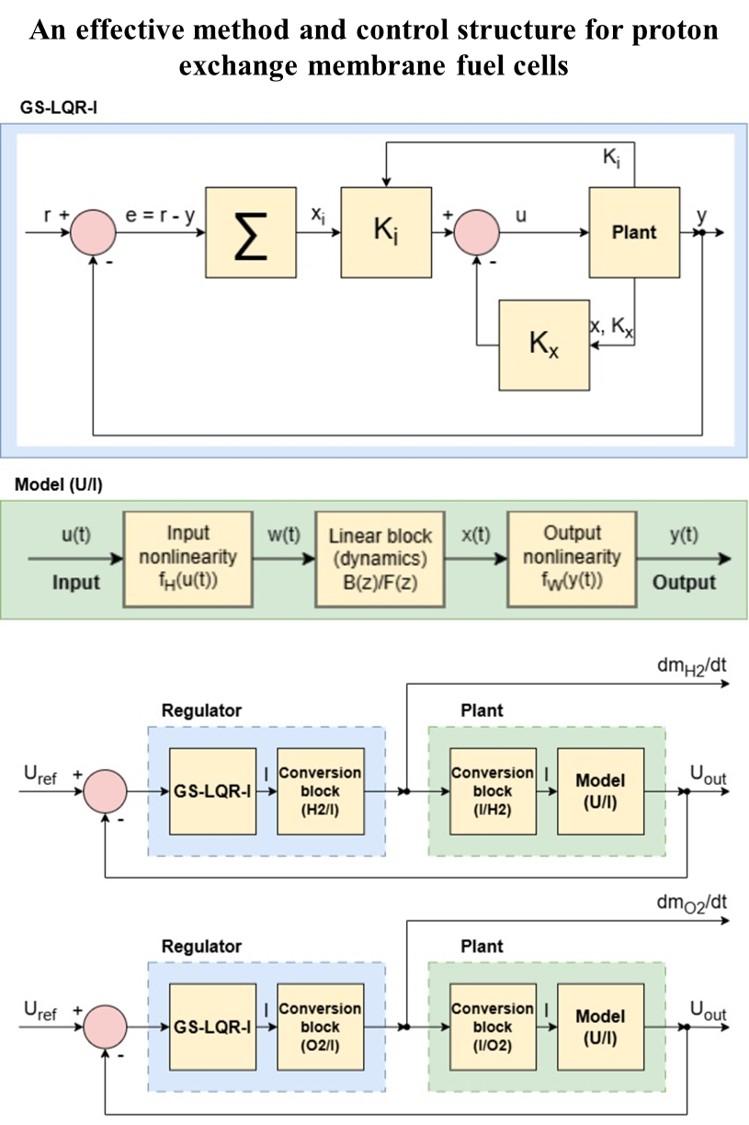
The nonlinear and dynamic behavior of PEM fuel cells presents challenges for voltage regulation and motivates the development of advanced control strategies. This paper investigates advanced control methods for nonlinear processes in proton exchange membrane (PEM) fuel cell applications and presents a control structure for a 500 W Horizon H-500 PEM fuel cell. This fuel cell is represented by a nonlinear Hammerstein–Wiener model that was identified from experimental data. The study focuses on voltage regulation by reactant mass flow. The control structure uses a simplified approach with predefined constant stoichiometric ratios for reactant flow calculation instead of variable ratios based on the actual operating conditions of the fuel cell. Since PEM fuel cells are highly nonlinear systems, it is necessary to use control approaches that can handle these nonlinearities. Four advanced control approaches are discussed: the linear quadratic regulator (LQR) with an integral term and gain scheduling (GS-LQR-I), sliding mode control, nonlinear model predictive control, and fuzzy logic control, each offering different trade-offs in terms of robustness, stability, and computational complexity. Among the considered approaches, GS-LQR-I was selected for implementation and further investigation. The LQR approach is based on a linear model of the controlled system. Therefore, local linear models needed to be derived from the nonlinear Hammerstein–Wiener model for gain-scheduled controller design. The resulting discrete-time closed-loop systems were analyzed using quadratic Lyapunov functions and the eigenvalues of the corresponding closed-loop system matrices. Numerical and graphical results for the selected GS-LQR-I method are presented. Control of PEM fuel cells is an important area of research and applied development because operating conditions strongly affect their efficiency, dynamic behavior, and lifetime. The proposed method demonstrated satisfactory control performance under the investigated operating conditions.
- Deng Z, Miao B, Cui Y, et al. Towards high-performance fuel cell systems: Comprehensive review of methods for modeling, control, and optimization. Renew Sustain Energy Rev. 2025;224:116122. doi: 10.1016/j.rser.2025.116122
- Özbek M, Wang S, Marx M, Söffker D. Modeling and control of a PEM fuel cell system: A practical study based on experimentally defined component behavior. J Process Control. 2013;23(3):282-293. doi: 10.1016/j.jprocont.2012.11.009
- Rakhmatillaev J, Bučinskas V, Kabulov N. An integrative review of control strategies in robotics. Robot Syst Appl. 2025;5(2):50-74. doi: 10.21595/rsa.2025.25014
- Leith DJ, Leithead WE. Survey of gain-scheduling analysis and design. Int J Control. 2000;73(11):1001-1025. doi: 10.1080/002071700411304
- Kozák Š. From PID to MPC: Control engineering methods development and applications. In: 2016 Cybernetics & Informatics (K&I). 2016:1-7. doi: 10.1109/CYBERI.2016.7438634
- Debbat MB, Salem M, Bachir-Bouiadjra R. LQR controller with an integral action for Z-source DC-DC converter. Prz Elektrotech. 2019;1(9):91-95. doi: 10.15199/48.2019.09.17
- Al-Durra A, Yurkovich S, Guezennec Y. Study of nonlinear control schemes for an automotive traction PEM fuel cell system. Int J Hydrogen Energy. 2010;35(20):11291-11307. doi: 10.1016/j.ijhydene.2010.07.046
- Hashmi SMH. Cooling strategies for PEM FC stacks. Dissertation. Hamburg, Germany: Helmut-Schmidt-Universität / Universität der Bundeswehr Hamburg; 2010.
- Borkovski S, Erkechova M. Control approaches of PEM fuel cells: A review. Industry 4.0. 2020;5(3):126-131.
- Khather SI, Ibrahim MA, Abdullah AI. Review and performance analysis of nonlinear model predictive control—current prospects, challenges and future directions. J Eur Syst Autom. 2023;56(4):593-603. doi: 10.18280/jesa.560409
- Chen X, Fang Y, Liu Q, et al. Temperature and voltage dynamic control of PEMFC stack using MPC method. Energy Rep. 2022;8(1):798-808. doi: 10.1016/j.egyr.2021.11.271
- Daud WRW, Rosli RE, Majlan EH, Hamid SAA, Mohamed R, Husaini T. PEM fuel cell system control: A review. Renew Energ. 2017;113:620-638. doi: 10.1016/j.renene.2017.06.027
- Trinh HA, Phan VD, Truong HVA, Ahn KK. Energy management strategy for PEM fuel cell hybrid power system considering DC bus voltage regulation. Electronics. 2022;11(17):2722. doi: 10.3390/electronics11172722
- Kim B, Cha D, Kim Y. The effects of air stoichiometry and air excess ratio on the transient response of a PEMFC under load change conditions. Appl Energy. 2015;138:143-149. doi: 10.1016/j.apenergy.2014.10.046
- Berning T, Knudsen Kær S. A thermodynamic analysis of an air-cooled proton exchange membrane fuel cell operated in different climate regions. Energies. 2020;13(10):2611. doi: 10.3390/en13102611
- Ljung L. System Identification Toolbox User's Guide. Natick, MA: The MathWorks, Inc.; 2023.
- Kappatou CD, Bongartz D, Najman J, Sass S, Mitsos A. Global dynamic optimization with Hammerstein-Wiener models embedded. J Glob Optim. 2022;84(2):321-347. doi: 10.1007/s10898-022-01145-z
- Putala R, Ferencey V. Hydrogen fuel cell system modeling approaches. In: 2025 Cybernetics & Informatics (K&I). 2025:192-198. doi: 10.1109/KI64036.2025.10916424
- Fang S, Feng J, Fan X, Chen D, Tan C. PEMFC gas-feeding control: Critical insights and review. Actuators. 2024;13(11):455. doi: 10.3390/act13110455
- The MathWorks, Inc. idnlhw/linearize: Linearize Hammerstein-Wiener model. MathWorks. Accessed September 23, 2026. https://se.mathworks.com/help/ident/ref/idnlhwlinearize.html.
- Fadali MS, Visioli A. Digital Control Engineering: Analysis and Design. 2nd ed. San Diego, CA: Academic Press; 2013.
- Mostafa ESME, Aboutahoun AW, Omar FFS. On the solution of the eigenvalue assignment problem for discrete-time systems. J Appl Math. 2017;2017(1):7256769. doi: 10.1155/2017/7256769
- Tropp JA. ACM 204: Matrix Analysis. Caltech CMS Lecture Notes 2022-01. Pasadena, CA: California Institute of Technology; 2022. doi: 10.7907/m421-yb89
- Shi F, Xu X, Liu X, Cao Y, Gao S, Mou J. Complex neuronal dynamics under memristive electromagnetic radiation: Modeling and digital signal processing implementation. Nonlinear Sci Control Eng. 2025;1(2):025400013. doi: 10.36922/NSCE025400013
- Zobiri F, Meslem N, Bidegaray-Fesquet B. Event-triggered stabilizing controllers for switched linear systems. Nonlinear Anal Hybrid Sys 2020;36:100831. doi: 10.1016/j.nahs.2019.100831