
Theoretical analysis and microcontroller-based design of a cyclic network of three mutually coupled Duffing oscillators

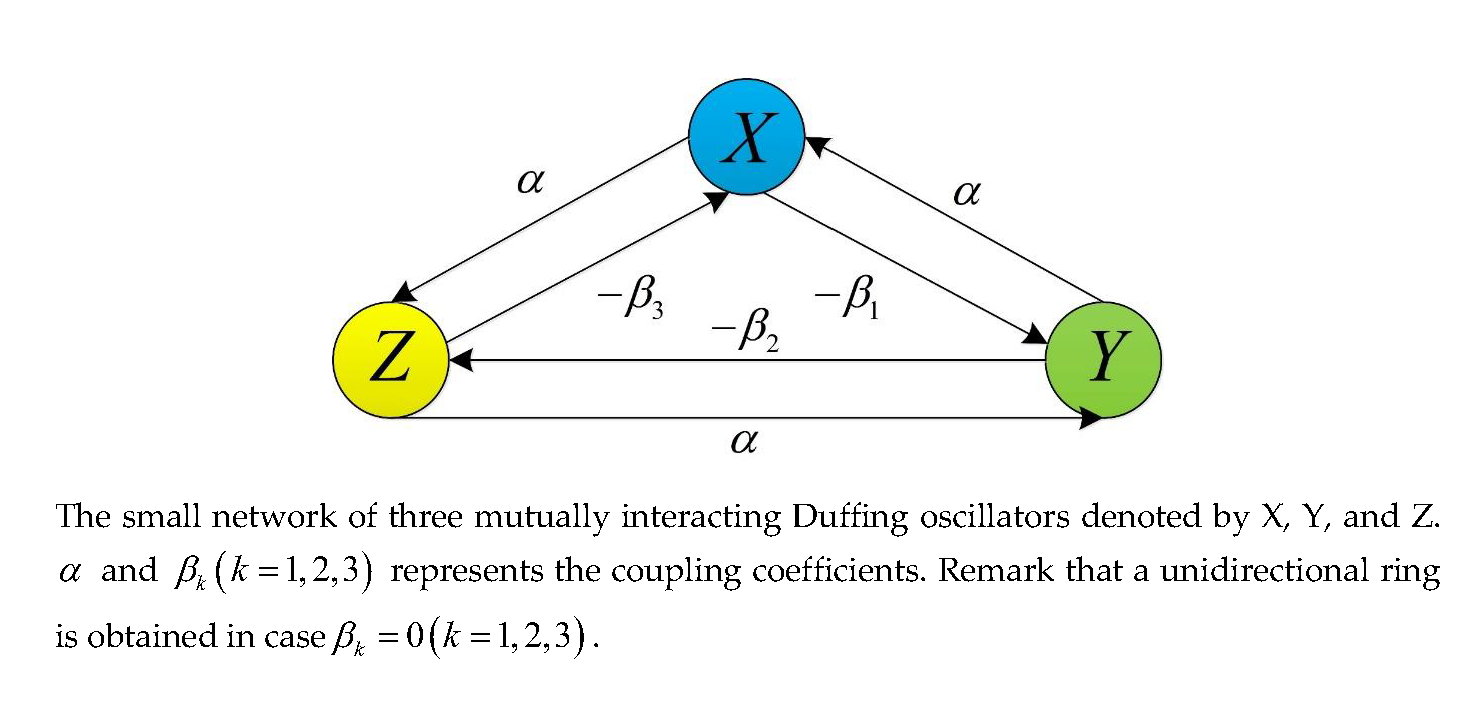
Recently, coupled oscillator systems have garnered significant interest due to their rich dynamics and applications in various fields. This article examines the collective dynamics of a ring network comprising three mutually interacting autonomous Duffing oscillators. Analytical and numerical methods are employed to elucidate the network’s overall behavior as a function of its parameters. We show that the route leading to multi-scroll chaos begins with a series of Hopf bifurcations (associated with 8 of the 27 equilibrium points), followed by a sequence of period-doubling bifurcations, boundary crises, and merging crises, ultimately giving rise to a multi-scroll attractor as one of the system parameters (e.g., a coupling strength) is varied. This route is characterized by several regions of multi-stability, where multiple attractors of different topologies coexist in varying numbers, depending on the exact value of the control parameter. This mechanism is elucidated using key analytical tools, such as bifurcation diagrams, phase portraits, and basins of attraction corresponding to competing attractors. Reducing the number of interactions within the network led to profound modifications in the locations of the equilibrium points, the mechanisms underlying the onset of chaos, and the topology of the resulting multi-scroll attractor. An experimental validation is carried out by considering a physical implementation of the model using the Arduino microcontroller. This study provides valuable insights that serve as an introduction to understanding the dynamics of significantly more complex networks of Duffing oscillators.
- Mahmoudvand S, Ghazavi MR, Farrokhabadi A. Nonlinear dynamic modeling and chaos analysis of aircraft landing gear under two-and three-point landings. Nonlinear Sci Control Eng.2025;1(1):025280001. http://dx.doi.org/10.36922/NSCE025280001
- Boccaletti S, Latora V, Moreno Y, et al. Complex networks: structure and dynamics. Phys Rep. 2006;424(4–5):175–308. http://dx.doi.org/10.1016/j.physrep.2005.10.009
- Pippal S, Kapoor S, Ranga A. Bifurcation and stability analysis with numerical simulations of a social model for marriage and divorce under fear effect. Nonlinear Sci Control Eng.2025;1(1):025290005. http://dx.doi.org/10.36922/NSCE025290005
- Ugur E, Tokta,s A, Tokta,s F, et al. Hybridization of benchmark functions for a high-performance 1D chaotic map and image encryption application. Nonlinear Sci Control Eng.2025;1(1):025340010. http://dx.doi.org/10.36922/NSCE025340010
- Terman D, Wang D. Global competition and local cooperation in a network of neural oscillators. Physica D.1995;81(1-2):148-176. http://dx.doi.org/10.1016/0167-2789(94)00205-5
- Pietra B, Daffertshofer A. Network dynamics of coupled oscillators and phase reduction techniques. Phys Rep.2019;819:1-105. http://dx.doi.org/10.1016/j.physrep.2019.06.001
- Duffing G. Erzwungene Schwingungen bei veranderlicher Eigenfrequenz und ihre technische Bedeutung. Vieweg; 1918.
- Tchakui MV, Woafo P. Dynamics of three unidirectionally coupled autonomous Duffing oscillators and application to inchworm piezoelectric motors: effects of the coupling coefficient and delay. Chaos.2016;26(11):113108. http://dx.doi.org/10.1063/1.4967388
- Leo Kingston S, Kapitaniak T, Dana SK. Transition tohyper chaos: Sudden expansion of attractor and intermittent large-amplitude events in dynamical systems. Chaos.2022;32(8):083101. http://dx.doi.org/10.1063/5.0108401
- Sabarathinam S, Thamilmaran K. Transient chaos in a globally coupled system of nearly conservative Hamiltonian Duffing oscillators. Chaos Solitons Fractals. 2015;73:129-140. http://dx.doi.org/10.1016/j.chaos.2015.01.004
- Jaimes-Reategui R, Castillo-Cruz JM, Garcıa-Lopez JH, et al. Self-organization in network motifs of three bistable Duffing oscillators. Cybern Phys. 2020;9(1):31-40. http://dx.doi.org/10.35470/2226-4116-2020-9-1-31-40
- Musielak D, Musielak Z, Benner J. Chaos and routes to chaos in coupled Duffing oscillators with multiple degrees off reedom. Chaos Solitons Fractals. 2005;24(4):907-922. http://dx.doi.org/10.1016/j.chaos.2004.09.119
- Clerc MG, Coulibaly S, Ferre MA, et al. Chimera states in a Duffing oscillators chain coupled to nearest neighbors. Chaos.2018;28(8):083115. http://dx.doi.org/10.1063/1.5025038
- Jothimurugan R, Thamilmaran K, Rajasekar S, et al. Multiple resonance and anti-resonance in coupled Duffing oscillators. Nonlinear Dyn. 2016;83:1803-1814. http://dx.doi.org/10.1007/s11071-015-2447-9
- Jaros P, Kapitaniak T, Perlikowski P. Multistability in nonlinearly coupled ring of Duffing systems. Eur Phys J Spec Top. 2016;225:2623–2634. http://dx.doi.org/10.1140/epjst/e2016-60015-7
- Borkowski L, Perlikowski P, Kapitaniak T, Stefanski A. Experimental observation of three-frequency quasiperiodic solution in a ring of unidirectionally coupled oscillators. Phys Rev E Stat Non lin Soft Matter Phys. 2015;91:062906. http://dx.doi.org/10.1103/PhysRevE.91.062906
- Barba-Franco JJ, Gallegos A, Jaimes-Reategui R, et al. Dynamics of a ring of three unidirectionally coupled Duffing oscillators with time-dependent damping. Euro phys Lett.2021;134(3):30005. http://dx.doi.org/10.1209/0295-5075/134/30005
- Balamurali R, Kengne LK, Rajagopal K, et al. Coupled non-oscillatory Duffing oscillators: multi stability, multi scroll chaos generation and circuit realization. Physica A.2022;607:128174. http://dx.doi.org/10.1016/j.physa.2022.128174
- Pastor I, Perez-Garcia VM, Encinas F, et al. Ordered and chaotic behavior of two coupled van der Pol oscillators. Phys Rev E. 1993;48(1):171-176. http://dx.doi.org/10.1103/PhysRevE.48.171
- Kengne J, Chedjou JC, Kom M, et al. Regular oscillations, chaos, and multi stability in a system of two coupled van der Pol oscillators: numerical and experimental studies. Nonlinear Dyn. 2014;76:1119-1132. http://dx.doi.org/10.1007/s11071-013-1195-y
- Singh AK, Yadava R. Transient motion and chaotic dynamics in a pair of van der Pol oscillators. Eur Phys J Plus.2019;134(9):421. http://dx.doi.org/10.1140/epjp/i2019-12804-x
- Strogatz SH. Nonlinear Dynamics and Chaos: With Applications to Physics, Biology, Chemistry, and Engineering. CRC Press; 2018. http://dx.doi.org/10.1201/9780429398490
- Guckenheimer J, Holmes P. Nonlinear Oscillations, Dynamical Systems, and Bifurcations of Vector Fields. Vol. 42. Springer Science & Business Media; 2013. http://dx.doi.org/10.1007/978-1-4612-1140-2