

Comparative patient satisfaction: Physician assistants versus junior doctors in surgical wards at a Swiss hospital

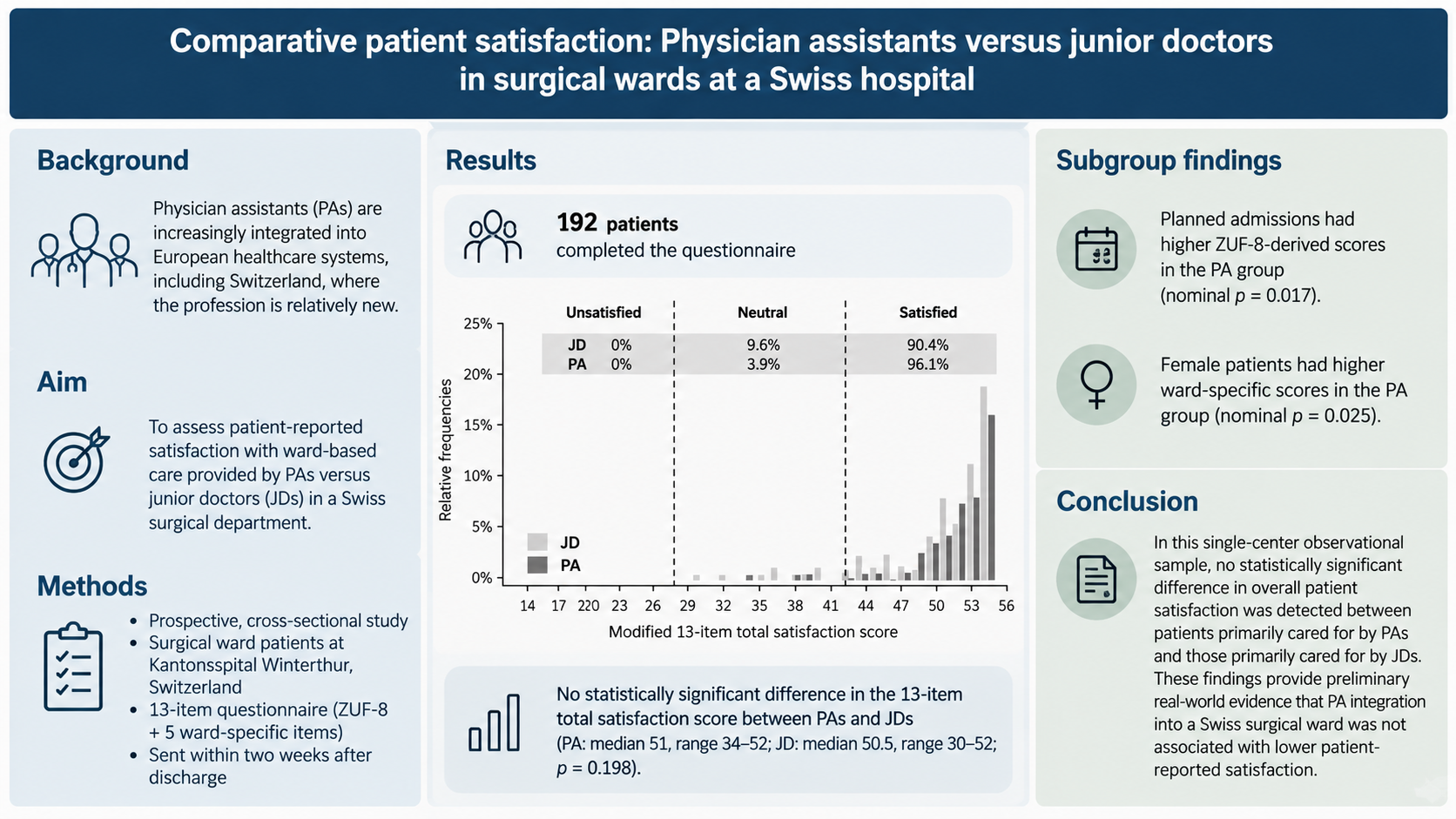
Background: Physician assistants (PAs) are increasingly integrated into European healthcare systems, including Switzerland, where the profession remains relatively new. Aim: To compare patient-reported satisfaction with ward-based care provided by PAs and junior doctors (JDs) in a Swiss surgical department. Methods: This prospective, cross-sectional study surveyed patients from the Department of Visceral and Thoracic Surgery at Kantonsspital Winterthur, Switzerland, within two weeks after discharge. Satisfaction was assessed using a 13-item questionnaire comprising items derived from the 8-item German Patient Satisfaction Questionnaire (ZUF-8) and 5 ward-specific items. Internal consistency was assessed post hoc using Cronbach’s alpha, and an exploratory adjusted linear regression was performed as a sensitivity analysis. Results: Among 192 respondents, no statistically significant difference was detected in total satisfaction scores (PA: median 51, range 34–52; JD: median 50.5, range 30–52; p = 0.198). Exploratory subgroup analyses showed higher ZUF-8-derived scores among patients with planned admissions in the PA group (nominal p = 0.017) and higher ward-specific scores among female patients in the PA group (nominal p = 0.025). After adjustment for age group, gender, and admission type, provider type was not significantly associated with total satisfaction (adjusted mean difference, PA vs. JD: 1.09 points, 95% CI, −0.18 to 2.37; p = 0.093). Conclusion: No statistically significant difference in overall patient satisfaction was detected between patients primarily cared for by PAs and those cared for by JDs. These single-center observational findings are preliminary and do not establish equivalence between provider groups. Relevance for patients: Patients reported high satisfaction with both provider groups, supporting further evaluation of PAs in surgical ward staffing models.
- Hayes H, Lenze N, Ritz HJ, Pandian V, Brenner MJ, Yalamanchi P. Workforce Trends and Evolving Roles of Physician Assistants in Otolaryngology: A National Longitudinal Survey. Ann Otol Rhinol Laryngol. 2026:34894251409704. doi: 10.1177/00034894251409704
- Hevesy M, Aitchison R, Ruiz A, Bednar S. Nurse practitioners and physician assistants in primary care: An update of changes since 2008. Dis Mon. 2016;62(2):23-36. doi: 10.1016/j.disamonth.2016.01.002
- Hooker RS, Brock DM, Cook ML. Characteristics of nurse practitioners and physician assistants in the United States. J Am Assoc Nurse Pract. 2016;28(1):39-46. doi: 10.1002/2327-6924.12293
- Larson EH, Hart LG. Growth and change in the physician assistant workforce in the United States, 1967-2000. J Allied Health. 2007;36(3):121-130
- van Vliet R, Ebben R, Diets N, Pelgrim T, Loef J, Vloet L. Nurse practitioners and physician assistants working in ambulance care: A systematic review. F1000Res. 2020;9:1182. doi: 10.12688/f1000research.25891.1
- Berg GM, Crowe RE, Nyberg S, Burdsal C. Trauma patient satisfaction with physician assistants: testing a structural equation model. JAAPA. 2012;25(5):42-43,49-51. doi: 10.1097/01720610-201205000-00008
- Drennan VM, Halter M, Wheeler C, Nice L, Brearley S, Ennis J, et al. What is the contribution of physician associates in hospital care in England? A mixed methods, multiple case study. BMJ Open. 2019;9(1):e027012. doi: 10.1136/bmjopen-2018-027012
- Timmermans MJ, van Vught AJ, Van den Berg M, Ponfoort ED, Riemens F, van Unen J, et al. Physician assistants in medical ward care: a descriptive study of the situation in the Netherlands. J Eval Clin Pract. 2016;22(3):395-402. doi: 10.1111/jep.12499
- Netherlands Association of Physician Assistants. Independency of Physician Assistants and Nurse Practitioners regulated in the Netherlands. 2017. Accessed August 23, 2026. https://www.napa.nl/english-information/?utm_source=chatgpt.com
- Moschella A, Burrows K. Patient Experience With Primary Care Physician Assistants in Ontario, Canada: Impact of Trust, Knowledge, and Access to Care. J Patient Exp. 2023;10:23743735231211782. doi: 10.1177/23743735231211782
- OECD. Fiscal sustainability of health systems: bridging health and finance perspectives. OECD Publishing; 2015. doi: 10.1787/9789264233386-en
- World Health Organization. Global strategy on human resources for health: workforce 2030. 2016. Accessed August 23, 2026. https://iris.who.int/server/api/core/bitstreams/3ef6ee65-42fa-4d2b-9c75-d55b2df17f9a/content
- Halvachizadeh S, Goezmen S, Schuster S, Teuben M, Baechtold M, Probst P, et al. The implementation of physicians assistant in a surgical ward improves continuity in daily clinical work and increases comprehensibility of nurses and physicians. Patient Saf Surg. 2022;16(1):34. doi: 10.1186/s13037-022-00344-7
- Andreatta P, Bowyer M, Dougherty PJ. CORR® Curriculum-Orthopaedic Education: Can Physician Assistants Replace Orthopaedic Surgeons in the Setting of Resuscitative Surgical Care for Trauma and Combat Casualties? Clin Orthop Relat Res. 2026;484(2):243-246. doi: 10.1097/CORR.0000000000003808
- Althausen PL, Shannon S, Owens B, Coll D, Cvitash M, Lu M, et al. Impact of Hospital-Employed Physician Assistants on a Level II Community-Based Orthopaedic Trauma System. J Orthop Trauma. 2016;30(Suppl 5):S40-S44. doi: 10.1097/01.bot.0000510721.23126.48
- Appleton-Dyer S, Field A, Dale-Gandar L, et al. Phase II of the Physician Assistant Demonstrations Evaluation Report. Report for Health Workforce New Zealand. Synergia; 2015:1-112
- Bunnell DJ. Physician assistants in cardiothoracic surgery. JAAPA. 2016;29(1):9-10. doi: 10.1097/01.JAA.0000475470.94509.ff.
- Burrows K, Nickell L, Krueger P. Physician assistants working in primary care in Canada: Findings from a national survey. Healthc Manage Forum. 2025;38(5):456-463. doi: 10.1177/08404704251347908
- Chalupa RL, Hooker RS. The education, role, distribution, and compensation of physician assistants in orthopedic surgery. JAAPA. 2016;29(5):1-7. doi: 10.1097/01.JAA.0000482318.38700.d1
- Dhuper S, Choksi S. Replacing an academic internal medicine residency program with a physician assistant--hospitalist model: a comparative analysis study. Am J Med Qual. 2009;24(2):132-139. doi: 10.1177/1062860608329646
- Dies N, Rashid S, Shandling M, Swallow C, Easson AM, Kennedy E. Physician assistants reduce resident workload and improve care in an academic surgical setting. JAAPA. 2016;29(2):41-46. doi: 10.1097/01.JAA.0000476214.34937.50
- Boudreaux ED, D’Autremont S, Wood K, Jones GN. Predictors of emergency department patient satisfaction: stability over 17 months. Acad Emerg Med. 2004;11(1):51-58. doi: 10.1197/j.aem.2003.06.012
- Chandra S, Ward P, Mohammadnezhad M. Factors Associated With Patient Satisfaction in Outpatient Department of Suva Sub-divisional Health Center, Fiji, 2018: A Mixed Method Study. Front Public Health. 2019;7:183. doi: 10.3389/fpubh.2019.00183
- Griffith CF, Young PA, Froman RL, Vasquez R, Mauskar MM. Patient satisfaction with dermatologists, resident physicians, and physician assistants: a multi-year cross-sectional study in an academic medical center. Dermatol Online J. 2023;29(3). doi: 10.5070/D329361436
- Joyce P. Patient Satisfaction with Care as Managed by the Physician Associate or the Doctor as Part of a Pilot Project in Ireland. J Health Med Sci. 2019;2(2):218-223. doi: 10.31014/aior.1994.02.02.40
- Lee S, Gross SE, Pfaff H, Dresen A. Waiting time, communication quality, and patient satisfaction: An analysis of moderating influences on the relationship between perceived waiting time and the satisfaction of breast cancer patients during their inpatient stay. Patient Educ Couns. 2020;103(4):819-825. doi: 10.1016/j.pec.2019.11.018
- Levesque J, Bogoch ER, Cooney B, Johnston B, Wright JG. Improving patient satisfaction with time spent in an orthopedic outpatient clinic. Can J Surg. 2000;43(6):431-436
- Attkisson CC, Zwick R. The client satisfaction questionnaire. Psychometric properties and correlations with service utilization and psychotherapy outcome. Eval Program Plann. 1982;5(3):233-237 doi: 10.1016/0149-7189(82)90074-X
- Schmidt J, Lamprecht F, Wittmann WW. [Satisfaction with inpatient management. Development of a questionnaire and initial validity studies]. Psychother Psychosom Med Psychol. 1989;39(7):248-255. Accessed August 23, 2026. https://eurekamag.com/research/041/304/041304811.php
- Hooker RS, Cipher DJ, Sekscenski E. Patient Satisfaction with Physician Assistant, Nurse Practitioner, and Physician Care: A National Survey of Medicare Beneficiaries. J Clin Outcomes Manag. 2005;12(2):88-92. Accessed August 23, 2026. https://www.researchgate.net/publication/265445650_Patient_Satisfaction_with_Physician_Assistant_Nurse_Practitioner_and_Physician_Care_A_National_Survey_of_Medicare_Beneficiaries
- Hooker RS, Moloney-Johns AJ, McFarland MM. Patient satisfaction with physician assistant/associate care: an international scoping review. Hum Resour Health. 2019;17(1):104. doi: 10.1186/s12960-019-0428-7
- Sharabianlou Korth MJ, Lu LY, et al. A Physician Assistant Is Associated With Higher Patient Satisfaction With Outpatient Orthopedic Surgery. Orthopedics. 2022;45(5). doi: 10.3928/01477447-20220511-04
- Kurtzman ET, Barnow BS. A Comparison of Nurse Practitioners, Physician Assistants, and Primary Care Physicians’ Patterns of Practice and Quality of Care in Health Centers. Med Care. 2017;55(6):615-622. doi: 10.1097/MLR.0000000000000689
- Milewski M, Coene RP, Flynn JM, et al. Better Patient Care Through Physician Extenders and Advanced Practice Providers. J Pediatr Orthop. 2022;42(suppl 1):S18-S24 doi: 10.1097/BPO.0000000000002125
- Halter M, Drennan V, Wang C, Wheeler C, Gage H, Nice L, et al. Comparing physician associates and foundation year two doctors-in-training undertaking emergency medicine consultations in England: a mixed-methods study of processes and outcomes. BMJ Open. 2020;10(9):e037557. doi: 10.1136/bmjopen-2020-037557
- Halter M, Drennan VM, Joly LM, Gabe J, Gage H, de Lusignan S. Patients’ experiences of consultations with physician associates in primary care in England: A qualitative study. Health Expect. 2017;20(5):1011-1019. doi: 10.1111/hex.12542
- Halter M, Wheeler C, Drennan VM, de Lusignan S, Grant R, Gabe J, et al. Physician associates in England’s hospitals: a survey of medical directors exploring current usage and factors affecting recruitment. Clin Med (Lond). 2017;17(2):126-131. doi: 10.7861/clinmedicine.17-2-126
- Timmermans MJC, van Vught A, Peters YAS, Meermans G, Peute JGM, Postma CT, et al. The impact of the implementation of physician assistants in inpatient care: A multicenter matched-controlled study. PLoS ONE. 2017;12(8):e0178212. doi: 10.1371/journal.pone.0178212
- Cleary PD, McNeil BJ. Patient satisfaction as an indicator of quality care. Inquiry. 1988;25(1):25-36
- Hall JA, Roter DL, Katz NR. Meta-analysis of correlates of provider behavior in medical encounters. Med Care. 1988;26(7):657-675. doi: 10.1097/00005650-198807000-00002
- Manary MP, Boulding W, Staelin R, Glickman SW. The patient experience and health outcomes. N Engl J Med. 2013;368(3):201-203. doi: 10.1056/NEJMp1211775
- Ong LM, Visser MR, Lammes FB, de Haes JC. Doctor-patient communication and cancer patients’ quality of life and satisfaction. Patient Educ Couns. 2000;41(2):145-156. doi: 10.1016/s0738-3991(99)00108-1
- Sitzia J, Wood N. Patient satisfaction: a review of issues and concepts. Soc Sci Med. 1997;45(12):1829-1843. doi: 10.1016/s0277-9536(97)00128-7
- Bertakis KD, Azari R. Patient gender differences in the prediction of medical expenditures. J Womens Health (Larchmt). 2010;19(10):1925-1932. doi: 10.1089/jwh.2009.1448
- Derose KP, Hays RD, McCaffrey DF, Baker DW. Does physician gender affect satisfaction of men and women visiting the emergency department? J Gen Intern Med. 2001;16(4):218-226. doi: 10.1046/j.1525-1497.2001.016004218.x
- Meijer K, Kuilman L. Patient satisfaction with PAs in the Netherlands. JAAPA. 2017;30(5):1-6. doi: 10.1097/01.JAA.0000515551.99355.c8
- Roter DL, Hall JA, Aoki Y. Physician gender effects in medical communication: a meta-analytic review. JAMA. 2002;288(6):756-764. doi: 10.1001/jama.288.6.756