

Large language models as integrative intelligence for multimodal cardiovascular decision support

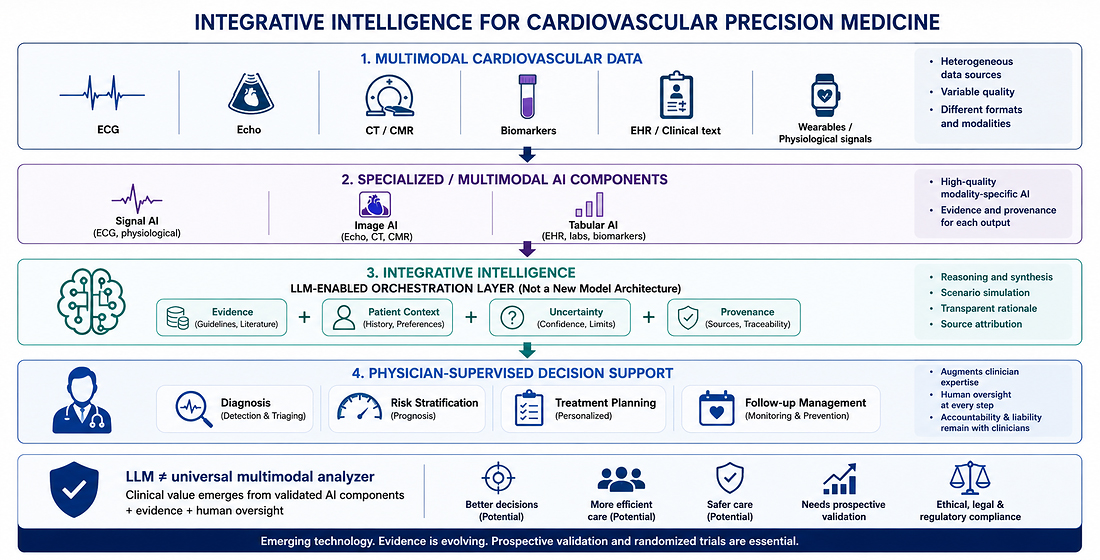
Background: In this narrative review, we examine large language models (LLMs) as an emerging component of cardiovascular artificial intelligence and propose the concept of integrative intelligence as a physician-supervised orchestration framework rather than a new model architecture. Current cardiovascular evidence remains heterogeneous and includes text-based LLMs, multimodal foundation or vision-language models, and dedicated modality-specific algorithms for electrocardiography (ECG), echocardiography, computed tomography (CT), cardiovascular magnetic resonance imaging (CMR), and physiological signals. Accordingly, conventional text–based LLMs should not be assumed to interpret raw cardiovascular waveforms or images directly. Instead, their most plausible near-term role is to synthesize clinical text, structured electronic health record data, biomarkers, retrieved evidence, and validated outputs from specialized analytical systems. Methods: We reviewed applications in acute coronary syndromes, heart failure, arrhythmias, valvular disease, cardio-oncology, documentation, and decision support, while distinguishing clinically evaluated applications from proof-of-concept and proposed future uses. Results: Available randomized and prospective evidence is still limited, and reported benefits are task-dependent; improvements in diagnostic reasoning, workflow, or intermediate decision-support measures should not be interpreted as established reductions in major cardiovascular events, readmissions, or mortality. We therefore emphasize data acquisition and multimodal fusion, external and prospective validation, calibration, omission errors, hallucinations, prompt sensitivity, automation bias, model drift, subgroup and out-of-distribution performance, evidence provenance, retrieval-augmented generation failure modes, cybersecurity, regulation, governance, and professional accountability. Conclusion: Integrative intelligence is presented as a testable translational framework for combining specialized AI, multimodal models, evidence retrieval, and human clinical judgment. Its clinical value will depend on rigorous multicenter validation, transparent auditability, and preservation of physician responsibility. Relevance for Patients: This review clarifies the emerging role of LLMs in cardiovascular medicine and proposes a physician-supervised framework for safe multimodal clinical integration.
- Boonstra MJ, Weissenbacher D, Moore JH, Gonzalez-Hernandez G, Asselbergs FW. Artificial intelligence: revolutionizing cardiology with large language models. Eur Heart J. 2024;45(5):332-345. doi: 10.1093/eurheartj/ehad838
- Wehbe RM. Charting the future of cardiology with large language model artificial intelligence. Nat Rev Cardiol. 2025;22:143-144. doi: 10.1038/s41569-024-01105-y
- Meng X, Yan X, Zhang K, et al. The application of large language models in medicine: a scoping review. iScience. 2024;27(5):109713. doi: 10.1016/j.isci.2024.109713
- Gendler M, Nadkarni GN, Sudri K, et al. Large language models in cardiology: systematic review. JMIR Cardio. 2026;10:e76734. doi: 10.2196/76734
- Agrawal M, Hegselmann S, Lang H, Kim Y, Sontag D. Large language models are few-shot clinical information extractors. In: Proceedings of the 2022 Conference on Empirical Methods in Natural Language Processing. Association for Computational Linguistics; 2022:1998-2022. doi: 10.18653/v1/2022.emnlp-main.130
- Zakka C, Shad R, Chaurasia A, et al. Almanac-retrieval-augmented language models for clinical medicine. NEJM AI. 2024;1(2):AIoa2300068. doi: 10.1056/AIoa2300068
- O’Sullivan JW, Palepu A, Saab K, et al. A large language model for complex cardiology care. Nat Med. 2026;32(2):616-623. doi: 10.1038/s41591-025-04190-9
- Ferreira Santos J, Ladeiras-Lopes R, Leite F, Dores H. Applications of large language models in cardiovascular disease: a systematic review. Eur Heart J Digit Health. 2025;6(4):540-553. doi: 10.1093/ehjdh/ztaf028
- Khera R, Oikonomou EK, Nadkarni GN, et al. Transforming cardiovascular care with artificial intelligence: from discovery to practice: JACC state-of-the-art review. J Am Coll Cardiol. 2024;84(1):97-114. doi: 10.1016/j.jacc.2024.05.003
- Kodera S, Takeda N. From DNA to drug discovery: AI models for cardiovascular precision medicine. J Cardiol. 2026. doi: 10.1016/j.jjcc.2026.06.007
- Johnson KW, Torres Soto J, Glicksberg BS, et al. Artificial intelligence in cardiology. J Am Coll Cardiol. 2018;71(23):2668-2679. doi: 10.1016/j.jacc.2018.03.521
- Makimoto H, Kohro T. Adopting artificial intelligence in cardiovascular medicine: a scoping review. Hypertens Res. 2024;47(3):685-699. doi: 10.1038/s41440-023-01469-7
- Moor M, Banerjee O, Abad ZSH, et al. Foundation models for generalist medical artificial intelligence. Nature. 2023;616(7956):259-265. doi: 10.1038/s41586-023-05881-4
- Thirunavukarasu AJ, Ting DSJ, Elangovan K, Gutierrez L, Tan TF, Ting DSW. Large language models in medicine. Nat Med. 2023;29(8):1930-1940. doi: 10.1038/s41591-023-02448-8
- Omar M, Nadkarni GN, Klang E, Glicksberg BS. Large language models in medicine: a review of current clinical trials across healthcare applications. PLoS Digit Health. 2024;3(11):e0000662. doi: 10.1371/journal.pdig.0000662
- Hager P, Jungmann F, Holland R, et al. Evaluation and mitigation of the limitations of large language models in clinical decision-making. Nat Med. 2024;30(9):2613-2622. doi: 10.1038/s41591-024-03097-1
- McCoy LG, Manrai AK, Rodman A. Large language models and the degradation of the medical record. N Engl J Med. 2024;391(17):1561-1564. doi: 10.1056/NEJMp2405999
- Kung TH, Cheatham M, Medenilla A, et al. Performance of ChatGPT on USMLE: potential for AI-assisted medical education using large language models. PLoS Digit Health. 2023;2(2):e0000198. doi: 10.1371/journal.pdig.0000198
- Lee P, Bubeck S, Petro J. Benefits, limits, and risks of GPT-4 as an AI chatbot for medicine. N Engl J Med. 2023;388(13):1233-1239. doi: 10.1056/NEJMsr2214184
- Yang XY, Li YM, Wang JY, Jia YH, Yi Z, Chen M. Utilizing multimodal artificial intelligence to advance cardiovascular diseases. Precis Clin Med. 2025;8(3):pbaf016. doi: 10.1093/pcmedi/pbaf016
- Lang RM, Badano LP, Mor-Avi V, et al. Recommendations for cardiac chamber quantification by echocardiography in adults: an update from the American Society of Echocardiography and the European Association of Cardiovascular Imaging. Eur Heart J Cardiovasc Imaging. 2015;16(3):233-271. doi: 10.1093/ehjci/jev014
- Voigt JU, Cvijic M. 2- and 3-dimensional myocardial strain in cardiac health and disease. JACC Cardiovasc Imaging. 2019;12(9):1849-1863. doi: 10.1016/j.jcmg.2019.01.044
- Li J, Li Y, Sun Z, et al. Exploring multimodal large language models on transthoracic echocardiogram tasks for cardiovascular decision support. J Biomed Inform. 2025;171:104930. doi: 10.1016/j.jbi.2025.104930
- Chao CJ, Banerjee I, Arsanjani R, et al. Evaluating large language models in echocardiography reporting: opportunities and challenges. Eur Heart J Digit Health. 2025;6(3):326-339. doi: 10.1093/ehjdh/ztae086
- Attia ZI, Kapa S, Lopez-Jimenez F, et al. Screening for cardiac contractile dysfunction using an artificial intelligence-enabled electrocardiogram. Nat Med. 2019;25:70-74. doi: 10.1038/s41591-018-0240-2
- Ribeiro AH, Ribeiro MH, Paixao GMM, et al. Automatic diagnosis of the 12-lead ECG using a deep neural network. Nat Commun. 2020;11(1):1760. doi: 10.1038/s41467-020-15432-4
- Lee H, Yoo S, Kim J, Cho Y, Suh D, Lee K. Comparative diagnostic performance of a multimodal large language model versus a dedicated electrocardiogram AI in detecting myocardial infarction from electrocardiogram images: comparative study. JMIR AI. 2025;4:e75910. doi: 10.2196/75910
- Rouhi AD, Menon SV, Ghanem YK, Han JJ. Concordance of large language model recommendations with multidisciplinary heart team decisions in coronary revascularization and aortic valve intervention: A systematic review and pooled analysis. Cardiol Ther. 2026. doi: 10.1007/s40119-026-00453-9
- Gulati M, Levy PD, Mukherjee D, et al. 2021 AHA/ACC/ASE/CHEST/SAEM/SCCT/SCMR guideline for the evaluation and diagnosis of chest pain. Circulation. 2021;144(22):e368-e454. doi: 10.1161/CIR.0000000000001029
- Hundley WG, Bluemke DA, Finn JP, et al. ACCF/ACR/AHA/NASCI/SCMR expert consensus document on cardiovascular magnetic resonance. J Am Coll Cardiol. 2010;55:2614-2662. doi: 10.1161/CIR.0b013e3181d44a8f
- Thygesen K, Alpert JS, Jaffe AS, et al. Fourth universal definition of myocardial infarction. Circulation. 2018;138(20):e618-e651. doi: 10.1161/CIR.0000000000000617
- Tsutsui H, Albert NM, Coats AJS, et al. Natriuretic Peptides: Role in the diagnosis and management of heart failure: A Scientific statement from the Heart Failure Association of the European Society of Cardiology, Heart Failure Society of America and Japanese Heart Failure Society. Eur J Heart Fail. 2023;25(5):616-631. doi: 10.1002/ejhf.2848
- Xu D, Cunningham JW. Harnessing large language models for chart review. J Am Heart Assoc. 2025;14(7):e041581. doi: 10.1161/JAHA.125.041581
- Jain SS, Elias P, Poterucha TJ, et al. Artificial intelligence in cardiovascular care-part 2: applications: JACC review topic of the week. J Am Coll Cardiol. 2024;83(24):2487-2496. doi: 10.1016/j.jacc.2024.03.401
- Ke YH, Jin L, Elangovan K, et al. Retrieval augmented generation for 10 large language models and its generalizability in assessing medical fitness. npj Digit Med. 2025;8(1):187. doi: 10.1038/s41746-025-01519-z.
- Templin T, Fort S, Padmanabham P, et al. Framework for bias evaluation in large language models in healthcare settings. npj Digit Med. 2025;8(1):414. doi: 10.1038/s41746-025-01786-w
- Radke RM, Diller GP, Reddy RG, Shivaram P, Danford DA, Kutty S. A multi-query, multimodal, receiver-augmented solution to extract contemporary cardiology guideline information using large language models. Eur Heart J Digit Health. 2025. doi: 10.1093/ehjdh/ztaf111
- Cheema B, Pandit J. AI and heart failure: present state and future with multimodal large language models. JACC Adv. 2024;3(9):101029. doi: 10.1016/j.jacadv.2024.101029
- Nolin-Lapalme A, et al. Maximising large language model utility in cardiovascular care: a practical guide. Can J Cardiol. 2024;40(10):1774-1787. doi: 10.1016/j.cjca.2024.05.024
- Perpetua EM, Palmer R, Le VT, et al. JACC: Advances expert panel perspective: shared decision-making in multidisciplinary team-based cardiovascular care. JACC Adv. 2024;3(7):100981. doi: 10.1016/j.jacadv.2024.100981
- Antiperovitch P, Liu I, Mokhtar AT, Tang A. Evaluating large language models in cardiovascular antithrombotic care: performance, accuracy, and implications for clinical practice. Can J Cardiol. 2025;41(8):1584-1591. doi: 10.1016/j.cjca.2025.04.008
- Byrne RA, Rossello X, Coughlan JJ, et al. 2023 ESC guidelines for the management of acute coronary syndromes. Eur Heart J. 2023;44(38):3720-3826. doi: 10.1093/eurheartj/ehad191
- McDonagh TA, Metra M, Adamo M, et al. 2023 focused update of the 2021 ESC guidelines for the diagnosis and treatment of acute and chronic heart failure. Eur Heart J. 2023;44(37):3627-3639. doi: 10.1093/eurheartj/ehad195
- Heidenreich PA, Bozkurt B, Aguilar D, et al. 2022 AHA/ACC/HFSA guideline for the management of heart failure. Circulation. 2022;145(18):e895-e1032. doi: 10.1161/CIR.0000000000001063
- Joglar JA, Chung MK, Armbruster AL, et al. 2023 ACC/AHA/ACCP/HRS guideline for the diagnosis and management of atrial fibrillation. Circulation. 2024;149(1):e1-e156. doi: 10.1161/CIR.0000000000001193
- Lin C, Lan Y, Zeng Z, et al. Evaluation of large language models in percutaneous coronary intervention decision-making. Front Cardiovasc Med. 2026;13:1690716. doi: 10.3389/fcvm.2026.1690716
- Vahanian A, Beyersdorf F, Praz F, et al. 2021 ESC/EACTS guidelines for the management of valvular heart disease. Eur Heart J. 2022;43(7):561-632. doi: 10.1093/eurheartj/ehab395
- Zhu W, Peng J, Yan Z, Chen Y, Xu J, Zhang L. Designing and evaluating large language model-enabled clinical decision support for heart failure: a modular and risk-tiered framework. Front Digit Health. 2026;8:1730457. doi: 10.3389/fdgth.2026.1730457
- Lyon AR, Lopez-Fernandez T, Couch LS, et al. 2022 ESC guidelines on cardio-oncology. Eur Heart J. 2022;43(41):4229-4361. doi: 10.1093/eurheartj/ehac244
- Herrmann J, Lenihan D, Armenian S, et al. Defining cardiovascular toxicities of cancer therapies: an International Cardio-Oncology Society consensus statement. Eur Heart J. 2022;43(4):280-299. doi: 10.1093/eurheartj/ehab674
- Goh E, Gallo RJ, Strong E, et al. GPT-4 assistance for improvement of physician performance on patient care tasks: a randomized controlled trial. Nat Med. 2025;31(4):1233-1238. doi: 10.1038/s41591-024-03456-y
- Wang G, Zhang K, Jiang J, et al. Human-large language model collaboration in clinical medicine: a systematic review and meta-analysis. npj Digit Med. 2026;9(1):195. doi: 10.1038/s41746-026-02382-2
- Ong KT, Seo J, Kim H, et al. Success and failure of human-AI collaboration in clinical reasoning: an experimental study on challenging real-world cases. Int J Med Inform. 2026;211:106342. doi: 10.1016/j.ijmedinf.2026.106342
- Topol EJ. High-performance medicine: the convergence of human and artificial intelligence. Nat Med. 2019;25(1):44-56. doi: 10.1038/s41591-018-0300-7
- World Health Organization. Ethics and Governance of Artificial Intelligence for Health: Guidance on Large Multi-Modal Models. World Health Organization; 2024. https://www.who.int/publications/i/item/9789240084759
- Wu J, Wu X, Zheng Y, Yang J. Clinical pathway-aware large language models for reliable and transparent medical dialogue. J Biomed Inform. 2025;172:104942. doi: 10.1016/j.jbi.2025.104942
- Elwyn G, Frosch DL, Kobrin S. Implementing shared decision-making: consider all the consequences. Implement Sci. 2016;11:114. doi: 10.1186/s13012-016-0480-9
- Jiang K, Adhikari J, Bernard GR. Interpreting ECG Images with Multimodal Large Language Models. In: Studies in Health Technology and Informatics. Amsterdam: IOS Press; 2026. doi: 10.3233/shti260321
- Jia YY, Pang LY, Bi MM, Yang XL, Song JP. Dependability of large language models in cardiovascular medicine: a scoping review. J Cardiothorac Vasc Anesth. 2025;39(12):3534-3540. doi: 10.1053/j.jvca.2025.07.026
- Mahajan A, Obermeyer Z, Daneshjou R, Lester J, Powell D. Cognitive bias in clinical large language models. npj Digit Med. 2025;8:428. doi: 10.1038/s41746-025-01790-0
- Yang Y, Liu X, Jin Q, Huang F, Lu Z, et al. Unmasking and quantifying racial bias of large language models in medical report generation. Commun Med. 2024;4:176. doi: 10.1038/s43856-024-00601-z
- Zhong X, Li S, Chen Z, Ge L, Yu D, Wang S, et al. Considerations for patient privacy of large language models in health care: scoping review. J Med Internet Res. 2025;27:e76571. doi: 10.2196/76571
- Omar M, Sorin V, Collins JD, et al. Multi-model assurance analysis showing large language models are highly vulnerable to adversarial hallucination attacks during clinical decision support. Commun Med. 2025;5(1):330. doi: 10.1038/s43856-025-01021-3
- Asgari E, Montana-Brown N, Dubois M, et al. A framework to assess clinical safety and hallucination rates of LLMs for medical text summarisation. npj Digit Med. 2025;8(1):274. doi: 10.1038/s41746-025-01670-7
- Amugongo LM, Mascheroni P, Brooks S, Doering S, Seidel J. Retrieval augmented generation for large language models in healthcare: a systematic review. PLoS Digit Health. 2025;4(6):e0000877. doi: 10.1371/journal.pdig.0000877
- Shool S, Adimi S, Saboori Amleshi R, Bitaraf E, Golpira R, Tara M. A systematic review of large language model evaluations in clinical medicine. BMC Med Inform Decis Mak. 2025;25(1):117. doi: 10.1186/s12911-025-02954-4
- Johri S, Jeong J, Tran BA, et al. An evaluation framework for clinical use of large language models in patient interaction tasks. Nat Med. 2025;31(1):77-86. doi: 10.1038/s41591-024-03328-5
- Bibbò L, Laganà F, Pullano SA, Angiulli G. Multimodal EEG–EMG and FEM-based adaptive control of passive upper-limb exoskeletons. Sensors. 2026;26(12):3924. doi: 10.3390/s26123924
- Qu C, Zhang X, Lu Y, Wang Y, Su C. MAF-Net: multimodal cross-attention-based fusion network for cardiovascular disease classification. PLoS ONE. 2026;21(4):e0345238. doi: 10.1371/journal.pone.0345238
- Goh E, Gallo R, Hom J, et al. Large language model influence on diagnostic reasoning: a randomized clinical trial. JAMA Netw Open. 2024;7(10):e2440969. doi: 10.1001/jamanetworkopen.2024.40969
- Wiens J, Saria S, Sendak M, et al. Do no harm: a roadmap for responsible machine learning for health care. Nat Med. 2019;25(9):1337-1340. doi: 10.1038/s41591-019-0548-6
- Gallifant J, Afshar M, Ameen S, et al. The TRIPOD-LLM reporting guideline for studies using large language models. Nat Med. 2025;31(1):60-69. doi: 10.1038/s41591-024-03425-5
- Kagiyama N, Tokodi M, Hathaway QA, et al. PRIME 2.0: proposed requirements for cardiovascular imaging-related multimodal-AI evaluation: an updated checklist. JACC Cardiovasc Imaging. 2026;19(2):225-251. doi: 10.1016/j.jcmg.2025.08.004
- European Parliament, Council of the European Union. Regulation (EU) 2024/1689 laying down harmonised rules on artificial intelligence (Artificial Intelligence Act). Off J Eur Union. 2024. https://eur-lex.europa.eu/eli/reg/2024/1689/oj?locale=en
- Singhal K, Azizi S, Tu T, et al. Large language models encode clinical knowledge. Nature. 2023;620(7972):172-180. doi: 10.1038/s41586-023-06291-2
- Ferreira Santos J, Dores H. Large language models in cardiovascular prevention: a narrative review and governance framework. Diagnostics. 2026;16(3):390. doi: 10.3390/diagnostics16030390
- Tran M, Balasooriya C, Jonnagaddala J, et al. Situating governance and regulatory concerns for generative artificial intelligence and large language models in medical education. npj Digit Med. 2025;8(1):315. doi: 10.1038/s41746-025-01721-z