
Myokines as mediators of muscle–brain crosstalk: Implications for neuroplasticity and neurodegenerative diseases

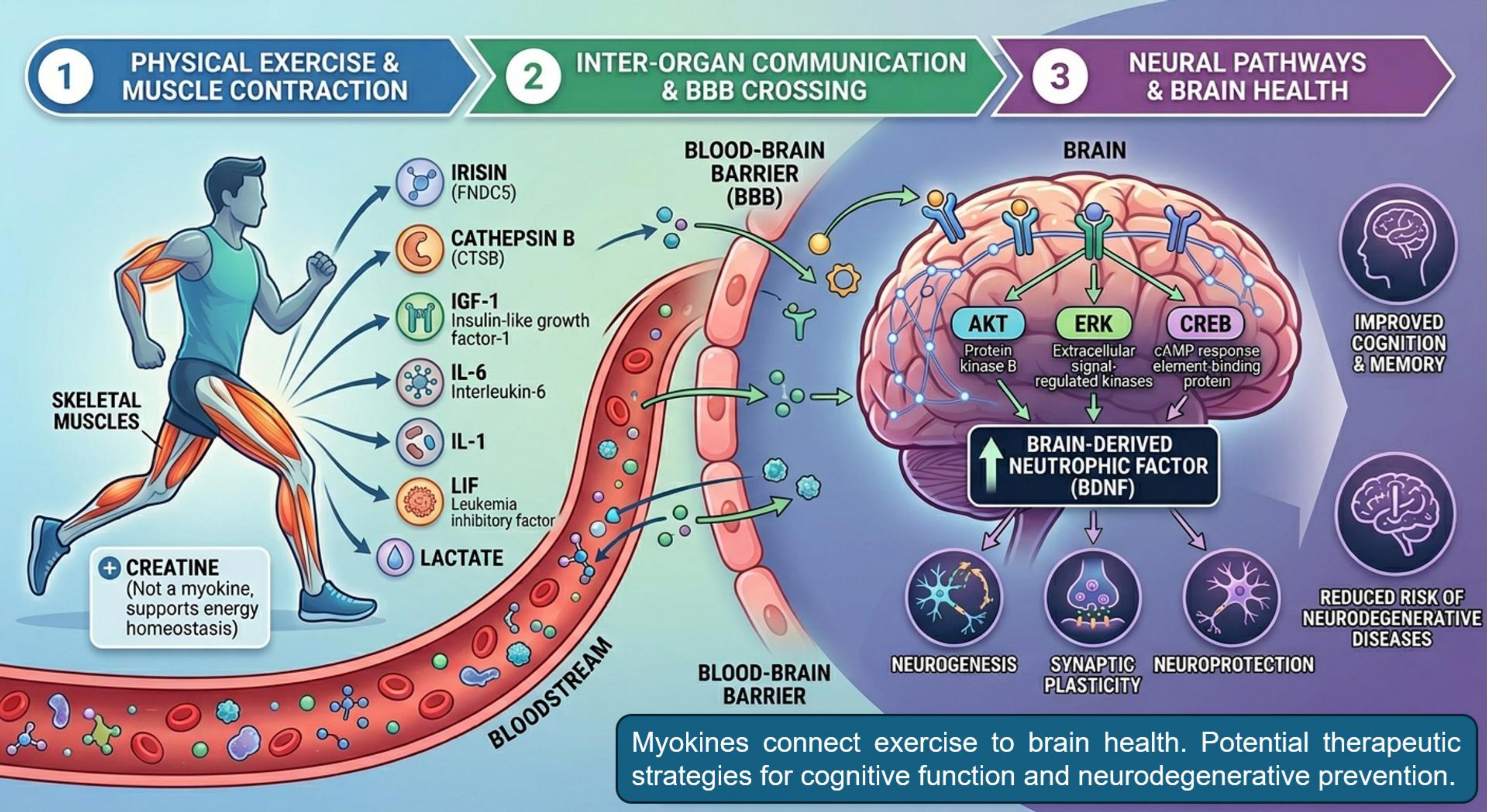
Background: Skeletal muscle is increasingly recognized as an endocrine organ that releases bioactive factors, termed myokines, capable of mediating inter-organ communication, including signaling to the brain. Aim: To summarize current evidence on key myokines involved in muscle–brain crosstalk and their potential roles in neuroplasticity, cognition, and neurodegenerative diseases. Methods: This narrative review synthesizes findings from experimental and clinical studies addressing exercise-induced myokines, their interaction with the blood–brain barrier, and associated intracellular signaling pathways relevant to central nervous system function. Results: Multiple myokines, including fibronectin type III domain-containing protein 5 (irisin), cathepsin B, insulin-like growth factor-1, interleukin-6, interleukin-1, leukemia inhibitory factor, and lactate, have been implicated in muscle–brain communication. These factors may influence brain function by crossing or modulating the blood–brain barrier and activating signaling pathways such as protein kinase B, extracellular signal-regulated kinases, and cAMP response element-binding protein. Evidence suggests that these mechanisms contribute to increased brain-derived neurotrophic factor expression, promoting neurogenesis, synaptic plasticity, and neuroprotection. Additionally, creatine, although not a myokine, may support brain function through its role in cellular energy homeostasis. Conclusion: Myokines represent key mediators linking physical exercise to brain health, with potential implications for the prevention and management of neurodegenerative conditions. However, further studies are required to clarify their mechanisms and clinical applicability. Relevance for Patients: Understanding how exercise-induced factors influence brain function may support the development of non-pharmacological and adjunct therapeutic strategies to preserve cognitive function and reduce the risk of neurodegenerative diseases.
- Bortoluzzi S, Scannapieco P, Cestaro A, Danieli GA, Schiaffino S. Computational reconstruction of the human skeletal muscle secretome. Proteins. 2006;62(3):776-792. doi: 10.1002/prot.20803
- Yoon JH, Yea K, Kim J, et al. Comparative proteomic analysis of the insulin-induced L6 myotube secretome. Proteomics. 2009;9(1):51-60. doi: 10.1002/pmic.200800187
- Pedersen BK. Muscle as a secretory organ. Compr Physiol. 2013;3(3):1337-1362. doi: 10.1002/cphy.c120033
- Henningsen J, Pedersen BK, Kratchmarova I. Quantitative analysis of the secretion of the MCP family of chemokines by muscle cells. Mol Biosyst. 2011;7(2):311-321. doi: 10.1039/c0mb00209g
- Henningsen J, Rigbolt KT, Blagoev B, Pedersen BK, Kratchmarova I. Dynamics of the skeletal muscle secretome during myoblast differentiation. Mol Cell Proteomics. 2010;9(11):2482-2496. doi: 10.1074/mcp.M110.002113
- Pedersen BK, Febbraio MA. Muscles, exercise and obesity: skeletal muscle as a secretory organ. Nat Rev Endocrinol. 2012;8(8):457-465. doi: 10.1038/nrendo.2012.49
- Benatti FB, Pedersen BK. Exercise as an anti-inflammatory therapy for rheumatic diseases-myokine regulation. Nat Rev Rheumatol. 2015;11(2):86-97. doi: 10.1038/nrrheum.2014.193
- Hojman P, Gehl J, Christensen JF, Pedersen BK. Molecular Mechanisms Linking Exercise to Cancer Prevention and Treatment. Cell Metab. 2018;27(1):10-21. doi: 10.1016/j.cmet.2017.09.015
- Pedersen L, Idorn M, Olofsson GH, et al. Voluntary Running Suppresses Tumor Growth through Epinephrine- and IL-6-Dependent NK Cell Mobilization and Redistribution. Cell Metab. 2016;23(3):554-562. doi: 10.1016/j.cmet.2016.01.011
- Motl RW, Pilutti LA. The benefits of exercise training in multiple sclerosis. Nat Rev Neurol. 2012;8(9):487-497. doi: 10.1038/nrneurol.2012.136
- Pedersen BK, Saltin B. Evidence for prescribing exercise as therapy in chronic disease. Scand J Med Sci Sports. 2006;16 Suppl 1:3-63. doi: 10.1111/j.1600-0838.2006.00520.x
- Tanasescu M, Leitzmann MF, Rimm EB, Willett WC, Stampfer MJ, Hu FB. Exercise type and intensity in relation to coronary heart disease in men. JAMA. 2002;288(16):1994-2000. doi: 10.1001/jama.288.16.1994
- Ma Y, Gao M, Sun H, Liu D. Interleukin-6 gene transfer reverses body weight gain and fatty liver in obese mice. Biochim Biophys Acta. 2015;1852(5):1001-1011. doi: 10.1016/j.bbadis.2015.01.017
- Quinn LS, Strait-Bodey L, Anderson BG, Argilés JM, Havel PJ. Interleukin-15 stimulates adiponectin secretion by 3T3-L1 adipocytes: evidence for a skeletal muscle-to-fat signaling pathway. Cell Biol Int. 2005;29(6):449-457. doi: 10.1016/j.cellbi.2005.02.005
- Roberts LD, Boström P, O’Sullivan JF, et al. β-Aminoisobutyric acid induces browning of white fat and hepatic β-oxidation and is inversely correlated with cardiometabolic risk factors. Cell Metab. 2014;19(1):96-108. doi: 10.1016/j.cmet.2013.12.003
- Banks WA, Kastin AJ, Broadwell RD. Passage of cytokines across the blood-brain barrier. Neuroimmunomodulation. 1995;2(4):241-248. doi: 10.1159/000097202
- Khan SU, Ghafoor S. Myokines: Discovery Challenges and Therapeutic Impediments. J Pak Med Assoc. 2019;69(7):1014-1017.
- Hawkins RA, O’Kane RL, Simpson IA, Viña JR. Structure of the blood-brain barrier and its role in the transport of amino acids. J Nutr. 2006;136(1 Suppl):218S-26S. doi: 10.1093/jn/136.1.218S
- Barar J, Rafi MA, Pourseif MM, Omidi Y. Blood-brain barrier transport machineries and targeted therapy of brain diseases. Bioimpacts. 2016;6(4):225-248. doi: 10.15171/bi.2016.30
- Skowrońska M, Albrecht J. Alterations of blood brain barrier function in hyperammonemia: an overview. Neurotox Res. 2012;21(2):236-244. doi: 10.1007/s12640-011-9269-4
- Kim S, Choi JY, Moon S, Park DH, Kwak HB, Kang JH. Roles of myokines in exercise-induced improvement of neuropsychiatric function. Pflugers Arch. 2019;471(3):491-505. doi: 10.1007/s00424-019-02253-8
- Rai M, Demontis F. Muscle-to-Brain Signaling Via Myokines and Myometabolites. Brain Plast. 2022;8(1):43-63. doi: 10.3233/BPL-210133
- Małkiewicz MA, Szarmach A, Sabisz A, Cubała WJ, Szurowska E, Winklewski PJ. Blood-brain barrier permeability and physical exercise. J Neuroinflammation. 2019;16(1):15. doi: 10.1186/s12974-019-1403-x
- Buttler L, Jordão MT, Fragas MG, Ruggeri A, Ceroni A, Michelini LC. Maintenance of Blood-Brain Barrier Integrity in Hypertension: A Novel Benefit of Exercise Training for Autonomic Control. Front Physiol. 2017;8:1048. doi: 10.3389/fphys.2017.01048
- Segarra M, Aburto MR, Acker-Palmer A. Blood-Brain Barrier Dynamics to Maintain Brain Homeostasis. Trends Neurosci. 2021;44(5):393-405. doi: 10.1016/j.tins.2020.12.002
- Roh HT, Cho SY, Yoon HG, So WY. Effect of Exercise Intensity on Neurotrophic Factors and Blood-Brain Barrier Permeability Induced by Oxidative-Nitrosative Stress in Male College Students. Int J Sport Nutr Exerc Metab. 2017;27(3):239-246. doi: 10.1123/ijsnem.2016-0009
- Young MF, Valaris S, Wrann CD. A role for FNDC5/Irisin in the beneficial effects of exercise on the brain and in neurodegenerative diseases. Prog Cardiovasc Dis. 2019;62(2):172-178. doi: 10.1016/j.pcad.2019.02.007
- Schumacher MA, Chinnam N, Ohashi T, Shah RS, Erickson HP. The structure of irisin reveals a novel intersubunit β-sheet fibronectin type III (FNIII) dimer: implications for receptor activation. J Biol Chem. 2013;288(47):33738-33744. doi: 10.1074/jbc.M113.516641
- Boström P, Wu J, Jedrychowski MP, et al. A PGC1-α-dependent myokine that drives brown-fat-like development of white fat and thermogenesis. Nature. 2012;481(7382):463-468. doi: 10.1038/nature10777
- Wrann CD, White JP, Salogiannnis J, et al. Exercise induces hippocampal BDNF through a PGC-1α/FNDC5 pathway. Cell Metab. 2013;18(5):649-659. doi: 10.1016/j.cmet.2013.09.008
- Quinn LS, Anderson BG, Conner JD, Wolden-Hanson T. Circulating irisin levels and muscle FNDC5 mRNA expression are independent of IL-15 levels in mice. Endocrine. 2015;50(2):368-377. doi: 10.1007/s12020-015-0607-9
- Tiano JP, Springer DA, Rane SG. SMAD3 negatively regulates serum irisin and skeletal muscle FNDC5 and peroxisome proliferator-activated receptor γ coactivator 1-α (PGC-1α) during exercise. J Biol Chem. 2015;290(12):7671-7684. doi: 10.1074/jbc.M114.617399
- Chen K, Wang K, Wang T. Protective effect of irisin against Alzheimer’s disease. Front Psychiatry. 2022;13:967683. doi: 10.3389/fpsyt.2022.967683
- Avgerinos KI, Liu J, Dalamaga M. Could exercise hormone irisin be a therapeutic agent against Parkinson’s and other neurodegenerative diseases?. Metabol Open. 2023;17:100233. doi: 10.1016/j.metop.2023.100233
- Li DJ, Li YH, Yuan HB, Qu LF, Wang P. The novel exercise-induced hormone irisin protects against neuronal injury via activation of the Akt and ERK1/2 signaling pathways and contributes to the neuroprotection of physical exercise in cerebral ischemia. Metabolism. 2017;68:31-42. doi: 10.1016/j.metabol.2016.12.003
- Pedersen BK. Physical activity and muscle-brain crosstalk. Nat Rev Endocrinol. 2019;15(7):383-392. doi: 10.1038/s41574-019-0174-x
- Aggarwal N, Sloane BF. Cathepsin B: multiple roles in cancer. Proteomics Clin Appl. 2014;8(5-6):427-437. doi: 10.1002/prca.201300105
- Moon HY, Becke A, Berron D, et al. Running-Induced Systemic Cathepsin B Secretion Is Associated with Memory Function. Cell Metab. 2016;24(2):332-340. doi: 10.1016/j.cmet.2016.05.025
- Isaac AR, Lima-Filho RAS, Lourenco MV. How does the skeletal muscle communicate with the brain in health and disease?. Neuropharmacology. 2021;197:108744. doi: 10.1016/j.neuropharm.2021.108744
- Safdar A, Tarnopolsky MA. Exosomes as Mediators of the Systemic Adaptations to Endurance Exercise. Cold Spring Harb Perspect Med. 2018;8(3):a029827. doi: 10.1101/cshperspect.a029827
- Obrietan K, Gao XB, Van Den Pol AN. Excitatory actions of GABA increase BDNF expression via a MAPK-CREB-dependent mechanism--a positive feedback circuit in developing neurons. J Neurophysiol. 2002;88(2):1005-1015. doi: 10.1152/jn.2002.88.2.1005
- Kowiański P, Lietzau G, Czuba E, Waśkow M, Steliga A, Moryś J. BDNF: A Key Factor with Multipotent Impact on Brain Signaling and Synaptic Plasticity. Cell Mol Neurobiol. 2018;38(3):579-593. doi: 10.1007/s10571-017-0510-4
- Miranda M, Morici JF, Zanoni MB, Bekinschtein P. Brain-Derived Neurotrophic Factor: A Key Molecule for Memory in the Healthy and the Pathological Brain. Front Cell Neurosci. 2019;13:363. doi: 10.3389/fncel.2019.00363
- Severinsen MCK, Pedersen BK. Muscle-Organ Crosstalk: The Emerging Roles of Myokines. Endocr Rev. 2020;41(4):594-609. doi: 10.1210/endrev/bnaa016
- Wang T, Maltez MT, Lee HW, Ahmad M, Wang HW, Leenen FHH. Effect of exercise training on the FNDC5/BDNF pathway in spontaneously hypertensive rats. Physiol Rep. 2019;7(24):e14323. doi: 10.14814/phy2.14323
- Chen W, Wang L, You W, Shan T. Myokines mediate the cross talk between skeletal muscle and other organs. J Cell Physiol. 2021;236(4):2393-2412. doi: 10.1002/jcp.30033
- Lewitt MS, Boyd GW. The Role of Insulin-Like Growth Factors and Insulin-Like Growth Factor-Binding Proteins in the Nervous System. Biochem Insights. 2019;12:1178626419842176. doi: 10.1177/1178626419842176
- Berg U, Bang P. Exercise and circulating insulin-like growth factor I. Horm Res. 2004;62 Suppl 1:50-58. doi: 10.1159/000080759
- Zheng WH, Quirion R. Comparative signaling pathways of insulin-like growth factor-1 and brain-derived neurotrophic factor in hippocampal neurons and the role of the PI3 kinase pathway in cell survival. J Neurochem. 2004;89(4):844-852. doi: 10.1111/j.1471-4159.2004.02350.x
- Leckie RL, Oberlin LE, Voss MW, et al. BDNF mediates improvements in executive function following a 1-year exercise intervention. Front Hum Neurosci. 2014;8:985. doi: 10.3389/fnhum.2014.00985
- Pedersen BK, Febbraio MA. Muscle as an endocrine organ: focus on muscle-derived interleukin-6. Physiol Rev. 2008;88(4):1379-1406. doi: 10.1152/physrev.90100.2007
- Fischer, CP. Interleukin-6 in acute exercise and training: what is the biological relevance? Exercise Immunology Review. 2026;12:6-33. doi: 10.22029/EIR.2006.1620
- Nybo L, Nielsen B, Pedersen BK, Møller K, Secher NH. Interleukin-6 release from the human brain during prolonged exercise. J Physiol. 2002;542(Pt 3):991-995. doi: 10.1113/jphysiol.2002.022285
- Rasmussen P, Vedel JC, Olesen J, et al. In humans IL-6 is released from the brain during and after exercise and paralleled by enhanced IL-6 mRNA expression in the hippocampus of mice. Acta Physiol (Oxf). 2011;201(4):475-482. doi: 10.1111/j.1748-1716.2010.02223.x
- Funk JA, Gohlke J, Kraft AD, McPherson CA, Collins JB, Jean Harry G. Voluntary exercise protects hippocampal neurons from trimethyltin injury: possible role of interleukin-6 to modulate tumor necrosis factor receptor-mediated neurotoxicity. Brain Behav Immun. 2011;25(6):1063-1077. doi: 10.1016/j.bbi.2011.03.012
- Steensberg A, Febbraio MA, Osada T, et al. Interleukin-6 production in contracting human skeletal muscle is influenced by pre-exercise muscle glycogen content. J Physiol. 2001;537(Pt 2):633-639. doi: 10.1111/j.1469-7793.2001.00633.x
- Timper K, Denson JL, Steculorum SM, et al. IL-6 Improves Energy and Glucose Homeostasis in Obesity via Enhanced Central IL-6 trans-Signaling. Cell Rep. 2017;19(2):267-280. doi: 10.1016/j.celrep.2017.03.043
- Zhang PL, Levy AM, Ben-Simchon L, Haggiag S, Chebath J, Revel M. Induction of neuronal and myelin-related gene expression by IL-6-receptor/IL-6: a study on embryonic dorsal root ganglia cells and isolated Schwann cells. Exp Neurol. 2007;208(2):285-296. doi: 10.1016/j.expneurol.2007.08.022
- Cao Z, Gao Y, Bryson JB, et al. The cytokine interleukin-6 is sufficient but not necessary to mimic the peripheral conditioning lesion effect on axonal growth. J Neurosci. 2006;26(20):5565-5573. doi: 10.1523/JNEUROSCI.0815-06.2006
- Rothaug M, Becker-Pauly C, Rose-John S. The role of interleukin-6 signaling in nervous tissue. Biochim Biophys Acta. 2016;1863(6 Pt A):1218-1227. doi: 10.1016/j.bbamcr.2016.03.018
- Erta M, Quintana A, Hidalgo J. Interleukin-6, a major cytokine in the central nervous system. Int J Biol Sci. 2012;8(9):1254-1266. doi: 10.7150/ijbs.4679
- van de Veerdonk FL, Netea MG. New Insights in the Immunobiology of IL-1 Family Members. Front Immunol. 2013;4:167. doi: 10.3389/fimmu.2013.00167
- Carmichael MD, Davis JM, Murphy EA, et al. Recovery of running performance following muscle-damaging exercise: relationship to brain IL-1β. Brain Behav Immun. 2005;19(5):445-452. doi: 10.1016/j.bbi.2005.03.012
- Carmichael MD, Davis JM, Murphy EA, et al. Role of brain IL-1beta on fatigue after exercise-induced muscle damage. Am J Physiol Regul Integr Comp Physiol. 2006;291(5):R1344-R1348. doi: 10.1152/ajpregu.00141.2006
- Carmichael MD, Davis JM, Murphy EA, et al. Role of brain macrophages on IL-1beta and fatigue following eccentric exercise-induced muscle damage. Brain Behav Immun. 2010;24(4):564-568. doi: 10.1016/j.bbi.2009.12.011
- Nicola NA, Babon JJ. Leukemia inhibitory factor (LIF). Cytokine Growth Factor Rev. 2015;26(5):533-544. doi: 10.1016/j.cytogfr.2015.07.001
- Broholm C, Laye MJ, Brandt C, et al. LIF is a contraction-induced myokine stimulating human myocyte proliferation. J Appl Physiol (1985). 2011;111(1):251-259. doi: 10.1152/japplphysiol.01399.2010
- Broholm C, Pedersen BK. Leukaemia inhibitory factor--an exercise-induced myokine. Exerc Immunol Rev. 2010;16:77-85. doi: 10.22029/EIR.2010.1652
- Guo A, Li K, Xiao Q. Sarcopenic obesity: Myokines as potential diagnostic biomarkers and therapeutic targets?. Exp Gerontol. 2020;139:111022. doi: 10.1016/j.exger.2020.111022
- Brooks GA. Lactate as a fulcrum of metabolism. Redox Biol. 2020;35:101454. doi: 10.1016/j.redox.2020.101454
- Steinman MQ, Gao V, Alberini CM. The Role of Lactate-Mediated Metabolic Coupling between Astrocytes and Neurons in Long-Term Memory Formation. Front Integr Neurosci. 2016;10:10. doi: 10.3389/fnint.2016.00010
- El Hayek L, Khalifeh M, Zibara V, et al. Lactate Mediates the Effects of Exercise on Learning and Memory through SIRT1-Dependent Activation of Hippocampal Brain-Derived Neurotrophic Factor (BDNF). J Neurosci. 2019;39(13):2369-2382. doi: 10.1523/JNEUROSCI.1661-18.2019
- Morland C, Andersson KA, Haugen ØP, et al. Exercise induces cerebral VEGF and angiogenesis via the lactate receptor HCAR1. Nat Commun. 2017;8:15557. doi: 10.1038/ncomms15557
- Yang J, Ruchti E, Petit JM, et al. Lactate promotes plasticity gene expression by potentiating NMDA signaling in neurons. Proc Natl Acad Sci U S A. 2014;111(33):12228-12233. doi: 10.1073/pnas.1322912111
- Stajer V, Vranes M, Ostojic SM. Correlation between biomarkers of creatine metabolism and serum indicators of peripheral muscle fatigue during exhaustive exercise in active men. Res Sports Med. 2020;28(1):147-154. doi: 10.1080/15438627.2018.1502185
- Keyser RE. Peripheral fatigue: high-energy phosphates and hydrogen ions. PM R. 2010;2(5):347-358. doi: 10.1016/j.pmrj.2010.04.009
- Marques EP, Wyse ATS. Creatine as a Neuroprotector: an Actor that Can Play Many Parts. Neurotox Res. 2019;36(2):411-423. doi: 10.1007/s12640-019-00053-7
- Machado M. Sarcopenic Obesity: An Emerging Public Health Problem, But an Answer Appears to Be Available. Aging Dis. 2022;13(3):639-640. doi: 10.14336/AD.2021.1118
- Cruz-Jentoft AJ, Sayer AA. Sarcopenia. Lancet. 2019;393(10191):2636-2646. doi: 10.1016/S0140-6736(19)31138-9
- Oliveira EF, Forbes SC, Borges EQ, Machado LF, Candow DG, Machado M. Association between dietary creatine and visuospatial short-term memory in older adults. Nutr Health. 2023;29(4):731-736. doi: 10.1177/02601060221102273
- Avgerinos KI, Spyrou N, Bougioukas KI, Kapogiannis D. Effects of creatine supplementation on cognitive function of healthy individuals: A systematic review of randomized controlled trials. Exp Gerontol. 2018;108:166-173. doi: 10.1016/j.exger.2018.04.013
- Forbes SC, Cordingley DM, Cornish SM, et al. Effects of Creatine Supplementation on Brain Function and Health. Nutrients. 2022;14(5):921. doi: 10.3390/nu14050921
- Ramos-Pinto L, Lopes G, Sousa V, et al. Dietary Creatine Supplementation in Gilthead Seabream (Sparus aurata) Increases Dorsal Muscle Area and the Expression of myod1 and capn1 Genes. Front Endocrinol. 2019;10:161. doi: 10.3389/fendo.2019.00161
- Schrama D, Cerqueira M, Raposo CS, et al. Dietary Creatine Supplementation in Gilthead Seabream (Sparus aurata): Comparative Proteomics Analysis on Fish Allergens, Muscle Quality, and Liver. Front Physiol. 2018;9:1844. doi: 10.3389/fphys.2018.01844
- Zhang J, Kwan HR, Chan CB, Lee CW. Localized release of muscle-generated BDNF regulates the initial formation of postsynaptic apparatus at neuromuscular synapses. Cell Death Differ. 2025;32(3):546-560. doi: 10.1038/s41418-024-01404-4
- Ahuja P, Ng CF, Pang BPS, et al. Muscle-generated BDNF (brain derived neurotrophic factor) maintains mitochondrial quality control in female mice. Autophagy. 2022;18(6):1367-1384. doi: 10.1080/15548627.2021.1985257
- Cruz-Jentoft AJ, Bahat G, Bauer J, et al. Sarcopenia: revised European consensus on definition and diagnosis. Age Ageing. 2019;48(1):16-31. doi: 10.1093/ageing/afy169