

Pancreatic metastases: An updated narrative review of epidemiology, diagnosis and management illustrated by a rare case of pulmonary artery intimal sarcoma

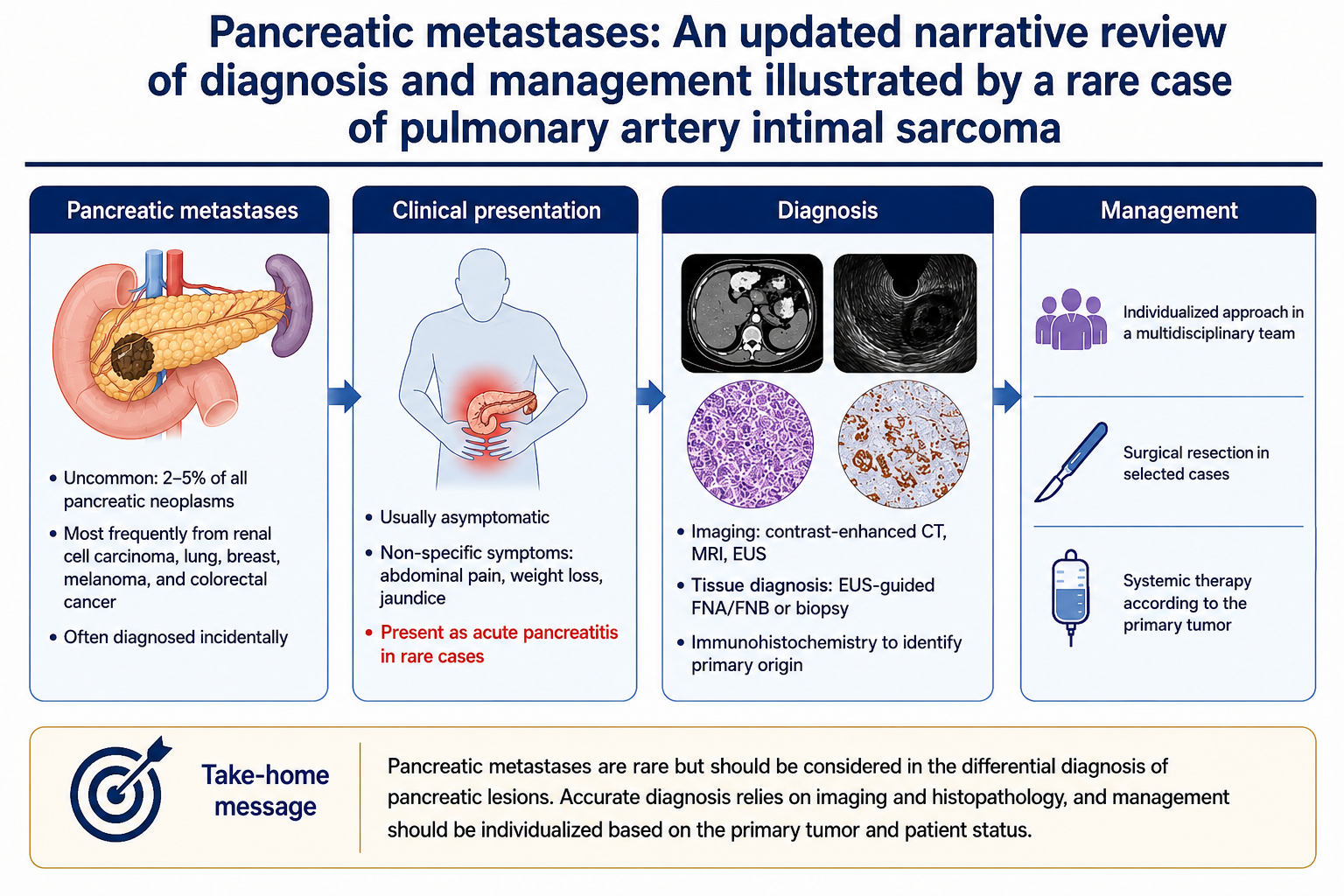
Background: Pancreatic metastases (PM) account for 2%–5% of pancreatic neoplasms diagnosed clinically, while autopsy series report a 3%–12% prevalence, reaching 43% in advanced malignancy. This statistic suggests underdiagnosis of silent lesions mimicking primary pancreatic tumors, representing a major diagnostic challenge. Aim: This study aims to summarize evidence on PM etiology, diagnosis, and management, as illustrated by an exceptional case of acute pancreatitis (AP) secondary to pulmonary artery intimal sarcoma (PAIS). Methods: A narrative review of the medical literature was conducted in June 2026 using PubMed/MEDLINE. Publications available up to January 2026 were reviewed, including electronic ahead-of-print publications. Relevant original studies, systematic reviews, pooled analyses, and clinical guidelines were reviewed, synthesized, and integrated with the case. Results: Renal cell carcinoma (RCC), which accounts for 30%–70% of reported PM in clinical and surgical series, is characterized by indolent biology and latency periods exceeding ten years. Sarcomas, which represent 4.3%–7.2% of reported PM, are biologically aggressive sources of PM. AP presentation is exceptionally uncommon and is a result of mechanical pancreatic duct obstruction. Endoscopic ultrasound-guided fine-needle biopsy is considered the diagnostic standard, with a 97.9% accuracy. Metastasectomy achieves a 76.6% five-year survival rate in RCC cases. In PAIS cases, AP has been reported to resolve following systemic chemotherapy; however, this temporal association should not be interpreted as evidence confirming the proposed pathogenic mechanism. Conclusion: PM should be considered in any pancreatic mass or AP of uncertain origin in patients with cancer. The oligometastatic disease model (≤5 lesions) supports curative-intent or prolonged systemic disease-control strategies. Relevance for patients: Accurate diagnosis prevents staging errors, preserves pancreatic function, and supports prolonged radiological surveillance in tumors with pancreatic tropism.
- Cui M, Amed M, Reid MD, Xue Y. Secondary pancreatic tumors in endoscopic ultrasound-guided fine-needle biopsy: Clinicopathologic characteristics and morphological diagnostic challenges. Hum Pathol. 2025;161:105869. doi: 10.1016/j.humpath.2025.105869
- Aziz H, Kotla A, Abbey R, et al. Renal metastasis to the pancreas: a comprehensive review. J Gastrointest Surg. 2026;30(4):102347. doi: 10.1016/j.gassur.2026.102347
- Hou T, Stewart JM, Lee JH, Gan Q. Solid Tumor Metastases to the Pancreas Diagnosed Using Fine-Needle Aspiration. Am J Clin Pathol. 2020;154(5):692-699. doi: 10.1093/ajcp/aqaa090
- Aversano A, Lissandrini L, Macor D, et al. The Role of Endoscopic Ultrasonography (EUS) in Metastatic Tumors in the Pancreas: 10 Years of Experience from a Single High-Volume Center. Diagnostics. 2024;14(12):1250. doi: 10.3390/diagnostics14121250
- Showalter SL, Hager E, Yeo CJ. Metastatic Disease to the Pancreas and Spleen. Semin Oncol. 2008;35(2):160-171. doi: 10.1053/j.seminoncol.2007.12.008
- Adsay NV, Andea A, Basturk O, Kilinc N, Nassar H, Cheng JD. Secondary tumors of the pancreas: an analysis of a surgical and autopsy database and review of the literature. Virchows Arch. 2004;444(6):527-535. doi: 10.1007/s00428-004-0987-3
- Spadaccini M, Conti Bellocchi MC, Mangiavillano B, et al. Secondary Tumors of the Pancreas: A Multicenter Analysis of Clinicopathological and Endosonographic Features. J Clin Med. 2023;12(8):2829. doi: 10.3390/jcm12082829
- Ducreux M, Cuhna ASa, Caramella C, et al. Cancer of the pancreas: ESMO Clinical Practice Guidelines for diagnosis, treatment and follow-up. Ann Oncol. 2015;26(5):v56-68. doi: 10.1093/annonc/mdv295
- Gonzalez RS, Bagci P, Basturk O, et al. Intrapancreatic distal common bile duct carcinoma: Analysis, staging considerations, and comparison with pancreatic ductal and ampullary adenocarcinomas. Mod Pathol. 2016;29(11):1358-1369. doi: 10.1038/modpathol.2016.125
- Adler H, Redmond CE, Heneghan HM, et al. Pancreatectomy for metastatic disease: A systematic review. Eur J Surg Oncol. 2014;40(4):379-386. doi: 10.1016/j.ejso.2013.12.022
- Zhou Y, Wang X, Chen S, Wang S. A pooled analysis of pancreatic resection for metastatic renal cell carcinoma. Front Oncol. 2024;14:1442256. doi: 10.3389/fonc.2024.1442256
- Jaen-Torrejimeno I, Rojas-Holguín A, López-Guerra D, Ramia JM, Blanco-Fernández G. Pancreatic resection for metastatic renal cell carcinoma. A systematic review. HPB. 2020;22(4):479-486. doi: 10.1016/j.hpb.2019.10.017
- Roalsø MT, Lucocq J, Pandanaboyana S, Søreide K. Surgery for metastasis to the pancreas: systematic review of observational cohort studies. HPB. 2025;27(10):1290-1300. doi: 10.1016/j.hpb.2025.07.003
- Søreide K, Hauge EM, Vigmostad MN. Renal cell carcinoma with metastasis to the pancreas: a model for oligometastasis, oligoprogression and metastatic organotropism. Clin Exp Metastasis. 2025;42(4):38. doi: 10.1007/s10585-025-10359-w
- López Subires S, Amondarain Amenabar N, Valverde C. Intimal sarcoma, review and future perspectives. Curr Opin Oncol. 2026;38(4):310-318. doi: 10.1097/CCO.0000000000001246
- Huang Q, Zhou H, Liu C, et al. Surgical Resection for Metastatic Tumors in the Pancreas: A Single-Center Experience and Systematic Review. Ann Surg Oncol. 2019;26(6):1649-1656. doi: 10.1245/s10434-019-07258-2
- Mohammad S, Chandrasekar V, Singh AV, et al. Biomarker identification of triple negative breast cancer subtypes using machine learning. npj Syst Biol Appl. 2026;12(1):96. doi: 10.1038/s41540-026-00721-3
- Ukegjini K, Steffen T, Tarantino I, Jonas JP, Rössler F, Petrowsky H, et al. Systematic review on groove pancreatitis: management of a rare disease. BJS Open. 2023;7(5):zrad094. doi: 10.1093/bjsopen/zrad094
- Pontrelli A, Di Meo G, Prete FP, De Simone B, Testini M. Management and outcomes of solid pseudopapillary neoplasm of the pancreas: a systematic review. Clin Exp Med. 2025;25(1):318. doi: 10.1007/s10238-025-01733-9
- Pavel M, Öberg K, Falconi M, et al. Gastroenteropancreatic neuroendocrine neoplasms: ESMO Clinical Practice Guidelines for diagnosis, treatment and follow-up. Ann Oncol. 2020;31(7):844-860. doi: 10.1016/j.annonc.2020.03.304
- Konstantinidis IT, Dursun A, Zheng H, et al. Metastatic Tumors in the Pancreas in the Modern Era. J Am Coll Surg. 2010;211(6):749-753. doi: 10.1016/j.jamcollsurg.2010.08.017
- Wadhwa V, Patel N, Grover D, Ali FS, Thosani N. Interventional gastroenterology in oncology. CA Cancer J Clin. 2023;73(3):286-319. doi: 10.3322/caac.21766
- Romanish M, Naous R. Metastatic Tumors to the Pancreas: An Institutional Experience. Ann Diagn Pathol. 2025;79:152528. doi: 10.1016/j.anndiagpath.2025.152528
- Neuzillet C, Decraecker M, Larrue H, et al. Management of intrahepatic and perihilar cholangiocarcinomas: Guidelines of the French Association for the Study of the Liver (AFEF). Liver Int. 2024;44(10):2517-2537. doi: 10.1111/liv.15948
- Adjei Antwi SK, Zironda A, Fogliati A, et al. Outcomes of palliative porto-mesenteric venous stenting in unresectable pancreatic malignancies. Oncologist. 2025;30(9):oyaf267. doi: 10.1093/oncolo/oyaf267
- Paolino G, Esposito I, Hong S, et al. Intraductal tubulopapillary neoplasm (ITPN) of the pancreas: a distinct entity among pancreatic tumors. Histopathology. 2022;81(3):297-309. doi: 10.1111/his.14698
- Kwon H, Ali ZA, Wong BM. Harnessing Semi-Supervised Machine Learning to Automatically Predict Bioactivities of Per- and Polyfluoroalkyl Substances (PFASs). Environ Sci Technol Lett. 2023;10(11):1017-1022. doi: 10.1021/acs.estlett.2c00530.
- Withana PA, Li J, Senadheera SS, et al. Machine learning prediction and interpretation of the impact of microplastics on soil properties. Environ Pollut. 2024;341:122833. doi: 10.1016/j.envpol.2023.122833