
Rooted Currents: Research-through-design for regenerative urbanism in Changzhou Island

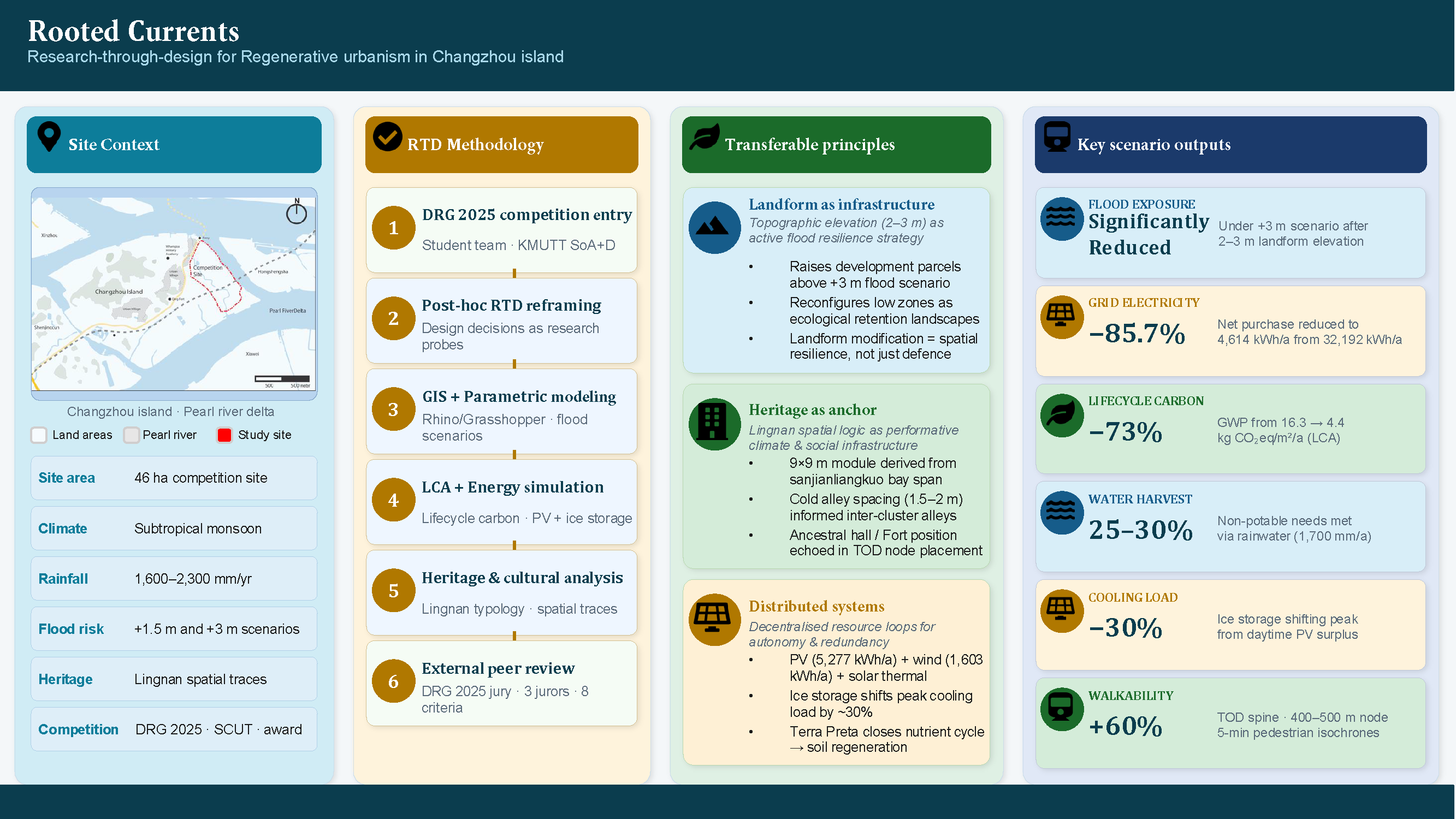
Changzhou Island in Guangzhou’s Pearl River Delta represents a site of both cultural significance and environmental vulnerability, facing increasing pressures from flooding, rapid urbanization, and the erosion of Lingnan architectural heritage. This article reframes the award-winning design proposal of the student competition Rooted Currents as a research-through-design (RTD) inquiry into regenerative urbanism in deltaic environments. The study develops a multi-scalar framework integrating landform modification, transit-oriented development, and distributed water–energy–nutrient systems, informed by heritage-based spatial strategies. Scenario-based modeling and literature-benchmarked estimations indicate that land elevation, ecological water management, and decentralized infrastructure can significantly reduce flood exposure and enhance resource self-sufficiency. At the architectural scale, reinterpreting Lingnan typologies, such as cold alleys and courtyard systems, demonstrates their continued relevance as performative climatic and social infrastructures. The findings are synthesized into three transferable principles: landform as infrastructure, heritage as anchor, and distributed systems of resilience. The article contributes by demonstrating how RTD can generate transferable knowledge for urban resilience in heritage-rich delta regions. While the results remain scenario-based, the study provides a framework applicable to rapidly transforming waterfront cities in China and beyond.
Bandarin, F., & van Oers, R. (2012). The Historic Urban Landscape: Managing Heritage in an Urban Century. Wiley-Blackwell. https://doi.org/10.1002/9781119968115
Bang, A., Krogh, P., Ludvigsen, M., & Markussen, T. (2012). The role of hypothesis in constructive design research. In Proceedings of the Art of Research IV. Design School Kolding.
Boncheva, A. I. (2022). Innovative Adaptation to Climate Change: Chinese Sponge Cities Program (SCP). Current Urban Studies, 10(02), 188-211. https://doi.org/10.4236/cus.2022.102011
Campisano, A., Butler, D., Ward, S., Burns, M. J., Friedler, E., DeBusk, K., Fisher-Jeffes, L. N., Ghisi, E., Rahman, A., Furumai, H., & Han, M. (2017, May 15). Urban rainwater harvesting systems: Research, implementation and future perspectives. Water Research, 115, 195-209. https://doi.org/10.1016/j.watres.2017.02.056
Cervero, R., & Murakami, J. (2010). Effects of built environments on vehicle miles traveled: Evidence from 370 US urbanized areas. Environment and Planning A: Economy and Space, 42(2), 400-418. https://doi.org/10.1068/a4236
Chan, F. K. S., Griffiths, J. A., Higgitt, D., Xu, S., Zhu, F., Tang, Y.-T., Xu, Y., & Thorne, C. R. (2018). Sponge City in China—A breakthrough of planning and flood risk management in the urban context. Land Use Policy, 76, 772-778. https://doi.org/10.1016/j.landusepol.2018.03.005
Chen, N., Guo, H., & Xiang, H. (2023). Evaluation of urban resilience level and analysis of obstacle factors: A case study of Hunan Province, China. Frontiers in Earth Science, 10. https://doi.org/10.3389/feart.2022.1033441
Chen, S., Zhu, Z., Liu, X., & Yang, L. (2022, Aug 19). Variation in Vegetation and Its Driving Force in the Pearl River Delta Region of China. International Journal of Environmental Research and Public Health, 19(16). https://doi.org/10.3390/ijerph191610343
Cole, R. J. (2012). Transitioning from green to regenerative design. Building Research & Information, 40(1), 39-53. https://doi.org/10.1080/09613218.2011.610608
Cross, N. (2006). Designerly ways of knowing. Springer.
Dodoo, A., Gustavsson, L., & Sathre, R. (2014). Lifecycle carbon implications of conventional and low-energy multi-storey timber building systems. Energy and Buildings, 82, 194-210. https://doi.org/10.1016/j.enbuild.2014.06.034
DRG. (2025). Competition Brief 2025. School of Architecture, South China University of Technology
Dunne, A., & Raby, F. (2013). Speculative Everything–Design, Fiction, and Social Dreaming. MIT Press.
Emmanuel, R. (2012). An Urban Approach To Climate Sensitive Design. Taylor & Francis. https://doi.org/10.4324/9780203414644
Frayling, C. (1993). Research in Art and Design. Royal College of Art Research Papers, 1(1), 1-5. https://researchonline.rca.ac.uk/id/eprint/384
Gaver, W. (2012). What should we expect from research through design? SIGCHI Conference on Human Factors in Computing Systems, Austin Texas.
Giaccardi, E. (2019). Histories and futures of research through design: From prototypes to connected things. International Journal of Design, 13(3), 139-155. https://www.ijdesign.org/index.php/IJDesign/article/view/3192/875
Groat, L. N., & Wang, D. (2013). Architectural research methods (2 ed.). John Wiley & Sons.
Han, R., Cai, S., Li, X., Zhang, S., & Wang, G. (2025). Sustaining urban memory through oyster shell Architecture: constructing an evaluation framework for vernacular heritage Planning in Guangzhou. Journal of Asian Architecture and Building Engineering, 1-18. https://doi.org/10.1080/13467581.2025.2558176
He, S., & Wu, F. (2016). Property-Led Redevelopment in Post-Reform China: A Case Study of Xintiandi Redevelopment Project in Shanghai. Journal of Urban Affairs, 27(1), 1-23. https://doi.org/10.1111/j.0735-2166.2005.00222.x
Ji, H., Liu, Y., & Chen, Z. (2023). Exploring the implementation path of passive cooling strategies in Lingnan architecture. Buildings, 13(12), 2954. https://doi.org/10.3390/buildings13122954
Kennedy, C., Pincetl, S., & Bunje, P. (2011, Aug-Sep). The study of urban metabolism and its applications to urban planning and design. Environmental Pollution, 159(8-9), 1965-1973. https://doi.org/10.1016/j.envpol.2010.10.022
Knapp, R. G. (2000). China’s Old Dwellings. University of Hawai‘i Press.
Kong, L., Mu, X., Hu, G., & Zhang, Z. (2022, Jul). The application of resilience theory in urban development: a literature review. Environmental Science and Pollution Research, 29(33), 49651-49671. https://doi.org/10.1007/s11356-022-20891-x
Law, L.-y., Chen, H., Liu, S., & Cheung, M.-h. (2025). Top-down rural heritage revitalization and economic development: A case study of Tangwei village, Dongguan, Guangdong, China. Journal of Chinese Architecture and Urbanism, 7(3). https://doi.org/10.36922/jcau.5029
Li, H., Ding, L., Ren, M., Li, C., & Wang, H. (2017). Sponge City Construction in China: A Survey of the Challenges and Opportunities. Water, 9(9), 594. https://doi.org/10.3390/w9090594
Li, Q., Wang, F., Yu, Y., Huang, Z., Li, M., & Guan, Y. (2019). Comprehensive performance evaluation of LID practices for the sponge city construction: A case study in Guangxi, China. Journal of Environmental Management, 231, 10-20. https://doi.org/10.1016/j.jenvman.2018.10.024
Lin, T.-P., Matzarakis, A., & Hwang, R.-L. (2010). Shading effect on long-term outdoor thermal comfort. Building and Environment, 45(1), 213-221. https://doi.org/10.1016/j.buildenv.2009.06.002
Liu, Z., Lin, Y., De Meulder, B., & Wang, S. (2019). Can greenways perform as a new planning strategy in the Pearl River Delta, China? Landscape and Urban Planning, 187, 81-95. https://doi.org/10.1016/j.landurbplan.2019.03.012
Lyu, G., Bertolini, L., & Pfeffer, K. (2016). Developing a TOD typology for Beijing metro station areas. Journal of Transport Geography, 55, 40-50. https://doi.org/10.1016/j.jtrangeo.2016.07.002
Mang, P., & Reed, B. (2012). Designing from place: a regenerative framework and methodology. Building Research & Information, 40(1), 23-38. https://doi.org/10.1080/09613218.2012.621341
Meerow, S., Newell, J. P., & Stults, M. (2016). Defining urban resilience: A review. Landscape and Urban Planning, 147, 38-49. https://doi.org/10.1016/j.landurbplan.2015.11.011
Meyer, H., Nijhuis, S., & Bobbink, I. (2017). Delta urbanism: the Netherlands. Routledge.
NDRC. (2022). 14th Five-Year Plan for Economic and Social Development and Long-range Objectives Through the Year 2035 of the People’s Republic of China. https://www.ndrc.gov.cn/
Ng, E. (2009). Policies and technical guidelines for urban planning of high-density cities - air ventilation assessment (AVA) of Hong Kong. Building and Environment, 44(7), 1478-1488. https://doi.org/10.1016/j.buildenv.2008.06.013
Nicholls, R. J., Wong, P. P., Burkett, V., Codignotto, J. O., Hay, J., McLean, R. F., Ragoonaden, S., & Woodroffe, C. D. (2007). Coastal systems and low-lying areas. In M. L. Parry, O. F. Canziani, J. P. Palutikof, P. J. v. d. Linden, & C. E. Hanson (Eds.), Climate Change 2007: Impacts, Adaptation and Vulnerability. Contribution of Working Group II to the Fourth Assessment Report of the Intergovernmental Panel on Climate Change (pp. 315-356). Cambridge University Press.
Nijhuis, S., Sun, Y., & Lange, E. (2023). Introduction: Adaptive Urban Transformation in the Pearl River Delta, China. In S. Nijhuis, Y. Sun, & E. Lange (Eds.), Adaptive Urban Transformation: Urban Landscape Dynamics, Regional Design and Territorial Governance in the Pearl River Delta, China (pp. 3-19). Springer International Publishing. https://doi.org/10.1007/978-3-030-89828-1_1
Nijhuis, S., Xiong, L., & Cannatella, D. (2020). Towards a landscape-based regional design approach for adaptive transformation in urbanizing deltas. Research in Urbanism Series, 6, 55-80. https://doi.org/10.7480/rius.6.94
Pahl-Wostl, C. (2015). Water Governance in the Face of Global Change. Springer International. https://doi.org/10.1007/978-3-319-21855-7
Pan, H., Shen, Q., & Zhang, M. (2009). Influence of Urban Form on Travel Behaviour in Four Neighbourhoods of Shanghai. Urban Studies, 46(2), 275-294. https://doi.org/10.1177/0042098008099355
Peiris, M. T. O. V. (2024). Assessment of Urban Resilience to Floods: A Spatial Planning Framework for Cities. Sustainability, 16(20), 9117. https://doi.org/10.3390/su16209117
Renne, J. L., & Curtis, C. (2016). Transit Oriented Development. https://doi.org/10.4324/9781315550008
Stappers, P. J., & Giaccardi, E. (2017). Research through design. In The encyclopedia of human-computer interaction (2 ed., pp. 1-94). The Interaction Design Foundation.
UNESCO. (2011). Recommendation on the Historic Urban Landscape. Proceedings of the records of the general conference, 36th session, Paris.
Vale, L. J. (2014). The politics of resilient cities: Whose resilience and whose city? Building Research & Information, 42(2), 191-201. https://doi.org/10.1080/09613218.2014.850602
Wang, S., Cui, Z., Lin, J., Xie, J., & Su, K. (2022). The coupling relationship between urbanization and ecological resilience in the Pearl River Delta. Journal of Geographical Sciences, 32(1), 44-64. https://doi.org/10.1007/s11442-022-1935-3
Wang, Z., Chen, Z., Ma, C., Wennersten, R., & Sun, Q. (2022). Nationwide Evaluation of Urban Energy System Resilience in China Using a Comprehensive Index Method. Sustainability, 14(4). https://doi.org/10.3390/su14042077
Warner, J., van Buuren, A., & Edelenbos, J. (2012). Making Space for the River: Governance Experiences with Multifunctional River Flood Management in the US and Europe. WIO, 11.
Yang, F., Liu, Z., Zhou, Y., & Wei, L. (2025, Jan). Urbanization weakens vegetation resilience in the Pearl River Delta, China. Journal of Environmental Management, 373, 123756. https://doi.org/10.1016/j.jenvman.2024.123756
Yang, L., Scheffran, J., Qin, H., & You, Q. (2014). Climate-related flood risks and urban responses in the Pearl River Delta, China. Regional Environmental Change, 15(2), 379-391. https://doi.org/10.1007/s10113-014-0651-7
Yin, D., Chen, Y., Jia, H., Wang, Q., Chen, Z., Xu, C., Li, Q., Wang, W., Yang, Y., Fu, G., & Chen, A. S. (2021). Sponge city practice in China: A review of construction, assessment, operational and maintenance. Journal of Cleaner Production, 280. https://doi.org/10.1016/j.jclepro.2020.124963
Yu, K., Li, D., Yuan, H., Fu, W., Qiao, Q., & Wang, S. (2015). Sponge city: Theory and practice. City Planning Review, 39(6), 26-36.
Zevenbergen, C., Fu, D., & Pathirana, A. (2018). Transitioning to Sponge Cities: Challenges and opportunities to address urban water problems in China. Water, 10(9), 1230. https://doi.org/10.3390/w10091230
Zhang, X., Shen, L., & Wu, Y. (2011). Green strategy for gaining competitive advantage in housing development: a China study. Journal of Cleaner Production, 19(2-3), 157-167. https://doi.org/10.1016/j.jclepro.2010.08.005
Zhao, Z., Yang, J., & Chen, G. (2024). Improvement of Traditional Energy-Saving Cold Alley Spaces: Case Study of Shixiangyuan Garden Renovation and Expansion Project in Guangzhou. Buildings, 14(6), 1563. https://doi.org/10.3390/buildings14061563
Zukin, S. (2010). Naked City: The Death and Life of Authentic Urban Places. Oxford University Press.