

Environmental chemical exposure, HIF-1 signaling, blood disorders, and tissue pathology: A public health framework for integrated surveillance in resource-limited settings

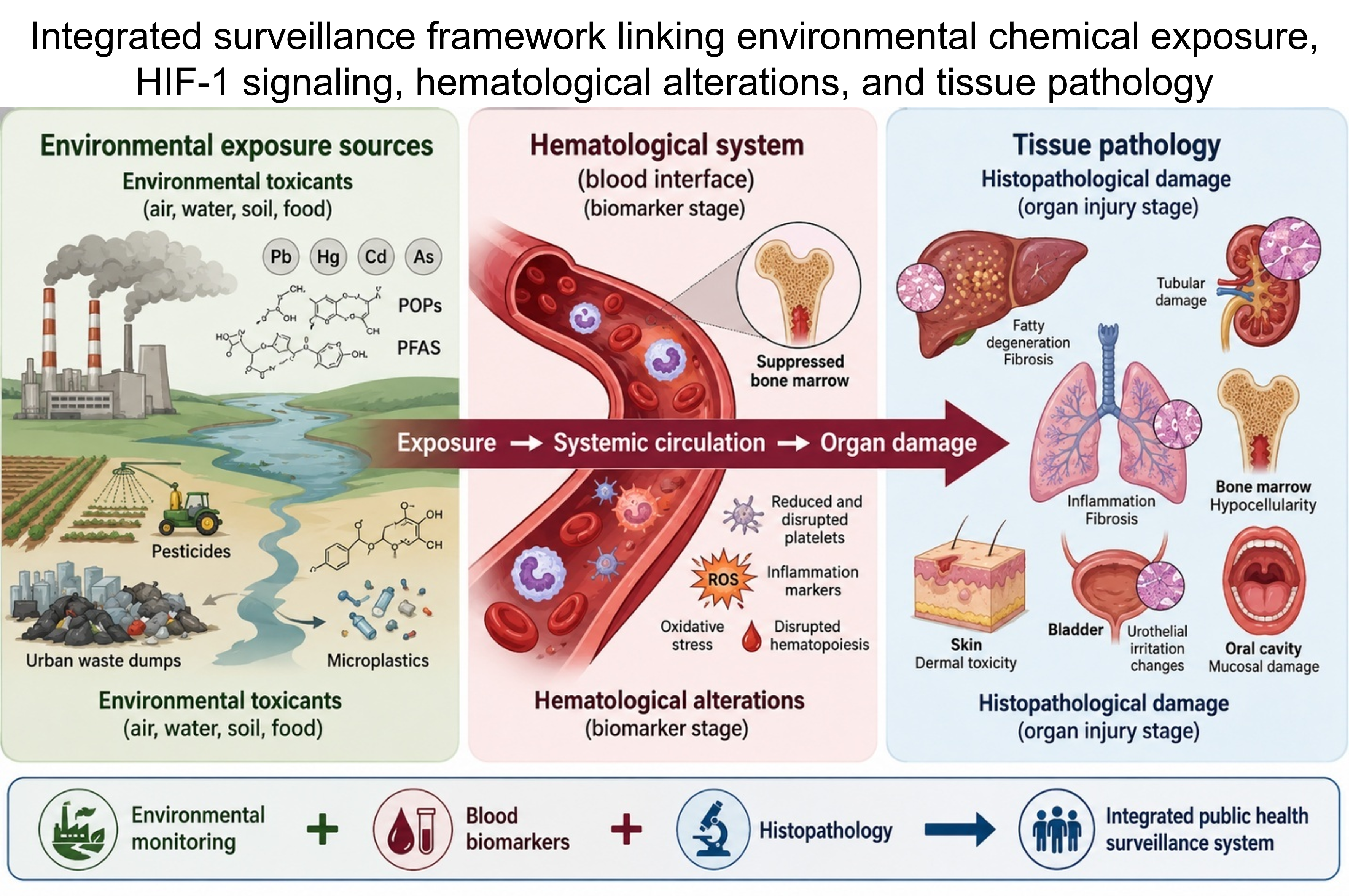
Environmental chemical exposure has emerged as a major but under-recognized driver of systemic disease, particularly in resource-limited settings where environmental monitoring and clinical surveillance systems remain fragmented. Human populations are continuously exposed to complex mixtures of toxicants, including heavy metals, persistent organic pollutants, pesticides, endocrine-disrupting chemicals, and emerging contaminants, through air, water, soil, and food pathways. These exposures produce cumulative biological effects such as oxidative stress, inflammation, disruption of cellular homeostasis, and activation of hypoxia-responsive pathways, particularly hypoxia-inducible factor-1 (HIF-1), ultimately contributing to chronic disease development. This review presents a conceptual integration of environmental chemical exposure with hematological alterations, hypoxia-associated molecular responses, and histopathological tissue damage, proposing a unified public health surveillance framework. Evidence indicates that the hematopoietic system is a primary early target of environmental toxicants, with observed outcomes including anemia, leukocyte abnormalities, platelet dysfunction, and bone marrow suppression. Environmental toxicants such as heavy metals may further induce pseudo-hypoxic cellular states through reactive oxygen species generation and mitochondrial dysfunction, resulting in stabilization of HIF-1α and amplification of inflammatory and metabolic disturbances. These blood-based alterations serve as sensitive biomarkers of exposure prior to overt clinical disease manifestation. At the tissue level, prolonged exposure results in structural damage across multiple organ systems, including the liver, kidneys, lungs, bone marrow, urinary bladder, skin, and oral cavity. These changes are characterized by inflammation, necrosis, fibrosis, epithelial degeneration, hypoxia-associated tissue remodeling, and progressive structural dysfunction, representing advanced stages of toxic injury and confirming systemic environmental damage. The proposed framework conceptualizes environmental exposure as a continuous pathway linking external contamination to internal biological response, mediated through blood as an intermediate diagnostic interface and influenced by hypoxia-responsive molecular signaling pathways. Integration of environmental monitoring with routine hematological testing and targeted histopathological evaluation provides a practical and cost-effective surveillance strategy for resource-limited settings. Overall, this framework supports a shift toward integrated, systems-based surveillance capable of detecting early biological effects of environmental chemical exposure before irreversible disease development occurs.
Abah, M. A., Abass, A. A., Oladosu, M. A., Tatah, S. V., Jackson, S. M., Ocheinehi, A. J., Nnaemeka, N. J., & Yohanna, N. R. (2025). Emerging contaminants in water and wastewater: A review of sources, fate, and removal technologies. Chemical and Environmental Science Archives, 5(4), 35–41. https://doi.org/10.47587/CESA.2025.5401
Abate, H. M., Bujnowski, D., Jowell, A., et al. (2026). Ubiquitous environmental exposures and risk of hepatocellular carcinoma: A narrative review. Digestive Diseases and Sciences, 71, 60–73. https://doi.org/10.1007/s10620-025-09212-7
Ahn, C., & Jeung, E. B. (2023). Endocrine-disrupting chemicals and disease endpoints. International Journal of Molecular Sciences, 24(6), Article 5342. https://doi.org/10.3390/ijms24065342
Al-Ibady, Q. A.-N. A. K., Abbas, R. F., Ghanim, S. A., & Ajmi, R. N. (2024). Emerging contaminants in water: A review of recent research on the occurrence, fate, and removal of emerging contaminants in water sources, highlighting recent developments in treatment technologies. The Peerian Journal, 35, 110–118. https://peerianjournal.com/index. php/tpj/article/view/966
Alsadik, A., Akintunde, O. O., Habibi, H. R., & Achari, G. (2025). PFAS in water environments: Recent progress and challenges in monitoring, toxicity, treatment technologies, and post-treatment toxicity. Environmental Systems Research, 14(1), Article 18. https://doi.org/10.1186/s40068-025-00411-9
Beier, J. I., Luo, J., Vanderpuye, C. M., Brizendine, P., Muddasani, P., Bolatimi, O., Heinig, S. A., Ekuban, F. A., Siddiqui, H., Ekuban, A., Gripshover, T. C., Wahlang, B., Watson, W. H., & Cave, M. C. (2025). Environmental pollutants, occupational exposures, and liver disease. Seminars in Liver Disease, 45(2), 148–166. https://doi.org/10.1055/a-2540-2861
Bhattarai, G., Shrestha, S. K., Sim, H. J., Lee, J. C., & Kook, S. H. (2024). Effects of fine particulate matter on bone marrow-conserved hematopoietic and mesenchymal stem cells: A systematic review. Experimental & Molecular Medicine, 56(1), 118–128. https://doi.org/10.1038/s12276-023-01149-z
Budi, H. S., Opulencia, M. J. C., Afra, A., Abdelbasset, W. K., Abdullaev, D., Majdi, A., Taherian, M., Ekrami, H. A., & Mohammadi, M. J. (2024). Source, toxicity and carcinogenic health risk assessment of heavy metals. Reviews on Environmental Health, 39(1), 77–90. https://doi.org/10.1515/reveh-2022-0096
Carlin, D. J., & Rider, C. V. (2024). Combined exposures and mixtures research: An enduring NIEHS priority. Environmental Health Perspectives, 132(7), Article 075001. https://doi.org/10.1289/EHP14340
Chen, L., & Gao, Z. (2018). Continuous hypoxia reduces the concentration of streptomycin in the blood. BMC Infectious Diseases, 18, Article 120. https://doi.org/10.1186/s12879-018-3027-7
Chen, Q. Y., Murphy, A., Sun, H., & Costa, M. (2019). Molecular and epigenetic mechanisms of Cr(VI)-induced carcinogenesis. Toxicology and Applied Pharmacology, 377, Article 114636. https://doi.org/10.1016/j.taap.2019.114636
Chen, Z., & Jia, G. (2025). Health effects of exposure to environmental pollutants: The combination of traditional and emerging pollutants. Toxics, 13(8), Article 641. https://doi.org/10.3390/toxics13080641
Cheng, Q., Liu, Q., & Lu, C. (2024). A state-of-the-science review of using mitochondrial DNA copy number as a biomarker for environmental exposure. Environmental Pollution, 346, Article 123642. https://doi.org/10.1016/j.envpol.2024.123642
Cheng, Y. F., Zhao, Y. J., Chen, C., & Zhang, F. (2025). Heavy metals toxicity: Mechanism, health effects, and therapeutic interventions. MedComm, 6(9), Article e70241. https://doi.org/10.1002/mco2.70241
Chu, L., Wang, P., Qiu, M., Abadi, A. M., & Chen, K. (2026). Extreme weather events and their health impacts: International variation. Annual Review of Public Health, 47(1), 325–347. https://doi.org/10.1146/annurev-publhealth-090924-033314
Clark, L. P., Zilber, D., Schmitt, C., Fargo, D. C., Reif, D. M., Motsinger-Reif, A. A., & Messier, K. P. (2025). A review of geospatial exposure models and approaches for health data integration. Journal of Exposure Science & Environmental Epidemiology, 35(2), 131–148. https://doi.org/10.1038/s41370-024-00712-8
Climate-Kidneys-Cognition Working Group. (2026). Global environmental change and the gut–kidney–brain axis: A review and framework of vulnerability and resilience. The Lancet Planetary Health, 10(4), Article 101453. https://doi.org/10.1016/j.lanplh.2026.101453
Corvetto, J. F., Simion, R., Boutros, P., Kassem, N., Belesova, K., Bärnighausen, T., Sauerborn, R., & Barteit, S. (2026). Mapping the global health burden of climate-sensitive exposures: A systematic scoping review. Environmental Health, 25, Article 31. https://doi.org/10.1186/s12940-026-01294-8
Cui, H. L., Gao, S. H., Wang, H. C., Zhang, L. Y., Luo, Y., Ying, G. G., Sun, W. L., Yu, Y. J., Liang, B., & Wang, A. J. (2026). Big data integration for environmental risk assessment of emerging contaminants. Nature Sustainability, 9(2), 196– 206. https://doi.org/10.1038/s41893-025-01718-2
Cui, Z. (2025). Microplastic exposure and human health: Advancing risk assessment and future research directions. Theoretical and Natural Science, 147(1), 66–71. https://doi.org/10.54254/2753-8818/2025.AU28680
Czaczkowska, L., Jabłońska, E., & Ratajczak-Wrona, W. (2025). Endocrine disruptors and breast cancer: A comprehensive review. Biomedicines, 13(11), Article 2774. https://doi.org/10.3390/biomedicines13112774
Daramola, A. O., Folaranmi, O. E., & Okonji, K. S. (2026). Chemical exposure, self-reported haematological symptoms, and laboratory safety practices among undergraduate and postgraduate science and medical students. Nigerian Research Journal of Chemical Sciences, 14(1), 298–311.
Disner, G. R., & Tareq, S. M. (2025). Editorial: Emerging water contaminants in developing countries: Detection, monitoring, and impact of xenobiotics. Frontiers in Water, 7, Article 1584752. https://doi.org/10.3389/frwa.2025.1584752
Dlamini, Z., Alaouna, M., Marutha, T., Hull, R., & Khanyile, R. (2025). The exposome perspective: Environmental and infectious agents as drivers of cancer disparities in low- and middle-income countries. Cancers, 17(15), Article 2537. https://doi.org/10.3390/cancers17152537
Donzelli, G., Gehring, R., Murugadoss, S., Roos, T., Schaffert, A., & Linzalone, N. (2025). A critical review on the toxicological and epidemiological evidence integration for assessing human health risks to environmental chemical exposures. Reviews on Environmental Health, 40(2), 427–436. https://doi.org/10.1515/reveh-2024-0072
Dos Santos, C. R., Rosa E Silva, G. O., Valias, C. F., Santos, L. V. S., & Amaral, M. C. S. (2024). Ecotoxicological study of seven pharmaceutically active compounds: Mixture effects and environmental risk assessment. Aquatic Toxicology, 275, Article 107068. https://doi.org/10.1016/j.aquatox.2024.107068
Dzierżyński, E., Gawlik, P. J., Puźniak, D., Zaborowski, M., & Milanowski, J. (2024). Microplastics in the human body: Exposure, detection, and risk of carcinogenesis. Cancers, 16(21), Article 3703. https://doi.org/10.3390/cancers16213703
Ewa, B., & Danuta, M. (2017). Polycyclic aromatic hydrocarbons and PAH-related DNA adducts. Journal of Applied Genetics, 58(3), 321–330. https://doi.org/10.1007/s13353-016-0380-3
Fenton, S. E., Ducatman, A., Boobis, A., DeWitt, J. C., Lau, C., Ng, C., Smith, J. S., & Roberts, S. M. (2021). Per- and polyfluoroalkyl substance toxicity and human health review. Environmental Toxicology and Chemistry, 40(3), 606–630. https://doi.org/10.1002/etc.4890
Fortenbery, G. W., Sarathy, B., Carraway, K. R., Mansfield, K. D., & Deshmukh, M. (2018). Hypoxic stabilization of mRNA is HIF-independent but requires mtROS. Cellular and Molecular Biology Letters, 23, Article 48. https://doi.org/10.1186/s11658-018-0112-2
Fuller, R., Landrigan, P. J., Balakrishnan, K., Bathan, G., Bose- O’Reilly, S., Brauer, M., Caravanos, J., Chiles, T., Cohen, A., Corra, L., Cropper, M., Fobil, J., Gray, V., Hanrahan, D., Hunter, H., Hu, H., Shuk Shukla, A., Keller, N. M., Kim, J., . . . Yam, C. (2022). Pollution and health: A progress update. The Lancet Planetary Health, 6(6), e535–e547. https://doi.org/10.1016/S2542-5196(22)00090-0
Ghosh, B., Chowdhury, M., Ghosh, S., Rabha, R., Chatterjee, A., Niyogi, S., Patra, P. K., & Hecker, M. (2026). Airborne particulate-bound metal exposure, haematological responses, and associated non-carcinogenic and carcinogenic risks in adult male residents of urban and industrial regions of West Bengal, India. Exposure and Health, 18, Article 17. https://doi.org/10.1007/s12403-026-00757-0
Grari, O., Khermach, A., Douzi, N., Chahid, N., Himri, A., Ouhnini, H., et al. (2026). Hematological impacts of environmental toxicants and sustainable strategies for prevention. Discovery Environment, 4, Article 80. https://doi.org/10.1007/s44274-026-00594-7
Groopman, J. D., Kensler, T. W., & Wild, C. P. (2008). Protective interventions to prevent aflatoxin-induced carcinogenesis in developing countries. Annual Review of Public Health, 29, 187–203. https://doi.org/10.1146/annurev.publhealth.29.020907. 090859
Hattab, S., Alaya, C., & Banni, M. (2025). Emerging pollutants in wastewater: A challenge for water reuse. In S. Zandaryaa, A. Fares, & G. Eckstein (Eds.), Emerging pollutants (pp. 297– 313). Springer. https://doi.org/10.1007/978-3-031-71758-1_13
Hernandez-Castillo, C., Shuck, S. C., & Termini, J. (2023). DNA adducts as biomarkers in toxicology. In V. B. Patel, V. R. Preedy, & R. Rajendram (Eds.), Biomarkers in toxicology (pp. 375–392). Springer. https://doi.org/10.1007/978-3-031-07392-2_21
Hughes, M. F., Beck, B. D., Chen, Y., Lewis, A. S., & Thomas, D. J. (2011). Arsenic exposure and toxicology: A historical perspective. Toxicological Sciences, 123(2), 305–332. https://doi.org/10.1093/toxsci/kfr184
Huhn, S., Escher, B. I., Krauss, M., Scholz, S., Hackermüller, J., & Altenburger, R. (2021). Unravelling the chemical exposome in cohort studies: Routes explored and steps to become comprehensive. Environmental Sciences Europe, 33(1), Article 17. https://doi.org/10.1186/s12302-020-00444-0
Islam, M., Roy, D., & Singha, D. (2025). Metal ion toxicity in the human body: Sources, effects, mechanisms, and detoxification methods. Chemistry Africa, 8, 779–797. https://doi.org/10.1007/s42250-025-01233-z
Jacobson, T. A., Kler, J. S., Bae, Y., Chen, J., Ladror, D. T., Iyer, R., Nunes, D. A., Montgomery, N. D., Pleil, J. D., & Funk, W. E. (2023). A state-of-the-science review and guide for measuring environmental exposure biomarkers in dried blood spots. Journal of Exposure Science & Environmental Epidemiology, 33, 505–523. https://doi.org/10.1038/s41370-022-00460-7
Jomova, K., Alomar, S. Y., Nepovimova, E., et al. (2025). Heavy metals: Toxicity and human health effects. Archives of Toxicology, 99, 153–209. https://doi.org/10.1007/s00204-024-03903-2
Kalenik, S., Zaczek, A., & Rodacka, A. (2025). Air pollution-induced neurotoxicity: The relationship between air pollution, epigenetic changes, and neurological disorders. International Journal of Molecular Sciences, 26(7), Article 3402. https://doi.org/10.3390/ijms26073402
Kassotis, C. D., & Phillips, A. L. (2023). Complex mixtures and multiple stressors: Evaluating combined chemical exposures and cumulative toxicity. Toxics, 11(6), Article 487. https://doi.org/10.3390/toxics11060487
Kim, S., Hollinger, H., & Radke, E. G. (2022). ‘Omics in environmental epidemiological studies of chemical exposures: A systematic evidence map. Environment International, 164, Article 107243. https://doi.org/10.1016/j.envint.2022.107243
Klibaner-Schiff, E., Simonin, M. E., Akdis, C. A., Nadeau, K. C., & Prunicki, M. (2024). Environmental exposures influence multigenerational epigenetic transmission. Clinical Epigenetics, 16(1), Article 145. https://doi.org/10.1186/s13148-024-01762-3
Kotha, S. V., Kuo, G., Kammula, S. V., Shi, L., Zhang, X., Liu, P., & Mao, X. (2025). The epidemiological and toxicological intersection of air pollution and dementia. Reviews of Environmental Contamination and Toxicology, 263(1), Article 25. https://doi.org/10.1007/s44169-025-00092-6
Kotnala, S., Tiwari, S., Nayak, A., Bhushan, B., Chandra, S., Medeiros, C. R., & Coutinho, H. D. (2025). Impact of heavy metal toxicity on human health and environment. Science of the Total Environment, 987, Article 179785. https://doi.org/10.1016/j.scitotenv.2025.179785
Kulcsárová, K., Piel, J. H. A., & Schaeffer, E. (2025). Environmental toxins in neurodegeneration: A narrative review. Neurological Research and Practice, 7, Article 93. https://doi.org/10.1186/s42466-025-00452-6
Kumar, A., Singh, V., & Shah, M. P. (2026). Environmental toxicology and human health: Current challenges and future perspectives. John Wiley & Sons. https://doi.org/10.1002/9781394399857.ch10
Kuo, C. C., Moon, K. A., Wang, L., Silbergeld, E., Navas-Acien, A., & Guallar, E. (2017). The association of arsenic metabolism with cancer, cardiovascular disease, and diabetes. Environmental Health Perspectives, 125(8), Article 087001. https://doi.org/10.1289/EHP577
Ladeira, C. (2024). Environmental and occupational exposure to chemical agents and health challenges I—What message can bring to regulatory science? Toxics, 12(11), Article 778. https://doi.org/10.3390/toxics12110778
Landrigan, P. J., & Vicini, A. (Eds.). (2021). Ethical challenges in global public health: Climate change, pollution, and the health of the poor. Wipf and Stock Publishers. https://jmt. scholasticahq.com/article/24226-ethical-challenges-in-global-public-health.pdf
Lawal, F. O., & Okonji, K. S. (2026). Heavy metal contamination of soils in industrial ceramic sites with long-term ecological and sustainable land use implications. Journal of Environmental Spectrum, 6(1), 27–36. https://doi.org/10.66567/t9wndc22
Lee, M., Saha, A., Sundaram, R., Albert, P. S., & Zhao, S. (2024). Accommodating detection limits of multiple exposures in environmental mixture analyses: An overview of statistical approaches. Environmental Health, 23, Article 48. https://doi.org/10.1186/s12940-024-01088-w
Liu, B., Zhao, X., He, H., Zhou, L., Fan, Y., Chai, X., Xu, X., Gong, X., An, S., Ling, X., & Chu, X. (2025). Exposure to urinary polycyclic aromatic hydrocarbon metabolites for the effect of lung function among children and adolescents: Epidemiological study and mechanism exploration. Ecotoxicology and Environmental Safety, 292, Article 117990. https://doi.org/10.1016/j.ecoenv.2025.117990
Liu, J. Y., & Sayes, C. M. (2024). Modeling mixtures interactions in environmental toxicology. Environmental Toxicology and Pharmacology, 106, Article 104380. https://doi.org/10.1016/j.etap.2024.104380
Liu, M., Liu, J., Xiong, F., Xu, K., Pu, Y., Huang, J., Zhang, J., Pu, Y., Sun, R., & Cheng, K. (2023). Research advances of microplastics and potential health risks of microplastics on terrestrial higher mammals: A bibliometric analysis and literature review. Environmental Geochemistry and Health, 45(6), 2803–2838. https://doi.org/10.1007/s10653-022-01458-8
Lodge, K. M., Vassallo, A., Liu, B., Long, M., Tong, Z., Newby, P. R., Agha-Jaffar, D., Paschalaki, K., Green, C. E., Belchamber, K. B. R., Ridger, V. C., Stockley, R. A., Sapey, E., Summers, C., Cowburn, A. S., Chilvers, E. R., Li, W., & Condliffe, A. M. (2022). Hypoxia increases the potential for neutrophil-mediated endothelial damage in chronic obstructive pulmonary disease. American Journal of Respiratory and Critical Care Medicine, 205(8), 903–916. https://doi.org/10.1164/rccm.202006-2467OC
McHale, C. M., Zhang, L., & Smith, M. T. (2012). Current understanding of benzene-induced leukemia. Carcinogenesis, 33(2), 240–252. https://doi.org/10.1093/carcin/bgr297
Miller, G. W., & Banbury Exposomics Consortium. (2025). Integrating exposomics into biomedicine. Science, 388(6745), 356–358. https://doi.org/10.1126/science.adr0544
Mulky, L., Ronak, R., & Somashekara, D. (2026). Pollution to solution: Understanding and addressing microplastic contamination in the environment. Environmental Quality Management, 35(3), Article e70307. https://doi.org/10.1002/tqem.70307
National Toxicology Program. (2023). NTP technical report on PFOA toxicology and carcinogenesis (NTP TR 598). National Institutes of Health. https://doi.org/10.22427/NTP-TR-598
Naujokas, M. F., Anderson, B., Ahsan, H., Suk, W. A., Christiani, D. C., Ward, N. O., & Smith, M. T. (2013). Chronic arsenic exposure health effects update. Environmental Health Perspectives, 121(3), 295–302. https://doi.org/10.1289/ehp.1205875
Nian, M., Braun, G., Escher, B. I., & Fang, M. (2024). Toxicological study of human exposure to mixtures of chemicals: Challenges and approaches. Environmental Science & Technology Letters, 11(8), 773–782. https://doi.org/10.1021/acs.estlett.4c00393
Ogunseitan, O. A. (2025). Planetary boundaries for recalcitrant materials and toxic chemical pollutants: Specifications for sustainable safe operating zones. Frontiers in Environmental Science, 13, Article 1593947. https://doi.org/10.3389/fenvs.2025.1593947
Okonji, K. S. (2025). Community perception of waterborne health risks in rocky-hill settlements of Nigeria: Implications for environmental justice and rural health policy in Sub- Saharan Africa. Ethiopian Journal of Environmental Studies and Management, 18(4), 458–469. https://ejesm.org/doi/ v18i4.3
Okonji, K. S. (2025). Environmental impacts of industrial activities on soil and water quality: A comprehensive review. International Journal of Engineering Sciences & Research Technology, 14(12), 14–25. https://doi.org/10.29121/ijesrtp.v14.i12.2025.2
Pan, S., Li, Z., Rubbo, B., Quon-Chow, V., Chen, J. C., Baumert, B. O., et al. (2025). Applications of mixture methods in epidemiological studies investigating the health impact of persistent organic pollutant exposures: A scoping review. Journal of Exposure Science & Environmental Epidemiology, 35, 522–534. https://doi.org/10.1038/s41370-024-00717-3
Peng, Z. (2025). The microplastics and human health: Their sources, and impact. International Journal of Advance in Clinical Science Research, 4, 15–25. https://h-tsp.com/index. php/ijacsr/article/view/91
Pratt, M. M., John, K., MacLean, A. B., Donnelly, K. C., & Poirier, M. C. (2011). PAH exposure and DNA adducts in human tissues. International Journal of Environmental Research and Public Health, 8(7), 2675–2691. https://doi.org/10.3390/ijerph8072675
Protano, C., Antonucci, A., De Giorgi, A., Zanni, S., Mazzeo, E., Cammalleri, V., et al. (2024). Exposure and early effect biomarkers for risk assessment of occupational exposure to formaldehyde: A systematic review. Sustainability, 16(9), Article 3631. https://doi.org/10.3390/su16093631
Ross, J. A., & Nesnow, S. (1999). PAH DNA adducts and ras mutations. Mutation Research/Fundamental and Molecular Mechanisms of Mutagenesis, 424(1–2), 155–166. https://doi.org/10.1016/S0027-5107(99)00016-0
Salaah, S. M. (2025). Persistent organic pollutants: Dual threats to environmental integrity and human health. IntechOpen. https://doi.org/10.5772/intechopen.1013805
Salavoura, A. (2025). Organic pollutants and disease. In Chemical environmental pollutants and their effect on health (pp. 215– 262). Springer Nature Switzerland. https://doi.org/10.1007/978-3-031-80271-3_5
Sanusi, I. O., Adepoju, A. A., & Abdulrahman, B. D. (2025). Heavy metal contamination, human health impact, and remediation techniques in water bodies: A review. Discovery Environment, 3, Article 268. https://doi.org/10.1007/s44274-025-00475-5
Scheringer, M., Arp, H. P. H., & Cousins, I. T. (2026). Boundaries, limits, global threats: How can the impacts of global synthetic pollutants be reduced? Environmental Science & Technology, 60(6), 4499–4505. https://doi.org/10.1021/acs.est.5c13807
Schönberger, T., Jakobs, M., Friedel, A. L., et al. (2024). Exposure to normobaric hypoxia shapes the acute inflammatory response in human whole blood cells in vivo. Pflügers Archiv - European Journal of Physiology, 476, 1369–1381. https://doi.org/10.1007/s00424-024-02969-2
Seyyedsalehi, M. S., & Boffetta, P. (2023). PFAS exposure and cancer risk: Systematic review. La Medicina del Lavoro, 114(5), Article e2023040. https://doi.org/10.23749/mdl.v114i5.15065
Shekhar, C., Khosya, R., Thakur, K., Mahajan, D., Kumar, R., Kumar, S., & Sharma, A. K. (2024). A systematic review of pesticide exposure, associated risks, and long-term human health impacts. Toxicology Reports, 13, Article 101840. https://doi.org/10.1016/j.toxrep.2024.101840
Singh, B., Bhat, A., Thenuwara, G., Ravi, K., Naik, A. S., O’Connor, C., & Tian, F. (2025). Hidden threats in water: The global rise of emerging contaminants. Pollutants, 5(4), Article 48. https://doi.org/10.3390/pollutants5040048
Singh, D. D. (2025). Epigenetic mechanisms of endocrine-disrupting chemicals in breast cancer. Journal of Xenobiotics, 15(1), 1–15. https://doi.org/10.3390/jox15010001
Smela, M. E., Currier, S. S., Bailey, E. A., & Essigmann, J. M. (2001). Aflatoxin B1 chemistry and carcinogenesis. Carcinogenesis, 22(4), 535–545. https://doi.org/10.1093/carcin/22.4.535
Smith, M. T. (2010). Benzene health effects and susceptibility. Annual Review of Public Health, 31, 133–148. https://doi.org/10.1146/annurev.publhealth.012809.103646
Snehamayee, N., Somya, S., Kumar, S. C., Niranjan, M., Ranjan, S. B., & Kumar, M. N. (2026). Microplastics and human health: A comprehensive review on exposure pathways, toxicity, and emerging risks. Microplastics, 5(1), Article 8. https://doi.org/10.3390/microplastics5010008
Supardiono, S., Rahayu, R., & Nurhidayatullah, N. (2024). Integrative approach to evaluation of physical, chemical and biological parameters: Analysis of Mujur River water quality. Jurnal Pijar Mipa, 19, 547–552. https://doi.org/10.29303/jpm.v19i3.6786
Thacharodi, A., Meenatchi, R., Hassan, S., Hussain, N., Bhat, M. A., Arockiaraj, J., Ngo, H. H., Le, Q. H., & Pugazhendhi, A. (2024). Microplastics in the environment: A critical overview on its fate, toxicity, implications, management, and bioremediation strategies. Journal of Environmental Management, 349, Article 119433. https://doi.org/10.1016/j.jenvman.2023.119433
Tian, L., Wang, Y., Qi, W., Wang, B., Zhang, X., Gong, M., Zhang, X., & Wang, T. (2025). Pathophysiological insights and clinical management strategies for interstitial lung diseases. Biomolecules & Therapeutics, 33(5), 785–803. https://doi.org/10.4062/biomolther.2025.003
United Nations Environment Programme. (2019). Global chemicals outlook II: From legacies to innovative solutions— Environmental exposure and health impacts. https://www. unep.org/resources/report/global-chemicals-outlook-ii-legacies-innovative-solutions
Vasarmidi, E., Worrell, J. C., Mahmutovic Persson, I., Yaqub, N., Miądlikowska, E., Barnig, C., Boots, A., Reynaert, N. L., & Cuevas Ocaña, S. (2025). Insights into interstitial lung disease pathogenesis. Breathe, 21(2), Article 240261. https://doi.org/10.1183/20734735.0261-2024
Wang, R., Tang, H., Yang, R., & Zhang, J. (2024). Emerging contaminants in water environments: Progress, evolution, and prospects. Water Science & Technology, 89(10), 2763– 2782. https://doi.org/10.2166/wst.2024.151
Wild, C. P., & Gong, Y. Y. (2010). Mycotoxins and human disease. Carcinogenesis, 31(1), 71–82. https://doi.org/10.1093/carcin/bgp264
World Health Organization. (2025, July 24). WHO unveils health and environment scorecards for 194 countries. https://www. who.int/news/item/24-07-2025-who-unveils-health-and-environment-scorecards-for-194-countries
Xie, Y. X., Wang, L., Zhou, Z. H., Liu, W. J., Wang, W., Yang, J. H., He, M. L., Qiu, J. G., & Jiang, B. H. (2024). m6A RNA methyltransferase METTL16 induces Cr(VI) carcinogenesis and lung cancer development through glutamine biosynthesis and GLUL expression. Journal of Hazardous Materials, 480, Article 136093. https://doi.org/10.1016/j.jhazmat.2024.136093
Yan, Z., Jin, X., Feng, C., Leung, K. M. Y., Zhang, X., Lin, Q., & Wu, F. (2025). Beyond the single-contaminant paradigm: Advancing mixture toxicity and cumulative risk assessment in environmental toxicology. Environmental Science & Technology, 59(22), 10711–10714. https://doi.org/10.1021/acs.est.5c05712
Zhang, R. K., Li, Y., Sun, F. L., Zhou, Z. H., Xie, Y. X., Liu, W. J., Wang, W., Qiu, J. G., Jiang, B. H., & Wang, L. (2024). RNA methyltransferase NSUN2-mediated m5C methylation promotes Cr(VI)-induced malignant transformation and lung cancer by accelerating metabolism reprogramming. Environment International, 192, Article 109055. https://doi.org/10.1016/j.envint.2024.109055
Zhang, X. R., Sun, F. L., Wei, B., & Jiang, B. H. (2025). SPP1 expression serves as a potential peripheral circulating biomarker for lung cancer prognostics and drives tumorigenesis. Genes & Diseases, 13(3), Article 101994. https://doi.org/10.1016/j.gendis.2025.101994
Zhang, X., Yu, C., Wang, P., & Yang, C. (2025). Microplastics and human health: Unraveling the toxicological pathways and implications for public health. Frontiers in Public Health, 13, Article 1567200. https://doi.org/10.3389/fpubh.2025.1567200
Zhang, Z., Shi, W., Ru, L., & Lv, W. (2024). Biomarkers of occupational benzene exposure: A systematic review to estimate the exposure levels and individual susceptibility at low doses. Toxicology and Industrial Health, 40(9–10), 539–555. https://doi.org/10.1177/07482337241259053
Zheng, Y., Liu, W., Yan, M., Yang, Z., Zhu, H., Sun, H., & Zhao, H. (2025). Quantitative identification and prioritization of combined effects of multiple endocrine disrupting compound exposure on oxidative stress. Journal of Hazardous Materials, 495, Article 138906. https://doi.org/10.1016/j.jhazmat.2025.138906
Zhu, G., Wen, Y., Cao, K., He, S., & Wang, T. (2024). A review of common statistical methods for dealing with multiple pollutant mixtures and multiple exposures. Frontiers in Public Health, 12, Article 1377685. https://doi.org/10.3389/fpubh.2024.1377685
Ziyaei, K., Mokhtari, M., Hashemi, M., Rezaei, K., & Abdi, F. (2024). Association between exposure to water sources contaminated with polycyclic aromatic hydrocarbons and cancer risk: A systematic review. Science of the Total Environment, 924, Article 171261. https://doi.org/10.1016/j.scitotenv.2024.171261