
Understanding melt pool characteristics as a means for reducing build layout quality variations in laser-based powder bed fusion: An approach toward spatial parameter compensations

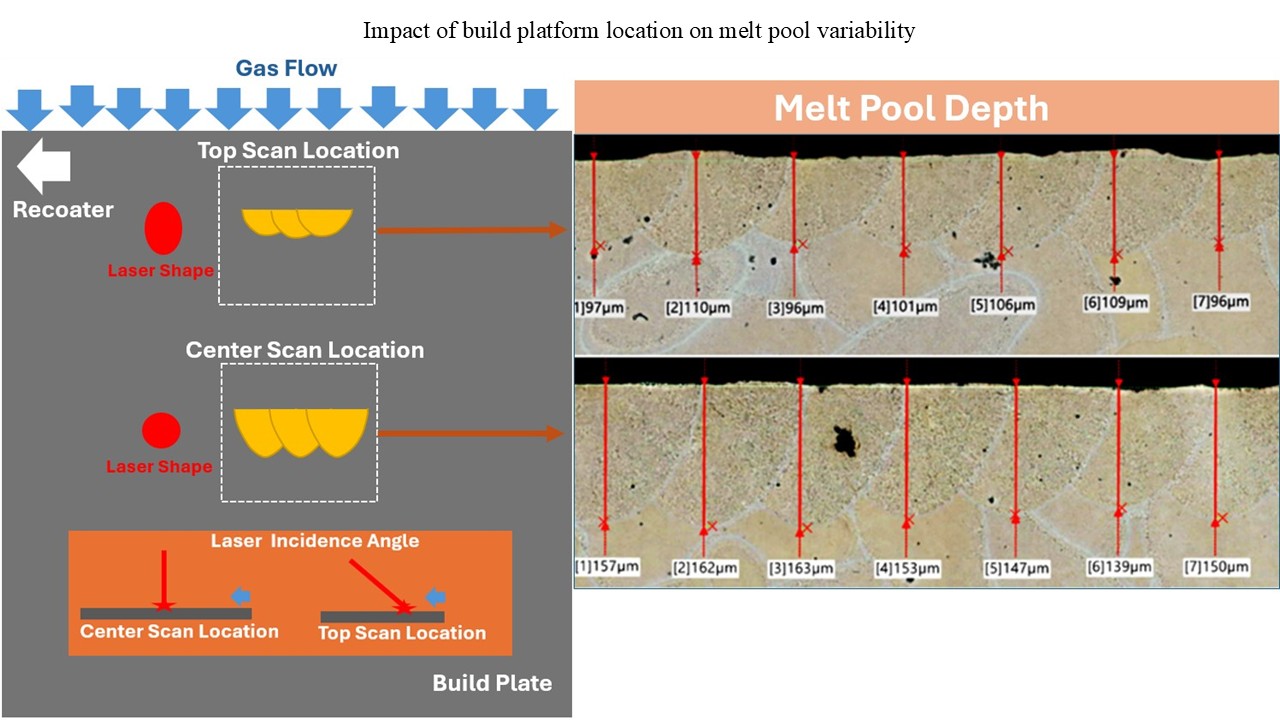
This study investigates the impact of build platform location on melt pool variability during laser-based powder bed fusion of metals. The incident angle and gas flow are hypothesized to influence melt pool penetration and contribute to spatial variations in the melt pool. Results show that the typical build strategy using the same material-dependent processing parameters for all parts throughout the build chamber produces parts with location-dependent properties. An overarching goal of the present work was to attempt to fabricate similar parts at different locations within the build chamber by identifying processing parameters that produce similar melt pool depths at these locations. It was further hypothesized that by normalizing process parameters through similar melt pool depths, similar porosity counts could be achieved at these locations, thus mitigating process-induced variability. The study emphasizes the necessity of spatial parameter adjustments to minimize variability across different locations within the build platform, as well as the requirement for uniform gas flow across the build chamber, thereby eliminating gas flow-dependent variations from the analysis.
- Moran TP, Warner DH, Soltani-Tehrani A, Shamsaei N, Phan N. Spatial inhomogeneity of build defects across the build plate in laser powder bed fusion. Addit Manuf. 2021;47:102333. doi: 10.1016/j.addma.2021.102333
- Robinson DKR, Lagnau A, Boon WPC. Innovation pathways in additive manufacturing: Methods for tracing emerging and branching paths from rapid prototyping to alternative applications. Technol Forecast Soc Change. 2019;146: 733-750. doi: 10.1016/j.techfore.2018.07.012
- de Formanoir C, Paggi U, Colebrants T, et al. Increasing the productivity of laser powder bed fusion: Influence of the hull-bulk strategy on part quality, microstructure and mechanical performance of Ti-6Al-4V. Addit Manuf. 2020;33:101129. doi: 10.1016/j.addma.2020.101129
- Mussatto A, Groarke R, Vijayaraghavan RK, et al. Assessing dependency of part properties on the printing location in laser-powder bed fusion metal additive manufacturing. Mater Today Commun. 2022;30:103209. doi: 10.1016/j.mtcomm.2022.103209
- Tradowsky U, White J, Ward RM, Read N, Reimers W, Attallah MM. Selective laser melting of AlSi10Mg: Influence of post-processing on the microstructural and tensile properties development. Mater Des. 2016;105:212-222. doi: 10.1016/j.matdes.2016.05.066
- Rebaioli L. A review on benchmark artifacts for evaluating the geometrical performance of additive manufacturing processes. Int J Adv Manuf Technol. 2017;93:2571-2598. doi: 10.1007/s00170-017-0570-0
- Kotadia HR, Gibbons G, Das A, Howes PD. A review of laser powder bed fusion additive manufacturing of aluminium alloys: Microstructure and properties. Addit Manuf. 2021;46:102155. doi: 10.1016/j.addma.2021.102155
- Taylor HC, Garibay EA, Wicker RB. Toward a common laser powder bed fusion qualification test artifact. Addit Manuf. 2021;39:101803. doi: 10.1016/j.addma.2020.101803
- Anwar A Bin, Pham QC. Selective laser melting of AlSi10Mg: Effects of scan direction, part placement and inert gas flow velocity on tensile strength. J Mater Process Technol. 2017;240:388-396. doi: 10.1016/j.jmatprotec.2016.10.015
- Philo AM, Sutcliffe CJ, Sillars S, Sienz J, Brown SGR, Lavery NP. A Study Into the Effects of Gas Flow Inlet Design of the Renishaw AM250 Laser Powder Bed Fusion Machine Using Computational Modelling. In: Solid Freeform Fabrication. Proceedings of the 28th Annual International Solid Freeform Fabrication Symposium, An Additive Manufacturing Conference, Austin, Texas, United states of America; 2017. p. 1203-1219.
- Subramanian R, Rule D, Nazik, O. Dependence of LPBF Surface Roughness on Laser Incidence Angle and Component Build Orientation. In: Proceedings of the ASME Turbo Expo 2021. Turbomachinery Technical Conference and Exposition: Industrial and Cogeneration; Manufacturing Materials and Metallurgy. Virtual. Vol. 7; 2021. doi: 10.1115/GT2021-59755
- Dowling L, Kennedy J, Shaughnessy SO, Trimble D. A review of critical repeatability and reproducibility issues in powder bed fusion. Mater Des. 2020;186:108346. doi: 10.1016/j.matdes.2019.108346
- Ladewig A, Schlick G, Fisser M, Schulze V, Glatzel U. Influence of the shielding gas flow on the removal of process by-products in the selective laser melting process. Addit Manuf. 2016;10:1-9. doi: 10.1016/j.addma.2016.01.004
- Wang J, Yin Q, Li H, Liu W, Shen S, Lv C. Influence of shielding gas flow on pore evolution in AlSi10Mg/In718 alloy by laser powder bed fusion. J Mater Res Technol. 2024;30:8774-8791. doi: 10.1016/j.jmrt.2024.05.194
- Bagasol AJI, Kaschel FR, Ramachandran S, Mirihanage W, Browne DJ, Dowling DP. The influence of a large build area on the microstructure and mechanical properties of PBF-LB Ti-6Al-4 V alloy. Int J Adv Manuf Technol. 2023;125 (3-4):1355-1369. doi: 10.1007/s00170-022-10671-9
- Weaver J, Schlenoff A, Deisenroth D, Moylan S. Assessing the influence of non-uniform gas speed on the melt pool depth in laser powder bed fusion additive manufacturing. Rapid Prototyp J. 2023;29(8):1580-1591. doi: 10.1108/RPJ-10-2022-0366
- Fathi-Hafshejani P, Soltani-Tehrani A, Shamsaei N, Mahjouri-Samani M. Laser incidence angle influence on energy density variations, surface roughness, and porosity of additively manufactured parts. Addit Manuf. 2022;50:102572. doi: 10.1016/j.addma.2021.102572
- Yogurtcuoglu V, Simsek U, Koc B. Effects of design parameters on surface roughness of additively manufactured thin-walled structures. J Addit Manuf Technol. 2023;2(1):692. doi: 10.18416/JAMTECH.2212692
- Sendino S, Gardon M, Lartategui F, Martinez S, Lamikiz A. The effect of the laser incidence angle in the surface of l-pbf processed parts. Coatings. 2020;10(11):1-12. doi: 10.3390/coatings10111024
- Li E, Shen H, Wang L, Wang G, Zhou Z. Laser shape variation influence on melt pool dynamics and solidification microstructure in laser powder bed fusion. Addit Manuf Lett. 2023;6:100141. doi: 10.1016/j.addlet.2023.100141
- Dowling L, Kennedy J, Trimble D. Effect of a modified energy density equation to achieve a more uniform energy input during LPBF for improved repeatability. J Manuf Process. 2022;77:607-615. doi: 10.1016/j.jmapro.2022.03.045
- Yeung H, Lane B. A residual heat compensation based scan strategy for powder bed fusion additive manufacturing. Manuf Lett. 2020;25:56-59. doi: 10.1016/j.mfglet.2020.07.005
- Rivas J, Mireles J, Wicker RB. Scanner position accuracy, repeatability, and process anomalies correlation in PBF-LBM. Addit Manuf Lett. 2025;15:100326. doi: 10.1016/j.addlet.2025.100326
- Valadez Mesta BL, Thome P, Lam MC, Tin S, Mireles J, Wicker RB. Impact of a typical scanner delay processing parameter on local microstructure in metallic laser-based powder bed fusion. Addit Manuf Lett. 2025;13:100273. doi: 10.1016/j.addlet.2025.100273
- Aiza I, Baldi C, de la Vega FM, et al. Effects of build orientation and inclined features on physical, microstructural and mechanical properties of powder bed fusion additively manufactured metallic parts. Prog Mater Sci. 2025;147:101357. doi: 10.1016/j.pmatsci.2024.101357
- Yang Y, Chen Z, Liu Z, Wang H, Zhang Y, Wang D. Influence of shielding gas flow consistency on parts quality consistency during large-scale laser powder bed fusion. Opt Laser Technol. 2023;158:108899. doi: 10.1016/j.optlastec.2022.108899
- Elkins CJ, Mireles J, Estrada HH, Morgan DW, Taylor HC, Wicker RB. Resolving the three-dimensional flow field within commercial metal additive manufacturing machines: Application of experimental Magnetic Resonance Velocimetry. Addit Manuf. 2023;73:103651. doi: 10.1016/j.addma.2023.103651
- Wilbig J, Wilson-Heid AE, Bernard L, Baptista J, Obaton AF. Comparison of porosity analysis based on X-Ray computed tomography on metal parts produced by additive manufacturing. Appl Sci. 2025;15(18):9876. doi: 10.3390/app15189876
- Rathore JS, King A, Le Bourdais F, Garandet JP. In-depth analysis of CT resolution impact on porosity evaluation in laser powder bed fusion additive manufacturing. Tomogr Mater Struct. 2025;8:100065. doi: 10.1016/j.tmater.2025.100065
- Holgado I, Ortega N, Yagüe-Fabra JA, Plaza S, Villarraga- Gómez H. Metrological evaluation and classification of porosity in metal additive manufacturing using X-ray computed tomography. Mater Des. 2025;254:114057. doi: 10.1016/j.matdes.2025.114057