

Department of Pathology, College of Korean Medicine, Kyung Hee University, Seoul, 02453, Republic of KoreaCancer multi-omics; Computational oncology; Precision medicine; Bioinformatics; Systems biology; Functional genomics; Cancer stem cells; Cellular senescence; Translational oncology; Aging biology

1. Department of Pathology, College of Korean Medicine, Kyung Hee University, Seoul 02447, Republic of Korea
2. Korean Medicine-Based Drug Repositioning Cancer Research Center, College of Korean Medicine, Kyung Hee University, Seoul 02447, Republic of KoreaCancer Biology; Natural Products; Herbal Medicine; Signal Transduction; Apoptosis; Tumor Microenvironment; Inflammation; Integrative Oncology
Dear Colleagues,
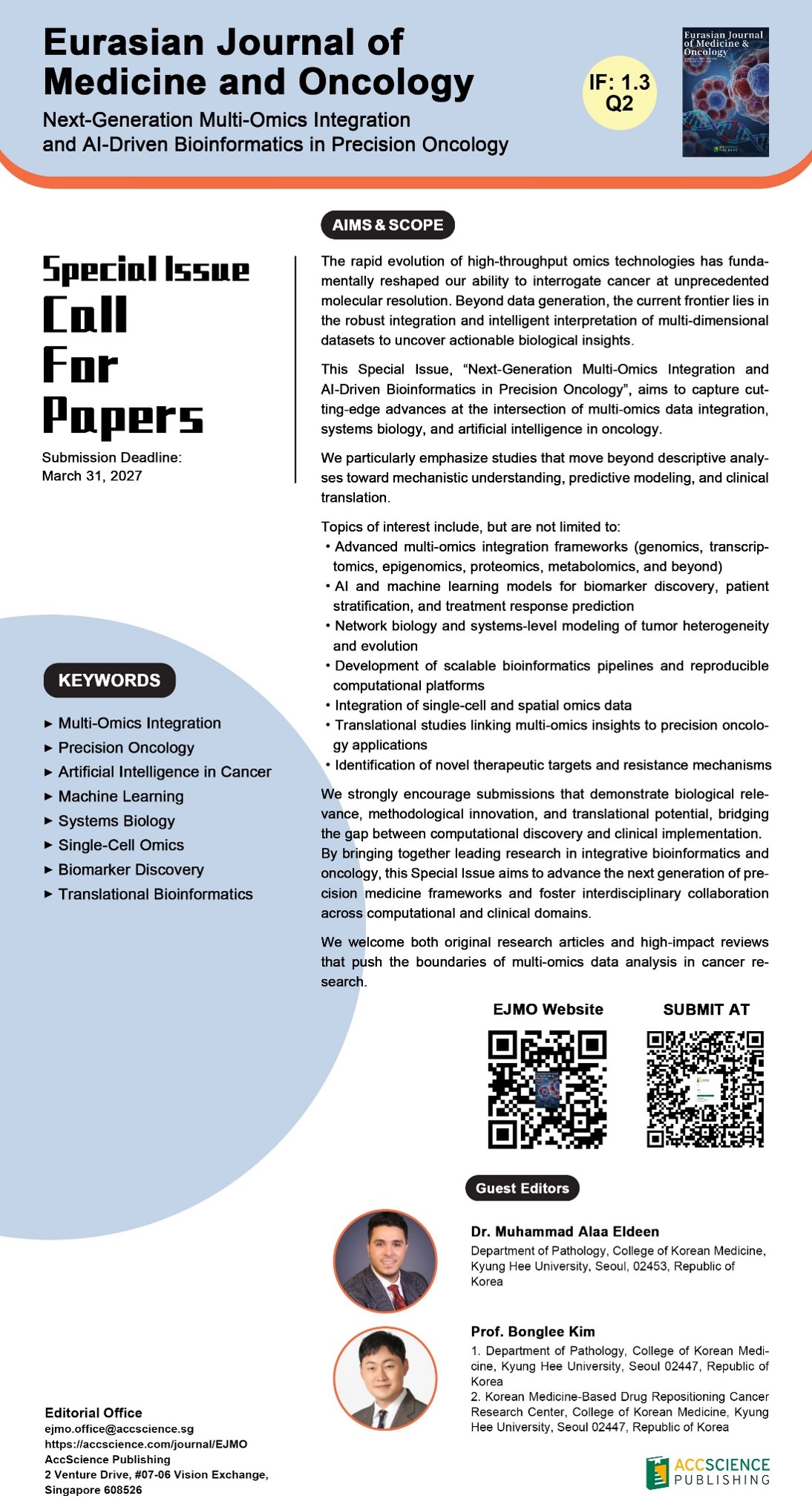
The rapid evolution of high-throughput omics technologies has fundamentally reshaped our ability to interrogate cancer at unprecedented molecular resolution. Beyond data generation, the current frontier lies in the robust integration and intelligent interpretation of multi-dimensional datasets to uncover actionable biological insights.
This Special Issue, “Next-Generation Multi-Omics Integration and AI-Driven Bioinformatics in Precision Oncology”, aims to capture cutting-edge advances at the intersection of multi-omics data integration, systems biology, and artificial intelligence in oncology.
We particularly emphasize studies that move beyond descriptive analyses toward mechanistic understanding, predictive modeling, and clinical translation.
Topics of interest include, but are not limited to:
- Advanced multi-omics integration frameworks (genomics, transcriptomics, epigenomics, proteomics, metabolomics, and beyond)
- AI and machine learning models for biomarker discovery, patient stratification, and treatment response prediction
- Network biology and systems-level modeling of tumor heterogeneity and evolution
- Development of scalable bioinformatics pipelines and reproducible computational platforms
- Integration of single-cell and spatial omics data
- Translational studies linking multi-omics insights to precision oncology applications
- Identification of novel therapeutic targets and resistance mechanisms
We strongly encourage submissions that demonstrate biological relevance, methodological innovation, and translational potential, bridging the gap between computational discovery and clinical implementation.
By bringing together leading research in integrative bioinformatics and oncology, this Special Issue aims to advance the next generation of precision medicine frameworks and foster interdisciplinary collaboration across computational and clinical domains.
We welcome both original research articles and high-impact reviews that push the boundaries of multi-omics data analysis in cancer research.