

Related Info Links
More by Authors Links
Journal Browser
Volume | Year
Issue
News and Announcements
EDITORIAL
Vitamin D3 and inducible DNA repair
Show Less
1 Institute of Toxicology, University Medical Center Mainz, Obere Zahlbacher Str. 67, D-55131 Mainz , Germany
EJMO, 026370489 https://doi.org/10.36922/EJMO026370489
Received: 9 September 2026 | Revised: 21 September 2026 | Accepted: 27 October 2026 | Published online: 26 November 2026

© 2026 by the Author(s). This article is an open access article distributed under the terms and conditions of the Creative Commons Attribution -Noncommercial 4.0 International License (CC-by the license) ( https://creativecommons.org/licenses/by-nc/4.0/ )
Graphical abstract
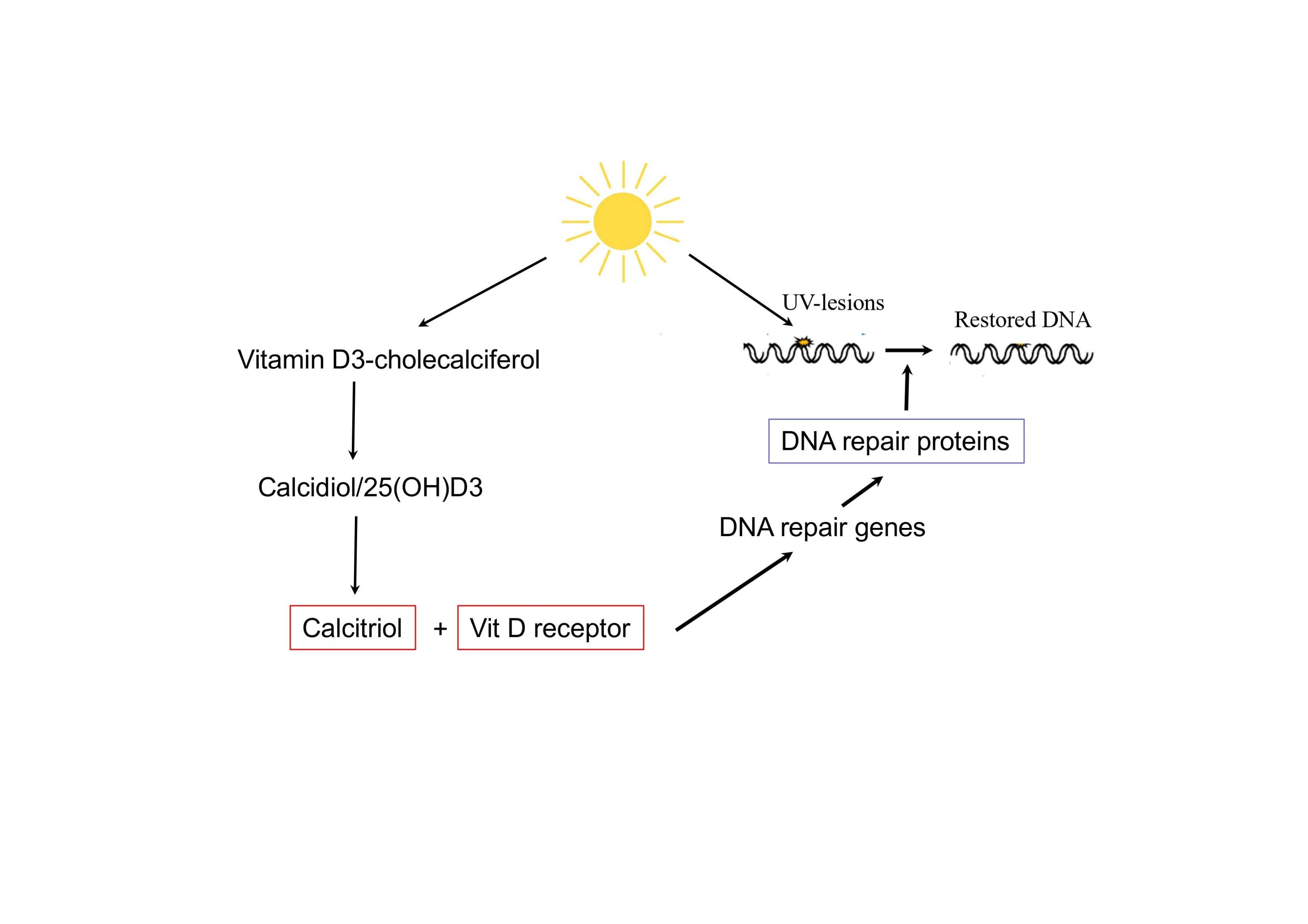
Conflict of interest
Prof. Dr. Bernd Kaina serves as one of the Editor-in-Chief of this journal. The author declares no conflict of interest.
References
- Nakamura J, Mutlu E, Sharma V, et al. The endogenous exposome. DNA Repair (Amst). 2014;19:3-13. doi: 10.1016/j.dnarep.2014.03.031
- Christmann M, Tomicic MT, Roos WP, Kaina B. Mechanisms of human DNA repair: an update. Toxicology. 2003;193(1-2):3-34. doi: 10.1016/S0300-483X(03)00287-7
- Cleaver JE. Defective repair replication of DNA in xeroderma pigmentosum. Nature. 1968;218(5142):652-656. doi: 10.1038/218652a0
- Janssen K, Eichhorn-Grombacher U, Schlink K, Nitzsche S, Oesch F, Kaina B. Long-time expression of DNA repair enzymes MGMT and APE in human peripheral blood mononuclear cells. Arch Toxicol. 2001;75(5):306-312. doi: 10.1007/s002040100226
- Christmann M, Kaina B. Transcriptional regulation of human DNA repair genes following genotoxic stress: trigger mechanisms, inducible responses and genotoxic adaptation. Nucleic Acids Res. 2013;41(18):8403-8420. doi: 10.1093/nar/gkt635
- Christmann M, Boisseau C, Kitzinger R, et al. Adaptive upregulation of DNA repair genes following benzo(a)pyrene diol epoxide protects against cell death at the expense of mutations. Nucleic Acids Res. 2016;44(22):10727-10743. doi: 10.1093/nar/gkw873
- Rybchyn MS, De Silva WGM, Sequeira VB, et al. Enhanced repair of UV-induced DNA damage by 1,25-dihydroxyvitamin D3 in skin is linked to pathways that control cellular energy. J Invest Dermatol. 2018;138(5):1146-1156. doi: 10.1016/j.jid.2017.11.037
- Wong CT, Oh DH. Vitamin D receptor promotes global nucleotide excision repair by facilitating XPC dissociation from damaged DNA. J Invest Dermatol. 2021;141(7):1656-1663. doi: 10.1016/j.jid.2020.11.033
- Christmann M, Tomicic MT, Origer J, Aasland D, Kaina B. c-Fos is required for excision repair of UV-light induced DNA lesions by triggering the re-synthesis of XPF. Nucleic Acids Res. 2006;34(22):6530-6539. doi: 10.1093/nar/gkl895