

Liquid biopsy-based longitudinal monitoring of copy number variations in six biomarker genes reveals exploratory associations with disease progression and treatment resistance in localized soft tissue sarcomas

Introduction: Soft tissue sarcomas (STS) are rare cancers without validated biomarkers for monitoring or prognosis. Liquid biopsy (LB) enables minimally invasive tumor tracking.
Objectives: This study aims to identify prognostic biomarkers in STS by assessing whether copy number variations (CNVs) of key genes correlate with outcomes, enabling early risk stratification and monitoring.
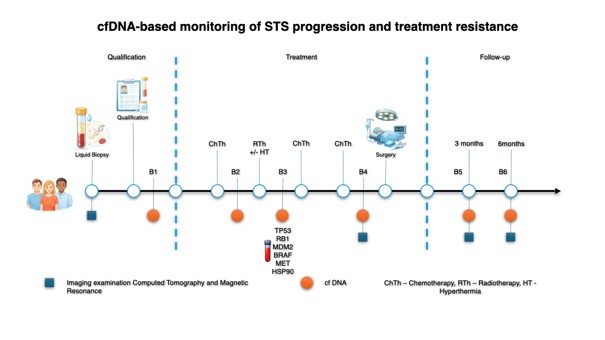
Methods: We conducted a preliminary longitudinal CNV analysis in plasma cell-free DNA from 19 patients using droplet digital polymerase chain reaction, measuring CNVs at multiple treatment stages (B1–B6). Statistical analyses were performed in R (v.4.4.3). Continuous variables are shown as median (interquartile range), and categorical variables as counts (%). Benjamini–Hochberg adjustment was applied, and progression-free survival (PFS) was analyzed using Kaplan–Meier and the log-rank test.
Results: Associations between CNVs and tumor size, necrosis, treatment response, disease progression, and PFS were observed. B1–B4 showed interconnected CNVs, involving TP53, RB1, MDM2, BRAF, MET, and HSP90. Progression may be associated with elevated CNVs for MDM2 and MET during chemotherapy (B2), and for TP53, RB1, MDM2, and HSP90 following radiotherapy (B3). At baseline, MDM2 CNV was higher in non-responders and increased during therapy in patients who subsequently experienced progression, which may be associated with poorer response to chemotherapy and radiotherapy. A p-value minimization framework suggested gene-specific CNV thresholds at B2 and B3, with higher CNV linked to shorter PFS.
Conclusion: Longitudinal LB profiling indicates that genomic changes in STS are linked to outcomes and resistance. MDM2 emerged as a potential biomarker. Given the small, exploratory study cohort, these findings need cautious interpretation and validation in larger groups.
- Williams TP, Grignol VP. Circulating biomarkers in sarcoma. Curr Oncol Rep. 2025;27(8):1013-1018. doi: 10.1007/s11912-025-01692-0
- Clark MA, Fisher C, Judson I, Thomas JM. Soft-tissue sarcomas in adults. N Engl J Med. 2005;353(7):701-711. doi: 10.1056/NEJMra041866
- Califf RM. Biomarker definitions and their applications. Exp Biol Med (Maywood). 2018;243(3):213-221. doi: 10.1177/1535370217750088
- Sharma SR, Paonessa NE, Casadei L, Costas De Faria F, Pollock RE, Grignol V. Clinical biomarkers in soft tissue sarcoma: a comprehensive review of current soft tissue sarcoma biomarkers. J Surg Oncol. 2022;125(2):239-245. doi: 10.1002/jso.26680
- Grasso D, Marzocchi B, Scoccianti G, et al. Untargeted metabolomics and liquid biopsy investigation of circulating biomarkers in soft tissue sarcoma. Cancers (Basel). 2025;17(3):553. doi: 10.3390/cancers17030553
- Li X, Seebacher NA, Hornicek FJ, Xiao T, Duan Z. Application of liquid biopsy in bone and soft tissue sarcomas: present and future. Cancer Lett. 2018;439:66-77. doi: 10.1016/j.canlet.2018.09.012
- Bettegowda C, Sausen M, Leary RJ, et al. Detection of circulating tumor DNA in early- and late-stage human malignancies. Sci Transl Med. 2014;6(224):224ra24. doi: 10.1126/scitranslmed.3007094
- Cohen JD, Li L, Wang Y, et al. Detection and localization of surgically resectable cancers with a multi-analyte blood test. Science. 2018;359(6378):926-930. doi: 10.1126/science.aar3247
- Snow A, Chen D, Lang JE. The current status of the clinical utility of liquid biopsies in cancer. Expert Rev Mol Diagn. 2019;19(11):1031-1041. doi: 10.1080/14737159.2019.1664290
- Aiyer S, Kim TH, Collier K, et al. Unlocking the potential of ctDNA in sarcomas: a review of recent advances. Cancers (Basel). 2025;17(6):1040. doi: 10.3390/cancers17061040
- Coombs CC, Dickherber T, Crompton BD. Chasing ctDNA in patients with sarcoma. Am Soc Clin Oncol Educ Book. 2020;40:e351-e360. doi: 10.1200/EDBK_280749
- Przybyl J, Chabon JJ, Spans L, et al. Combination approach for detecting different types of alterations in circulating tumor DNA in leiomyosarcoma. Clin Cancer Res. 2018;24(11):2688-2699. doi: 10.1158/1078-0432.CCR-17-3704
- Braig D, Becherer C, Bickert C, et al. Genotyping of circulating cell-free DNA enables noninvasive tumor detection in myxoid liposarcomas. Int J Cancer. 2019;145(4):1148-1161. doi: 10.1002/ijc.32216
- Cocucci E, Racchetti G, Meldolesi J. Shedding microvesicles: artefacts no more. Trends Cell Biol. 2009;19(2):43-51. doi: 10.1016/j.tcb.2008.11.003
- Capdevila P, Carrasco C, Diaz-Beveridge R. Risk stratification in soft-tissue sarcoma using Sarculator: a single-center experience. ESMO Rare Cancers. 2025;4:100114. doi: 10.1016/j.esmorc.2025.100114
- Amin MB, Edge SB, Greene FL, et al, eds. AJCC Cancer Staging Manual. 8th ed. Springer; 2017.
- Edge SB, Byrd DR, Compton CC, Fritz AG, Greene FL, Trotti A, eds. AJCC Cancer Staging Manual. 7th ed. Springer; 2010.
- Nathan H, Raut CP, Thornton K, et al. Predictors of survival after resection of retroperitoneal sarcoma. Ann Surg. 2009;250(6):970-976. doi: 10.1097/sla.0b013e3181b25183
- Massarweh NN, Dickson PV, Anaya DA. Soft tissue sarcomas: staging principles and prognostic nomograms. J Surg Oncol. 2015;111(5):532-539. doi: 10.1002/jso.23851
- ESMO/European Sarcoma Network Working Group. Soft tissue and visceral sarcomas: ESMO Clinical Practice Guidelines for diagnosis, treatment and follow-up. Ann Oncol. 2014;25(suppl 3):iii102-iii112. doi: 10.1093/annonc/mdu254
- Callegaro D, Miceli R, Mariani L, Raut CP, Gronchi A. Soft tissue sarcoma nomograms and their incorporation into practice. Cancer. 2017;123(15):2802-2820. doi: 10.1002/cncr.30721
- Chibon F, Lagarde P, Salas S, et al. Validated prediction of clinical outcome in sarcomas and multiple types of cancer on the basis of a gene expression signature related to genome complexity. Nat Med. 2010;16(7):781-787. doi: 10.1038/nm.2174
- Casadei L, Calore F, Braggio DA, et al. MDM2 derived from dedifferentiated liposarcoma extracellular vesicles induces MMP2 production from preadipocytes. Cancer Res. 2019;79(19):4911-4922. doi: 10.1158/0008-5472.CAN-19-0203
- Bill KLJ, Seligson ND, Hays JL, et al. Degree of MDM2 amplification affects clinical outcomes in dedifferentiated liposarcoma. Oncologist. 2019;24(7):989-996. doi: 10.1634/theoncologist.2019-0047
- Brooks CL, Gu W. p53 ubiquitination: Mdm2 and beyond. Mol Cell. 2006;21(3):307-315. doi: 10.1016/j.molcel.2006.01.020
- Manfredi JJ. Mdm2 and MdmX: partners in p53 destruction. Cancer Res. 2021;81(7):1633-1634. doi: 10.1158/0008-5472.CAN-21-0145
- Yao Y, Zhang Q, Li Z, Zhang H. MDM2: current research status and prospects of tumor treatment. Cancer Cell Int. 2024;24(1):170. doi: 10.1186/s12935-024-03356-8
- Fontecha MB, Del Rosario Anadón M, Lahitou IMM, et al. Exploring the significance of MDM2 gene promoter variants in chronic myeloid leukemia. Leuk Res. 2025;149:107644. doi: 10.1016/j.leukres.2025.107644
- Momand J, Jung D, Wilczynski S, Niland J. The MDM2 gene amplification database. Nucleic Acids Res. 1998;26(15):3453-3459. doi: 10.1093/nar/26.15.3453
- Oliner JD, Saiki AY, Caenepeel S. The role of MDM2 amplification and overexpression in tumorigenesis. Cold Spring Harb Perspect Med. 2016;6(6):a026336. doi: 10.1101/cshperspect.a026336
- Oliner JD, Kinzler KW, Meltzer PS, George DL, Vogelstein B. Amplification of a gene encoding a p53-associated protein in human sarcomas. Nature. 1992;358(6381):80-83. doi: 10.1038/358080a0
- Su Q, Hou J, Du X, et al. The role and research progress of the MET signalling pathway in targeted therapy for osteosarcoma. Oncol Rev. 2025;19:1615111. doi: 10.3389/or.2025.1615111
- Chen N, Zhang Q, Sun L, et al. Comprehensive study of gene fusions in sarcomas. Invest New Drugs. 2025;43(1):3-17. doi: 10.1007/s10637-024-01486-4
- Liu Y, Li C, Liu H, Tan S. Combination therapy involving HSP90 inhibitors for combating cancer: an overview of clinical and preclinical progress. Arch Pharm Res. 2024;47(5):442-464. doi: 10.1007/s12272-024-01494-1
- Shim BY, Yoo J, Lee YS, Hong YS, Kim HK, Kang JH. Prognostic role of Rb, p16, cyclin D1 proteins in soft tissue sarcomas. Cancer Res Treat. 2010;42(3):144-150. doi: 10.4143/crt.2010.42.3.144
- Yang Z, Carrio-Cordo P, Baudis M. Copy number variation heterogeneity reveals biological inconsistency in hierarchical cancer classifications. Mol Cytogenet. 2024;17(1):26. doi: 10.1186/s13039-024-00692-2
- Lei C, Zang H, Zhang H, et al. RNA-based next-generation sequencing strategy for screening MDM2-amplified sarcomas. Sci Rep. 2026;16(1):16402. doi: 10.1038/s41598-026-46618-3
- Calore F, Casadei L, Sarchet PD, et al. Extracellular vesicle-MDM2-DNA as a potential liquid biopsy biomarker for disease identification in retroperitoneal liposarcoma. Ann Surg. 2025;281(6):1048-1054. doi: 10.1097/SLA.0000000000006345
- Huber C, Zinserling J, Benda N, Vetter T, Rueckbeil M. Methodological insights on biomarker-based patient selection: a review of scientific advice procedures at the European Medicines Agency. Clin Pharmacol Ther. 2025;117(5):1226-1235. doi: 10.1002/cpt.3558
- Wang Y, Fujiwara T, Kurozumi T, et al. Advances in liquid biopsy for bone and soft-tissue sarcomas. Int J Clin Oncol. 2025;30(9):1722-1733. doi: 10.1007/s10147-025-02813-2
- Gronchi A, Miah AB, Dei Tos AP, et al. Soft tissue and visceral sarcomas: ESMO-EURACAN-GENTURIS Clinical Practice Guidelines for diagnosis, treatment and follow-up. Ann Oncol. 2021;32(11):1348-1365. doi: 10.1016/j.annonc.2021.07.006
- Casali PG, Abecassis N, Aro HT, et al. Soft tissue and visceral sarcomas: ESMO-EURACAN Clinical Practice Guidelines for diagnosis, treatment and follow-up. Ann Oncol. 2018;29(suppl 4):iv51-iv67. doi: 10.1093/annonc/mdy096
- Spałek MJ, Koseła-Paterczyk H, Borkowska A, et al. Combined preoperative hypofractionated radiotherapy with doxorubicin-ifosfamide chemotherapy in marginally resectable soft tissue sarcomas: results of a phase 2 clinical trial. Int J Radiat Oncol Biol Phys. 2021;110(4):1053-1063. doi: 10.1016/j.ijrobp.2021.02.019
- Stergioula A, Kormas T, Kokkali S, et al. What is the prognostic value of the pathologic response after neoadjuvant radiotherapy in soft tissue sarcoma? An institutional study using the EORTC-STBSG response score. Cancers (Basel). 2024;16(20):3449. doi: 10.3390/cancers16203449
- Spałek MJ, Borkowska AM, Telejko M, et al. The feasibility study of hypofractionated radiotherapy with regional hyperthermia in soft tissue sarcomas. Cancers (Basel). 2021;13(6):1332. doi: 10.3390/cancers13061332
- Laurini JA. Protocol for the Examination of Specimens From Patients With Soft Tissue Tumors. College of American Pathologists; June 2021. Accessed October 13, 2026. https://www.cap.org/wp-content/uploads/protocols/Soft.Tissue.Bx_4.1.0.0.REL_CAPCP_R.pdf?download=true
- Wardelmann E, Haas RL, Bovée JV, et al. Evaluation of response after neoadjuvant treatment in soft tissue sarcomas; the European Organization for Research and Treatment of Cancer-Soft Tissue and Bone Sarcoma Group (EORTC-STBSG) recommendations for pathological examination and reporting. Eur J Cancer. 2016;53:84-95. doi: 10.1016/j.ejca.2015.09.021
- Schaefer IM, Hornick JL, Barysauskas CM, et al. Histologic appearance after preoperative radiation therapy for soft tissue sarcoma: assessment of the European Organization for Research and Treatment of Cancer-Soft Tissue and Bone Sarcoma Group response score. Int J Radiat Oncol Biol Phys. 2017;98(2):375-383. doi: 10.1016/j.ijrobp.2017.02.087
- Schmiester M, Freytag A, Gillissen B, et al. Genomic evolution of high-risk soft tissue sarcomas under thermo- and chemotherapeutic selection pressure. Int J Hyperthermia. 2025;42(1):2573753. doi: 10.1080/02656736.2025.2573753
- Hernandez-Monge J, Martínez-Sánchez M, Rousset-Roman A, Medina-Medina I, Olivares-Illana V. MDM2 regulates RB levels during genotoxic stress. EMBO Rep. 2021;22(1):e50615. doi: 10.15252/embr.202050615
- Wei H, Zhang Y, Jia Y, et al. Heat shock protein 90: biological functions, diseases, and therapeutic targets. MedComm (2020). 2024;5(2):e470. doi: 10.1002/mco2.470
- Zhang J, He P. In silico and in vitro assessment of TP53, ATM, RAD51, and BAX genes in gastric cancer and their contribution to radiotherapy resistance. Hereditas. 2025;162(1):125. doi: 10.1186/s41065-025-00496-3
- Vargas R, Petty A, Lindner DJ, et al. Synergistic effect of MDM2 inhibitors and radiotherapy in endometrial cancer. NPJ Precis Oncol. 2025;9(1):290. doi: 10.1038/s41698-025-01063-9
- Kim YJ, Kim M, Park HK, et al. Co-expression of MDM2 and CDK4 in transformed human mesenchymal stem cells causes high-grade sarcoma with a dedifferentiated liposarcoma-like morphology. Lab Invest. 2019;99(9):1309-1320. doi: 10.1038/s41374-019-0263-4
- Steele CD, Pillay N. The genomics of undifferentiated sarcoma of soft tissue: progress, challenges and opportunities. Semin Cancer Biol. 2020;61:42-55. doi: 10.1016/j.semcancer.2019.11.009