

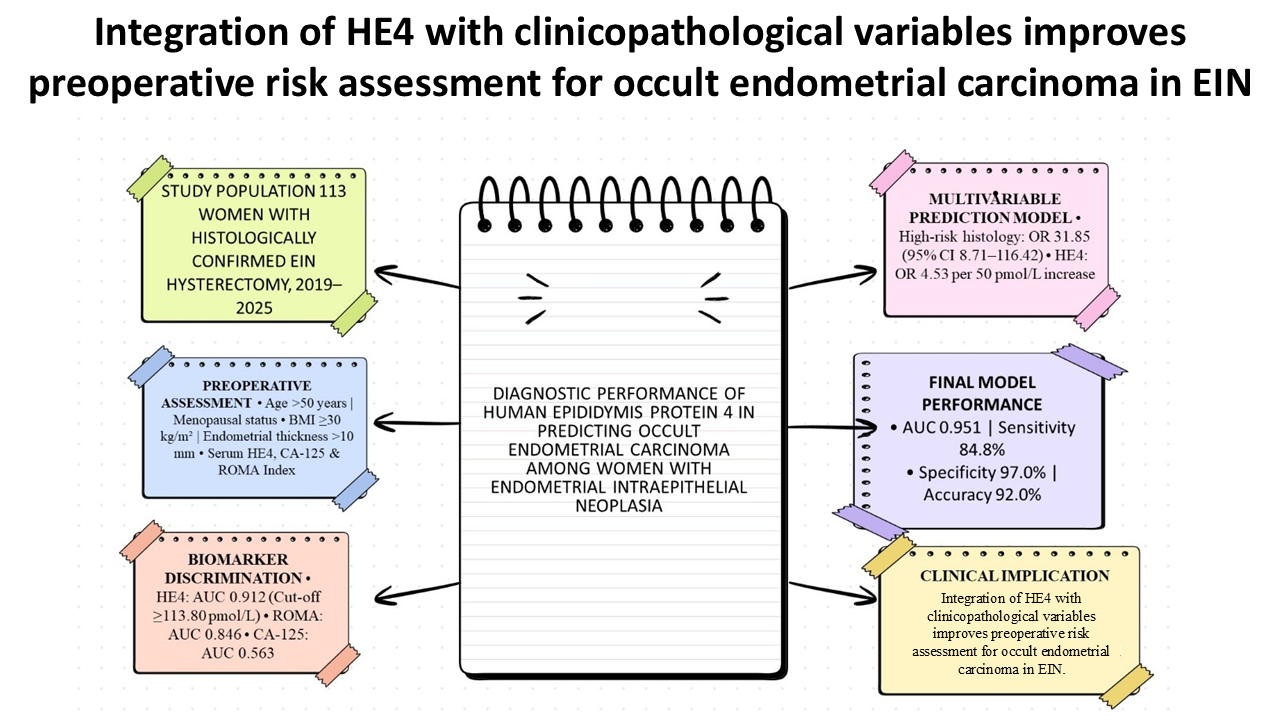
Diagnostic performance of human epididymis protein 4 in predicting occult endometrial carcinoma among women with endometrial intraepithelial neoplasia

Introduction: Endometrial intraepithelial neoplasia (EIN) carries a substantial risk of concurrent occult endometrial carcinoma. Accurate preoperative risk assessment is important for appropriate surgical planning
Objective: To assess the diagnostic accuracy of serum human epididymis protein 4 (HE4) in identifying occult endometrial carcinoma in women with EIN, compare its performance with cancer antigen 125 (CA-125) and the Risk of Ovarian Malignancy Algorithm (ROMA) index, and assess the value of integrating clinical, ultrasonographic, histopathological, and biomarker variables into a preoperative prediction model.
Methods: This retrospective study included 113 women with histologically confirmed EIN who underwent hysterectomy between 2019 and 2025. Clinical, ultrasonographic, histopathological, and biomarker data, including serum CA-125, HE4, and ROMA, were evaluated. Diagnostic performance was assessed using receiver operating characteristic analysis, and independent predictors were identified by multivariable logistic regression.
Results: Occult endometrial carcinoma was identified in 46/113 women (40.7%). Malignant postoperative findings were associated with age > 50 years, obesity, postmenopausal status, endometrial thickness >10 mm, and high-risk preoperative histopathology. HE4 showed the highest diagnostic performance (area under the curve [AUC] = 0.912; 95% confidence interval [CI]: 0.832–0.961; p < 0.001), compared with ROMA (AUC = 0.846) and CA-125 (AUC = 0.563). High-risk preoperative histopathology (odds ratio = 31.85; 95% CI: 8.71–116.42; p < 0.001) and HE4 (OR = 4.53 per 50 pmol/L increase; 95% CI: 1.86–11.02; p = 0.001) were independent predictors. The final model demonstrated excellent discrimination (AUC = 0.951), with 84.8% sensitivity, 97.0% specificity, and 92.0% accuracy.
Conclusion: HE4 outperformed CA-125 and ROMA and remained an independent predictor of occult carcinoma. Integrating HE4 with clinicopathological variables may improve preoperative risk stratification and surgical decision-making in women with EIN.
- Wu M, Kaur H, Sosa S. A 60-year-old woman with endometrial intraepithelial neoplasia: a case of persistent postmenopausal bleeding. Cureus. 2026;18(2):e103797. doi: 10.7759/cureus.103797
- Barbosa L, Nunes L, Napoleao B, Ribeiro M, Pagani M, Silveira V. Endometrioid intraepithelial neoplasia: analysis of postoperative outcome. Int J Gynecol Cancer. 2025;35(11):102458. doi: 10.1016/j.ijgc.2025.102458
- Nees LK, Heublein S, Steinmacher S, et al. Endometrial hyperplasia as a risk factor of endometrial cancer. Arch Gynecol Obstet. 2022;306(2):407-421. doi: 10.1007/s00404-021-06380-5
- Lundeberg KR, Gregg RW, Hope ER, Winkler SS, Riggs M. Management of endometrial intraepithelial neoplasia: a retrospective review of practice patterns at a single military treatment facility and civilian partner hospital. Womens Health Rep. 2025;6(1):919-924. doi: 10.1177/26884844251379404
- Höhn AK, Brambs CE, Hiller GGR, May D, Schmoeckel E, Horn LC. 2020 WHO classification of female genital tumors. Geburtshilfe Frauenheilkd. 2021;81(10):1145-1153. doi: 10.1055/a-1545-4279
- Giannella L, Grelloni C, Bernardi M, et al. Atypical endometrial hyperplasia and concurrent cancer: a comprehensive overview on a challenging clinical condition. Cancers (Basel). 2024;16(5):914. doi: 10.3390/cancers16050914
- Vetter MH, Smith B, Benedict J, et al. Preoperative predictors of endometrial cancer at time of hysterectomy for endometrial intraepithelial neoplasia or complex atypical hyperplasia. Am J Obstet Gynecol. 2020;222(1):60.e1-60.e7. doi: 10.1016/j.ajog.2019.08.002
- Chen H, Strickland AL, Castrillon DH. Histopathologic diagnosis of endometrial precancers: updates and future directions. Semin Diagn Pathol. 2022;39(3):137-147. doi: 10.1053/j.semdp.2021.12.001
- McCoy CA, Coleman HG, McShane CM, et al. Factors associated with interobserver variation amongst pathologists in the diagnosis of endometrial hyperplasia: a systematic review. PLoS One. 2024;19(4):e0302252. doi: 10.1371/journal.pone.0302252
- Thongsang W, Kuljarusnont S, Hanamornroongruang S, Ruengkhachorn I. Prevalence of occult endometrial carcinoma in patients with endometrial intraepithelial neoplasia who underwent hysterectomy. World J Surg Oncol. 2025;23(1):24. doi: 10.1186/s12957-025-03677-6
- Wolff K, Gumin D, Shqara RA, et al. Risk factors and predictive modeling for occult endometrial cancer in women with atypical hyperplasia: a retrospective study. Arch Gynecol Obstet. 2026;313(1):67. doi: 10.1007/s00404-026-08329-y
- Behrouzi R, Barr CE, Crosbie EJ. HE4 as a biomarker for endometrial cancer. Cancers (Basel). 2021;13(19):4764. doi: 10.3390/cancers13194764
- Lou Y, Jiang F, Du Y, Guan J. Nomogram using human epididymis protein 4 predicted concurrent endometrial cancer from endometrial atypical hyperplasia before surgery. Front Oncol. 2024;14:1442127. doi: 10.3389/fonc.2024.1442127
- Barr CE, Njoku K, Jones ER, et al. Serum CA125 and HE4 as biomarkers for the detection of endometrial cancer and associated high-risk features. Diagnostics (Basel). 2022;12(11):2834. doi: 10.3390/diagnostics12112834
- Crha T, Ovesná P, Weinberger V, et al. Serum levels of CA125 and HE4 as a tool for predicting regional lymph node metastatic involvement in endometrial carcinoma. Cancers (Basel). 2025;17(17):2740. doi: 10.3390/cancers17172740
- Lombaers MS, Cornel KMC, Visser NCM, et al. Preoperative CA125 significantly improves risk stratification in high-grade endometrial cancer. Cancers (Basel). 2023;15(9):2605. doi: 10.3390/cancers15092605
- Wang Y, Han C, Teng F, Bai Z, Tian W, Xue F. Predictive value of serum HE4 and CA125 concentrations for lymphatic metastasis of endometrial cancer. Int J Gynaecol Obstet. 2017;136(1):58-63. doi: 10.1002/ijgo.12010
- Koleva V, Shefket S, Stoencheva S. Clinical significance of human epididymis protein 4 (HE4), cancer antigen 125 (CA125), the risk of ovarian malignancy algorithm (ROMA), and Copenhagen index for the diagnosis of endometrial carcinoma. Folia Med (Plovdiv). 2025;67(1). doi: 10.3897/folmed.67.e143849
- Liu J, Han L, Sun Q, Li Y, Niyazi M. Meta-analysis of the diagnostic accuracy of HE4 for endometrial carcinoma. Eur J Obstet Gynecol Reprod Biol. 2020;252:404-411. doi: 10.1016/j.ejogrb.2020.07.015
- Levin G, Matanes E, Brezinov Y, et al. Machine learning for prediction of concurrent endometrial carcinoma in patients diagnosed with endometrial intraepithelial neoplasia. Eur J Surg Oncol. 2024;50(3):108006. doi: 10.1016/j.ejso.2024.108006
- Gumin D, Sharon A, Mustafa Mikhail S, et al. Diagnostic accuracy of endometrial sampling methods for determining histologic type and grade in endometrial cancer: a retrospective cohort study. Cureus. 2025;17:e95428. doi: 10.7759/cureus.95428
- Boardman L, Novetsky AP, Valea F, et al. Management of endometrial intraepithelial neoplasia or atypical endometrial hyperplasia: ACOG Clinical Consensus No. 5. Obstet Gynecol. 2023;142(3):735-744. doi: 10.1097/AOG.0000000000005297
- Concin N, Matias-Guiu X, Vergote I, et al. ESGO/ESTRO/ESP guidelines for the management of patients with endometrial carcinoma. Int J Gynecol Cancer. 2021;31(1):12-39. doi: 10.1136/ijgc-2020-002230
- Abu-Rustum NR, Campos SM, Amarnath S, et al. NCCN Guidelines® Insights: uterine neoplasms, version 3.2025. J Natl Compr Canc Netw. 2025;23(8):284-291. doi: 10.6004/jnccn.2025.0038
- Zhao J, Hu Y, Zhao Y, Chen D, Fang T, Ding M. Risk factors of endometrial cancer in patients with endometrial hyperplasia: implication for clinical treatments. BMC Womens Health. 2021;21(1):312. doi: 10.1186/s12905-021-01452-9
- Raglan O, Kalliala I, Markozannes G, et al. Risk factors for endometrial cancer: an umbrella review of the literature. Int J Cancer. 2019;145(7):1719-1730. doi: 10.1002/ijc.31961
- Ordeanu IM, Busuioc CJ, Văduva CC, et al. Obesity as a catalyst for endometrial hyperplasia and cancer progression: a narrative review of epidemiology, molecular pathways, and prevention. Biomedicines. 2025;13(11):2612. doi: 10.3390/biomedicines13112612
- Tîrnovanu MC, Cojocaru E, Tîrnovanu VG, et al. The role of ultrasound in diagnosing endometrial pathologies: adherence to IETA Group consensus and preoperative assessment of myometrial invasion in endometrial cancer. Diagnostics (Basel). 2025;15(7):891. doi: 10.3390/diagnostics15070891
- Clarke MA, Long BJ, Sherman ME, et al. Risk assessment of endometrial cancer and endometrial intraepithelial neoplasia in women with abnormal bleeding and implications for clinical management algorithms. Am J Obstet Gynecol. 2020;223(4):549.e1-549.e13. doi: 10.1016/j.ajog.2020.03.032
- Sabyeying P, Samutchaikij T, Rattanalappaiboon D, Detwongya C. Age-associated with endometrial intraepithelial neoplasia and endometrial carcinoma in patients with abnormal uterine bleeding. Thai J Obstet Gynaecol. 2025;33:95-103. doi: 10.14456/TJOG.2025.11
- Shawn LyBarger K, Miller HA, Frieboes HB. CA125 as a predictor of endometrial cancer lymphovascular space invasion and lymph node metastasis for risk stratification in the preoperative setting. Sci Rep. 2022;12(1):19783. doi: 10.1038/s41598-022-22026-1
- Ünsal M, Kimyon Comert G, Karalok A, et al. The preoperative serum CA125 can predict the lymph node metastasis in endometrioid-type endometrial cancer. Ginekol Pol. 2018;89(11):599-606. doi: 10.5603/GP.a2018.0103
- O'Toole SA, Huang Y, Norris L, et al. HE4 and CA125 as preoperative risk stratifiers for lymph node metastasis in endometrioid carcinoma of the endometrium: a retrospective study in a cohort with histological proof of lymph node status. Gynecol Oncol. 2021;160(2):514-519. doi: 10.1016/j.ygyno.2020.11.004
- Abdalla N, Piórkowski R, Stanirowski P, Słomka A, Cendrowski K, Sawicki W. Assessment of levels of the tumor markers HE4 and CA125 considering staging, grading and histological types of endometrial cancer. Prz Menopauzalny. 2016;15(3):133-137. doi: 10.5114/pm.2016.63059
- Abbink K, Zusterzeel PL, Geurts-Moespot AJ, et al. HE4 is superior to CA125 in the detection of recurrent disease in high-risk endometrial cancer patients. Tumour Biol. 2018;40(2):1010428318757103. doi: 10.1177/1010428318757103
- Bignotti E, Ragnoli M, Zanotti L, et al. Diagnostic and prognostic impact of serum HE4 detection in endometrial carcinoma patients. Br J Cancer. 2011;104(9):1418-1425. doi: 10.1038/bjc.2011.109
- Yuan J, Xu C, Liu C, et al. Diagnostic value of serum human epididymal secretory protein 4 for endometrial cancer: a systematic review and meta analysis. Discov Oncol. 2024;15(1):498. doi: 10.1007/s12672-024-01234-3-18
- Giordano WG, Pepe L, Martinelli C, et al. Liquid biopsy biomarkers in endometrial cancer: current landscape and future perspectives. Biomolecules. 2026;16(6):911. doi: 10.3390/biom16060911
- Zeevi G, Dahan C, Bercovich O, et al. Preoperative risk factors and predictive model for endometrial carcinoma in women with endometrial intraepithelial neoplasia. Int J Gynecol Cancer. 2026;36(2):103393. doi: 10.1016/j.ijgc.2025.103393
- Aytekin O, Karagöz Ç, Göktaş E, et al. Preoperative predictors of concurrent endometrial carcinoma in patients with endometrial intraepithelial neoplasia: the role of HALP score and other inflammatory markers. Turk J Obstet Gynecol. 2025;26(1):34-40. doi: 10.4274/jtgga.galenos.2025.2024-12-5
- Peters PN, March L, Smith GD, et al. A prospective algorithm for pre-operative risk stratification and individualized lymph node assessment in patients with endometrial intraepithelial neoplasia (EIN). Gynecol Oncol Rep. 2026;66:102177. doi: 10.1016/j.gore.2026.102177