
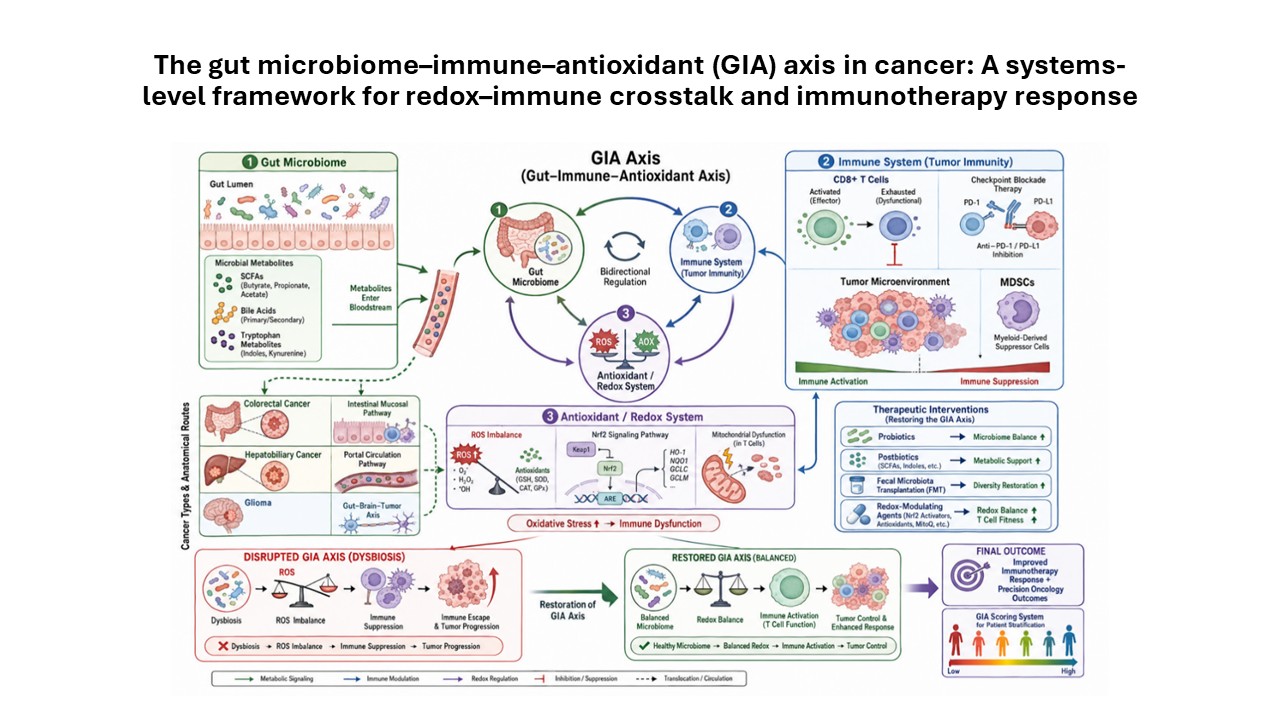
The gut microbiome-immune-antioxidant axis: Redox-driven host-microbial crosstalk as a determinant of cancer immunotherapy response

Introduction: The gut microbiome, host redox homeostasis, and immune regulation are mechanistically interdependent. However, their integrated role in driving resistance to immune checkpoint inhibitors remains incompletely defined.
Objective: This review introduces the gut microbiome, immune, and antioxidant (GIA) axis as a unifying, systems-level conceptual framework to explain treatment heterogeneity and optimize cancer immunotherapy outcomes.
Scope: We synthesize current mechanistic and translational evidence linking microbiota-derived metabolites, including short-chain fatty acids, bile acids, and tryptophan derivatives, to oxidative stress responses, mitochondrial fitness, and anti-tumor immune competence across colorectal, hepatobiliary, and neuro-oncologic malignancies.
Key findings: Disruption of the GIA network promotes immunotherapy resistance through excessive oxidative burden, pathological Nrf2 signaling, and the expansion of immunosuppressive myeloid populations. Conversely, targeted microbiome interventions, including probiotics, postbiotics, and fecal microbiota transplantation, can successfully restore redox-immune equilibrium, remodel the tumor microenvironment, and enhance the efficacy of checkpoint blockade.
Conclusion: We propose a precision immuno-oncology framework utilizing composite GIA-axis biomarker profiling for patient stratification. Integrating these multidisciplinary insights identifies actionable translational opportunities to overcome therapeutic resistance and transition host-microbiome-immune integration from conceptual promise to clinical reality.
- Sung H, Ferlay J, Siegel RL, et al. Global Cancer Statistics 2020: GLOBOCAN Estimates of Incidence and Mortality Worldwide for 36 Cancers in 185 Countries. CA Cancer J Clin. 2021;71(3):209-249. doi: 10.3322/caac.21660
- Bray F, Laversanne M, Weiderpass E, Soerjomataram I. The ever-increasing importance of cancer as a leading cause of premature death worldwide. Cancer. 2021;127(16):3029-3030. doi: 10.1002/cncr.33587
- Dagogo-Jack I, Shaw AT. Tumour heterogeneity and resistance to cancer therapies. Nat Rev Clin Oncol. 2018;15(2):81-94. doi: 10.1038/nrclinonc.2017.166
- Sharma P, Hu-Lieskovan S, Wargo JA, Ribas A. Primary, Adaptive, and Acquired Resistance to Cancer Immunotherapy. Cell. 2017;168(4):707-723. doi: 10.1016/j.cell.2017.01.017
- Binnewies M, Roberts EW, Kersten K, et al. Understanding the tumor immune microenvironment (TIME) for effective therapy. Nat Med. 2018;24(5):541-550. doi: 10.1038/s41591-018-0014-x
- Rajan RK, Bhattacharjee B, Hazarika H, et al. Piceatannol: a multifaceted polyphenol—from pharmacological actions to formulation development and clinical trials. Adv Tradit Med. 2025;25(4):837-884. doi: 10.1007/s13596-025-00845-7
- Garrett WS. Cancer and the microbiota. Science. 2015;348(6230):80-86. doi: 10.1126/science.aaa4972
- Zitvogel L, Ma Y, Raoult D, Kroemer G, Gajewski TF. The microbiome in cancer immunotherapy: Diagnostic tools and therapeutic strategies. Science. 2018;359(6382):1366-1370. doi: 10.1126/science.aar6918
- Mardinoglu A, Shoaie S, Bergentall M, et al. The gut microbiota modulates host amino acid and glutathione metabolism in mice. Mol Syst Biol. 2015;11(10):834. doi: 10.15252/msb.20156487
- Wong SH, Yu J. Gut microbiota in colorectal cancer: mechanisms of action and clinical applications. Nat Rev Gastroenterol Hepatol. 2019;16(11):690-704. doi: 10.1038/s41575-019-0209-8
- Louis P, Hold GL, Flint HJ. The gut microbiota, bacterial metabolites and colorectal cancer. Nat Rev Microbiol. 2014;12(10):661-672. doi: 10.1038/nrmicro3344
- Kostic AD, Chun E, Robertson L, et al. Fusobacterium nucleatum potentiates intestinal tumorigenesis and modulates the tumor-immune microenvironment. Cell Host Microbe. 2013;14(2):207-215. doi: 10.1016/j.chom.2013.07.007
- Routy B, Le Chatelier E, Derosa L, et al. Gut microbiome influences efficacy of PD-1–based immunotherapy against epithelial tumors. Science. 2018;359(6371):91-97. doi: 10.1126/science.aan3706
- Matson V, Fessler J, Bao R, et al. The commensal microbiome is associated with anti–PD-1 efficacy in metastatic melanoma patients. Science. 2018;359(6371):104-108. doi: 10.1126/science.aao3290
- Reczek CR, Chandel NS. ROS-dependent signal transduction. Curr Opin Cell Biol. 2015;33:8-13. doi: 10.1016/j.ceb.2014.09.010
- Hayes JD, Dinkova-Kostova AT, Tew KD. Oxidative Stress in Cancer. Cancer Cell. 2020;38(2):167-197. doi: 10.1016/j.ccell.2020.06.001
- Rojo de la Vega M, Chapman E, Zhang DD. NRF2 and the Hallmarks of Cancer. Cancer Cell. 2018;34(1):21-43. doi: 10.1016/j.ccell.2018.03.022
- Jones RM, Neish AS. Redox signaling mediated by the gut microbiota. Free Radic Biol Med. 2017;105:41-47. doi: 10.1016/j.freeradbiomed.2016.10.495
- Gopalakrishnan V, Spencer CN, Nezi L, et al. Gut microbiome modulates response to anti-PD-1 immunotherapy in melanoma patients. Science. 2018;359(6371):97-103. doi: 10.1126/science.aan4236
- Sena LA, Li S, Jairaman A, et al. Mitochondria are required for antigen-specific T cell activation through reactive oxygen species signaling. Immunity. 2013;38(2):225-236. doi: 10.1016/j.immuni.2012.10.020
- Kunst C, Schmid S, Michalski M, et al. The Influence of Gut Microbiota on Oxidative Stress and the Immune System. Biomedicines. 2023;11(5):1388. doi: 10.3390/biomedicines11051388
- Zhao J, Zhao F, Yuan J, Liu H, Wang Y. Gut microbiota metabolites, redox status, and the related regulatory effects of probiotics. Heliyon. 2023;9(11):e21431. doi: 10.1016/j.heliyon.2023.e21431
- Zünd JN, Caflisch M, Mujezinovic D, et al. Deciphering oxidative stress responses in human gut microbes and fecal microbiota: a cultivation-based approach. FEMS Microbiol Ecol. 2025;101(6):fiaf054. doi: 10.1093/femsec/fiaf054
- Sun Y, Wang X, Li L, et al. The role of gut microbiota in intestinal disease: from an oxidative stress perspective. Front Microbiol. 2024;15:1328324. doi: 10.3389/fmicb.2024.1328324
- Gupta P, Dutta S, Dutta K, et al. Interconnection between gut microbial metabolites and mitochondrial ROS production: implications for cellular health. Mol Cell Biochem. 2026;481(1):41-65. doi: 10.1007/s11010-025-05397-7
- Jiang S-S, Chen Y-X, Fang J-Y. Fusobacterium nucleatum: Ecology, pathogenesis, and clinical implications. Nat Rev Microbiol. 2026;24:197-214. doi: 10.1038/s41579-025-01237-z
- Luo F, Wang X, Ye C, Sun H. Microbial Biomarkers in Liquid Biopsy for Cancer: An Overview and Future Directions. Cancer Control. 2024;31:10732748241292019. doi: 10.1177/10732748241292019
- Zhu J, Qin S, Gu R, et al. Amuc_1434 From Akkermansia muciniphila Enhances CD8+ T Cell-Mediated Anti-Tumor Immunity by Suppressing PD-L1 in Colorectal Cancer. FASEB J. 2025;39(8):e70540. doi: 10.1096/fj.202403295RR
- Pei B, Peng S, Huang C, Zhou F. Bifidobacterium modulation of tumor immunotherapy and its mechanism. Cancer Immunol Immunother. 2024;73(5):94. doi: 10.1007/s00262-024-03665-x
- Galasso L, Termite F, Mignini I, et al. Unraveling the Role of Fusobacterium nucleatum in Colorectal Cancer: Molecular Mechanisms and Pathogenic Insights. Cancers (Basel). 2025;17(3):368. doi: 10.3390/cancers17030368
- Zhou L, Zhang M, Wang Y, et al. Faecalibacterium prausnitzii Produces Butyrate to Maintain Th17/Treg Balance and to Ameliorate Colorectal Colitis by Inhibiting Histone Deacetylase 1. Inflamm Bowel Dis. 2018;24(9):1926-1940. doi: 10.1093/ibd/izy182
- Saito R, Shigematsu Y, Amori M, et al. Association of Enterotoxigenic Bacteroides fragilis with Immune Modulation in Colorectal Cancer Liver Metastasis. Cancers (Basel). 2025;17(17):2733. doi: 10.3390/cancers17172733
- González-Bosch C, Boorman E, Zunszain PA, Mann GE. Short-chain fatty acids as modulators of redox signaling in health and disease. Redox Biol. 2021;47:102165. doi: 10.1016/j.redox.2021.102165
- Chen N, Chan CK, Khan FU, et al. Gut microbiota-derived metabolites as immune modulators in aging and age-related chronic inflammatory diseases. Ageing Res Rev. 2026;116:103036. doi: 10.1016/j.arr.2026.103036
- Shi J, Zhao C, Zhang D, et al. Xiayuxue decoction alleviates MASH by regulating gut microbiota, bile acid metabolism, and m6A modification. Phytomedicine. 2026;154:158023. doi: 10.1016/j.phymed.2026.158023
- Cornwell A, Badiei A. From Gasotransmitter to Immunomodulator: The Emerging Role of Hydrogen Sulfide in Macrophage Biology. Antioxidants (Basel). 2023;12(4):935. doi: 10.3390/antiox12040935
- Islam SU, Lee JH, Shehzad A, et al. Decursinol Angelate Inhibits LPS-Induced Macrophage Polarization through Modulation of the NFκB and MAPK Signaling Pathways. Molecules. 2018;23(8):1880. doi: 10.3390/molecules23081880
- Kaisanlahti A, Turunen J, Hekkala J, et al. Gut microbiota-derived extracellular vesicles form a distinct entity from gut microbiota. mSystems. 2025;10(5):e0031125. doi: 10.1128/msystems.00311-25
- Weinberg SE, Chandel NS. Mitochondria reactive oxygen species signaling in immune responses. Immunity. 2025;58(8):1904-1921. doi: 10.1016/j.immuni.2025.07.012
- Shu P, Liang H, Zhang J, et al. Reactive oxygen species formation and its effect on CD4+ T cell-mediated inflammation. Front Immunol. 2023;14:1199233. doi: 10.3389/fimmu.2023.1199233
- Xiong B, Zhang Y, Liu S, et al. NOX Family: Regulators of Reactive Oxygen Species Balance in Tumor Cells. FASEB J. 2025;39(8):e70565. doi: 10.1096/fj.202500238RRR
- Konaté MM, Antony S, Doroshow JH. Inhibiting the Activity of NADPH Oxidase in Cancer. Antioxid Redox Signal. 2020;33(6):435-454. doi: 10.1089/ars.2020.8046
- Singh MK, Yun HR, Ranbhise JS, et al. Hypoxia, ROS, and HIF Signaling in I/R Injury: Implications and Future Prospects. Antioxidants. 2026;15(2):153. doi: 10.3390/antiox15020153
- Liang X, Weng J, You Z, et al. Oxidative stress in cancer: from tumor and microenvironment remodeling to therapeutic frontiers. Mol Cancer. 2025;24(1):219. doi: 10.1186/s12943-025-02375-x
- Song M-Y, Lee D-Y, Chun K-S, Kim E-H. The Role of NRF2/KEAP1 Signaling Pathway in Cancer Metabolism. Int J Mol Sci. 2021;22(9):4376. doi: 10.3390/ijms22094376
- Verza FA, GC DAS, Nishimura FG. The impact of oxidative stress and the NRF2-KEAP1-ARE signaling pathway on anticancer drug resistance. Oncol Res. 2025;33(8):1819-1834. doi: 10.32604/or.2025.065755
- Jiang X, Yu M, Wang WK, et al. The regulation and function of Nrf2 signaling in ferroptosis-activated cancer therapy. Acta Pharmacol Sin. 2024;45(11):2229-2240. doi: 10.1038/s41401-024-01336-2
- Lee J, Seo Y, Roh J-L. Ferroptosis and Nrf2 Signaling in Head and Neck Cancer: Resistance Mechanisms and Therapeutic Prospects. Antioxidants. 2025;14(8):993. doi: 10.3390/antiox14080993
- Chen T-H, Wang H-C, Chang C-J, Lee S-Y. Mitochondrial Glutathione in Cellular Redox Homeostasis and Disease Manifestation. Int J Mol Sci. 2024;25(2):1314. doi: 10.3390/ijms25021314
- Li J, Huang C, Tang P, et al. The distinct roles of ROS in tumor immunity: from mechanisms to immunotherapeutic applications. J Hematol Oncol. 2026;19(1):16. doi: 10.1186/s13045-026-01780-z
- Bjørklund G, Zou L, Peana M, et al. The Role of the Thioredoxin System in Brain Diseases. Antioxidants. 2022;11(11):2161. doi: 10.3390/antiox11112161
- Zhou M, Gao H, Wang X, et al. Nrf2 as a redox checkpoint in autoimmune joint inflammation: microenvironmental redox control across the arthritis spectrum. Front Immunol. 2026;17:1775908. doi: 10.3389/fimmu.2026.1775908
- Schaer DJ, Schulthess-Lutz N, Baselgia L, et al. Stress-NRF2 response axis polarizes tumor macrophages and undermines immunotherapy. J Immunother Cancer. 2025;13(10):e013063. doi: 10.1136/jitc-2025-013063
- Giulietti S, Bigini V, Savatin DV. ROS and RNS production, subcellular localization, and signaling triggered by immunogenic danger signals. J Exp Bot. 2024;75(15):4512-4534. doi: 10.1093/jxb/erad449
- Gülow K, Tümen D, Heumann P, et al. Unraveling the Role of Reactive Oxygen Species in T Lymphocyte Signaling. Int J Mol Sci. 2024;25(11):6114. doi: 10.3390/ijms25116114
- de la Lastra JMP, Andrés CMC, Munguira EB, Juan CA, Pérez-Lebeña E. Pathophysiology of reactive oxygen species (ROS). Arch Toxicol. 2026;100(2):475-513. doi: 10.1007/s00204-025-04276-w
- Ton Nu QC, Park P-H. Metabolic modulation of CD8⁺ T cells by metformin: A promising adjuvant strategy for CD8⁺ T Cell-Based Immunotherapies. Pharmacol Res. 2025;222:108015. doi: 10.1016/j.phrs.2025.108015
- Zhou Y, Bai M, Chen L, et al. Targeting inflammatory microenvironments: overcoming therapy resistance and immunosuppression. Mol Cancer. 2026;25(1):81. doi: 10.1186/s12943-026-02583-z
- Silva-Romeiro S, Flores-Campos RdC, Sánchez-León ML, Sánchez-Margalet V, De la Cruz-Merino L. Emerging Role of MDSCs as Novel Biomarkers and Therapeutic Targets for Cancer Immunotherapy. ImmunoTargets Ther. 2025;14:1267-1291. doi: 10.2147/ITT.S485642
- Stojanovic B, Milivojcevic Bevc I, Dimitrijevic Stojanovic M, et al. Oxidative Stress, Inflammation, and Cellular Senescence in Neuropathic Pain: Mechanistic Crosstalk. Antioxidants. 2025;14(10):1166. doi: 10.3390/antiox14101166
- Han I-H, Choi I, Kim S, et al. CD18-targeted peptide-drug conjugate remodels the immunosuppressive tumor microenvironment of prostate cancer by selective depletion of M2 macrophages. npj Precis Oncol. 2026;10:215. doi: 10.1038/s41698-026-01377-2
- Panda H, Rowland NG, Krall CM, et al. NRF2 immunobiology in cancer: implications for immunotherapy and therapeutic targeting. Oncogene. 2025;44(39):3641-3651. doi: 10.1038/s41388-025-03560-4
- Wen H, Suzuki T, Zhang A, et al. NRF2 activation in cancer cells suppresses immune infiltration into the tumor microenvironment. iScience. 2025;28(10):113519. doi: 10.1016/j.isci.2025.113519
- Kuang H, Chen Y, Yang X, et al. Macrophage polarization as a therapeutic target in lung diseases: From pathogenesis to precision intervention. Int Immunopharmacol. 2026;180:116660. doi: 10.1016/j.intimp.2026.116660
- Aboelella NS, Brandle C, Kim T, Ding ZC, Zhou G. Oxidative Stress in the Tumor Microenvironment and Its Relevance to Cancer Immunotherapy. Cancers (Basel). 2021;13(5):986. doi: 10.3390/cancers13050986
- Joof AN, Bajinka O, Zhou Y, Ren F, Tan Y. The Central Role of NRF2 in Cancer Metabolism and Redox Signaling: Novel Insights into Crosstalk with ER Stress and Therapeutic Modulation. Cell Biochem Biophys. 2025;83(4):4145-4161. doi: 10.1007/s12013-025-01821-3
- Akter S, Madhuvilakku R, Kar AK, et al. Reactive oxygen species (ROS) in cancer: from mechanism to therapeutic implications. Signal Transduct Target Ther. 2026;11(1):111. doi: 10.1038/s41392-026-02583-x
- Chargui A, Hammami I, Hashem A, et al. Cd stabilizes HIF-1α under normoxic conditions via lysine-63-linked ubiquitination and induces ER stress and cell proliferation. Toxicol Res. 2025;41(3):221-234. doi: 10.1007/s43188-024-00266-9
- Gomar S, Bou R, Puertas FJ, et al. Current Insights into Glutathione Depletion in Adult Septic Patients. Antioxidants. 2025;14(9):1033. doi: 10.3390/antiox14091033
- Sánchez-Alcoholado L, Ramos-Molina B, Otero A, et al. The Role of the Gut Microbiome in Colorectal Cancer Development and Therapy Response. Cancers (Basel). 2020;12(6):1406. doi: 10.3390/cancers12061406
- Paduraru DN, Palcau AC, Dinca VG, Ciuc DM, Constantinescu A. The Role of Gut Microbiota in Colorectal Cancer Pathogenesis: A Comprehensive Literature Review. Int J Mol Sci. 2025;26(24):11870. doi: 10.3390/ijms262411870
- Shah SC, Itzkowitz SH. Colorectal Cancer in Inflammatory Bowel Disease: Mechanisms and Management. Gastroenterology. 2022;162(3):715-730.e3. doi: 10.1053/j.gastro.2021.10.035
- Li J, Ji Y, Chen N, Dai L, Deng H. Colitis-associated carcinogenesis: crosstalk between tumors, immune cells and gut microbiota. Cell Biosci. 2023;13(1):194. doi: 10.1186/s13578-023-01139-8
- Bai B, Ma J, Xu W, et al. Gut microbiota and colorectal cancer: mechanistic insights, diagnostic advances, and microbiome-based therapeutic strategies. Front Microbiol. 2025;16:1699893. doi: 10.3389/fmicb.2025.1699893
- Irrazabal T, Thakur BK, Kang M, et al. Limiting oxidative DNA damage reduces microbe-induced colitis-associated colorectal cancer. Nat Commun. 2020;11(1):1802. doi: 10.1038/s41467-020-15549-6
- Gasaly N, Hermoso MA, Gotteland M. Butyrate and the Fine-Tuning of Colonic Homeostasis: Implication for Inflammatory Bowel Diseases. Int J Mol Sci. 2021;22(6):3061. doi: 10.3390/ijms22063061
- Chen JY, Wen JY, Lin JL, et al. Deoxycholic acid induces reactive oxygen species accumulation and promotes colorectal cancer cell apoptosis through the CaMKII-Ca(2+) pathway. World J Gastrointest Oncol. 2025;17(8):107453. doi: 10.4251/wjgo.v17.i8.107453
- Bautista J, Lamas-Maceiras M, Hidalgo-Tinoco C, et al. Gut microbiome-driven colorectal cancer via immune, metabolic, neural, and endocrine axes reprogramming. NPJ Biofilms Microbiomes. 2026;12(1):21. doi: 10.1038/s41522-025-00883-8
- Marroncini G, Naldi L, Martinelli S, Amedei A. Gut-Liver-Pancreas Axis Crosstalk in Health and Disease: From the Role of Microbial Metabolites to Innovative Microbiota Manipulating Strategies. Biomedicines. 2024;12(7):1398. doi: 10.3390/biomedicines12071398
- Mooli RGR, Mukhi D, Ramakrishnan SK. Oxidative Stress and Redox Signaling in the Pathophysiology of Liver Diseases. Compr Physiol. 2022;12(2):3167-3192. doi: 10.1002/cphy.c200021
- Han B, Lv X, Liu G, et al. Gut microbiota-related bile acid metabolism-FXR/TGR5 axis impacts the response to anti-α4β7-integrin therapy in humanized mice with colitis. Gut Microbes. 2023;15(1):2232143. doi: 10.1080/19490976.2023.2232143
- Hashem HR, Yehia T, Azab M, et al. Gut microbiome dysbiosis in hepatocellular carcinoma patients with persistent HCV viremia versus viral clearance: a cross-sectional study. Gut Pathog. 2025;17(1):88. doi: 10.1186/s13099-025-00761-w
- Schepis T, De Lucia SS, Nista EC, et al. Microbiota in Pancreatic Diseases: A Review of the Literature. J Clin Med. 2021;10(24):5920. doi: 10.3390/jcm10245920
- Ding T, Liu C, Li Z. The mycobiome in human cancer: analytical challenges, molecular mechanisms, and therapeutic implications. Mol Cancer. 2025;24(1):18. doi: 10.1186/s12943-025-02227-8
- Chai Y, Huang Z, Shen X, et al. Microbiota Regulates Pancreatic Cancer Carcinogenesis through Altered Immune Response. Microorganisms. 2023;11(5):1240. doi: 10.3390/microorganisms11051240
- Romeo M, Dallio M, Di Nardo F, et al. The Role of the Gut-Biliary-Liver Axis in Primary Hepatobiliary Liver Cancers: From Molecular Insights to Clinical Applications. J Pers Med. 2025;15(4):124. doi: 10.3390/jpm15040124
- Ying H, Kimmelman AC, Bardeesy N, et al. Genetics and biology of pancreatic ductal adenocarcinoma. Genes Dev. 2025;39(1-2):36-63. doi: 10.1101/gad.351863.124
- Laivacuma S, Oblate O, Derovs A. Gut Microbiota and the Gut-Liver Axis in Liver Disease: From Chronic Viral Hepatitis to Cirrhosis, Hepatocellular Carcinoma, and Microbiome-Based Therapies. Microorganisms. 2025;13(5):1053. doi: 10.3390/microorganisms13051053
- Damerell V, Klaassen-Dekker N, Brezina S, et al. Circulating tryptophan-kynurenine pathway metabolites are associated with all-cause mortality among patients with stage I-III colorectal cancer. Int J Cancer. 2025;156(3):552-565. doi: 10.1002/ijc.35183
- Toumazi D, Charalambous C, Constantinou C, Nicolaou N. From the gut to the brain: The involvement of the gut microbiota in the development and progression of glioblastoma. Neurooncol Adv. 2026;8(1):vdaf267. doi: 10.1093/noajnl/vdaf267
- Wang G, Zhong K, Wang Z, et al. Tumor-associated microglia and macrophages in glioblastoma: From basic insights to therapeutic opportunities. Front Immunol. 2022;13:964898. doi: 10.3389/fimmu.2022.964898
- Mohamed ZS, Wu Q, Jacome MA, Chen J, Etame AB. The Role of Gut Microbiome on Glioblastoma Oncogenesis and Malignant Evolution. Int J Mol Sci. 2025;26(7):2935. doi: 10.3390/ijms26072935
- Kaja E, Grupińska J, Budzyń M, et al. Disease- and chemotherapy-associated salivary microbiome changes in breast cancer patients. Breast Cancer Res Treat. 2026;216(1):2. doi: 10.1007/s10549-026-07902-y
- Wu H, He K, Wang H, et al. The gut-brain axis in the context of colorectal cancer. Pharmacol Res. 2025;217:107816. doi: 10.1016/j.phrs.2025.107816
- Yangyanqiu W, Jian C, Yuqing Y, Zhanbo Q, Shuwen H. Gut microbes involvement in gastrointestinal cancers through redox regulation. Gut Pathog. 2023;15(1):35. doi: 10.1186/s13099-023-00562-z
- Lu Y, Feng X, Wang Z, et al. Bile acid metabolism and hepatocellular carcinoma: mechanisms of drug resistance and intervention strategies. Precis Clin Med. 2025;8(3):pbaf020. doi: 10.1093/pcmedi/pbaf020
- Maneshi P, Mason J, Dongre M, Öhlund D. Targeting Tumor-Stromal Interactions in Pancreatic Cancer: Impact of Collagens and Mechanical Traits. Front Cell Dev Biol. 2021;9:787485. doi: 10.3389/fcell.2021.787485
- Nejadrostam S, Shadvar P, Jameie SB, Jameie M, Farhadi M. Gut microbiota and glioblastoma: composition, mechanisms, and therapeutic interventions. Infect Agent Cancer. 2026;21(1):15. doi: 10.1186/s13027-026-00740-z
- Hitch TCA, Hall LJ, Walsh SK, et al. Microbiome-based interventions to modulate gut ecology and the immune system. Mucosal Immunol. 2022;15(6):1095-1113. doi: 10.1038/s41385-022-00564-1
- Hou S, Yu J, Li Y, Zhao D, Zhang Z. Advances in Fecal Microbiota Transplantation for Gut Dysbiosis-Related Diseases. Adv Sci (Weinh). 2025;12(13):e2413197. doi: 10.1002/advs.202413197
- Abouelela ME, Helmy YA. Next-Generation Probiotics as Novel Therapeutics for Improving Human Health: Current Trends and Future Perspectives. Microorganisms. 2024;12(3):430. doi: 10.3390/microorganisms12030430
- Du W, Zou ZP, Ye BC, Zhou Y. Gut microbiota and associated metabolites: key players in high-fat diet-induced chronic diseases. Gut Microbes. 2025;17(1):2494703. doi: 10.1080/19490976.2025.2494703
- Ngo V, Duennwald ML. Nrf2 and Oxidative Stress: A General Overview of Mechanisms and Implications in Human Disease. Antioxidants (Basel). 2022;11(12):2345. doi: 10.3390/antiox11122345
- Eraghieh Farahani H, Pourhajibagher M, Asgharzadeh S, Bahador A. Postbiotics: Novel Modulators of Gut Health, Metabolism, and Their Mechanisms of Action. Probiotics Antimicrob Proteins. 2025;18(4):5037-5053. doi: 10.1007/s12602-025-10832-8
- Lei W, Zhou K, Lei Y, Li Q, Zhu H. Gut microbiota shapes cancer immunotherapy responses. NPJ Biofilms Microbiomes. 2025;11(1):143. doi: 10.1038/s41522-025-00786-8
- Tripathy A, Dash J, Kancharla S, et al. Probiotics: A Promising Candidate for Management of Colorectal Cancer. Cancers (Basel). 2021;13(13):3178. doi: 10.3390/cancers13133178
- Tsao SP, Nurrahma BA, Kumar R, et al. Probiotic Enhancement of Antioxidant Capacity and Alterations of Gut Microbiota Composition in 6-Hydroxydopamin-Induced Parkinson's Disease Rats. Antioxidants (Basel). 2021;10(11):1823. doi: 10.3390/antiox10111823
- Thorakkattu P, Khanashyam AC, Shah K, et al. Postbiotics: Current Trends in Food and Pharmaceutical Industry. Foods. 2022;11(19):3094. doi: 10.3390/foods11193094
- Abdolmohammadi P, Aali M, Lehmann C. Cytokine Toxicity and Bacterial Dysbiosis in Chemotherapy- and/or Radiotherapy-Induced Oral Mucositis: Pathophysiological Mechanisms and Therapeutic Interventions. Life. 2026;16(4):644. doi: 10.3390/life16040644
- Zeng J, Tan Z, Zhang K, et al. Butyrate enhances recovery of chemotherapy-induced oral mucositis by enhancing tight junction protein expression and inhibiting inflammatory responses. Med Oral Patol Oral Cir Bucal. 2025;30(5):e657-e663. doi: 10.4317/medoral.27080
- Ahmad MF, Ahmad FA, Alsayegh AA, et al. Probiotics and Cancer: Mechanistic Insights and Organ-Specific Impact. Biomolecules. 2025;15(6):879. doi: 10.3390/biom15060879
- Shimizu K, Ojima M, Ogura H. Gut Microbiota and Probiotics/Synbiotics for Modulation of Immunity in Critically Ill Patients. Nutrients. 2021;13(7):2439. doi: 10.3390/nu13072439
- Prajapati SK, Yadav D, Katiyar S, Jain S, Yadav H. Postbiotics as Mitochondrial Modulators in Inflammatory Bowel Disease: Mechanistic Insights and Therapeutic Potential. Biomolecules. 2025;15(7):954. doi: 10.3390/biom15070954
- Kaur AP, Bhardwaj S, Dhanjal DS, et al. Plant Prebiotics and Their Role in the Amelioration of Diseases. Biomolecules. 2021;11(3):440. doi: 10.3390/biom11030440
- Tanaka M, Vécsei L. From Microbial Switches to Metabolic Sensors: Rewiring the Gut-Brain Kynurenine Circuit. Biomedicines. 2025;13(8):2020. doi: 10.3390/biomedicines13082020
- Zikou E, Koliaki C, Makrilakis K. The Role of Fecal Microbiota Transplantation (FMT) in the Management of Metabolic Diseases in Humans: A Narrative Review. Biomedicines. 2024;12(8):1871. doi: 10.3390/biomedicines12081871
- Ionescu VA, Diaconu CC, Gheorghe G, et al. Gut Microbiota and Colorectal Cancer: A Balance Between Risk and Protection. Int J Mol Sci. 2025;26(8):3733. doi: 10.3390/ijms26083733
- Liu S, Liu J, Wang Y, Deng F, Deng Z. Oxidative Stress: Signaling Pathways, Biological Functions, and Disease. MedComm. 2025;6(7):e70268. doi: 10.1002/mco2.70268
- Barragan-Carrillo R, Zengin ZB, Pal SK. Microbiome Modulation for the Treatment of Solid Neoplasms. J Clin Oncol. 2025;43(24):2734-2738. doi: 10.1200/jco-25-00374
- Moon CM, Hong SN. Fecal Microbiota Transplantation beyond Clostridioides Difficile Infection. Clin Endosc. 2021;54(2):149-151. doi: 10.5946/ce.2021.068
- Zhang Y, Xu X, Wang S, et al. Fecal microbiota transplantation combined with anti-PD-1 therapy in refractory microsatellite-stable gastric cancer: a phase I feasibility and safety study. J Immunother Cancer. 2026;14(3):e013823. doi: 10.1136/jitc-2025-013823
- Kang X, Lau HC, Yu J. Modulating gut microbiome in cancer immunotherapy: Harnessing microbes to enhance treatment efficacy. Cell Rep Med. 2024;5(4):101478. doi: 10.1016/j.xcrm.2024.101478
- Petrelli F, Ghidini A, Dottorini L, et al. Clinical Evidence for Microbiome-Based Strategies in Cancer Immunotherapy: A State-of-the-Art Review. Medicina (Kaunas). 2025;61(9):1595. doi: 10.3390/medicina61091595
- Malik A, Yousaf MN, Samiullah S, Tahan V, Mahdi A. Overlapping Hepatotoxicity and Colitis Associated with Immune Checkpoint Inhibitors. J Community Hosp Intern Med Perspect. 2023;13(3):75-78. doi: 10.55729/2000-9666.1172
- Yousefi Y, Baines KJ, Maleki Vareki S. Microbiome bacterial influencers of host immunity and response to immunotherapy. Cell Rep Med. 2024;5(4):101487. doi: 10.1016/j.xcrm.2024.101487
- Luu M, Riester Z, Baldrich A, et al. Microbial short-chain fatty acids modulate CD8+ T cell responses and improve adoptive immunotherapy for cancer. Nat Commun. 2021;12(1):4077. doi: 10.1038/s41467-021-24331-1
- Allegra A, Murdaca G, Mirabile G, Gangemi S. Redox Signaling Modulates Activity of Immune Checkpoint Inhibitors in Cancer Patients. Biomedicines. 2023;11(5):1325. doi: 10.3390/biomedicines11051325
- Jaganjac M, Milkovic L, Sunjic SB, Zarkovic N. The NRF2, Thioredoxin, and Glutathione System in Tumorigenesis and Anticancer Therapies. Antioxidants (Basel). 2020;9(11):1151. doi: 10.3390/antiox9111151
- Zhao H, Wang D, Zhang Z, Xian J, Bai X. Effect of Gut Microbiota-Derived Metabolites on Immune Checkpoint Inhibitor Therapy: Enemy or Friend? Molecules. 2022;27(15):4799. doi: 10.3390/molecules27154799
- Antohi AL, Gheorghiţă AD, Andronic O, Gradisteanu Pircalabioru G, Treteanu AR. Across the Social Network of the Gut: Bacterial, Fungal, and Viral Determinants of Checkpoint Inhibitor Efficacy and Toxicity. Int J Mol Sci. 2026;27(6):2538. doi: 10.3390/ijms27062538
- Kim K, Lee M, Shin Y, Lee Y, Kim TJ. Optimizing Cancer Treatment Through Gut Microbiome Modulation. Cancers (Basel). 2025;17(7):1252. doi: 10.3390/cancers17071252
- Oh JJ, Lee YJ, Han YJ, et al. Inhibition of RBM23 induces ferroptosis in colon cancer cells via c-Myc regulation. Cancer Cell Int. 2026;26(1):195. doi: 10.1186/s12935-026-04262-x
- Wang M, Zhang L, Chang W, Zhang Y. The crosstalk between the gut microbiota and tumor immunity: Implications for cancer progression and treatment outcomes. Front Immunol. 2022;13:1096551. doi: 10.3389/fimmu.2022.1096551
- Effendi R, Anshory M, Kalim H, et al. Akkermansia muciniphila and Faecalibacterium prausnitzii in Immune-Related Diseases. Microorganisms. 2022;10(12):2382. doi: 10.3390/microorganisms10122382
- Wang M, Guo J, Hart AL, Li JV. Indole-3-Aldehyde Reduces Inflammatory Responses and Restores Intestinal Epithelial Barrier Function Partially via Aryl Hydrocarbon Receptor (AhR) in Experimental Colitis Models. J Inflamm Res. 2023;16:5845-5864. doi: 10.2147/jir.S432747
- Guo Y, Chang G, Wan R, et al. Discovery of a novel ROS-based signature for predicting prognosis and immunosuppressive tumor microenvironment in lung adenocarcinoma. J Cancer. 2024;15(9):2691-2711. doi: 10.7150/jca.93975
- Di Maio G, Tafuri MG, Casillo M, et al. Physiological Regulation of Nutritional and Metabolic Biomarkers in Obesity: Implications for Precision Nutrition. Nutrients. 2026;18(6):1014. doi: 10.3390/nu18061014
- Chen C, Wang GQ, Li DD, Zhang F. Microbiota-gut-brain axis in neurodegenerative diseases: molecular mechanisms and therapeutic targets. Mol Biomed. 2025;6(1):64. doi: 10.1186/s43556-025-00307-1
- Prasad S, Singh S, Menge S, et al. Gut redox and microbiome: charting the roadmap to T-cell regulation. Front Immunol. 2024;15:1387903. doi: 10.3389/fimmu.2024.1387903
- O'Riordan KJ, Moloney GM, Keane L, Clarke G, Cryan JF. The gut microbiota-immune-brain axis: Therapeutic implications. Cell Rep Med. 2025;6(3):101982. doi: 10.1016/j.xcrm.2025.101982
- Msigwa SS, Mkwambe MC, Yu QY, et al. Comparative evaluation of oxidative stress biomarkers F2-isoprostanes and 8-OHdG in Parkinson's disease and Type 2 Diabetes Mellitus: a systematic review and meta-analysis of human studies. Ann Med. 2026;58(1):2654251. doi: 10.1080/07853890.2026.2654251
- Sun S, Liu L, Zhang J, et al. The role of neoantigens and tumor mutational burden in cancer immunotherapy: advances, mechanisms, and perspectives. J Hematol Oncol. 2025;18(1):84. doi: 10.1186/s13045-025-01732-z
- Lim ECN, Lim CED. Microbiome-Targeted Therapies in Gastrointestinal Diseases: Clinical Evidence and Emerging Innovations. Acta Microbiol Hell. 2025;70(3):36. doi: 10.3390/amh70030036
- Najmi M, Tran T, Witt RG, Nelson KC. Modulation of the Gut Microbiome to Enhance Immunotherapy Response in Metastatic Melanoma Patients: A Clinical Review. Dermatol Ther (Heidelb). 2022;12(11):2489-2497. doi: 10.1007/s13555-022-00810-1
- Yang SY, Han SM, Lee JY, et al. Advancing Gut Microbiome Research: The Shift from Metagenomics to Multi-Omics and Future Perspectives. J Microbiol Biotechnol. 2025;35:e2412001. doi: 10.4014/jmb.2412.12001
- d'Andrea V, Loscalzo J, De Domenico M. Challenges and opportunities in the network medicine of complex diseases. Med. 2026;7(2):100920. doi: 10.1016/j.medj.2025.100920
- Hasin Y, Seldin M, Lusis A. Multi-omics approaches to disease. Genome Biol. 2017;18(1):83. doi: 10.1186/s13059-017-1215-1
- Tegegne HA, Savidge TC. Gut microbiome metagenomics in clinical practice: bridging the gap between research and precision medicine. Gut Microbes. 2025;17(1):2569739. doi: 10.1080/19490976.2025.2569739