

Placental weight and neonatal outcomes among term singleton neonates in Sudan: A cross-sectional study

Introduction: Placental weight is an important indicator of placental growth and function and plays a significant role in fetal development and neonatal adaptation. Variations in placental weight may reflect intrauterine conditions that influence neonatal anthropometric outcomes and early neonatal morbidity.
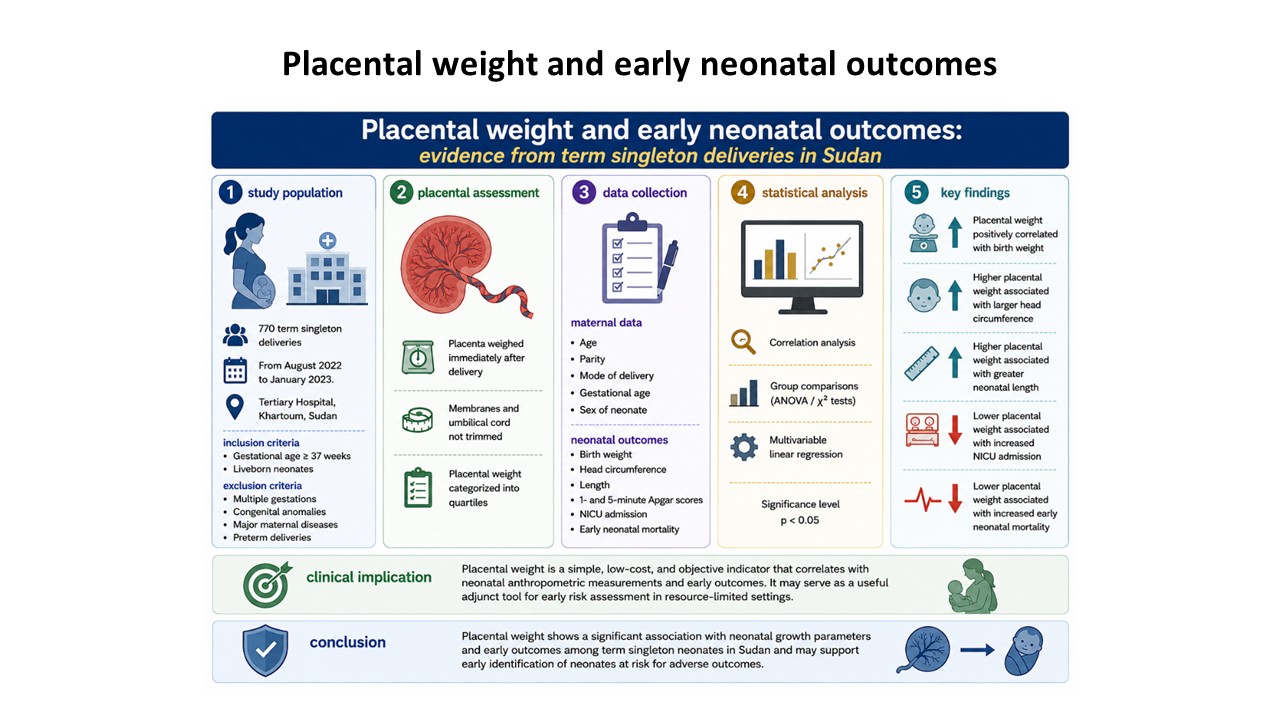
Objectives: This study aimed to examine the association between placental weight, neonatal anthropometric measurements, and admission to the neonatal intensive care unit among term singleton neonates.
Methods: A hospital-based cross-sectional analytical study was conducted among 770 term singleton neonates delivered at Omdurman Maternity Hospital, Sudan. Data regarding placental weight, neonatal anthropometric measurements, gestational age, Apgar scores, and neonatal intensive care unit admission were collected and analyzed. Pearson correlation analysis was used to examine the relationships between placental weight and neonatal variables.
Results: Placental weight demonstrated significant positive correlations with: neonatal birth weight (r = 0.457, p < 0.001), head circumference (r = 0.332, p < 0.001), and neonatal length (r = 0.208, p < 0.001). No statistically significant association was observed between placental weight and gestational age (p = 0.266). The overall placental weight-to-birth weight ratio was 0.198. Neonates admitted to the neonatal intensive care unit demonstrated substantially lower mean placental weights (540.91 ± 213.61 g) compared with neonates in good condition, suggesting a statistically significant association between reduced placental weight and adverse early neonatal outcomes.
Conclusion: Placental weight is significantly associated with neonatal growth measurements and early neonatal outcomes in term singleton pregnancies. Routine placental assessment may support the identification of neonatal risks and contribute to improved neonatal monitoring and care.
- Murphy VE, Smith R, Giles WB, Clifton VL. Endocrine regulation of human fetal growth: the role of the mother, placenta, and fetus. Endocr Rev. 2006;27(2):141-169. doi: 10.1210/er.2005-0011
- Wang X, Song Y, Wu D, et al. Inter-individual variations and modulators of MDR1 transport activity in human placenta. Placenta. 2020;97:46-50. doi: 10.1016/j.placenta.2020.06.001
- Liu J, Liu D, Liang H, et al. Association of placenta weight and morphology with term low birth weight: a case-control study. Open Med (Wars). 2025;20(1):20251264. doi: 10.1515/med-2025-1264
- Sathasivam R, Selliah P, Sivalingarajah R, Mayorathan U, Munasinghe BM. Placental weight and its relationship with the birth weight of term infants and body mass index of the mothers. J Int Med Res. 2023;51(5). doi: 10.1177/03000605231172895
- Basnet K, Yadav BK, Khan SA, et al. Birth weight status of newborns and its relationship with other anthropometric parameters. Medicine (Baltimore). 2025;104(44):e45374. doi: 10.1097/MD.0000000000045374
- Nkwabong E, Kamgnia Nounemi N, Sando Z, Mbu RE, Mbede J. Risk factors and placental histopathological findings of term born low birth weight neonates. Placenta. 2015;36(2):138-141. doi: 10.1016/j.placenta.2014.12.005
- Ibrahim G. The role of the health system in women’s utilisation of maternal health services in Sudan. Doctoral Thesis. London, UK: City, University of London; 2015. Accessed May 8, 2026. http://openaccess.city.ac.uk/17079/
- Elhassan S, Osman M, Altaher A, et al. Adverse maternal and neonatal outcomes in Northern Sudan: the role of antenatal care and socioeconomic inequities in war. Reprod Health. 2025;22(1):186. doi: 10.1186/s12978-025-02129-4
- Mugo NS, Dibley MJ, Agho KE. Prevalence and risk factors for non-use of antenatal care visits: analysis of the 2010 South Sudan household survey. BMC Pregnancy Childbirth. 2015;15:68. doi: 10.1186/s12884-015-0491-6
- Dassie GA, Lemi H, Getachew T, Ayana S. Maternal diet quality during pregnancy and birth outcomes in low- and middle-income countries: a scoping review. BMC Nutr. 2026;12(1):25. doi: 10.1186/s40795-025-01229-5
- Hamid AA, Ahmed MH, Ali AA, et al. Correlation of placental weight with neonatal weight and HbA1c in normal Sudanese pregnant ladies in Alban-Jaded Teaching Hospital. Iraqi Natl J Med. 2023;5(2):66-71. doi: 10.37319/iqnjm.5.2.6
- Elhag NB, Alabass HM, Hamid OA, Albasheer K, Adam I. Prevalence and associated factors of low birth weight in central Sudan: a cross-sectional study. Sudan J Med Sci. 2025;20(2):137-148. doi: 10.18502/sjms.v20i2.18148
- Panigrahi M, Solan S, Samanta P. Placental health score (PHS) for early prediction of placental insufficiency and preterm birth: a cross-sectional analytical study. Cureus. 2025;17(10):e94521. doi: 10.7759/cureus.94521
- Hersh A, Carroli G, Hofmeyr GJ, et al. Third stage of labor: evidence-based practice for prevention of adverse maternal and neonatal outcomes. Am J Obstet Gynecol. 2024;230(3):S1046-S1060.e1. doi: 10.1016/j.ajog.2022.11.1298
- Simanjuntak L, Simanjuntak PA. Placental index, placental characteristics, birth weight, and neonatal outcome in pregnancies. Open Access Maced J Med Sci. 2023;11(B):351- 354. doi: 10.3889/oamjms.2023.9637
- Javaid N, Akhter N, Naz R, Akhter T, Butt M, Irfan A. Placental metrics and gestational markers: predictors of adverse perinatal outcomes and fetal growth restriction. J Rawalpindi Med Coll. 2026;30(1). doi: 10.37939/jrmc.v30i1.2829
- Mahato S, Sharma K. Placental characteristics and neonatal outcome of singleton deliveries in a zonal hospital, Janakpur. J Chitwan Med Coll. 2022;12(4):86-90. doi: 10.54530/jcmc.1219
- Emechebe CI, Njoku CO, Ukaga JT, et al. The correlation between placental weight and foetal outcome in a tertiary health facility in southern Nigeria. J Adv Med Med Res. 2021;33(15):27-34. doi: 10.9734/jammr/2021/v33i1530983
- Hayward CE, Lean S, Sibley CP, et al. Placental Adaptation: What Can We Learn from Birthweight:Placental Weight Ratio? Front Physiol. 2016;7:28. doi: 10.3389/fphys.2016.00028
- Salih SHA, Omar AM. The relationship between the weight of the placenta and neonatal outcome. IOSR J Nurs Health Sci. 2017;6(6 ver. I):1-8. doi: 10.9790/1959-0606010108
- Flatley C, Sole-Navais P, Vaudel M, et al. Placental weight centiles adjusted for age, parity and fetal sex. Placenta. 2022;117:87-94. doi: 10.1016/j.placenta.2021.10.011
- Inamdar SSS, Kuntoji NG, Mallapur A, Mural PH. Correlation between placental weight and birth weight of the newborn and its effect on perinatal outcome: a hospital-based cross-sectional study. Int J Reprod Contracept Obstet Gynecol. 2025;14(3):786-790. doi: 10.18203/2320-1770.ijrcog20250505
- Salafia CM, Misra DP, Yampolsky M, Charles AK, Miller RK. Allometric metabolic scaling and fetal and placental weight. Placenta. 2009;30(4):355-360. doi: 10.1016/j.placenta.2009.01.006
- Richardson BS, de Vrijer B, Brown HK, Stitt L, Choo S, Regnault TRH. Gestational age impacts birth to placental weight ratio and umbilical cord oxygen values with implications for the fetal oxygen margin of safety. Early Hum Dev. 2022;164:105511. doi: 10.1016/j.earlhumdev.2021.105511
- Tasca C, Parisi F, Zambon M, et al. A real-life prospective blinded evaluation of placental biometry and macroscopic morphology from 1008 unselected consecutive pregnancies. Placenta. 2024;146:9-16. doi: 10.1016/j.placenta.2023.12.021
- Lonimitdee K, Prommas S. Placental weight for gestational age and adverse neonatal outcome at Bhumibol Adulyadej Hospital. Thai J Obstet Gynaecol. 2015;23(4):211-215. doi: 10.14456/TJOG.2015.21
- Shehata F, Levin I, Shrim A, et al. Placenta/birthweight ratio and perinatal outcome: a retrospective cohort analysis. BJOG. 2011;118(6):741-747. doi: 10.1111/j.1471-0528.2011.02892.x
- Sypiańska M, Stupak A. Introduction to the Proteomic Analysis of Placentas with Fetal Growth Restriction and Impaired Lipid Metabolism. Metabolites. 2024;14(11):632. doi: 10.3390/metabo14110632
- Salavati N, Gordijn SJ, Sovio U, et al. Birth weight to placenta weight ratio and its relationship to ultrasonic measurements, maternal and neonatal morbidity: A prospective cohort study of nulliparous women. Placenta. 2018;63:45-52. doi: 10.1016/j.placenta.2017.11.008
- Batool S, Aslam F, Khalid A, Shaheen F, Amin Y, Kausar S. Outcome of conservative management of placenta previa with accreta spectrum disorder by applying continuous squeezing suture with cervical lifting. Indus J Biosci Res. 2025;3(5):518-523. doi: 10.70749/ijbr.v3i5.1120
- Kumar M, Meena D, Chauhan S, Mufti T, Debnath E, Yadav R. Placental biomarkers in prediction of perinatal death: A prospective study. Placenta. 2026;181:88-94. doi: 10.1016/j.placenta.2026.05.001
- Elrasheed FE. Placental Weight, Maternal Characteristics, and Perinatal Outcomes Are Associated with Foetal Biometric Indicators in a tertiary Care Setting. AJBR. 2025;28(3S):747-754. doi: 10.53555/AJBR.v28i3S.8096
- Mandò C, Calabrese S, Mazzocco MI, et al. Sex specific adaptations in placental biometry of overweight and obese women. Placenta. 2016;38:1-7. doi: 10.1016/j.placenta.2015.12.008
- Adamczyk M, Michalak M, Kedzia WW, et al. The impact of fetal sex and maternal parity on birth weight, placental mass, and placental efficiency: a retrospective analysis from a Polish tertiary center. Ginekologia Polska. 2026;97(6):466- 485. doi: 10.5603/gpl.109312
- Penteado MP, Grandi C, Rodrigues LDS, Cardoso VC. Association between placental efficiency with anthropometry and nutritional phenotypes in full-term newborns from the 2010/2011 BRISA birth cohort. J Pediatr (Rio J). 2024;100(4):377-383. doi: 10.1016/j.jped.2023.11.011
- Odendaal H, Brink LT, Lachman A, Nel D. Risk factors for small for gestational age as defined by a birthweight z-score below minus one: A prospective observational study. Med Res Arch. 2024;12(8):5731. doi: 10.18103/mra.v12i8.5731
- Redline RW, Roberts DJ, Parast MM, et al. Placental pathology is necessary to understand common pregnancy complications and achieve an improved taxonomy of obstetrical disease. Am J Obstet Gynecol. 2023;228(2):187- 202. doi: 10.1016/j.ajog.2022.08.010
- Panti AA, Ekele BA, Nwobodo EI, Yakubu A. The relationship between the weight of the placenta and birth weight of the neonate in a Nigerian Hospital. Niger Med J. 2012;53(2):80- 84. doi: 10.4103/0300-1652.103547
- Papadopoulou FG, Mamopoulos AM, Triantos A, et al. Leptin levels in maternal and cord serum: relationship with fetal development and placental weight. J Matern Fetal Med. 2000;9(5):298-302. doi: 10.1002/1520-6661(200009/10)9:5<298::AID-MFM9>3.0.CO;2-P
- Elmusharaf K, Byrne E, AbuAgla A, AbdelRahim A, Manandhar M, Sondorp E, O’Donovan D. Patterns and determinants of pathways to reach comprehensive emergency obstetric and neonatal care (CEmONC) in South Sudan: qualitative diagrammatic pathway analysis. BMC Pregnancy Childbirth. 2017;17(1):278. doi: 10.1186/s12884-017-1463-9