
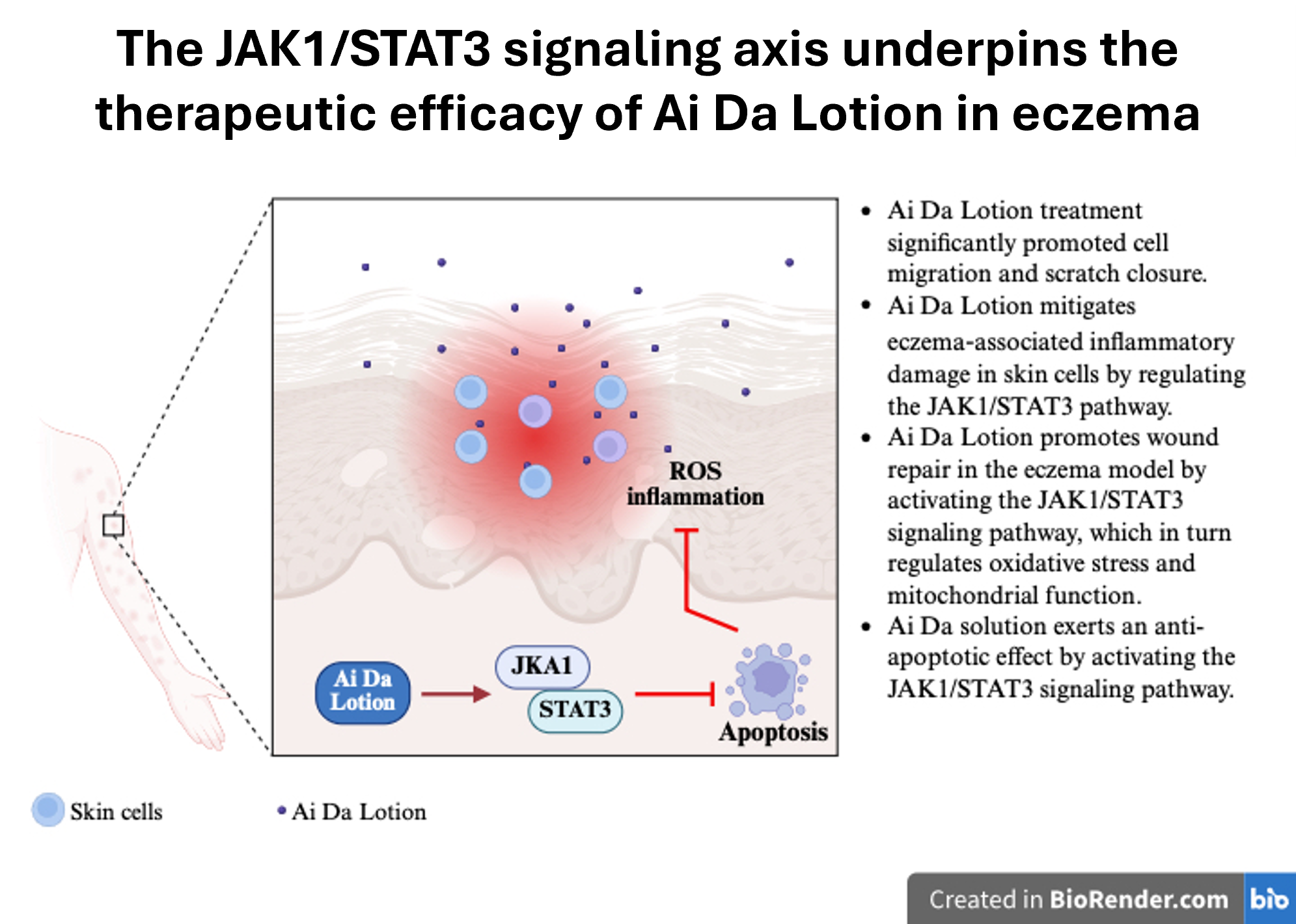
Ai Da Lotion improves eczema lesions via modulation of the JAK1/STAT3 pathway and regulation of apoptosis and oxidative stress

Introduction: Ai Da Lotion is widely used for eczema in the clinic; however, its active ingredients and molecular mechanism remain unclear.
Objective: We set out to define the molecular basis for how Ai Da Lotion—a compound traditional Chinese medicine preparation—acts to treat eczema, with the goal of generating sound scientific support for its clinical use and modern translational development.
Methods: In this study, we combined ultra high-performance liquid chromatography–quadrupole time-of-flight mass spectrometry profiling with network pharmacology and molecular docking to identify the formula’s bioactive constituents and key targets, then validated these findings in keratinocyte-based models of eczema.
Results: Chemical profiling identified 889 constituents, and physicochemical screening narrowed these to 42 candidate active compounds. Target network analysis uncovered 37 core nodes, with Janus kinase 1 (JAK1) and signal transducer and activator of transcription 3 (STAT3) emerging as the dominant regulatory pair. Two lead compounds—8-deoxylactucin and 6β-hydroxymethandrostenolone—bound JAK1 and STAT3 with high affinity (binding energy <−7.6 kcal/mol). Functionally, Ai Da Lotion promoted keratinocyte migration, attenuated oxidative stress, stabilized mitochondrial membrane potential, and suppressed Caspase-3–mediated apoptosis. These protective effects were recapitulated upon JAK1/STAT3 overexpression and blocked by selective pathway inhibition, indicating that the formula works primarily through JAK1/STAT3 modulation.
Conclusion: Our results provide a mechanistic basis for Ai Da Lotion and illustrate a practical strategy for dissecting the pharmacology of complex herbal dermatological preparations.
- Kwon HE, Ahn HJ, Jeong SJ, et al. The increased prevalence of keloids in atopic dermatitis patients with allergic comorbidities: a nationwide retrospective cohort study. Sci Rep. 2021;11(1). doi: 10.1038/s41598-021-03164-4
- Apfelbacher C, Bewley A, Molin S, et al. Prevalence of chronic hand eczema in adults: a cross-sectional survey of over 60 000 respondents from the general population of Canada, France, Germany, Italy, Spain and the UK. Br J Dermatol. 2025;192(6):1047-1054. doi: 10.1093/bjd/ljaf020
- Maspero J, De Paula Motta Rubini N, Zhang J, et al. Epidemiology of adult patients with atopic dermatitis in AWARE 1: A second international survey. World Allergy Organ J. 2023;16(3):100724. doi: 10.1016/j.waojou.2022.100724
- Agilan B, Rajendra Prasad N, Kanimozhi G, et al. Caffeic Acid Inhibits Chronic UVB-Induced Cellular Proliferation Through JAK-STAT3 Signaling in Mouse Skin. Photochem Photobiol. 2016;92(3):467-474. doi: 10.1111/php.12588
- Fargnoli MC, Molin S, Bewley A, et al. Moderate to severe Chronic Hand Eczema in clinical practice: etiological subtypes, clinical signs and symptoms, and comorbidities— results from the RWEAL study. J Dermatolog Treat. 2026;37(1). doi: 10.1080/09546634.2025.2603121
- Tsai SYC, Phipatanakul W, Hawryluk EB, et al. Comparative safety of oral Janus kinase inhibitors versus dupilumab in patients with atopic dermatitis: A population-based cohort study. J Allergy Clin Immunol. 2024;154(5):1195-1203.e3. doi: 10.1016/j.jaci.2024.07.019
- Benandi K, Spires A, Hansen A, Linfante A. Systemic risk profiles of topical ruxolitinib and oral Janus kinase inhibitors in patients with atopic dermatitis: A retrospective cohort study from the TriNetX network. J Am Acad Dermatol. 2025;93(4):1035-1041. doi: 10.1016/j.jaad.2025.06.058
- Singleton H, Hodder A, Almilaji O, et al. Educational and psychological interventions for managing atopic dermatitis (eczema). Cochrane Database Syst Rev. 2024;2024(8). doi: 10.1002/14651858.cd014932.pub2
- Hallit S, Haddad C, Zeidan RK, et al. Cognitive function among schoolchildren in Lebanon: association with maternal alcohol drinking and smoking during pregnancy and domestic use of detergents and pesticides during childhood. Environ Sci Pollut Res. 2019;26(14):14373-14381. doi: 10.1007/s11356-019-04797-9
- Drucker AM, Morra DE, Prieto-Merino D, et al. Systemic Immunomodulatory Treatments for Atopic Dermatitis. JAMA Dermatol. 2022;158(5):523. doi: 10.1001/jamadermatol.2022.0455
- Yori F, Sarmiento C, Gimeno Beltran J, Umbert I. The Combination of Mineral Salts and Natural Antioxidants Agents Is Highly Effective in Atopic Dermatitis. Clin Cosmet Investig Dermatol. 2025;18:3695-3711. doi: 10.2147/ccid.s562171
- Zalewski A, Krajewski PK, Szepietowski JC. Psychosocial Consequences of Hand Eczema—A Prospective Cross- Sectional Study. J Clin Med. 2023;12(17):5741. doi: 10.3390/jcm12175741
- Buske-Kirschbaum A, Trikojat K, Tesch F, et al. Altered hypothalamus-pituitary-adrenal axis function: A relevant factor in the comorbidity of atopic eczema and attention deficit/hyperactivity disorder? Psychoneuroendocrinology. 2019;105:178-186. doi: 10.1016/j.psyneuen.2018.12.005
- Matthewman J, Schultze A, Strongman H, et al. Cohort studies on 71 outcomes among people with atopic eczema in UK primary care data. Nat Commun. 2024;15(1). doi: 10.1038/s41467-024-54035-1
- Rao H, Tan JBL. Polysaccharide-based hydrogels for atopic dermatitis management: A review. Carbohydr Polym. 2025;349:122966. doi: 10.1016/j.carbpol.2024.122966
- Paz M, Lio P. Skin-Immune-Neuro-Gastro-Endocrine (SINGE) System: Lighting the Fire on Atopic Dermatitis Research. Dermatol Pract Concept. 2025;15(4):5329. doi: 10.5826/dpc.1504a5329
- Wang X, Meng J, Wu Q, Feng J, Jing H. Clinical Efficacy of Integrated Traditional Chinese and Western Medicine in the Treatment of Eczema: A Meta-Analysis. Comput Math Methods Med. 2022;2022:1-7. doi: 10.1155/2022/7202626
- Gao W, Qiao X, Zhu J, et al. Clinical Efficacy of Tacrolimus Ointment + 3% Boric Acid Lotion Joint Chinese Angelica Decoction in Chronic Perianal Eczema. Comput Math Methods Med. 2021;2021:1-5. doi: 10.1155/2021/1016108
- Law SK, Wang Y, Wu XX. Comparison of the Effectiveness Differences between Western and Chinese Medicinal Ointments against Eczema. Pharmaceuticals. 2025;18(9):1248. doi: 10.3390/ph18091248
- Uzun S, Wang Z, McKnight TA, et al. Improvement of skin lesions in corticosteroid withdrawal-associated severe eczema by multicomponent traditional Chinese medicine therapy. Allergy Asthma Clin Immunol. 2021;17(1). doi: 10.1186/s13223-021-00555-0
- Ahuja A, Gupta J, Gupta R. Miracles of Herbal Phytomedicines in Treatment of Skin Disorders: Natural Healthcare Perspective. Infect Disord Drug Targets. 2023;23(3):328-338. doi: 10.2174/1871526520666200622142710
- Wan HL, Chen HZ, Shi XQ. Study on effect of Traditional Chinese Medicine Jianpi Chushi decoction and ointment on chronic eczema. Asian Pac J Trop Med. 2016;9(9):920-923. doi: 10.1016/j.apjtm.2016.07.019
- Blauvelt A, Silverberg JI, Lynde CW, et al. Abrocitinib induction, randomized withdrawal, and retreatment in patients with moderate-to-severe atopic dermatitis: Results from the JAK1 Atopic Dermatitis Efficacy and Safety (JADE) REGIMEN phase 3 trial. J Am Acad Dermatol. 2022;86(1):104-112. doi: 10.1016/j.jaad.2021.05.075
- Kasap N, Kara A, Celik V, et al. Atypical Localization of Eczema Discriminates DOCK8 or STAT3 Deficiencies from Atopic Dermatitis. J Clin Immunol. 2023;43(8):1882-1890. doi: 10.1007/s10875-023-01554-z
- Zhang T, Huang J, Zhang Z, et al. Flow cytometry and 5-ethynyl-2’-deoxyuridine (EdU) labeling to detect the cell cycle dynamics of Phaeodactylum tricornutum under light. J Phycol. 2022;58(4):555-567. doi: 10.1111/jpy.13250
- De Biasi S, Gibellini L, Cossarizza A. Uncompensated Polychromatic Analysis of Mitochondrial Membrane Potential Using JC-1 and Multilaser Excitation. Curr Protoc Cytom. 2015;72(1). doi: 10.1002/0471142956.cy0732s72
- Zhang S, Ye C, Guo L, et al. iLOV3.0 Fluorescent Probes for Monitoring ROS Changes in Mammalian Cells. Bioconjug Chem. 2025;36(8):1709-1720. doi: 10.1021/acs.bioconjchem.5c00208
- Wang F, Deng H, Zhou M, et al. Anti-PD-1 exacerbates bleomycin-induced lung injury in mice via Caspase-3/ GSDME-mediated pyroptosis. Cell Death Dis. 2025;16(1). doi: 10.1038/s41419-024-07319-9
- Luo Z, Liu X, Xu C, et al. Exploring the mechanism of Zanthoxylum bungeanum essential oil in alleviating acute pruritus in rats based on network pharmacology, molecular docking, and experimental pharmacology. J Ethnopharmacol. 2026;357:120889. doi: 10.1016/j.jep.2025.120889
- Dadi H, Jones TA, Merico D, et al. Combined immunodeficiency and atopy caused by a dominant negative mutation in caspase activation and recruitment domain family member 11 (CARD11). J Allergy Clin Immunol. 2018;141(5):1818-1830.e2. doi: 10.1016/j.jaci.2017.06.047
- Chen M, Wang Y, Wang M, et al. Keratin 6A promotes skin inflammation through JAK1-STAT3 activation in keratinocytes. J Biomed Sci. 2025;32(1). doi: 10.1186/s12929-025-01143-9
- Dorjbal B, Stinson JR, Ma CA, et al. Hypomorphic caspase activation and recruitment domain 11 (CARD11) mutations associated with diverse immunologic phenotypes with or without atopic disease. J Allergy Clin Immunol. 2019;143(4):1482-1495. doi: 10.1016/j.jaci.2018.08.013
- Mokaram Doust Delkhah A. Identification of STAT3 signaling as a shared pathogenic signature in systemic lupus erythematosus, chronic obstructive pulmonary disease, and asthma. Sci Rep. 2025;15(1). doi: 10.1038/s41598-025-07184-2
- Niehues T, von Hardenberg S, Velleuer E. Rapid identification of primary atopic disorders (PAD) by a clinical landmark-guided, upfront use of genomic sequencing. Allergol Select. 2024;8(01):304-323. doi: 10.5414/ALX02520E
- Aramwit P, Fongsodsri K, Tuentam K, et al. Sericin coated thin polymeric films reduce keratinocyte proliferation via the mTOR pathway and epidermal inflammation through IL17 signaling in psoriasis rat model. Sci Rep. 2023;13(1). doi: 10.1038/s41598-023-39218-y
- Brewer MG, Yoshida T, Kuo FI, et al. Antagonistic Effects of IL-4 on IL-17A-Mediated Enhancement of Epidermal Tight Junction Function. Int J Mol Sci. 2019;20(17):4070. doi: 10.3390/ijms20174070
- De La Cruz NC, Mockel M, Niehues H, et al. Ex Vivo Infection of Human Skin Models with Herpes Simplex Virus 1: Accessibility of the Receptor Nectin-1 during Formation or Impairment of Epidermal Barriers Is Restricted by Tight Junctions. J Virol. 2023;97(6). doi: 10.1128/jvi.00262-23
- Na K, Lkhagva-Yondon E, Kim M, et al. Oral treatment with Aloe polysaccharide ameliorates ovalbumin-induced atopic dermatitis by restoring tight junctions in skin. Scand J Immunol. 2019;91(3). doi: 10.1111/sji.12856