
Prognostic evaluation and immune microenvironment profiling of Ewing sarcoma through characterization of lipid metabolism-related genes

Introduction: Lipid metabolism contributes to tumor progression and immune regulation in Ewing sarcoma (EwS), but its relationship with prognosis and tumor immune microenvironment (TIME) remains inadequately clarified.
Objectives: This study investigated lipid metabolism-related gene (LMRG) subtypes, their associations with immune microenvironmental characteristics, and the prognostic value of an LMRG-based risk model in EwS.
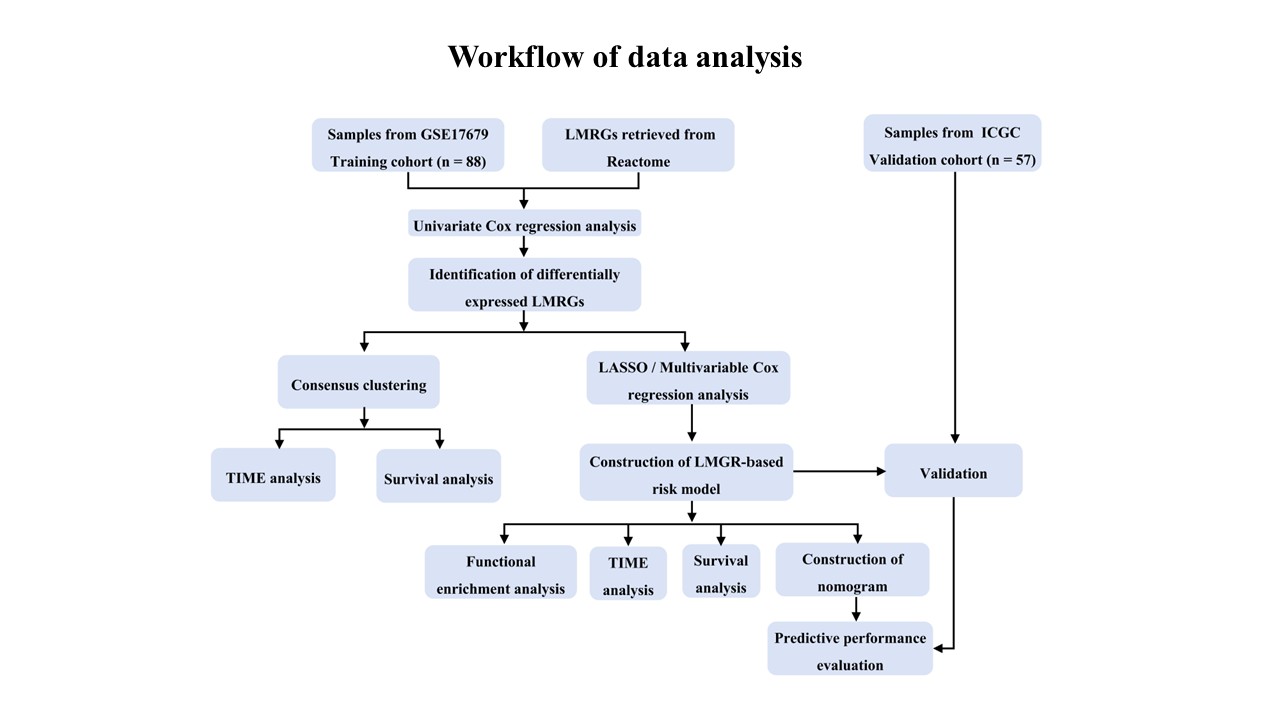
Methods: Transcriptomic datasets of EwS from GEO (GSE17679; training cohort) and ICGC (validation cohort) were analyzed using computational techniques. LMRG subtypes were identified by consensus clustering. The TIME was inferred using ESTIMATE, TIMER algorithm, and single-sample gene set enrichment analysis (ssGSEA). A multigene risk score model was developed through LASSO and multivariable Cox regression, evaluated with Kaplan–Meier survival curves and time-dependent receiver operating characteristic (ROC) curves. A nomogram was constructed based on the model integrated with clinicopathologic variables.
Results: Two molecular subtypes showed distinct survival; the immune-enriched, low-purity subtype had poorer outcomes. A five-gene signature (TXNRD1, FABP5, ORMDL1, RAB5A, DBI) stratified patients into high- and low-risk groups, with AUCs of 0.90–0.94 in the training cohort and 0.58–0.85 in the validation cohort. The risk score was associated with increased ESTIMATE and immune scores, along with reduced tumor purity. The integrated nomogram achieved a C-index of 0.759 with acceptable calibration.
Conclusion: Dysregulated lipid metabolism is intricately linked to the TIME and patient prognosis in EwS. The LMRG-based risk model provides a potentially useful tool for prognostic stratification and highlights potential therapeutic avenues targeting lipid metabolism and immune modulation.
- Zhang Z, Pan J, Cheng D, et al. Expression of lactate-related signatures correlates with immunosuppressive microenvironment and prognostic prediction in ewing sarcoma. Front Genet. 2022;13:965126. doi: 10.3389/fgene.2022.965126
- Zhang Z, Shi Y, Zhu Z, et al. Characterization of myeloid signature genes for predicting prognosis and immune landscape in Ewing sarcoma. Cancer Sci. 2023;114(4):1240-1255. doi: 10.1111/cas.15688
- Koustas E, Sarantis P, Karamouzis MV, Vielh P, Theocharis S. The Controversial Role of Autophagy in Ewing Sarcoma Pathogenesis-Current Treatment Options. Biomolecules. 2021;11(3). doi: 10.3390/biom11030355
- Jia F, Liu L, Weng Q, Zhang H, Zhao X. Glycolysis-Metabolism-Related Prognostic Signature for Ewing Sarcoma Patients. Mol Biotechnol. 2024;66(10):2882-2896. doi: 10.1007/s12033-023-00899-5
- Bierbaumer L, Katschnig AM, Radic-Sarikas B, et al. YAP/ TAZ inhibition reduces metastatic potential of Ewing sarcoma cells. Oncogenesis. 2021;10(1):2. doi: 10.1038/s41389-020-00294-8
- Tanner JM, Bensard C, Wei P, et al. EWS/FLI is a Master Regulator of Metabolic Reprogramming in Ewing Sarcoma. Mol Cancer Res. 2017;15(11):1517-1530. doi: 10.1158/1541-7786.Mcr-17-0182
- Jiménez JA, Apfelbaum AA, Hawkins AG, et al. EWS-FLI1 and Menin Converge to Regulate ATF4 Activity in Ewing Sarcoma. Mol Cancer Res. 2021;19(7):1182-1195. doi: 10.1158/1541-7786.Mcr-20-0679
- Wang D, Ye Q, Gu H, Chen Z. The role of lipid metabolism in tumor immune microenvironment and potential therapeutic strategies. Front Oncol. 2022;12:984560. doi: 10.3389/fonc.2022.984560
- Zeng W, Yin X, Jiang Y, Jin L, Liang W. PPARα at the crossroad of metabolic-immune regulation in cancer. FEBS J. 2022;289(24):7726-7739. doi: 10.1111/febs.16181
- Fu Z, Yu B, Liu M, et al. Construction of a prognostic signature in Ewing’s sarcoma: Based on metabolism-related genes. Transl Oncol. 2021;14(12):101225. doi: 10.1016/j.tranon.2021.101225
- Shukrun R, Baron S, Fidel V, et al. Suggested role for neutrophil extracellular trap formation in Ewing sarcoma immune microenvironment. Cancer Sci. 2024;115(1):36-47. doi: 10.1111/cas.15992
- He F, Xu J, Zeng F, et al. Integrative analysis of Ewing’s sarcoma reveals that the MIF-CD74 axis is a target for immunotherapy. Cell Commun Signal. 2025;23(1):23. doi: 10.1186/s12964-024-02020-y
- Maan M, Peters JM, Dutta M, Patterson AD. Lipid metabolism and lipophagy in cancer. Biochem Biophys Res Commun. 2018;504(3):582-589. doi: 10.1016/j.bbrc.2018.02.097
- Qian H, Lei T, Hu Y, Lei P. Expression of Lipid-Metabolism Genes Is Correlated With Immune Microenvironment and Predicts Prognosis in Osteosarcoma. Front Cell Dev Biol. 2021;9:673827. doi: 10.3389/fcell.2021.673827
- Leek JT, Johnson WE, Parker HS, Jaffe AE, Storey JD. The sva package for removing batch effects and other unwanted variation in high-throughput experiments. Bioinformatics. 2012;28(6):882-883. doi: 10.1093/bioinformatics/bts034
- Subramanian A, Tamayo P, Mootha VK, et al. Gene set enrichment analysis: a knowledge-based approach for interpreting genome-wide expression profiles. Proc Natl Acad Sci USA. 2005;102(43):15545-15550. doi: 10.1073/pnas.0506580102
- Koundouros N, Poulogiannis G. Reprogramming of fatty acid metabolism in cancer. Br J Cancer. 2020;122(1):4-22. doi: 10.1038/s41416-019-0650-z
- Tang Y, Chen Z, Zuo Q, Kang Y. Regulation of CD8+ T cells by lipid metabolism in cancer progression. Cell Mol Immunol. 2024;21(11):1215-1230. doi: 10.1038/s41423-024-01224-z
- Chen H, Song Y, Deng C, et al. Comprehensive analysis of immune infiltration and gene expression for predicting survival in patients with sarcomas. Aging. 2020;13(2):2168-2183. doi: 10.18632/aging.202229
- Șenbabaoğlu Y, Michailidis G, Li JZ. Critical limitations of consensus clustering in class discovery. Sci Rep. 2014;4:6207. doi: 10.1038/srep06207
- Xiao B, Liu L, Li A, et al. Identification and Verification of Immune-Related Gene Prognostic Signature Based on ssGSEA for Osteosarcoma. Front Oncol. 2020;10:607622. doi: 10.3389/fonc.2020.607622
- Yoshihara K, Shahmoradgoli M, Martínez E, et al. Inferring tumour purity and stromal and immune cell admixture from expression data. Nat Commun. 2013;4:2612. doi: 10.1038/ncomms3612
- Zhou Y, Xu B, Wu S, Liu Y. Prognostic Immune-Related Genes of Patients With Ewing’s Sarcoma. Front Genet. 2021;12:669549. doi: 10.3389/fgene.2021.669549
- Fujiwara T, Fukushi J, Yamamoto S, et al. Macrophage infiltration predicts a poor prognosis for human ewing sarcoma. Am J Pathol. 2011;179(3):1157-70. doi: 10.1016/j.ajpath.2011.05.034
- Cohnen J, Kornstädt L, Hahnefeld L, et al. Tumors Provoke Inflammation and Perineural Microlesions at Adjacent Peripheral Nerves. Cells. 2020;9(2):320. doi: 10.3390/cells9020320
- Shi X, Zheng Y, Jiang L, et al. EWS-FLI1 regulates and cooperates with core regulatory circuitry in Ewing sarcoma. Nucleic Acids Res. 2020;48(20):11434-11451. doi: 10.1093/nar/gkaa901
- Liu R, Wang C, Tao Z, Hu G. Lipid Metabolism Reprogramming in Cancer: Insights into Tumor Cells and Immune Cells Within the Tumor Microenvironment. Biomedicines. 2025;13(8):1895. doi: 10.3390/biomedicines13081895
- Jin R, Hao J, Yu J, Wang P, Sauter ER, Li B. Role of FABP5 in T Cell Lipid Metabolism and Function in the Tumor Microenvironment. Cancers. 2023;15(3):657. doi: 10.3390/cancers15030657
- Jin HR, Wang J, Wang ZJ, et al. Lipid metabolic reprogramming in tumor microenvironment: from mechanisms to therapeutics. J Hematol Oncol. 2023;16(1):103. doi: 10.1186/s13045-023-01498-2
- Haight JA, Koppenhafer SL, Geary EL, Gordon DJ. Auranofin and reactive oxygen species inhibit protein synthesis and regulate the level of the PLK1 protein in Ewing sarcoma cells. Front Oncol. 2024;14:1394653. doi: 10.3389/fonc.2024.1394653
- Kawaguchi K, Kinameri A, Suzuki S, Senga S, Ke Y, Fujii H. The cancer-promoting gene fatty acid-binding protein 5 (FABP5) is epigenetically regulated during human prostate carcinogenesis. Biochem J. 2016;473(4):449-461. doi: 10.1042/bj20150926
- Liu F, Liu W, Zhou S, et al. Identification of FABP5 as an immunometabolic marker in human hepatocellular carcinoma. J Immunother Cancer. 2020;8(2):e000501. doi: 10.1136/jitc-2019-000501
- Wang Q, Liu W, Chen S, et al. ORMDL1 is upregulated and associated with favorable outcomes in colorectal cancer. Transl Oncol. 2021;14(10):101171. doi: 10.1016/j.tranon.2021.101171
- Li S, Zhao X, Fu K, et al. Resistance to antibody-drug conjugates: A review. Acta Pharm Sin B. 2025;15(2):737-756. doi: 10.1016/j.apsb.2024.12.036
- Engebraaten O, Yau C, Berg K, et al. RAB5A expression is a predictive biomarker for trastuzumab emtansine in breast cancer. Nat Commun. 2021;12(1):6427. doi: 10.1038/s41467-021-26018-z
- Wu KC, Condon ND, Hill TA, Reid RC, Fairlie DP, Lim J. Ras-Related Protein Rab5a Regulates Complement C5a Receptor Trafficking, Chemotaxis, and Chemokine Secretion in Human Macrophages. J Innate Immun. 2023;15(1):468-484. doi: 10.1159/000530012
- Montégut L, Liu P, Zhao L, et al. Acyl-coenzyme a binding protein (ACBP) - a risk factor for cancer diagnosis and an inhibitor of immunosurveillance. Mol Cancer. 2024;23(1):187. doi: 10.1186/s12943-024-02098-5
- Li S, Motiño O, Lambertucci F, et al. Neutralization of acyl coenzyme A binding protein for the experimental prevention and treatment of hepatocellular carcinoma. Cell Rep Med. 2025;6(7):102232. doi: 10.1016/j.xcrm.2025.102232
- Montégut L, Martins I, Kroemer G. Neutralization of the autophagy-repressive tissue hormone DBI/ACBP (diazepam binding inhibitor, acyl-CoA binding protein) enhances anticancer immunosurveillance. Autophagy. 2024;20(12):2836-2838. doi: 10.1080/15548627.2024.2411854
- Qu S, Xue H, Dong X, et al. Aneustat (OMN54) has aerobic glycolysis-inhibitory activity and also immunomodulatory activity as indicated by a first-generation PDX prostate cancer model. Int J Cancer. 2018;143(2):419-429. doi: 10.1002/ijc.31310
- Sun J, Yu L, Qu X, Huang T. The role of peroxisome proliferator-activated receptors in the tumor microenvironment, tumor cell metabolism, and anticancer therapy. Front Pharmacol. 2023;14:1184794. doi: 10.3389/fphar.2023.1184794