

Enhancing rare tumor detection: A cross-modal generative adversarial network benchmark for data augmentation in cardiac, liver, and retinal imaging

Introduction: Rare pathologies in medical imaging suffer from severe data scarcity, leading to AI models with low sensitivity and high false-negative rates, resulting in missed diagnoses with potentially life-threatening consequences. Although generative adversarial networks (GANs) offer a promising solution by generating synthetic images, no empirically derived quality thresholds currently exist for safe clinical deployment.
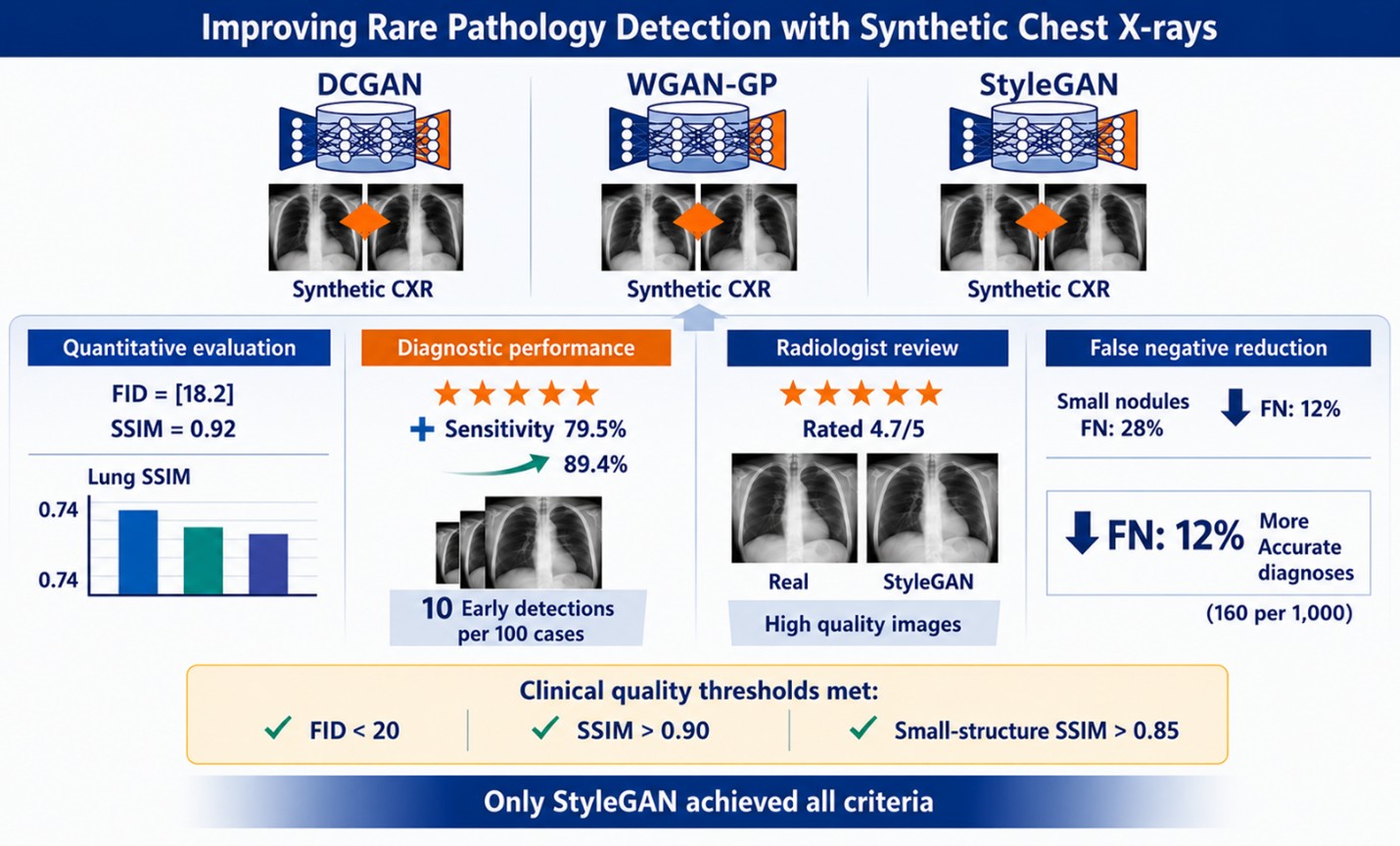
Objective: To systematically evaluate DCGAN, WGAN-GP, and StyleGAN for generating clinically useful synthetic chest X-rays, focusing on false-negative reduction and establishing clinical quality thresholds.
Methods: Using the NIH Chest X-ray dataset (89,139 images; 14 pathologies), three GAN architectures were trained to augment underrepresented classes. Evaluation included quantitative metrics (FID and structure-specific SSIM), diagnostic performance across three datasets, blinded radiologist review (n = 5; 100 images per model), and failure analysis quantifying false-negative rates.
Results: StyleGAN outperformed alternatives (FID = 18.2 vs. DCGAN: 45.6; WGAN-GP: 23.4), achieved SSIM of 0.92 (vs. 0.78 and 0.85), and preserved lung patterns at 0.90 (vs. 0.74 and 0.82). Sensitivity increased from 79.5% to 94.2%, yielding approximately 10 additional early detections per 100 rare pathology cases. StyleGAN reduced false negatives for small nodules to 12% compared to 28% for DCGAN—a 16% absolute reduction, translating to 160 additional correct diagnoses per 1,000 high-risk screenings. Radiologists rated StyleGAN images 4.7/5 (vs. DCGAN: 2.8/5). This study proposes the first empirically derived clinical quality thresholds for synthetic chest X-rays: FID < 20, SSIM > 0.90, small-structure SSIM > 0.85, and radiologist score > 4.5/5. Only StyleGAN met all criteria.
Conclusion: High-quality GANs, particularly StyleGAN, significantly reduce false negatives and improve rare pathology detection. By directly linking synthetic image quality to measurable reductions in false negatives, this study establishes clinically actionable safety thresholds and provides a regulatory-aligned framework for responsible deployment of GAN-augmented medical imaging systems.
- Loganathan P, Gajendran M, Perisetti A, et al. Endoscopic Advances in the Diagnosis and Management of Gastroesophageal Reflux Disease. Medicina. 2024;60(7):1120.
- World Health Organization. Cancer. World Health Organization. 2022. Accessed March 22, 2025. https://www. who.int/news-room/fact-sheets/detail/cancer
- Rayan AM, Adam A, Al-Arabi G, Ahmed MR. The applications of X-ray technology in medical imaging: advances, challenges, and future perspectives (A review). J Sustain Food Water Energy Environ. 2025;1(2):39-61.
- Iqbal A, Sharif M, Yasmin M, Raza M, Aftab S. Generative adversarial networks and its applications in the biomedical image segmentation: a comprehensive survey. Int J Multimed Inf Retr. 2022;11(3):333-368.
- Galbusera F, Cina A. Image annotation and curation in radiology: an overview for machine learning practitioners. Eur Radiol Exp. 2024;8(1):11.
- Bijalwan A, Sikarwar SS. Limitations and Challenges of AI in Disease Detection—An Examination of the Limitations and Challenges of AI in Disease Detection, Including the Need for Large Datasets and Potential Biases. In: AI in Disease Detection: Advancements and Applications. Hoboken, New Jersey: Wiley-IEEE Press; 2025:289-311.
- Goceri E. Medical image data augmentation: techniques, comparisons and interpretations. Artif Intell Rev. 2023;56(11):12561-12605.
- Goodfellow IJ, Pouget-Abadie J, Mirza M, et al. Generative adversarial nets. Adv Neural Inf Process Syst. 2014;27.
- Sultan B, Rehman A, Riyaz L. Generative Adversarial Networks in the Field of Medical Image Segmentation. In: Deep Learning Applications in Medical Image Segmentation: Overview, Approaches, and Challenges. Hoboken, New Jersey: Wiley-IEEE Press; 2025:185-225.
- Keskes M. Generative Adversarial Networks for Synthetic Data Generation in Deep Learning Applications. J Artif Intell Res Innov. 2025;1(1):28-33.
- Ali M, Ali M, Hussain M, Koundal D. Generative adversarial networks (GANs) for medical image processing: recent advancements. Arch Comput Methods Eng. 2025;32(2):1185- 1198.
- Munteanu D, Moldovanu S, Miron M. The Explanation and Sensitivity of AI Algorithms Supplied with Synthetic Medical Data. Electronics. 2025;14(7):1270.
- Dash A, Swarnkar T. Data-GAN augmentation techniques in medical image analysis: a deep survey. SN Comput Sci. 2025;6(4):348.
- Chlap P, Min H, Vandenberg N, Dowling J, Holloway L, Haworth A. A review of medical image data augmentation techniques for deep learning applications. J Med Imaging Radiat Oncol. 2021;65(5):545-563.
- Chakraborty T, Reddy KS U, Naik SM, Panja M, Manvitha B. Ten years of generative adversarial nets (GANs): a survey of the state-of-the-art. Mach Learn Sci Technol. 2024;5(1):11001.
- Bermano AH, Gal R, Alaluf Y, et al. State-of-the-Art in the Architecture, Methods and Applications of StyleGAN. Comput Graph Forum. 2022;41:591-611. doi: 10.1111/cgf.14503
- Bakar WAWA, Josdi NLN, Man M, Kadir EA, Pandey BK. Evolution of Generative Adversarial Networks (GANs) in Medicine: A Systematic Review of Architectures, Applications, and Implementation Challenges. Artif Intell Appl. 2025. doi: 10.47852/bonviewAIA52026216
- Johari MF, Chiew KL, Tan CCL, Sarbini IN. Generative Models in Synthetic 2d Medical Image Generation: A Systematic Review. ResearchGate. 2025.
- Gulrajani I, Ahmed F, Arjovsky M, Dumoulin V, Courville AC. Improved training of wasserstein gans. Adv Neural Inf Process Syst. 2017;30.
- Karras T, Laine S, Aila T. A style-based generator architecture for generative adversarial networks. arXiv. 2019:4401-4410. https://arxiv.org/abs/1812.04948
- Heusel M, Ramsauer H, Unterthiner T, Nessler B, Hochreiter S. Gans trained by a two time-scale update rule converge to a local nash equilibrium. Adv Neural Inf Process Syst. 2017;30.
- Wang Z, Bovik AC, Sheikh HR, Simoncelli EP. Image quality assessment: from error visibility to structural similarity. IEEE Trans image Process. 2004;13(4):600-612.
- T\uab\uacaru G, Moldovanu S, R\uaducan E, Barbu M. A robust machine learning model for diabetic retinopathy classification. J Imaging. 2023;10(1):8.
- Noor MN, Ashraf I, Nazir M. Analysis of GAN-based data augmentation for GI-tract disease classification. In: Advances in Deep Generative Models for Medical Artificial Intelligence. Springer; 2023:43-64.
- Admass WS, Munaye YY, Bogale GA. Convolutional neural networks and histogram-oriented gradients: a hybrid approach for automatic mango disease detection and classification. Int J Inf Technol. 2024;16(2):817-829.
- Bedrinana LA, Landeo JG, Sucasaca JC, Malaga- Chuquitaype C. Over-sampling for data augmentation in data-driven models for the shear strength prediction of RC membranes. Structures. 2024;Vol 60:105870. doi: 10.1016/j.istruc.2024.105870
- Che Azemin MZ, Mohd Tamrin MI, Hilmi MR, Mohd Kamal K. Assessing the efficacy of StyleGAN 3 in generating realistic medical images with limited data availability. In: Proceedings of the 2024 13th International Conference on Software and Computer Applications. New York, NY United States: Association for Computing Machinery; 2024:192- 197. doi: 10.1145/3651781.3651810
- Qin Y. Enhancing media image style transfer with advanced StyleGAN2 architectures. Sci Rep. 2025;16:583. doi: 10.1038/s41598-025-30170-7
- Asadi F. Synthetic data for deep learning medical applications: generation, evaluation, and utilization. Master’s thesis. Rangsit University; 2024. Accessed 25 June 2026. https://rsuir-library.rsu.ac.th/handle/123456789/2833
- Ktena I, Wiles O, Albuquerque I, et al. Generative models improve fairness of medical classifiers under distribution shifts. Nat Med. 2024;30(4):1166-1173.
- Sharma P, Kumar M, Sharma HK, Biju SM. Generative adversarial networks (GANs): introduction, taxonomy, variants, limitations, and applications. Multimed Tools Appl. 2024;83(41):88811-88858.
- Laishram L, Shaheryar M, Lee JT, Jung SK. Toward a privacy-preserving face recognition system: A survey of leakages and solutions. ACM Comput Surv. 2025;57(6):1-38. doi: 10.1145/3673224
- Li H, Li H, Ou M, et al. Fundus image quality assessment and enhancement: a systematic review. arXiv. Preprint posted online 2025. doi: 10.48550/arXiv.2501.11520
- Herath H, Herath H, Madusanka N, Lee B-I. A systematic review of medical image quality assessment. J Imaging. 2025;11(4):100.
- Kumar R, Pan C-T, Lin Y-M, Yow-Ling S, Chung T-S, Janesha UGS. Enhanced multi-model deep learning for rapid and precise diagnosis of pulmonary diseases using chest X-ray imaging. Diagnostics. 2025;15(3):248.
- Dharani R, Danesh K. Optimized deep learning ensemble for accurate oral cancer detection using CNNs and metaheuristic tuning. Intell Med. 2025;11:100258.
- Karthikeyan VD, Anusuya S. Boosting Cardiac MRI Segmentation with Swish-Optimized U-Net and ResUNet GANA Comparative Analysis on ACDC Dataset. In: Proceedings of rhe 2025 5th Asian Conference on Innovation in Technology (ASIANCON). India: PIMPRI; 2025:1-8. doi: 10.1109/ASIANCON66527.2025.11281168
- Geraghty M, Malandrini F, Callea G, et al. Regulatory readiness for innovation: a mixed-methods study of national competent authority professional and organizational capacities in the context of pre-market clinical investigations and early feasibility studies. Expert Rev Med Devices. 2026;(just-accepted).
- Lee S-J, Kim D-E, Lee I-G. Privacy-preserving generative adversarial network-based data synthesis for intelligent intrusion detection systems. In: 2025 International Conference on Information Networking (ICOIN). Thailand: Chiang Mai; 2025:493-498, doi: 10.1109/ICOIN63865.2025.10993160