

Redefining oncology nursing: Strategic roles in integrated care pathways

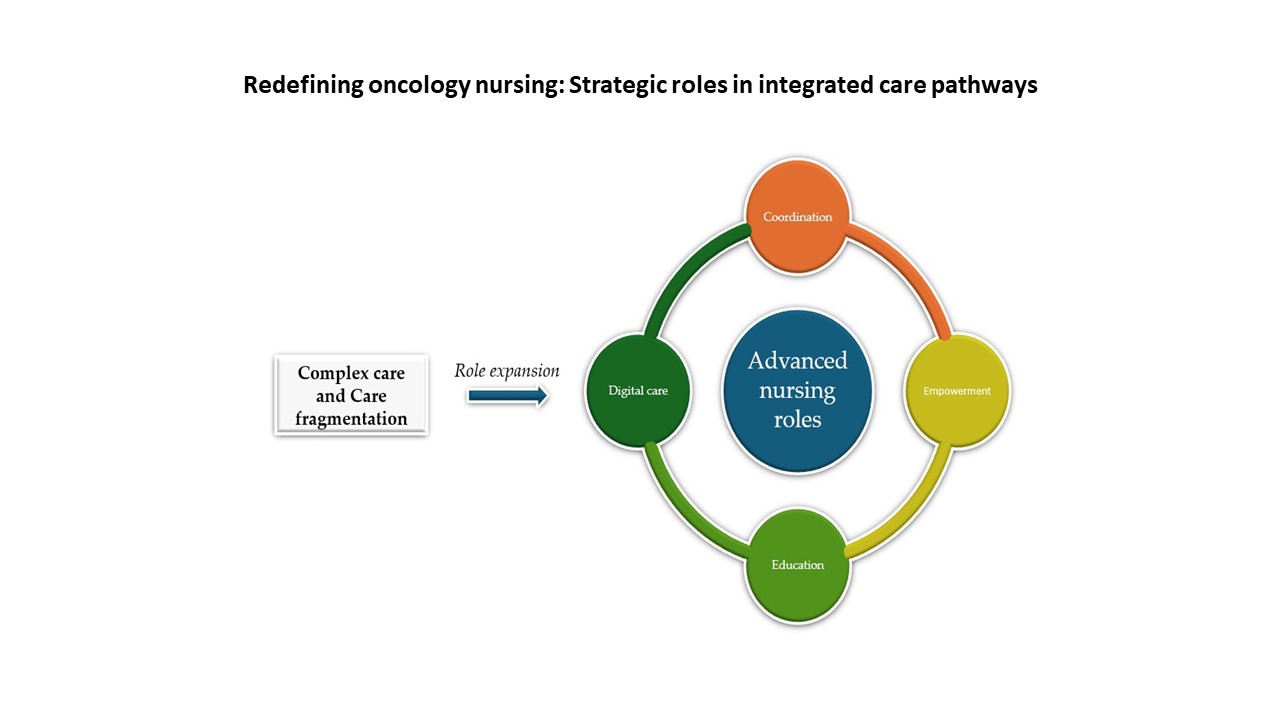
Contemporary oncology is increasingly characterized by prolonged survival, treatment complexity, and the consequent transformation of cancer into a chronic or long-term condition. These developments have produced significant clinical benefits, but they have also increased organizational and care multidimensionality, with pathways that are often fragmented and variable across different settings. In this context, nursing assumes a transversal role, coordination, and coherence within multidisciplinary oncology pathways. Advanced nursing roles—including Case Manager Nurses, Nurse Navigators, and Oncology Specialist Nurses—facilitate coordination, support clinical decision-making, promote patient empowerment and therapeutic education, while simultaneously reducing the organizational and cognitive burden on patients, families, and their communities. The integration of digital tools, hybrid care models, and community-based interventions further strengthens nurses’ capacity to ensure quality, adherence, and safety of care. The heterogeneity of care models reflects the elaboration of real-world oncology, but it may compromise effectiveness if not guided by evidence-based practices. Nurses, thanks to their longitudinal and systemic perspective, act as regulators of complexity, translating evidence into context-adapted pathways while maintaining high standards of quality. Recognition and institutionalization of advanced nursing competencies are therefore essential to ensure coherent, equitable, and sustainable oncology care globally.
- Cao W, Qin K, Li F, Chen W. Comparative study of cancer profiles between 2020 and 2022 using global cancer statistics (GLOBOCAN). J Natl Cancer Cent. 2024;4(2):128-134. doi: 10.1016/j.jncc.2024.05.001
- Bizuayehu HM, Dadi AF, Ahmed KY, et al. Burden of 30 cancers among men: Global statistics in 2022 and projections for 2050 using population-based estimates. Cancer. 2024;130(21):3708-3723. doi: 10.1002/cncr.35458
- Zhu Z, Pan X. Cancer care equality: for the interests of patients with cancer. ESMO Open. 2024;9(11):103971. doi: 10.1016/j.esmoop.2024.103971
- Berger-Höger B, Liethmann K, Mühlhauser I, Haastert B, Steckelberg A. Nurse-led coaching of shared decision-making for women with ductal carcinoma in situ in breast care centers: A cluster randomized controlled trial. Int J Nurs Stud. 2019;93:141-152. doi: 10.1016/j.ijnurstu.2019.01.013
- Bower JE, Lacchetti C, Alici Y, et al. Management of Fatigue in Adult Survivors of Cancer: ASCO-Society for Integrative Oncology Guideline Update. J Clin Oncol. 2024;42(20):2456- 2487. doi: 10.1200/JCO.24.00541
- Petrelli F, Cangelosi G, Nittari G, et al. Chronic Care Model in Italy: a narrative review of the literature. Prim Health Care Res Dev. 2021;22:e32. doi: 10.1017/S1463423621000268
- Alqaisi O, Tai P, Storme G. Specialized Nursing-Led Interventions for Bladder Cancer Management: A Scoping Review of Evidence and Clinical Outcomes. Medicina. 2026;62(1):185. doi: 10.3390/medicina62010185
- Porat-Dahlerbruch J, Miller T, Boyd J, Ellen ME, Clark RRS. The International Advanced Practice Nurse Integration Policy Intervention Taxonomy: A 10-Country Nominal Group Consensus Technique Study. Int Nurs Rev. 2025;72(3):e70096. doi: 10.1111/inr.70096
- Cangelosi G, Grappasonni I, Pantanetti P, et al. Nurse Case Manager Lifestyle Medicine (NCMLM) in the type 2 diabetes patient concerning post-COVID-19 pandemic management: integrated scoping literature review. Ann Ig. 2022;34(6):585-602. doi: 10.7416/ai.2022.2500
- Hills S, Terry D, Gazula S, Browning C. Type 2 Diabetes and Lifestyle Discussions With Practice Nurses in Primary Health Care: A Scoping Review of Patient Experiences. Nurs Open. 2025;12(10):e70321. doi: 10.1002/nop2.70321
- Byrne AL, Hegney D, Harvey C, et al. Exploring the nurse navigator role: A thematic analysis. J Nurs Manag. 2020;28(4):814-821. doi: 10.1111/jonm.12997
- Muzio K, Hiemstra J, Morton-Ninomiya M, Toameh D, Nicholson E, Isaac KV. The Value of the Nurse Navigator in Complex Cancer Care: A Scoping Review. Healthcare. 2025;13(13):1585. doi: 10.3390/healthcare13131585
- Kale E, Guzes E, Alatas F, Sharafi P. Next-generation cancer therapies: translating experimental advances into clinical practice. Postgrad Med J. 2026:qgaf242. doi: 10.1093/postmj/qgaf242
- Knap M, Ozga D, Krupa S, et al. Position statement of the European Specialist Nurses Organisation (ESNO) in specialist nursing as advanced practice nursing towards 2030. Nurs 21st Century. 2020;19(4):274-280.
- Acuña Mora M, Sparud-Lundin C, Moons P, Bratt EL. Definitions, instruments and correlates of patient empowerment: A descriptive review. Patient Educ Couns. 2022;105(2):346-355. doi: 10.1016/j.pec.2021.06.014
- Linnavuori E, Inkeroinen S, Kostylev A, et al. Delivering Patient Education in Healthcare Organizations: An Integrative Review of the Nursing Administrative Actions. J Nurs Manag. 2024;2024(1):1296011. doi: 10.1155/2024/1296011
- Chen Y, Lehmann CU, Malin B. Digital Information Ecosystems in Modern Care Coordination and Patient Care Pathways and the Challenges and Opportunities for AI Solutions. J Med Internet Res. 2024;26:e60258. doi: 10.2196/60258
- Ten Ham-Baloyi W. Nurses’ roles in changing practice through implementing best practices: A systematic review. Health SA. 2022;27:1776. doi: 10.4102/hsag.v27i0.1776
- Naito T. Uniting for greater impact: The crucial role of oncology nurses in cancer care. Asia Pac J Oncol Nurs. 2023;11(2):100370. doi: 10.1016/j.apjon.2023.100370
- Barragan-Carillo R, Asirwa FC, Dienstmann R, Pendhakar D, Ruiz-Garcia E. Global Oncology: Tackling Disparities and Promoting Innovations in Low- and Middle-Income Countries. Am Soc Clin Oncol Educ Book. 2025;45(3):e473930. doi: 10.1200/EDBK-25-473930
- Hui D, Hoge G, Bruera E. Models of supportive care in oncology. Curr Opin Oncol. 2021;33(4):259-266. doi: 10.1097/CCO.0000000000000733
- Word Health Organization. UHC service planning & models of care. Available from: https://www.who.int/teams/ integrated-health-services/clinical-services-and-systems/ service-organizations-and-integration [Last accessed on January 25, 2026].
- Sarta A, Durand R, Vergne JP. Organizational Adaptation. J Manag. 2021;47(1):43-75. doi: 10.1177/0149206320929088
- D’Alleva A, Leigheb F, Rinaldi C, et al. Achieving quadruple aim goals through clinical networks: A systematic review. J Healthc Qual Res. 2019;34(1):29-39. doi: 10.1016/j.jhqr.2018.10.010
- Bağçivan G, Colomer-Lahiguera S, Dowling M, et al. Cancer nursing research priorities: findings from a cancer nurses’ consultation in Europe. Br J Nurs. 2025;34(5):S10-S18. doi: 10.12968/bjon.2024.0177
- Selby P, Popescu R, Lawler M, Butcher H, Costa A. The Value and Future Developments of Multidisciplinary Team Cancer Care. Am Soc Clin Oncol Educ Book. 2019;39:332- 340. doi: 10.1200/EDBK_236857
- Dowling M, Pape E, Geese F, et al. Advanced Practice Nursing Titles and Roles in Cancer Care: A Scoping Review. Semin Oncol Nurs. 2024;40(3):151627. doi: 10.1016/j.soncn.2024.151627.
- Semerci R, Samba VL, Diaz DRN, Punjwani R, Challinor J. Advanced Practice Pediatric Oncology Nursing as Imagined or In Place in Four Lower- and Upper-Middle-Income Countries. Semin Oncol Nurs. 2024;40(3):151631. doi: 10.1016/j.soncn.2024.151631
- Lin XLS, Tan SW, Wang HYS, Ang KHM, Maniya S, Woo BFY. Healthcare professionals’ perspectives towards the role of ward-based advanced practice nurses: A cross-sectional study. J Adv Nurs. 2025;81(6):3083-3095. doi: 10.1111/jan.16401
- Bana M, Riedo S, Ribi K. Self-Management Support for Cancer Survivors: A Descriptive Evaluation of the Symptom Navi Training from the Perspective of Health Care Professionals. Curr Oncol. 2025;32(6):326. doi: 10.3390/curroncol32060326