

Comparison of remote rehabilitation and traditional face-to-face rehabilitation for chronic low back pain: A systematic review and meta-analysis of randomized controlled trial

Introduction: Telerehabilitation is a promising delivery model for chronic low back pain (CLBP), but evidence of its efficacy remains conflicting due to substantial heterogeneity across studies. This meta-analysis evaluates its efficacy on pain and function, focusing on the influence of control group types.
Objective: To evaluate the efficacy of telerehabilitation for CLBP across different control group types.
Methods: We searched PubMed, Embase, and the Cochrane Central Register of Controlled Trials up to February 2026 for RCTs comparing telerehabilitation with face-to-face therapy or usual care. The primary outcome was pain intensity. Risk of bias (using Risk of Bias 2) and evidence certainty (using Grading of Recommendations Assessment, Development and Evaluation) were assessed.
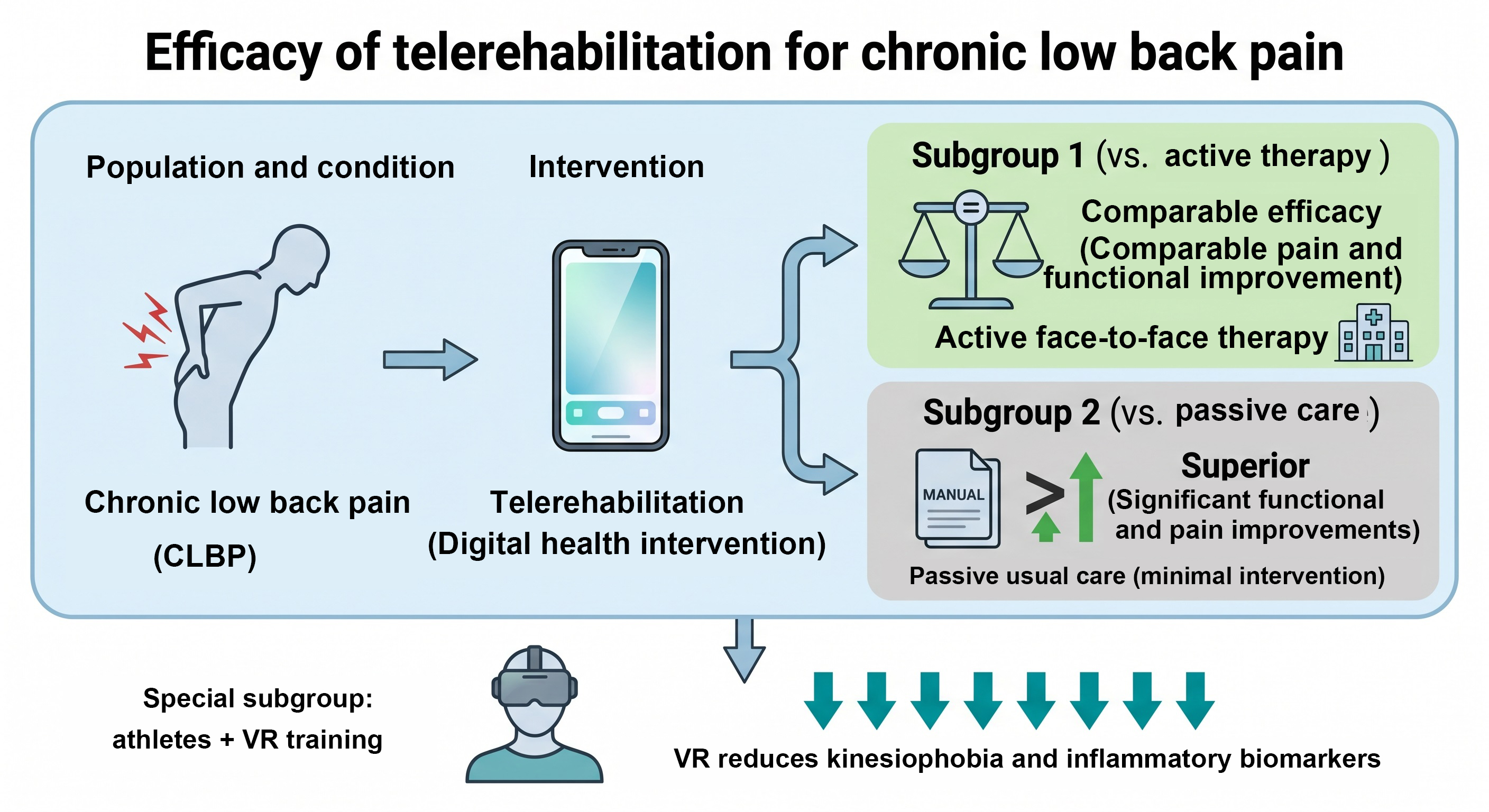
Results: Eleven randomized controlled trials were included. Overall, telerehabilitation and control groups showed no statistically significant difference in pain intensity (standardized mean difference [SMD] = −1.62, 95% confidence interval [CI]: −3.27–0.02, p = 0.053), with extreme heterogeneity (I2 = 94.6%). Subgroup analysis partially accounted for this inconsistency: compared to passive usual care, telerehabilitation was associated with significantly greater pain relief (SMD = −1.65, 95% CI: −2.17–−1.13, p < 0.001) and functional improvement. Conversely, telerehabilitation yielded outcomes comparable to active face-to-face therapy, with no significant difference in pain reduction (SMD = −0.27, 95% CI: −0.81, 0.27, p > 0.05) or improvement in functional disability (SMD = −0.26, 95% CI: −0.81, 0.29], p > 0.05). In athletes, Virtual reality training showed potential in reducing kinesiophobia and inflammatory biomarkers.
Conclusion: Our findings suggest that telerehabilitation is a promising, viable alternative for the management of CLBP. It demonstrated potential superiority over passive usual care and comparable efficacy to standard in-person therapy. However, these results should be interpreted with caution due to substantial heterogeneity, small subgroup sample sizes, and potential publication bias.
- Wu A, March L, Zheng X, et al. Global low back pain prevalence and years lived with disability from 1990 to 2017: estimates from the Global Burden of Disease Study 2017. Ann Transl Med. 2020;8(6):299. doi: 10.21037/atm.2020.02.175
- Lewandrowski KU. The Implications of Low Back Pain on Prolonged Lifespan and Future Targeted Care Models to Support the Pursuit of Healthy Longevity. In: Regenerative Medicine & Peripheral Nerve Endoscopy. Sharjah, UAE: Bentham Science Publishers; 2024:1-15.
- Yang N, Di J, Wang W, Feng H. Global burden of low back pain from 1990 to 2021: a comprehensive analysis of risk factors and trends using the global burden of disease study 2021. BMC Public Health. 2025;25(1):1886. doi: 10.1186/s12889-023-17332-9
- Cheng M, Xue Y, Cui M, et al. Global, Regional, and National Burden of Low Back Pain. Spine. 2025;50(7):E128-E139. doi: 10.1097/brs.0000000000005265
- Feng Y, Zhu C, Liu H, et al. Effect of telemedicine-supported structured exercise program in patients with chronic low back pain: a randomized controlled trial. PLoS One. 2025;20(6):e0326218. doi: 10.1371/journal.pone.0326218
- Chen S, Chen M, Wu X, et al. Global, regional and national burden of low back pain 1990–2019: a systematic analysis of the Global Burden of Disease study 2019. J Orthop Transl. 2022;32:49-58. doi: 10.1016/j.jot.2021.07.005
- Parthan A, Evans CJ, Le K. Chronic low back pain: epidemiology, economic burden and patient-reported outcomes in the USA. Expert Rev Pharmacoecon Outcomes Res. 2006;6(3):359-369. doi: 10.1586/14737167.6.3.359
- Koldaş Doğan Ş, Sonel Tur B, Kurtaiş Y, Atay MB. Comparison of three different approaches in the treatment of chronic low back pain. Clin Rheumatol. 2008;27(7):873- 881. doi: 10.1007/s10067-007-0815-7
- Urits I, Burshtein A, Sharma M, et al. Low back pain, a comprehensive review: pathophysiology, diagnosis, and treatment. Curr Pain Headache Rep. 2019;23(3):23. doi: 10.1007/s11916-019-0757-1
- Mense S. Pathophysiology of low back pain and the transition to the chronic state – experimental data and new concepts. Schmerz. 2001;15(6):413-417. doi: 10.1007/s004820100002
- Biyani A, Andersson GBJ. Low Back Pain: Pathophysiology and Management. J Am Acad Orthop Surg. 2004;12(2):106- 115. doi: 10.5435/00124635-200403000-00006
- Searle A, Spink M, Ho A, Chuter V. Exercise interventions for the treatment of chronic low back pain: a systematic review and meta-analysis of randomised controlled trials. Clin Rehabil. 2015;29(12):1155-1167. doi: 10.1177/0269215515570379
- Pinto EM, Neves JR, Laranjeira M, Reis J. The importance of inflammatory biomarkers in non-specific acute and chronic low back pain: a systematic review. Eur Spine J. 2023;32(9):3230-3244. doi: 10.1007/s00586-023-07717-1
- Palacín-Marín F, Esteban-Moreno B, Olea N, Herrera- Viedma E, Arroyo-Morales M. Agreement between telerehabilitation and face-to-face clinical outcome assessments for low back pain in primary care. Spine. 2013;38(11):947-952. doi: 10.1097/BRS.0b013e318281a36c
- Pergolizzi JV Jr, LeQuang JA. Rehabilitation for low back pain: A narrative review for managing pain and improving function in acute and chronic conditions. Pain Ther. 2020;9(1):83-96. doi: 10.1007/s40122-020-00149-5
- Yang J, Lo WLA, Zheng F, Cheng X, Yu Q, Wang C. Evaluation of cognitive behavioral therapy on improving pain, fear avoidance, and self-efficacy in patients with chronic low back pain: A systematic review and meta-analysis. Pain Res Manag. 2022;2022:4276175. doi: 10.1155/2022/4276175
- Allam Z, Bibri SE, Sharpe SA. The rising impacts of the COVID-19 pandemic and the Russia–Ukraine war: energy transition, climate justice, global inequality, and supply chain disruption. Resources. 2022;11(11):99.doi: 10.3390/resources11110099
- Peek N, Sujan M, Scott P. Digital health and care in pandemic times: impact of COVID-19. BMJ Health Care Inform. 2020;27(1):e100166. doi: 10.1136/bmjhci-2020-100166
- Niakan Kalhori SR, Bahaadinbeigy K, Deldar K, Gholamzadeh M, Hajesmaeel-Gohari S, Ayyoubzadeh SM. Digital health solutions to control the COVID-19 pandemic in countries with high disease prevalence: literature review. J Med Internet Res. 2021;23(3):e19473. doi: 10.2196/19473
- Shnitzer H, Chan J, Yau T, et al. The safety of telerehabilitation: systematic review. JMIR Rehabil Assist Technol. 2025;12:e68681. doi: 10.2196/68681
- Baroni MP, Jacob MFA, Rios WR, et al. The state of the art in telerehabilitation for musculoskeletal conditions. Arch Physiother. 2023;13(1):1. doi: 10.1186/s40945-022-00155-0
- Molina-Garcia P, Mora-Traverso M, Prieto-Moreno R, Diaz-Vasquez A, Antony B, Ariza-Vega P. Effectiveness and cost-effectiveness of telerehabilitation for musculoskeletal disorders: a systematic review and meta-analysis. Ann Phys Rehabil Med. 2024;67(1):101791. doi: 10.1016/j.rehab.2023.101791
- Rose T, Nam CS, Chen KB. Immersion of virtual reality for rehabilitation-Review. Appl Ergon. 2018;69:153-161. doi: 10.1016/j.apergo.2018.01.009
- Choi T, Heo S, Choi W, Lee S. A systematic review and meta-analysis of the effectiveness of virtual reality-based rehabilitation therapy on reducing the degree of pain experienced by individuals with low back pain. Int J Environ Res Public Health. 2023;20(4):3502. doi: 10.3390/ijerph20043502
- Page MJ, McKenzie JE, Bossuyt PM, et al. A declaração PRISMA 2020: diretriz atualizada para relatar revisões sistemáticas [The PRISMA 2020 statement: an updated guideline for reporting systematic reviews]. Rev Panam Salud Publica. 2022;46:e112. [In Portuguese] doi: 10.26633/RPSP.2022.112
- Galvão TF, Tiguman GMB, Sarkis-Onofre R. A declaração PRISMA 2020 em português: recomendações atualizadas para o relato de revisões sistemáticas [The PRISMA 2020 statement in Portuguese: updated recommendations for reporting systematic reviews]. Epidemiol Serv Saude. 2022;31(2):e2022364. doi: 10.1590/SS2237-9622202200011
- Guyatt G, Oxman A, Vist G, et al. GRADE: an emerging consensus on rating quality of evidence and strength of recommendations. BMJ. 2008;336(7650):924-926. doi: 10.1136/bmj.39489.470347.AD
- Gopalakrishna G, Mustafa RA, Davenport C, et al. Applying Grading of Recommendations Assessment, Development and Evaluation (GRADE) to diagnostic tests was challenging but doable. J Clin Epidemiol. 2014;67(7):760-768. doi: 10.1016/j.jclinepi.2014.01.006
- Hunter JP, Saratzis A, Sutton AJ, Boucher RH, Sayers RD, Bown MJ. In meta-analyses of proportion studies, funnel plots were found to be an inaccurate method of assessing publication bias. J Clin Epidemiol. 2014;67(8):897-903. doi: 10.1016/j.jclinepi.2014.03.003
- Peters JL, Sutton AJ, Jones DR, Abrams KR, Rushton L. Comparison of two methods to detect publication bias in meta-analysis. JAMA. 2006;295(6):676-680. doi: 10.1001/jama.295.6.676
- Jin ZC, Zhou XH, He J. Statistical methods for dealing with publication bias in meta-analysis. Stat Med. 2015;34(2):343- 360. doi: 10.1002/sim.6342
- Koppenaal T, van Dongen JM, Kloek CJ, et al. Effectiveness and cost-effectiveness of a stratified blended physiotherapy intervention compared with face-to-face physiotherapy in patients with nonspecific low back pain: cluster randomized controlled trial. J Med Internet Res. 2023;25:e43034. doi: 10.2196/43034
- Heapy AA, Higgins DM, Goulet JL, et al. Interactive voice response–based self-management for chronic back pain: the COPES noninferiority randomized trial. JAMA Intern Med. 2017;177(6):765-773. doi: 10.1001/jamainternmed.2017.0223
- Karaduman C, Ataş Balci L. The effects of in-person-supervised, tele-supervised, and unsupervised stabilization exercises on pain, functionality, and kinesiophobia in patients with chronic low back pain: a randomized, single-blind trial. Physiother Theory Pract. 2024;40(11):2492-2502. doi: 10.1080/09593985.2023.2263554
- Mbada CE, Olaoye MI, Dada OO, et al. Comparative efficacy of clinic-based and telerehabilitation application of Mckenzie therapy in chronic low-back pain. Int J Telerehabil. 2019;11(1):41-58. doi: 10.5195/ijt.2019.6260
- Fanuscu A, Öz M, Asliyüce YÖ, Turhan E, Ülger Ö. Effects of clinic-based and telerehabilitation-based motor control exercises in individuals with chronic low-back pain: a randomized controlled trial with 3-month follow-up. Clin J Pain. 2024;40(12):700-708.doi: 10.1097/AJP.0000000000001245
- Son A, Johnson J, Leachman J, Bloyder J, Brant JM. Efficacy of Self-Natural Posture Exercise (SNPE) programs on chronic low back pain: A randomized controlled feasibility trial with waitlist control. J Back Musculoskelet Rehabil. 2024;37(6):1601-1616. doi: 10.3233/BMR-230441
- Afzal MW, Ahmad A, Bandpei MM, Gilani SA, Hanif A, Waqas MS. Effects of virtual reality exercises and routine physical therapy on pain intensity and functional disability in patients with chronic low back pain. J Pak Med Assoc. 2022;72(3):413-417. doi: 10.47391/JPMA.3424
- Yang J, Wei Q, Ge Y, Meng L, Zhao M. Smartphone-based remote self-management of chronic low back pain: A preliminary study. J Healthc Eng. 2019;2019:4632946. doi: 10.1155/2019/4632946
- Nambi G, Abdelbasset WK, Alrawaili SM, Alsubaie SF, Abodonya AM, Saleh AK. Virtual reality or isokinetic training; its effect on pain, kinesiophobia and serum stress hormones in chronic low back pain: A randomized controlled trial. Technol Health Care. 2021;29(1):155-166. doi: 10.3233/THC-202301
- Nambi G, Alghadier M, Kashoo FZ, et al. Effects of virtual reality exercises versus isokinetic exercises in comparison with conventional exercises on the imaging findings and inflammatory biomarker changes in soccer players with non-specific low back pain: a randomized controlled trial. Int J Environ Res Public Health. 2022;20(1):524. doi: 10.3390/ijerph20010524
- Alahmri F, Nuhmani S, Muaidi Q. Effectiveness of telerehabilitation on chronic low back Pain: Systematic review and Meta-Analysis. Int J Med Inform. 2026;206:106174. doi: 10.1016/j.ijmedinf.2025.106174