
Prediction of response to neoadjuvant chemotherapy for triple-negative breast cancer using nuclear magnetic resonance-based urine metabolomics and self-organizing maps

Introduction: Breast cancer constitutes the most common invasive neoplasm among women, with triple-negative breast cancer (TNBC) representing 10–20% of all cases and lacking a standardized therapeutic approach. Chemotherapy remains the cornerstone of treatment for TNBC patients.
Objective: Our research aimed to identify urinary metabolomic biomarkers capable of discerning chemotherapeutic response variability.
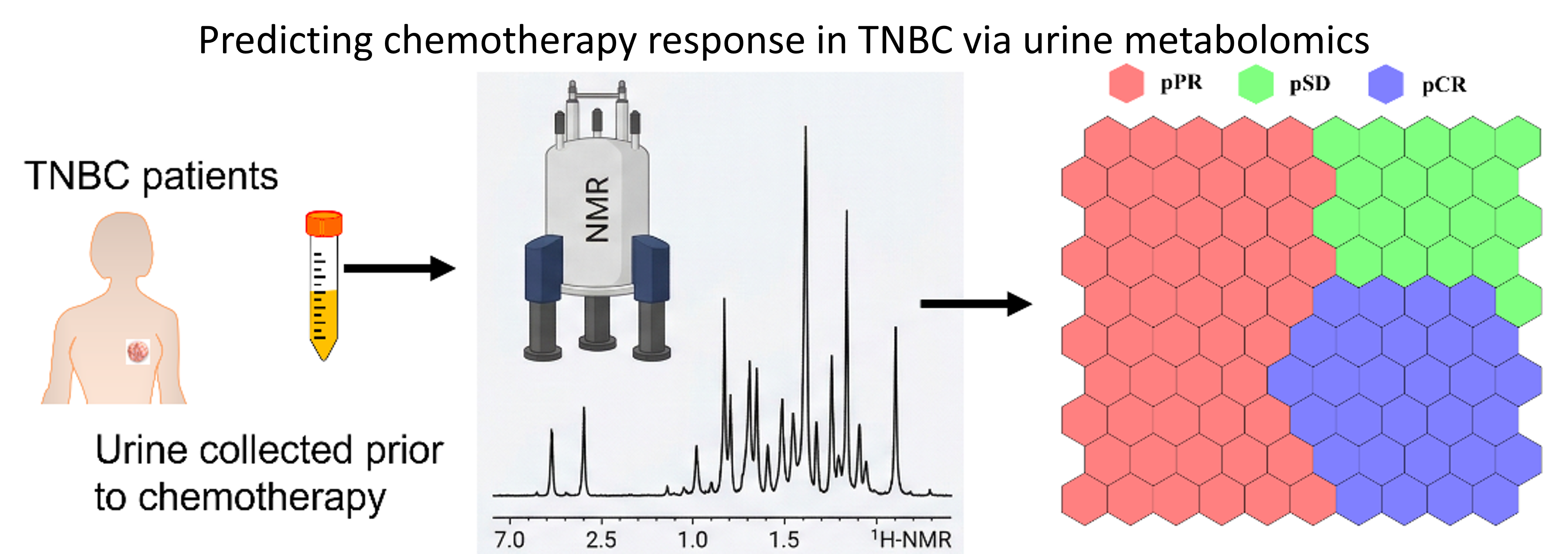
Methods: In this study, we utilized a nuclear magnetic resonance (NMR)-based urinary metabolomics technique to evaluate the metabolic profiles of TNBC patients exhibiting diverse chemotherapeutic responses.
Results: We found that the relative abundance of urinary metabolites effectively differentiated TNBC patients based on chemosensitivity. Multivariate receiver operating characteristic curve analysis indicated potential biomarkers indicative of chemotherapy responsiveness across three patient cohorts. Pathway analysis suggested perturbations in aminoacyl-tRNA biosynthesis; arginine, aspartate, and glutamate metabolism; and valine, leucine, and isoleucine biosynthesis in the pCR subgroup, and in arginine and proline metabolism, aminoacyl-tRNA biosynthesis, and histidine metabolism in the pathological partial response subgroup.
Conclusion: Our NMR metabolomic data suggest that urinary metabolites hold potential as predictors of chemotherapy sensitivity in TNBC patients.
- Siegel RL, Miller KD, Fuchs HE, Jemal A. Cancer statistics, 2022. CA Cancer J Clin. 2022;72(1):7-33. doi: 10.3322/caac.21708
- Yin L, Duan JJ, Bian XW, Yu SC. Triple-negative breast cancer molecular subtyping and treatment progress. Breast Cancer Res. 2020;22(1). doi: 10.1186/s13058-020-01296-5
- Masuda N, Lee SJ, Ohtani S, et al. Adjuvant Capecitabine for Breast Cancer after Preoperative Chemotherapy. N Engl J Med. 2017;376(22):2147-2159. doi: 10.1056/nejmoa1612645
- Liedtke C, Mazouni C, Hess KR, et al. Response to Neoadjuvant Therapy and Long-Term Survival in Patients With Triple-Negative Breast Cancer. J Clin Oncol. 2008;26(8):1275-1281. doi: 10.1200/jco.2007.14.4147
- Glück S, Ross JS, Royce M, et al. TP53 genomics predict higher clinical and pathologic tumor response in operable early-stage breast cancer treated with docetaxel-capecitabine ± trastuzumab. Breast Cancer Res Treat. 2011;132(3):781-791. doi: 10.1007/s10549-011-1412-7
- He X, Gu J, Zou D, et al. NMR-Based Metabolomics Analysis Predicts Response to Neoadjuvant Chemotherapy for Triple-Negative Breast Cancer. Front Mol Biosci. 2021;8. doi: 10.3389/fmolb.2021.708052
- Zou J, Wang E. Cancer Biomarker Discovery for Precision Medicine: New Progress. Curr Med Chem. 2020;26(42):7655-7671. doi: 10.2174/0929867325666180718164712
- Olivier M, Asmis R, Hawkins GA, Howard TD, Cox LA. The Need for Multi-Omics Biomarker Signatures in Precision Medicine. Int J Mol Sci. 2019;20(19):4781. doi: 10.3390/ijms20194781
- Jacob M, Lopata AL, Dasouki M, Abdel Rahman AM. Metabolomics toward personalized medicine. Mass Spectrom Rev. 2019;38(3):221-238. doi: 10.1002/mas.21548
- Yang H, Pawitan Y, Fang F, Czene K, Ye W. Biomarkers and Disease Trajectories Influencing Women’s Health: Results from the UK Biobank Cohort. Phenomics. 2022;2(3):184-193. doi: 10.1007/s43657-022-00054-1
- Beatty A, Fink L, Strigun A, et al. Abstract A73: Metabolite profiling reveals the glutathione biosynthetic pathway as a therapeutic target in triple negative breast cancers. Mol Cancer Res. 2016;14(1_Supplement):A73-A73. doi: 10.1158/1557-3125.metca15-a73
- Stewart DA, Winnike JH, McRitchie SL, Clark RF, Pathmasiri WW, Sumner SJ. Metabolomics Analysis of Hormone-Responsive and Triple-Negative Breast Cancer Cell Responses to Paclitaxel Identify Key Metabolic Differences. J Proteome Res. 2016;15(9):3225-3240. doi: 10.1021/acs.jproteome.6b00430
- Huang DP, Ye XH, Jin C. Successful use of bevacizumb and paclitaxel in a male breast cancer with liver metastases. Int J Clin Exp Med. 2014;7(9):3076-3079. PMID: 25356184
- Gu J, Xiao Y, Shu D, et al. Metabolomics Analysis in Serum from Patients with Colorectal Polyp and Colorectal Cancer by 1H-NMR Spectrometry. Dis Markers. 2019;2019:1-14. doi: 10.1155/2019/3491852
- Beckonert O, Keun HC, Ebbels TMD, et al. Metabolic profiling, metabolomic and metabonomic procedures for NMR spectroscopy of urine, plasma, serum and tissue extracts. Nat Protoc. 2007;2(11):2692-2703. doi: 10.1038/nprot.2007.376
- Gu J, Su F, Hong P, Zhang Q, Zhao M. 1H NMR-based metabolomic analysis of nine organophosphate flame retardants metabolic disturbance in Hep G2 cell line. Sci Total Environ. 2019;665:162-170. doi: 10.1016/j.scitotenv.2019.02.055
- Shao W, Gu J, Huang C, et al. Malignancy-associated metabolic profiling of human glioma cell lines using 1H NMR spectroscopy. Mol Cancer. 2014;13(1). doi: 10.1186/1476-4598-13-197
- Khakimov B, Mobaraki N, Trimigno A, Aru V, Engelsen SB. Signature Mapping (SigMa): An efficient approach for processing complex human urine 1H NMR metabolomics data. Anal Chim Acta. 2020;1108:142-151. doi: 10.1016/j.aca.2020.02.025
- Wishart DS, Feunang YD, Marcu A, et al. HMDB 4.0: the human metabolome database for 2018. Nucleic Acids Res. 2017;46(D1):D608-D617. doi: 10.1093/nar/gkx1089
- Savorani F, Tomasi G, Engelsen SB. icoshift: A versatile tool for the rapid alignment of 1D NMR spectra. J Magn Reson. 2010;202(2):190-202. doi: 10.1016/j.jmr.2009.11.012
- Cassiède M, Nair S, Dueck M, et al. Assessment of 1H NMR-based metabolomics analysis for normalization of urinary metals against creatinine. Clin Chim Acta. 2017;464:37-43. doi: 10.1016/j.cca.2016.10.037
- Kohonen T. Self-organized formation of topologically correct feature maps. Biol Cybern. 1982;43:59-69. doi: 10.1007/BF00337288
- Zupan J, Novič M, Ruisánchez I. Kohonen and counterpropagation artificial neural networks in analytical chemistry. Chemom Intell Lab Syst. 1997;38(1):1-23. doi: 10.1016/s0169-7439(97)00030-0
- Melssen W, Wehrens R, Buydens L. Supervised Kohonen networks for classification problems. Chemom Intell Lab Syst. 2006;83(2):99-113. doi: 10.1016/j.chemolab.2006.02.003
- Wongravee K, Lloyd GR, Silwood CJ, Grootveld M, Brereton RG. Supervised Self Organizing Maps for Classification and Determination of Potentially Discriminatory Variables: Illustrated by Application to Nuclear Magnetic Resonance Metabolomic Profiling. Anal Chem. 2009;82(2):628-638. doi: 10.1021/ac9020566
- Kumpula LS, Mäkelä SM, Mäkinen VP, et al. Characterization of metabolic interrelationships and in silico phenotyping of lipoprotein particles using self-organizing maps. J Lipid Res. 2010;51(2):431-439. doi: 10.1194/jlr.d000760
- Mäkinen VP, Forsblom C, Thorn LM, et al. Metabolic Phenotypes, Vascular Complications, and Premature Deaths in a Population of 4,197 Patients With Type 1 Diabetes. Diabetes. 2008;57(9):2480-2487. doi: 10.2337/db08-0332
- Ballabio D, Consonni V, Todeschini R. The Kohonen and CP-ANN toolbox: A collection of MATLAB modules for Self Organizing Maps and Counterpropagation Artificial Neural Networks. Chemom Intell Lab Syst. 2009;98(2):115-122. doi: 10.1016/j.chemolab.2009.05.007
- Ballabio D, Vasighi M. A MATLAB toolbox for Self Organizing Maps and supervised neural network learning strategies. Chemom Intell Lab Syst. 2012;118:24-32. doi: 10.1016/j.chemolab.2012.07.005
- Zweig MH, Campbell G. Receiver-operating characteristic (ROC) plots: a fundamental evaluation tool in clinical medicine. Clin Chem. 1993;39(4):561-577. doi: 10.1093/clinchem/39.4.561
- Mandrekar JN. Receiver Operating Characteristic Curve in Diagnostic Test Assessment. J Thorac Oncol. 2010;5(9):1315-1316. doi: 10.1097/jto.0b013e3181ec173d
- Pang Z, Chong J, Zhou G, et al. MetaboAnalyst 5.0: narrowing the gap between raw spectra and functional insights. Nucleic Acids Res. 2021;49(W1):W388-W396. doi: 10.1093/nar/gkab382
- Goeman JJ, Bühlmann P. Analyzing gene expression data in terms of gene sets: methodological issues. Bioinformatics. 2007;23(8):980-987. doi: 10.1093/bioinformatics/btm051
- Chong J, Soufan O, Li C, et al. MetaboAnalyst 4.0: towards more transparent and integrative metabolomics analysis. Nucleic Acids Res. 2018;46(W1):W486-W494. doi: 10.1093/nar/gky310
- Ballabio D, Vasighi M, Consonni V, Kompany-Zareh M. Genetic Algorithms for architecture optimisation of Counter-Propagation Artificial Neural Networks. Chemom Intell Lab Syst. 2011;105(1):56-64. doi: 10.1016/j.chemolab.2010.10.010
- Bianchini G, Balko JM, Mayer IA, Sanders ME, Gianni L. Triple-negative breast cancer: challenges and opportunities of a heterogeneous disease. Nat Rev Clin Oncol. 2016;13(11):674-690. doi: 10.1038/nrclinonc.2016.66
- Lieu EL, Nguyen T, Rhyne S, Kim J. Amino acids in cancer. Exp Mol Med. 2020;52(1):15-30. doi: 10.1038/s12276-020-0375-3
- Vettore L, Westbrook RL, Tennant DA. New aspects of amino acid metabolism in cancer. Br J Cancer. 2019;122(2):150- 156. doi: 10.1038/s41416-019-0620-5
- Sivanand S, Vander Heiden MG. Emerging Roles for Branched-Chain Amino Acid Metabolism in Cancer. Cancer Cell. 2020;37(2):147-156. doi: 10.1016/j.ccell.2019.12.011
- Jasbi P, Wang D, Cheng SL, et al. Breast cancer detection using targeted plasma metabolomics. J Chromatogr B. 2019;1105:26-37. doi: 10.1016/j.jchromb.2018.11.029
- Willmann L, Erbes T, Halbach S, et al. Exometabolom analysis of breast cancer cell lines: Metabolic signature. Sci Rep. 2015;5(1). doi: 10.1038/srep13374
- Lo C, Hsu YL, Cheng CN, et al. Investigating the Association of the Biogenic Amine Profile in Urine with Therapeutic Response to Neoadjuvant Chemotherapy in Breast Cancer Patients. J Proteome Res. 2020;19(10):4061-4070. doi: 10.1021/acs.jproteome.0c00362
- Thomas E, Holmes FA, Smith TL, et al. The Use of Alternate, Non–Cross-Resistant Adjuvant Chemotherapy on the Basis of Pathologic Response to a Neoadjuvant Doxorubicin- Based Regimen in Women With Operable Breast Cancer: Long-Term Results From a Prospective Randomized Trial. J Clin Oncol. 2004;22(12):2294-2302. doi: 10.1200/jco.2004.05.207