

A metabolite-centered view of hepatic stellate cells in MASLD-related liver cancer

The study by Labrecque and colleagues places hepatic stellate cells at the center of metabolic dysfunction-associated steatotic liver disease (MASLD)–related hepatocellular carcinoma (HCC) by linking spatially defined stellate-cell subpopulations to geranylgeranyl pyrophosphate (GGPP)–dependent YES-associated protein (YAP) activation. Its most important contribution is not merely the identification of a statin-sensitive GGPP–Rho–YAP axis, but also the suggestion that tumor–stroma crosstalk in MASLD-HCC is organized spatially within the peritumoral pseudocapsule. This Perspective article discusses how these findings reshape our understanding of hepatic stellate cell (HSC) heterogeneity, statin chemoprevention, metabolic signaling, and future therapeutic strategies in cirrhotic and non-cirrhotic MASLD-HCC.
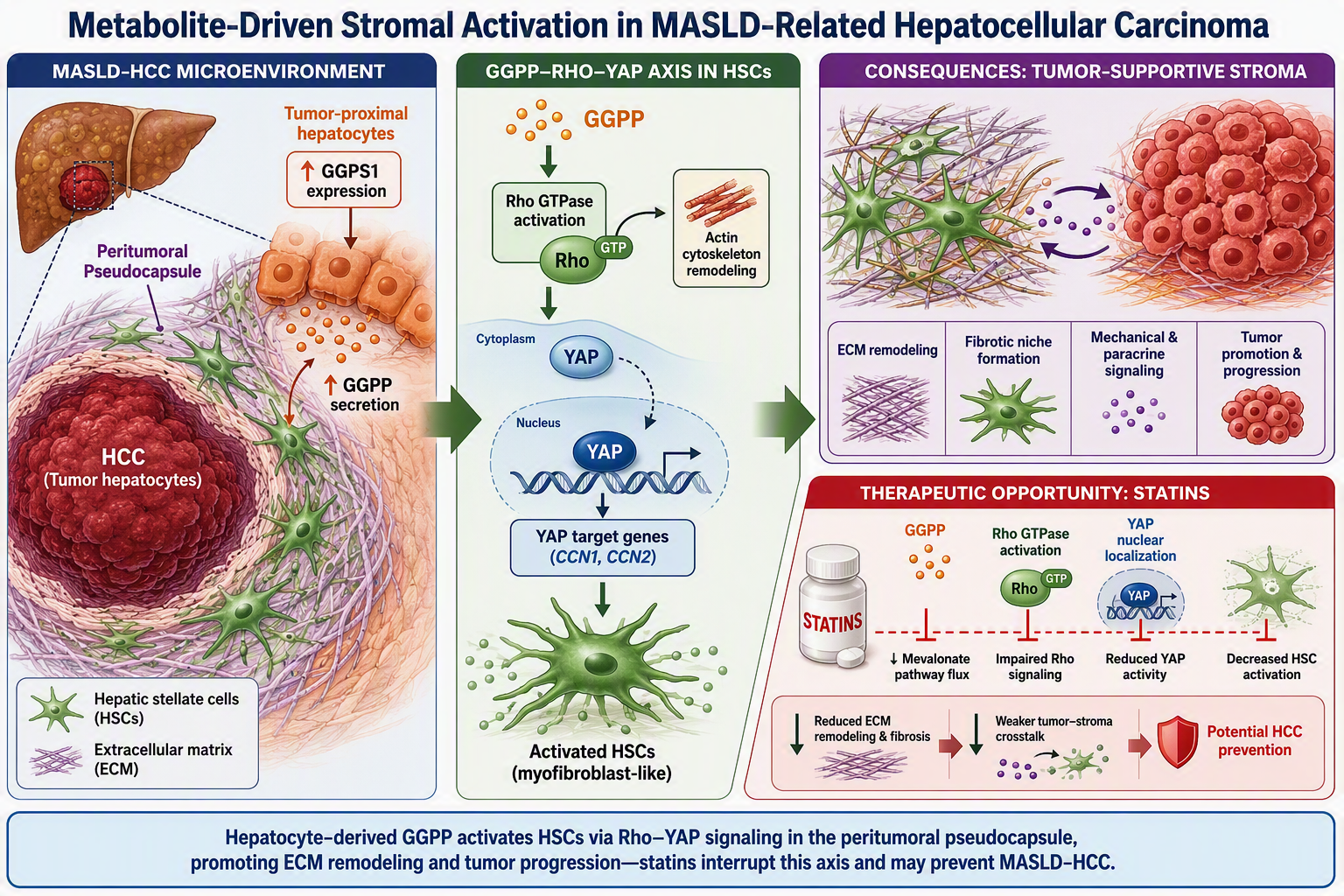
- Labrecque CL, Ko A, Qiao B, et al. Hepatic stellate cell subpopulations in human MASLD-related hepatocellular carcinoma upregulate YAP via geranylgeranyl pyrophosphate. Hepatol Commun. 2026;10(9):e1015.doi: 10.1097/hc9.0000000000001015
- Younossi ZM, Paik JM, Henry L, et al. The growing economic and clinical burden of nonalcoholic steatohepatitis in the United States. J Clin Exp Hepatol. 2023;13:454-467. doi: 10.1016/j.jceh.2022.12.005
- Singal AG, Llovet JM, Yarchoan M, et al. AASLD Practice Guidance on prevention, diagnosis, and treatment of hepatocellular carcinoma. Hepatology. 2023;78:1922-1965. doi: 10.1097/HEP.0000000000000466
- Filliol A, Saito Y, Nair A, et al. Opposing roles of hepatic stellate cell subpopulations in hepatocarcinogenesis. Nature. 2022;610:356-365. doi: 10.1038/s41586-022-05289-6
- Fan W, Adebowale K, Váncza L, et al. Matrix viscoelasticity promotes liver cancer progression in the pre-cirrhotic liver. Nature. 2024;626:635-642. doi: 10.1038/s41586-023-06991-9
- Mannaerts I, Leite SB, Verhulst S, et al. The Hippo pathway effector YAP controls mouse hepatic stellate cell activation. J Hepatol. 2015;63:679-688. doi: 10.1016/j.jhep.2015.04.011
- Totaro A, Panciera T, Piccolo S. YAP/TAZ upstream signals and downstream responses. Nat Cell Biol. 2018;20:888–899. doi: 10.1038/s41556-018-0142-z
- Benhammou JN, Qiao B, Ko A, Sinnett-Smith J, Pisegna JR, Rozengurt E. Lipophilic statins inhibit YAP coactivator transcriptional activity in HCC cells through Rho-mediated modulation of actin cytoskeleton. Am J Physiol Gastrointest Liver Physiol. 2023;325:G239-G250. doi: 10.1152/ajpgi.00089.2023
- Kaplan DE, Serper MA, Mehta R, et al. Effects of hypercholesterolemia and statin exposure on survival in a large national cohort of patients with cirrhosis. Gastroenterology. 2019;156(6):1693-1706.e12. doi: 10.1053/j.gastro.2019.01.026
- Jiang W, Hu JW, He XR, Jin WL, He XY. Statins: A repurposed drug to fight cancer. J Exp Clin Cancer Res. 2021;40:241. doi: 10.1186/s13046-021-02041-2
- Wu Q, Yang Y, Lin S, Geller DA, Yan Y. The microenvironment in the development of MASLD-MASH-HCC and associated therapeutic in MASH-HCC. Front Immunol. 2025;16:1569915. doi: 10.3389/fimmu.2025.1569915
- Seyhan D, Allaire M, Fu Y, et al. Immune microenvironment in hepatocellular carcinoma: from pathogenesis to immunotherapy. Cell Mol Immunol. 2025;22(10):1132-1158. doi: 10.1038/s41423-025-01308-4