
Real-world risk assessment of drug-induced cytokine release syndrome: Analysis of the Food and Drug Administration Adverse Event Reporting System

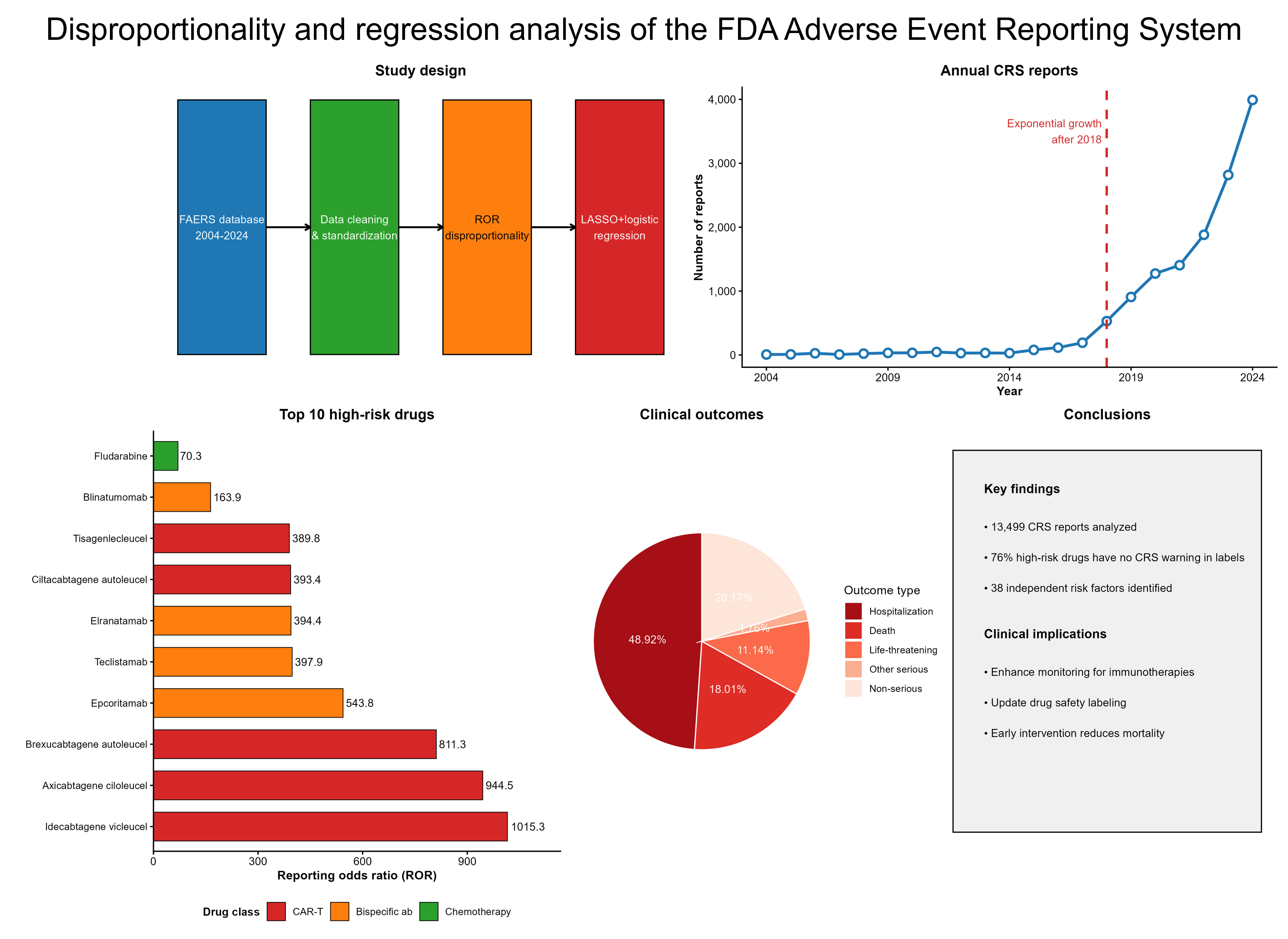
Cytokine release syndrome (CRS) is a potentially life-threatening systemic inflammatory reaction associated with immunotherapies and other medications, yet its risk profile across marketed drugs remains poorly characterized. This study aims to evaluate the risk of drug-induced CRS using real-world data, thereby providing valuable insights for clinical medication safety assessment. We employed reporting odds ratios to assess the disproportionality in reports of drug-induced CRS from January 2004 to December 2024. Using univariate, least absolute shrinkage and selection operator, and multivariate regression analyses, we explored drugs associated with CRS, and the area under the curve was used to evaluate model performance. We collected a total of 13,499 reports. According to the Anatomical Therapeutic Chemical classification system, antineoplastic and immunomodulating agents were associated with the highest number of drug-related CRS cases (n = 12,759). Drug signal detection revealed that axicabtagene ciloleucel was linked to most CRS events (n = 3,389). Furthermore, among the top 50 drugs implicated in CRS, the prescribing information for 38 of them did not mention any association with CRS. Our findings demonstrate that antineoplastic and immunomodulating agents are the main drugs associated with CRS. A total of 18 drugs were identified as independent risk factors for drug-induced CRS. Alarmingly, most high-risk drugs lack relevant CRS warnings in their package leaflets. Clinicians should strengthen clinical monitoring for these medications, especially within one month after administration. Updated safety labeling and further relevant research are also required to ensure the safety of clinical medications.
- Zhu L, Zhu J, Wang Q, et al. Global, regional, and national burden of 34 cancer groups across 204 countries and territories, 1990-2021, and projections to 2050: a systematic analysis of the Global Burden of Disease Study 2021. Front Oncol. 2025;15:1660125. doi: 10.3389/fonc.2025.1660125
- Zafar A, Khatoon S, Khan MJ, Abu J, Naeem A. Advancements and limitations in traditional anti-cancer therapies: a comprehensive review of surgery, chemotherapy, radiation therapy, and hormonal therapy. Discov Oncol. 2025;16(1):607. doi: 10.1007/s12672-025-02198-8
- Helmberger T. The evolution of interventional oncology in the 21st century. Br J Radiol. Sep 1 2020;93(1113):20200112. doi: 10.1259/bjr.20200112
- Tan S, Li D, Zhu X. Cancer immunotherapy: Pros, cons and beyond. Biomed Pharmacother. 2020;124:109821. doi: 10.1016/j.biopha.2020.109821
- Nakajima F, Khanna A, Xu G, et al. Immunotherapy with anti-CD3 monoclonal antibodies and recombinant interleukin 2: stimulation of molecular programs of cytotoxic killer cells and induction of tumor regression. Proc Natl Acad Sci USA. 1994;91(17):7889-7893. doi: 10.1073/pnas.91.17.7889
- Wang J, Arora K, de Lima M. Cytokine release syndrome after allogeneic hematopoietic stem cell transplantation using posttransplant cyclophosphamide: current understanding and management. Front Immunol. 2026;17:1642583. doi: 10.3389/fimmu.2026.1642583
- Arvanitis P, Tziotis A, Papadimatos S, Farmakiotis D. Pathogenesis, Diagnosis, and Management of Cytokine Release Syndrome in Patients with Cancer: Focus on Infectious Disease Considerations. Curr Oncol. 2025;32(4):198. doi: 10.3390/curroncol32040198
- Xi X, Yan X, Chen Y, et al. Cytokine release syndrome associated with immune checkpoint inhibitors: a pharmacovigilance study based on spontaneous reports in FAERS. Expert Opin Drug Saf. 2025;24(7):839-846. doi: 10.1080/14740338.2024.2385489
- Ozaki T, Yumita S, Ogasawara S, et al. Cytokine release syndrome following durvalumab and tremelimumab in advanced hepatocellular carcinoma: A case report with cytokine and damage-associated molecular pattern analysis. Hepatol Res. 2024;55(2):291-297. doi: 10.1111/hepr.14088
- Lee DW, Gardner R, Porter DL, et al. Current concepts in the diagnosis and management of cytokine release syndrome. Blood. 2014;124(2):188-195. doi: 10.1182/blood-2014-05-552729
- Santomasso BD, Nastoupil LJ, Adkins S, et al. Management of Immune-Related Adverse Events in Patients Treated With Chimeric Antigen Receptor T-Cell Therapy: ASCO Guideline. J Clin Oncol. 2021;39(35):3978-3992. doi: 10.1200/jco.21.01992
- Liu D, Zhao J. Cytokine release syndrome: grading, modeling, and new therapy. J Hematol Oncol. 2018;11(1):121. doi: 10.1186/s13045-018-0653-x
- Radtke KK, Bender BC, Li Z, et al. Clinical Pharmacology of Cytokine Release Syndrome with T-Cell-Engaging Bispecific Antibodies: Current Insights and Drug Development Strategies. Clin Cancer Res. 2025;31(2):245-257. doi: 10.1158/1078-0432.Ccr-24-2247
- Chen P, Tang Y, He W, et al. Potential Pathophysiological Mechanisms Underlying Multiple Organ Dysfunction in Cytokine Release Syndrome. Mediators Inflamm. 2022;2022:1-17. doi: 10.1155/2022/7137900
- Salem JE, Manouchehri A, Moey M, et al. Cardiovascular toxicities associated with immune checkpoint inhibitors: an observational, retrospective, pharmacovigilance study. Lancet Oncol. 2018;19(12):1579-1589. doi: 10.1016/s1470-2045(18)30608-9
- Liu H, Yang Q, Li Z, Yan S, Ming S. Systematic analysis of sugammadex-related adverse drug reaction signals using FAERS database. Int J Surg. 2024;111(2):1988-1994. doi: 10.1097/js9.0000000000002194
- Liu H, Li X, Sun Y, et al. Eosinophilia-related adverse events reporting associated with medications: a disproportionality and regression analysis of the FDA Adverse Event Reporting System. Int J Clin Pharm. 2026. doi: 10.1007/s11096-026-02109-z
- Ayuketang FA, Jäger U. Management of Cytokine Release Syndrome (CRS) and HLH. In: The EBMT/EHA CAR-T Cell Handbook. Springer International Publishing; 2022:135-139. doi: 10.1007/978-3-030-94353-0_26
- Li J, Wang Y, Yang X, Zhu H, Jiang Z. Drug-induced hypoglycemia: a disproportionality analysis of the FAERS database. Expert Opin Drug Saf. 2024;23(8):1061-1067. doi: 10.1080/14740338.2023.2278700
- Lakhan SE. Early Evaluation of the Food and Drug Administration (FDA) Adverse Event Monitoring System (AEMS): An Analysis of Over 32 Million Pharmacovigilance Reports. Cureus. 2026;18(4):e106259. doi: 10.7759/cureus.106259
- Duggirala HJ, Tonning JM, Smith E, et al. Use of data mining at the Food and Drug Administration. J Am Med Inform Assoc. 2016;23(2):428-434. doi: 10.1093/jamia/ocv063
- Böhm R, Bulin C, Waetzig V, Cascorbi I, Klein HJ, Herdegen T. Pharmacovigilance-based drug repurposing: The search for inverse signals via OpenVigil identifies putative drugs against viral respiratory infections. Br J Clin Pharmacol. 2021;87(11):4421-4431. doi: 10.1111/bcp.14868
- Li Z, Zhu N, Liu Y, et al. A disproportionality analysis of real-world events from the FDA Adverse Event Reporting System (FAERS) for Atezolizumab. BMC Pharmacol Toxicol. 2025;26(1):51. doi: 10.1186/s40360-025-00879-2
- Brown EG, Wood L, Wood S. The medical dictionary for regulatory activities (MedDRA). Drug Saf. 1999;20(2):109-117. doi: 10.2165/00002018-199920020-00002
- Bate A, Evans SJ. Quantitative signal detection using spontaneous ADR reporting. Pharmacoepidemiol Drug Saf. 2009;18(6):427-436. doi: 10.1002/pds.1742
- Caster O, Aoki Y, Gattepaille LM, Grundmark B. Disproportionality Analysis for Pharmacovigilance Signal Detection in Small Databases or Subsets: Recommendations for Limiting False-Positive Associations. Drug Saf. 2020;43(5):479-487. doi: 10.1007/s40264-020-00911-w
- Ooba N, Kubota K. Selected control events and reporting odds ratio in signal detection methodology. Pharmacoepidemiol Drug Saf. 2010;19(11):1159-1165. doi: 10.1002/pds.2014
- Liang Q, Liao X, Wu H, Huang Y, Liang T, Li H. Real-world study of adverse events associated with gepant use in migraine treatment based on the VigiAccess and U.S. Food and Drug Administration’s adverse event reporting system databases. Front Pharmacol. 2024;15:1431562. doi: 10.3389/fphar.2024.1431562
- Li Z, Zhou Z, Zhang N, et al. Hepatitis associated with immune checkpoint inhibitors-based combinations of other therapies: A real-world pharmacovigilance analysis based on the FDA adverse event reporting system (FAERS) database. Cancer Immunol Immunother. 2024;74(1):25. doi: 10.1007/s00262-024-03858-4
- Cobb DA, Lee DW. Cytokine Release Syndrome Biology and Management. Cancer J. 2021;27(2):119-125. doi: 10.1097/ppo.0000000000000515
- Siegel RL, Miller KD, Wagle NS, Jemal A. Cancer statistics, 2023. CA Cancer J Clin. 2023;73(1):17-48. doi: 10.3322/caac.21763
- Rodet N, Zahed H, Colombet M, Bray F, McCormack V. Understanding age and sex differentials in cancer incidence and mortality: An international population-based study. Int J Cancer. 2026;158(8):2102-2110. doi: 10.1002/ijc.70244
- Chan AC, Martyn GD, Carter PJ. Publisher Correction: Fifty years of monoclonals: the past, present and future of antibody therapeutics. Nat Rev Immunol. 2025. doi: 10.1038/s41577-025-01261-3
- Strohl WR. Structure and function of therapeutic antibodies approved by the US FDA in 2023. Antib Ther. 2024;7(2):132-156. doi: 10.1093/abt/tbae007
- Tanaka T, Narazaki M, Kishimoto T. Interleukin (IL-6) Immunotherapy. Cold Spring Harb Perspect Biol. Aug 1 2018;10(8):a028456. doi: 10.1101/cshperspect.a028456
- Martín-Antonio B. Editorial: Understanding the Cytokine Release Syndrome: Toward Improving Cancer Immunotherapy. Front Immunol. 2021;12:666703. doi: 10.3389/fimmu.2021.666703
- Aggarwal BB, Gupta SC, Kim JH. Historical perspectives on tumor necrosis factor and its superfamily: 25 years later, a golden journey. Blood. 2012;119(3):651-665. doi: 10.1182/blood-2011-04-325225
- Shimabukuro-Vornhagen A, Gödel P, Subklewe M, et al. Cytokine release syndrome. J Immunother Cancer. 2018;6(1):56. doi: 10.1186/s40425-018-0343-9
- Liu Y, Jia YX, Li TT. Zhong liu mian yi zhi liao suo zhi xi bao yin zi shi fang zong he zheng de yan jiu jin zhan [Research progress on cytokine release syndrome due to tumor immunotherapy]. Chinese Journal of Cancer Prevention and Treatment. 2022;14(05):575-580. [In Chinese]
- Gkrinia EMM, Belančić A, Janković SM. Putting FAERS data into perspective: cautionary considerations for comparative safety assessment. Eur J Hosp Pharm. 2026. doi: 10.1136/ejhpharm-2026-005052