
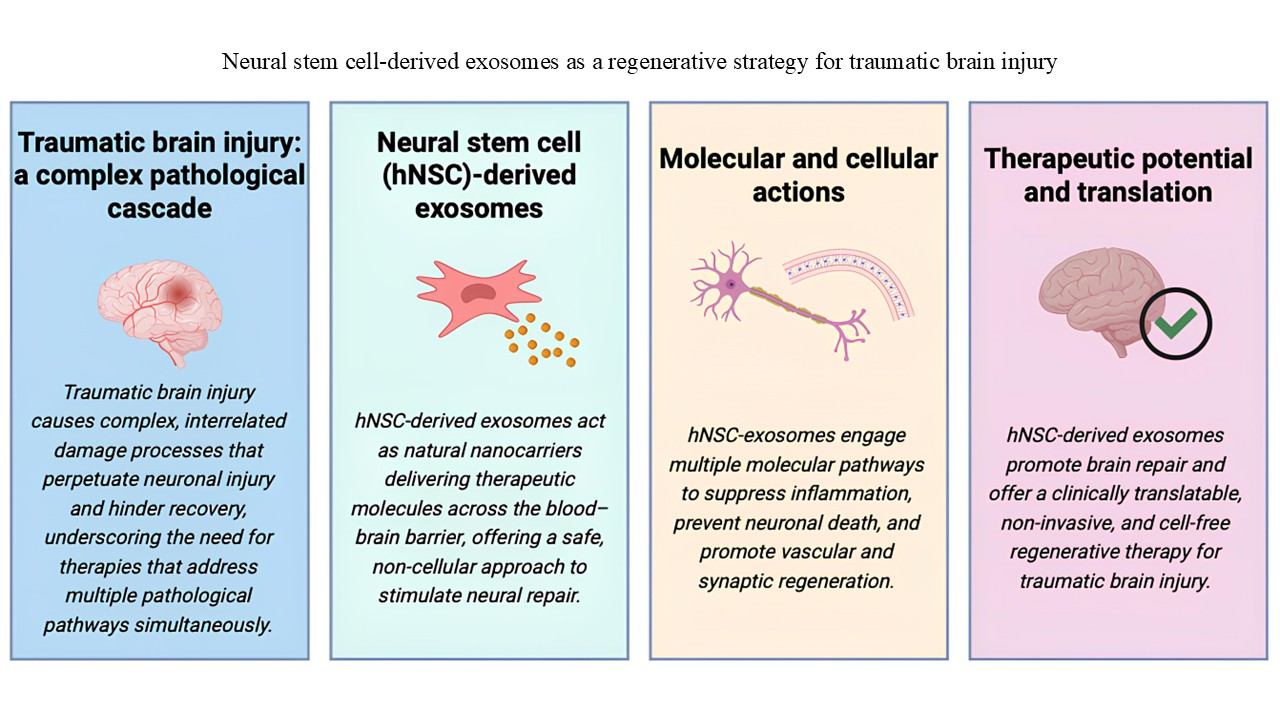
Neural stem cell-derived exosomes as a regenerative strategy for traumatic brain injury

Traumatic brain injury (TBI) is a leading cause of death and long-term disability worldwide, and current management rarely restores higher-order neurological function. Neural stem cell (NSC) transplantation offers regenerative potential but is constrained by poor graft survival, immune rejection, tumorigenic risk, and challenges in crossing the blood–brain barrier (BBB). These limitations have driven interest in exosome-based cell-free strategies. Human NSC-derived exosomes (hNSC-Exos) can cross the BBB and deliver neurotrophic factors and microRNAs to injured neural circuits, providing a biologically aligned vector for TBI treatment. This narrative review synthesizes evidence on hNSC-Exos as regenerative agents for TBI. We summarize their neurotrophic and neuroprotective properties and key mechanisms in preclinical models, including signal transducer and activator of transcription 3-mediated microglial polarization, phosphatase and tensin homolog-induced kinase 1/Parkin-dependent mitophagy, phosphoinositide 3-kinase/protein kinase B anti-apoptotic signaling, and extracellular signal-regulated kinase 1/2-driven synaptic plasticity, alongside effects on angiogenesis and BBB restoration. This review examines major translational barriers: donor and culture-related heterogeneity, the lack of standardized, good manufacturing practice-compatible isolation and characterization methods, limited biodistribution and dosing data, and the absence of early clinical trials in TBI. Finally, the review outlines priorities in exosome engineering, intranasal and other minimally invasive delivery routes, and biomarker-based potency assays to advance hNSC-Exos toward clinically actionable, cell-free regenerative therapies for TBI.
- Guan B, Anderson DB, Chen L, Feng S, Zhou H. Global, regional and national burden of traumatic brain injury and spinal cord injury, 1990-2019: A systematic analysis for the Global Burden of Disease Study 2019. BMJ Open. 2023;13(10):e075049. doi: 10.1136/bmjopen-2023-075049
- Zhong L, Wang J, Wang P, et al. Neural stem cell-derived exosomes and regeneration: Cell-free therapeutic strategies for traumatic brain injury. Stem Cell Res Ther. 2023;14(1):198. doi: 10.1186/s13287-023-03409-1
- Xiong Y, Mahmood A, Chopp M. Mesenchymal stem cell-derived extracellular vesicles as a cell-free therapy for traumatic brain injury via neuroprotection and neurorestoration. Neural Regen Res. 2024;19(1):49-54. doi: 10.4103/1673-5374.374143
- Yuan P, Ding L, Chen H, et al. Neural stem cell-derived exosomes regulate neural stem cell differentiation through miR-9-Hes1 axis. Front Cell Dev Biol. 2021;9:601600. doi: 10.3389/fcell.2021.601600
- Gao X, Xiong Y, Li Q, et al. Extracellular vesicle-mediated transfer of miR-21-5p from mesenchymal stromal cells to neurons alleviates early brain injury to improve cognitive function via the PTEN/Akt pathway after subarachnoid hemorrhage. Cell Death Dis. 2020;11(5):363. doi: 10.1038/s41419-020-2530-0
- Llorente V, Velarde P, Desco M, Gómez-Gaviro MV. Current understanding of the neural stem cell niches. Cells. 2022;11(19):3002. doi: 10.3390/cells11193002
- Zhao X, Moore D. Neural stem cells: Developmental mechanisms and disease modeling. Cell Tissue Res. 2018;371(1):1-6. doi: 10.1007/s00441-017-2738-1
- Zhang Y, Liu Y, Liu H, Tang WH. Exosomes: Biogenesis, biologic function and clinical potential. Cell Biosci. 2019;9(1):19. doi: 10.1186/s13578-019-0282-2
- Wessler S, Meisner-Kober N. On the road: Extracellular vesicles in intercellular communication. Cell Commun Signal. 2025;23(1):95. doi: 10.1186/s12964-024-01999-8
- Van Niel G, Carter DRF, Clayton A, Lambert DW, Raposo G, Vader P. Challenges and directions in studying cell-cell communication by extracellular vesicles. Nat Rev Mol Cell Biol. 2022;23(5):369-382. doi: 10.1038/s41580-022-00460-3
- Han QF, Li WJ, Hu KS, et al. Exosome biogenesis: Machinery, regulation, and therapeutic implications in cancer. Mol Cancer. 2022;21(1):207. doi: 10.1186/s12943-022-01671-0
- Li J, Zhang Y, Dong PY, Yang GM, Gurunathan S. A comprehensive review on the composition, biogenesis, purification, and multifunctional role of exosome as delivery vehicles for cancer therapy. Biomed Pharmacother. 2023;165:115087. doi: 10.1016/j.biopha.2023.115087
- Pitt JM, Kroemer G, Zitvogel L. Extracellular vesicles: Masters of intercellular communication and potential clinical interventions. J Clin Invest. 2016;126(4):1139-1143. doi: 10.1172/JCI87316
- Si Q, Wu L, Pang D, Jiang P. Exosomes in brain diseases: Pathogenesis and therapeutic targets. MedComm (2020). 2023;4(3):e287. doi: 10.1002/mco2.287
- Petroni D, Fabbri C, Babboni S, Menichetti L, Basta G, Del Turco S. Extracellular vesicles and intercellular communication: Challenges for in vivo molecular imaging and tracking. Pharmaceutics. 2023;15(6):1639. doi: 10.3390/pharmaceutics15061639
- Berumen Sánchez G, Bunn KE, Pua HH, Rafat M. Extracellular vesicles: Mediators of intercellular communication in tissue injury and disease. Cell Commun Signal. 2021;19(1):104. doi: 10.1186/s12964-021-00787-y
- Li Y, Fang B. Neural stem cell-derived extracellular vesicles: The light of central nervous system diseases. Biomed Pharmacother. 2023;165:115092. doi: 10.1016/j.biopha.2023.115092
- Gu C, Li Y, Liu J, et al. Neural stem cell-derived exosomes-loaded adhesive hydrogel controlled-release promotes cerebral angiogenesis and neurological function in ischemic stroke. Exp Neurol. 2023;370:114547. doi: 10.1016/j.expneurol.2023.114547
- Liu Q, Tan Y, Qu T, et al. Therapeutic mechanism of human neural stem cell-derived extracellular vesicles against hypoxia-reperfusion injury in vitro. Life Sci. 2020;254:117772. doi: 10.1016/j.lfs.2020.117772
- Rani S, Lai A, Nair S, et al. Extracellular vesicles as mediators of cell-cell communication in ovarian cancer and beyond - a lipids focus. Cytokine Growth Factor Rev. 2023;73:52-68. doi: 10.1016/j.cytogfr.2023.06.004
- Xiong Y, Mahmood A, Chopp M. Emerging potential of exosomes for treatment of traumatic brain injury. Neural Regen Res. 2017;12(1):19-22. doi: 10.4103/1673-5374.198966
- Abedi M, Hajinejad M, Atabi F, Sahab-Negah S. Exosome derived from human neural stem cells improves motor activity and neurogenesis in a traumatic brain injury model. BioMed Res Int. 2022;2022(1):6409346. doi: 10.1155/2022/6409346
- Waseem A, Saudamini, Haque R, Janowski M, Raza SS. Mesenchymal stem cell‐derived exosomes: Shaping the next era of stroke treatment. Neuroprotection. 2023;1(2):99-116. doi: 10.1002/nep3.30
- Mavroudis I, Jabeen S, Balmus IM, et al. Exploring the potential of exosomal biomarkers in mild traumatic brain injury and post-concussion syndrome: A systematic review. J Pers Med. 2023;14(1):35. doi: 10.3390/jpm14010035
- Zhong Y, Gu L, Ye Y, et al. JAK2/STAT3 axis intermediates microglia/macrophage polarization during cerebral ischemia/reperfusion injury. Neuroscience. 2022;496:119-128. doi: 10.1016/j.neuroscience.2022.05.016
- Fan Z, Zhang W, Cao Q, et al. JAK2/STAT3 pathway regulates microglia polarization involved in hippocampal inflammatory damage due to acute paraquat exposure. Ecotoxicol Environ Saf. 2022;234:113372. doi: 10.1016/j.ecoenv.2022.113372
- Zhao M, Wang J, Zhu S, et al. Human neural stem cell-derived exosomes activate PINK1/Parkin pathway to protect against oxidative stress-induced neuronal injury in ischemic stroke. J Transl Med. 2025;23(1):402. doi: 10.1186/s12967-025-06283-y
- Jin SM, Youle RJ. PINK1- and Parkin-mediated mitophagy at a glance. J Cell Sci. 2012;125(4):795-799. doi: 10.1242/jcs.093849
- Ge P, Dawson VL, Dawson TM. PINK1 and Parkin mitochondrial quality control: A source of regional vulnerability in Parkinson’s disease. Mol Neurodegener. 2020;15(1):20. doi: 10.1186/s13024-020-00367-7
- Quinn PMJ, Moreira PI, Ambrósio AF, Alves CH. PINK1/PARKIN signalling in neurodegeneration and neuroinflammation. Acta Neuropathol Commun. 2020;8(1):189. doi: 10.1186/s40478-020-01062-w
- Wang Y, Xu R, Yan Y, et al. Exosomes-mediated signaling pathway: A new direction for treatment of organ ischemia-reperfusion injury. Biomedicines. 2024;12(2):353. doi: 10.3390/biomedicines12020353
- Goyal A, Agrawal A, Verma A, Dubey N. The PI3K-AKT pathway: A plausible therapeutic target in Parkinson’s disease. Exp Mol Pathol. 2023;129:104846. doi: 10.1016/j.yexmp.2022.104846
- Guo N, Wang X, Xu M, Bai J, Yu H, Zhang L. PI3K/AKT signaling pathway: Molecular mechanisms and therapeutic potential in depression. Pharmacol Res. 2024;206:107300. doi: 10.1016/j.phrs.2024.107300
- Sun J, Nan G. The extracellular signal-regulated kinase 1/2 pathway in neurological diseases: A potential therapeutic target (review). Int J Mol Med. 2017;39(6):1338-1346. doi: 10.3892/ijmm.2017.2962
- Wang F, Xia Z, Sheng P, et al. Targeting the Erk1/2 and autophagy signaling easily improved the neurobalst differentiation and cognitive function after young transient forebrain ischemia compared to old gerbils. Cell Death Discov. 2022;8(1):87. doi: 10.1038/s41420-022-00888-8
- Sahu R, Upadhayay S, Mehan S. Inhibition of extracellular regulated kinase (ERK)-1/2 signaling pathway in the prevention of ALS: Target inhibitors and influences on neurological dysfunctions. Eur J Cell Biol. 2021;100(7-8):151179. doi: 10.1016/j.ejcb.2021.151179
- Zhang Y, Zhang Y, Chopp M, Zhang ZG, Mahmood A, Xiong Y. Mesenchymal stem cell-derived exosomes improve functional recovery in rats after traumatic brain injury: A dose-response and therapeutic window study. Neurorehabil Neural Repair. 2020;34(7):616-626. doi: 10.1177/1545968320926164
- Liu MW, Li H, Xiong GF, et al. Mesenchymal stem cell exosomes therapy for the treatment of traumatic brain injury: Mechanism, progress, challenges and prospects. J Transl Med. 2025;23(1):427. doi: 10.1186/s12967-025-06445-y
- Zhang L, Lin Y, Bai W, Sun L, Tian M. Human umbilical cord mesenchymal stem cell‐derived exosome suppresses programmed cell death in traumatic brain injury via PINK1/Parkin‐mediated mitophagy. CNS Neurosci Ther. 2023;29(8):2236-2258. doi: 10.1111/cns.14159
- Zhang Q, Liu J, Wang W, et al. The role of exosomes derived from stem cells in nerve regeneration: A contribution to neurological repair. Exp Neurol. 2024;380:114882. doi: 10.1016/j.expneurol.2024.114882
- Putthanbut N, Lee JY, Borlongan CV. Extracellular vesicle therapy in neurological disorders. J Biomed Sci. 2024;31(1):85. doi: 10.1186/s12929-024-01075-w
- Chi W, He Y, Chen S, et al. Advances in research on biomaterials and stem cell/exosome-based strategies in the treatment of traumatic brain injury. Acta Pharm Sin B. 2025;15(7):3511-3544. doi: 10.1016/j.apsb.2025.05.010
- Lin M, Alimerzaloo F, Wang X, et al. Harnessing stem cell-derived exosomes: A promising cell-free approach for spinal cord injury. Stem Cell Res Ther. 2025;16(1):182. doi: 10.1186/s13287-025-04296-4
- Panaro MA, Benameur T, Porro C. Extracellular vesicles miRNA cargo for microglia polarization in traumatic brain injury. Biomolecules. 2020;10(6):901. doi: 10.3390/biom10060901
- Li Z, Song Y, He T, et al. M2 microglial small extracellular vesicles reduce glial scar formation via the miR-124/ STAT3 pathway after ischemic stroke in mice. Theranostics. 2021;11(3):1232-1248. doi: 10.7150/thno.48761
- Liang W, Wang YD, Shen DF, et al. Exosomes derived from bone marrow mesenchymal stem cells inhibit neuroinflammation after traumatic brain injury. Neural Regen Res. 2022;17(12):2717. doi: 10.4103/1673-5374.339489
- Strogulski NR, Portela LV, Polster BM, Loane DJ. Fundamental neurochemistry review: Microglial immunometabolism in traumatic brain injury. J Neurochem. 2023;167(2):129-153. doi: 10.1111/jnc.15959
- Santos MFD, Roxo C, Solá S. Oxidative-signaling in neural stem cell-mediated plasticity: Implications for neurodegenerative diseases. Antioxidants. 2021;10(7):1088. doi: 10.3390/antiox10071088
- Olatona OA, Sterben SP, Kansakar SBS, Symes AJ, Liaudanskaya V. Mitochondria: The hidden engines of traumatic brain injury-driven neurodegeneration. Front Cell Neurosci. 2025;19:1570596. doi: 10.3389/fncel.2025.1570596
- Zvenigorodsky V, Gruenbaum BF, Shelef I, et al. Evaluation of blood-brain barrier disruption using low- and high-molecular-weight complexes in a single brain sample in a rat traumatic brain injury model: Comparison to an established magnetic resonance imaging technique. Int J Mol Sci. 2024;25(20):11241. doi: 10.3390/ijms252011241
- Van Vliet EA, Ndode-Ekane XE, Lehto LJ, et al. Long-lasting blood-brain barrier dysfunction and neuroinflammation after traumatic brain injury. Neurobiol Dis. 2020;145:105080. doi: 10.1016/j.nbd.2020.105080
- Nie X, Yuan T, Yu T, Yun Z, Yu T, Liu Q. Non-stem cell-derived exosomes: A novel therapeutics for neurotrauma. J Nanobiotechnology. 2024;22(1):108. doi: 10.1186/s12951-024-02380-0
- Bodnar CN, Watson JB, Higgins EK, Quan N, Bachstetter AD. Inflammatory regulation of CNS barriers after traumatic brain injury: A tale directed by interleukin-1. Front Immunol. 2021;12:688254. doi: 10.3389/fimmu.2021.688254
- Wang C, Cheng F, Han Z, et al. Human-induced pluripotent stem cell-derived neural stem cell exosomes improve blood-brain barrier function after intracerebral hemorrhage by activating astrocytes via PI3K/AKT/MCP-1 axis. Neural Regen Res. 2025;20(2):518-532. doi: 10.4103/NRR.NRR-D-23-01889
- Li Y, Liu B, Zhao T, et al. Comparative study of extracellular vesicles derived from mesenchymal stem cells and brain endothelial cells attenuating blood-brain barrier permeability via regulating Caveolin-1-dependent ZO-1 and Claudin-5 endocytosis in acute ischemic stroke. J Nanobiotechnology. 2023;21(1):70. doi: 10.1186/s12951-023-01828-z
- Zhuang Z, Liu M, Luo J, et al. Exosomes derived from bone marrow mesenchymal stem cells attenuate neurological damage in traumatic brain injury by alleviating glutamate-mediated excitotoxicity. Exp Neurol. 2022;357:114182. doi: 10.1016/j.expneurol.2022.114182
- Wang M, Chen D, Pan R, et al. Neural stem cell-derived small extracellular vesicles: A new therapy approach in neurological diseases. Front Immunol. 2025;16:1548206. doi: 10.3389/fimmu.2025.1548206
- Gurunathan S, Kang MH, Jeyaraj M, Qasim M, Kim JH. Review of the isolation, characterization, biological function, and multifarious therapeutic approaches of exosomes. Cells. 2019;8(4):307. doi: 10.3390/cells8040307
- Liang X, Tian T, Zhao A, et al. Clinical application of combined detection of urine albumincreatinine ratio and urine β2-microglobulin for the diagnosis of the early renal injury of pregnancy with diabetes. J Clin Pathol Res. 2018;38(9):1890-1896. doi: 10.3978/j.issn.2095-6959.2018.09.012
- Chen L, Xiong Y, Chopp M, Zhang Y. Engineered exosomes enriched with select microRNAs amplify their therapeutic efficacy for traumatic brain injury and stroke. Front Cell Neurosci. 2024;18:1376601. doi: 10.3389/fncel.2024.1376601
- National Academies of Sciences, Engineering, and Medicine, Policy and Global Affairs, Committee on Science, Engineering, Medicine, et al. Understanding Reproducibility and Replicability. In: Reproducibility and Replicability in Science. National Academies Press, US; 2019. Available from: https://www.ncbi.nlm.nih.gov/books/NBK547546
- Ginsburg J, Smith T. Traumatic Brain Injury. In: StatPearls. StatPearls Publishing; 2025. Available from: https://www. ncbi.nlm.nih.gov/books/NBK557861 [Last accessed on 2025 Oct 21].
- McConnell HL, Mishra A. Cells of the Blood-Brain Barrier: An Overview of the Neurovascular Unit in Health and Disease. In: Stone N, editor. The Blood-Brain Barrier. Vol. 2492. Methods in Molecular Biology. Germany: Springer US; 2022. p. 3-24. doi: 10.1007/978-1-0716-2289-6_1
- Chen T, Dai Y, Hu C, et al. Cellular and molecular mechanisms of the blood-brain barrier dysfunction in neurodegenerative diseases. Fluids Barriers CNS. 2024;21(1):60. doi: 10.1186/s12987-024-00557-1
- Xu H, Jia Z, Ma K, et al. Protective effect of BMSCs-derived exosomes mediated by BDNF on TBI via miR-216a-5p. Med Sci Monit. 2020;26:e920855. doi: 10.12659/MSM.920855
- López-Leal R, Díaz-Viraqué F, Catalán RJ, et al. Schwann cell reprogramming into repair cells increases miRNA-21 expression in exosomes promoting axonal growth. J Cell Sci. 2020;133(12):jcs239004. doi: 10.1242/jcs.239004
- Smith AN, Shaughness M, Collier S, Hopkins D, Byrnes KR. Therapeutic targeting of microglia mediated oxidative stress after neurotrauma. Front Med. 2022;9:1034692. doi: 10.3389/fmed.2022.1034692
- Seo DY, Heo JW, Ko JR, Kwak HB. Exercise and neuroinflammation in health and disease. Int Neurourol J. 2019;23(Suppl 2):S82-S92. doi: 10.5213/inj.1938214.107
- Évora A, Garcia G, Rubi A, et al. Exosomes enriched with miR-124-3p show therapeutic potential in a new microfluidic triculture model that recapitulates neuron-glia crosstalk in Alzheimer’s disease. Front Pharmacol. 2025;16:1474012. doi: 10.3389/fphar.2025.1474012
- Wang Y, Li D, Zhang L, et al. Exosomes derived from microglia overexpressing miR-124-3p alleviate neuronal endoplasmicreticulum stress damage after repetitive mild traumatic brain injury. Neural Regen Res. 2024;19(9):2010-2018. doi: 10.4103/1673-5374.391189
- Yang J, Gong Z, Dong J, et al. lncRNA XIST inhibition promotes M2 polarization of microglial and aggravates the spinal cord injury via regulating miR-124-3p/IRF1 axis. Heliyon. 2023;9(7):e17852. doi: 10.1016/j.heliyon.2023.e17852
- Wu P, He B, Li X, Zhang H. Roles of microRNA-124 in traumatic brain injury: A comprehensive review. Front Cell Neurosci. 2023;17:1298508. doi: 10.3389/fncel.2023.1298508
- Madhu LN, Kodali M, Upadhya R, et al. Extracellular vesicles from human‐induced pluripotent stem cell‐derived neural stem cells alleviate proinflammatory cascades within disease-associated microglia in Alzheimer’s disease. J Extracell Vesicles. 2024;13(11):e12519. doi: 10.1002/jev2.12519
- Zhu ZH, Jia F, Ahmed W, et al. Neural stem cell-derived exosome as a nano-sized carrier for BDNF delivery to a rat model of ischemic stroke. Neural Regen Res. 2023;18(2):404. doi: 10.4103/1673-5374.346466
- Rong Y, Liu W, Wang J, et al. Neural stem cell-derived small extracellular vesicles attenuate apoptosis and neuroinflammation after traumatic spinal cord injury by activating autophagy. Cell Death Dis. 2019;10(5):340. doi: 10.1038/s41419-019-1571-8
- Qu Q, Pang Y, Zhang C, Liu L, Bi Y. Exosomes derived from human umbilical cord mesenchymal stem cells inhibit vein graft intimal hyperplasia and accelerate reendothelialization by enhancing endothelial function. Stem Cell Res Ther. 2020;11(1):133. doi: 10.1186/s13287-020-01639-1
- Brabazon F, Wilson CM, Jaiswal S, Reed J, Frey WH, Byrnes KR. Intranasal insulin treatment of an experimental model of moderate traumatic brain injury. J Cereb Blood Flow Metab. 2017;37(9):3203-3218. doi: 10.1177/0271678X16685106
- López-Preza FI, Nuñez-Lumbreras MD, Sosa-Testé I, et al. Subchronic intranasal administration of neuroepo reduces long-term consequences of severe traumatic brain injury in male rats. Antioxidants (Basel). 2025;14(6):710. doi: 10.3390/antiox14060710
- Manni L, Leotta E, Mollica I, et al. Acute intranasal treatment with nerve growth factor limits the onset of traumatic brain injury in young rats. Br J Pharmacol. 2023;180(15):1949-1964. doi: 10.1111/bph.16056
- Li P, Sun S, Zhu X, et al. Intranasal delivery of engineered extracellular vesicles promotes neurofunctional recovery in traumatic brain injury. J Nanobiotechnol. 2025;23(1):229. doi: 10.1186/s12951-025-03181-9
- Owjfard M, Rahimian Z, Ghaderpanah R, et al. Therapeutic effects of intranasal administration of resveratrol on the rat model of brain ischemia. Heliyon. 2024;10(12):e32592. doi: 10.1016/j.heliyon.2024.e32592
- Mohamed GA, Lench DH, Grewal P, Rosenberg M, Voeks J. Stem cell therapy: A new hope for stroke and traumatic brain injury recovery and the challenge for rural minorities in South Carolina. Front Neurol. 2024;15:1419867. doi: 10.3389/fneur.2024.1419867
- Timmer ML, Jacobs B, Schonherr MC, Spikman JM, Van Der Naalt J. The spectrum of long-term behavioral disturbances and provided care after traumatic brain injury. Front Neurol. 2020;11:246. doi: 10.3389/fneur.2020.00246
- Camilotto N, Caamaño P, Leiva S. Behavioral changes after traumatic brain injury: A systematic review and meta-analysis on the frontal systems behavior scale. Int J Psychol Res. 2024;17(1):112-129. doi: 10.21500/20112084.6414
- Maresca G, Lo Buono V, Anselmo A, et al. Traumatic brain injury and related antisocial behavioral outcomes: A systematic review. Medicina (Mex). 2023;59(8):1377. doi: 10.3390/medicina59081377
- Niemeier JP, Perrin PB, Holcomb MG, Nersessova KS, Rolston CD. Factor structure, reliability, and validity of the frontal systems behavior scale (FrSBe) in an acute traumatic brain injury population. Rehabil Psychol. 2013;58(1):51-63. doi: 10.1037/a0031612