
Life Cycle Assessment and Risk-Based Approaches for Sustainable Environmental Management and Pollution Control



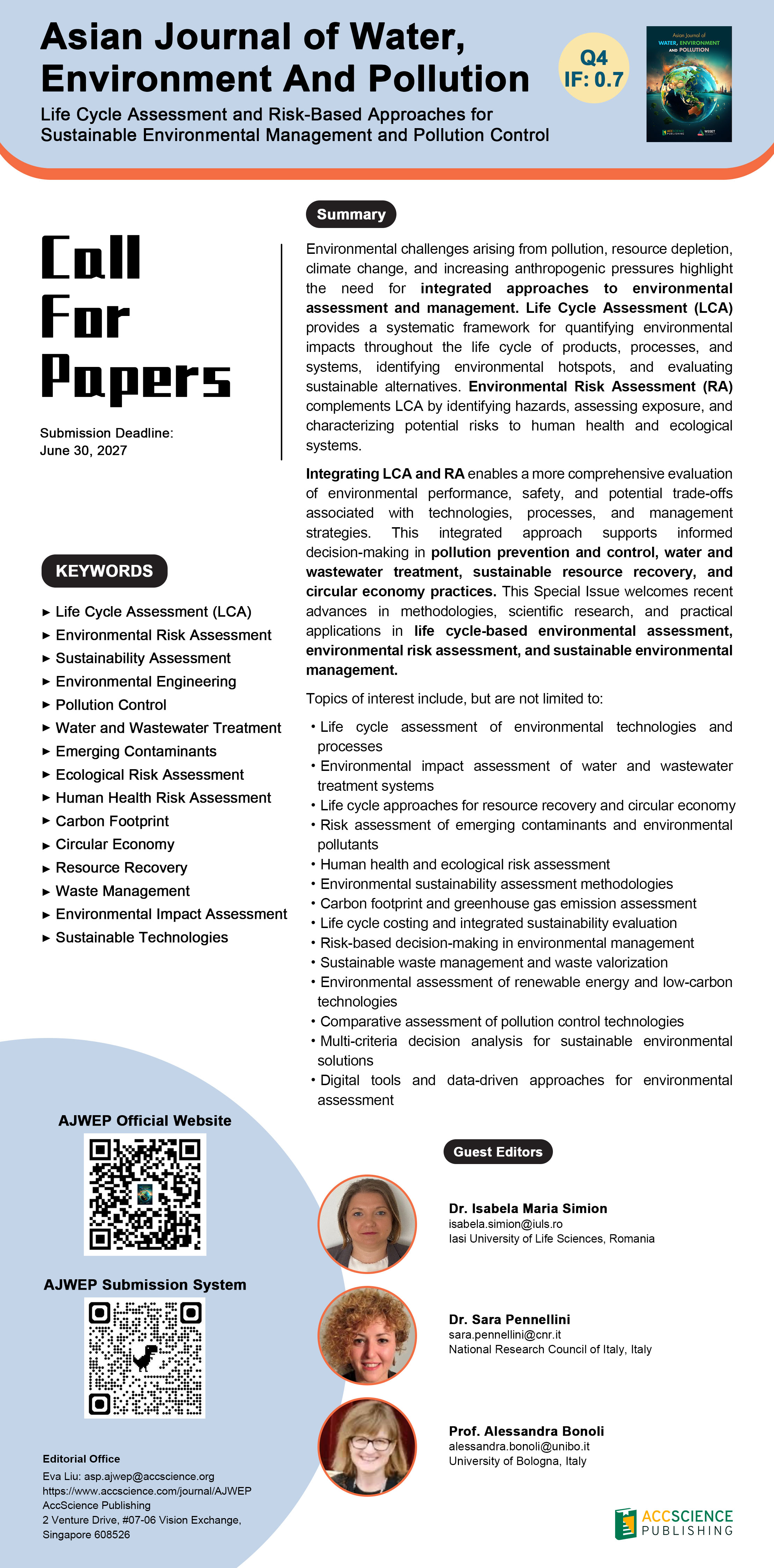
Environmental challenges associated with pollution, natural resource depletion, climate change, and increasing anthropogenic pressures have underscored the need for integrated and scientifically robust approaches to assess, manage, and mitigate environmental impacts and risks. Life Cycle Assessment (LCA) has emerged as a fundamental methodological tool for quantifying environmental impacts throughout the entire life cycle of products, processes, and systems, while risk assessment approaches provide critical insights into potential hazards and environmental consequences. LCA supports the identification of environmental hotspots, the comparison of alternative technologies, and the development of more sustainable production and management strategies. LCA supports the identification of environmental hotspots, the comparison of alternative technologies, and the development of more sustainable production and management strategies.
Equally important, risk assessment (RA) plays a critical role in identifying, evaluating, and characterizing potential adverse effects arising from chemical, biological, physical, and anthropogenic stressors. Risk assessment approaches provide a systematic framework for hazard identification, exposure assessment, dose–response analysis, and risk characterization, enabling the evaluation of potential impacts on human health and ecological receptors.
The integration of Life Cycle Assessment and environmental risk assessment represents an important step towards a more comprehensive understanding of the environmental consequences associated with products, processes, technologies, and management interventions. Combining life cycle-based approaches with risk-oriented methodologies enables the identification of potential trade-offs between environmental performance and safety, the assessment of unintended consequences, and the evaluation of both short- and long-term environmental implications. Such integrated frameworks can provide valuable scientific support for selecting environmentally sound technologies, optimizing pollution prevention and control measures, improving water and wastewater treatment systems, and promoting sustainable resource recovery and circular economy practices.
This Special Issue aims to bring together recent scientific advances, innovative methodologies, and practical applications in life cycle-based environmental assessment, environmental risk assessment, and sustainable environmental management. Topics of interest include, but are not limited to:
- Life cycle assessment of environmental technologies and processes
- Environmental impact assessment of water and wastewater treatment systems
- Life cycle approaches for resource recovery and circular economy
- Risk assessment of emerging contaminants and environmental pollutants
- Human health and ecological risk assessment
- Environmental sustainability assessment methodologies
- Carbon footprint and greenhouse gas emission assessment
- Life cycle costing and integrated sustainability evaluation
- Risk-based decision-making in environmental management
- Sustainable waste management and waste valorization
- Environmental assessment of renewable energy and low-carbon technologies
- Comparative assessment of pollution control technologies
- Multi-criteria decision analysis for sustainable environmental solutions
- Digital tools and data-driven approaches for environmental assessment