
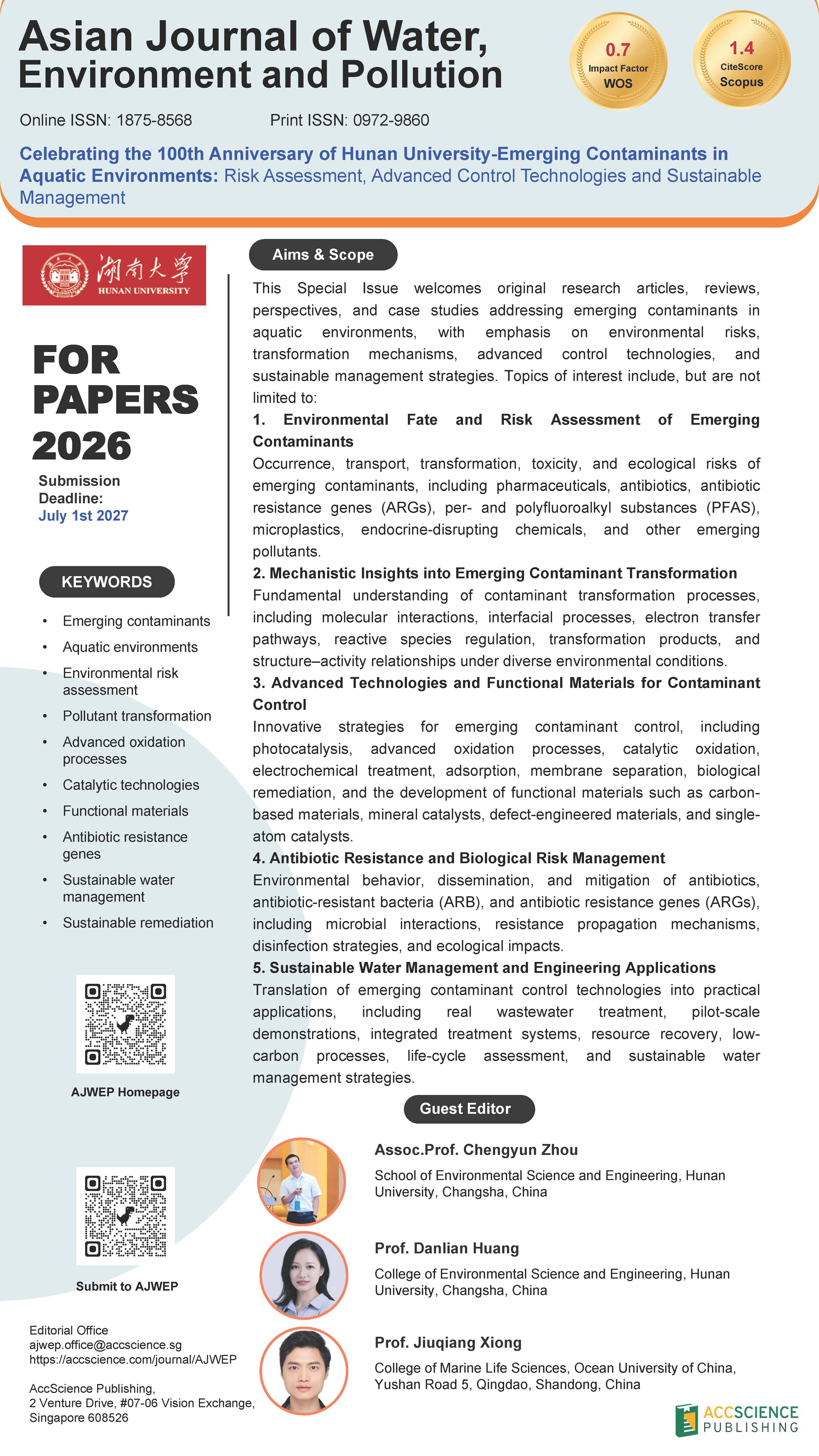
Celebrating the 100th Anniversary of Hunan University-Emerging Contaminants in Aquatic Environments: Risk Assessment, Advanced Control Technologies and Sustainable Management

School of Environmental Science and Engineering, Hunan University, Changsha, ChinaWater pollution control and resource recovery; Heterogeneous advanced oxidation technologies (photocatalysis, Fenton-like oxidation); Treatment of new pollutants; and Resource recovery of solid waste.


Background
The widespread occurrence of emerging contaminants, including pharmaceuticals, antibiotics, antibiotic resistance genes, per- and polyfluoroalkyl substances (PFAS), microplastics, and endocrine-disrupting chemicals, has raised increasing concerns regarding aquatic ecosystems and human health. Their complex environmental behaviors, persistent characteristics, transformation pathways, and uncertain ecological risks present significant challenges to conventional water management strategies. This Special Issue aims to highlight recent advances in the identification, risk assessment, transformation mechanisms, and advanced control technologies for emerging contaminants in aquatic environments. Particular emphasis will be placed on innovative catalytic processes, functional materials, sustainable remediation strategies, and integrated management approaches that bridge fundamental understanding and practical applications. This Special Issue is organized to celebrate the 100th anniversary of Hunan University and provide a platform for interdisciplinary advances toward sustainable water environments.
Scope
This Special Issue welcomes original research articles, reviews, perspectives, and case studies addressing emerging contaminants in aquatic environments, with emphasis on environmental risks, transformation mechanisms, advanced control technologies, and sustainable management strategies. Topics of interest include, but are not limited to:
- Environmental Fate and Risk Assessment of Emerging Contaminants
Occurrence, transport, transformation, toxicity, and ecological risks of emerging contaminants, including pharmaceuticals, antibiotics, antibiotic resistance genes (ARGs), per- and polyfluoroalkyl substances (PFAS), microplastics, endocrine-disrupting chemicals, and other emerging pollutants. - Mechanistic Insights into Emerging Contaminant Transformation
Fundamental understanding of contaminant transformation processes, including molecular interactions, interfacial processes, electron transfer pathways, reactive species regulation, transformation products, and structure–activity relationships under diverse environmental conditions.
- Advanced Technologies and Functional Materials for Contaminant Control
Innovative strategies for emerging contaminant control, including photocatalysis, advanced oxidation processes, catalytic oxidation, electrochemical treatment, adsorption, membrane separation, biological remediation, and the development of functional materials such as carbon-based materials, mineral catalysts, defect-engineered materials, and single-atom catalysts.
- Antibiotic Resistance and Biological Risk Management
Environmental behavior, dissemination, and mitigation of antibiotics, antibiotic-resistant bacteria (ARB), and antibiotic resistance genes (ARGs), including microbial interactions, resistance propagation mechanisms, disinfection strategies, and ecological impacts.
- Sustainable Water Management and Engineering Applications
Translation of emerging contaminant control technologies into practical applications, including real wastewater treatment, pilot-scale demonstrations, integrated treatment systems, resource recovery, low-carbon processes, life-cycle assessment, and sustainable water management strategies.