
Artificial Intelligence and Data-Driven Solutions for Environmental Sustainability and Resource Management

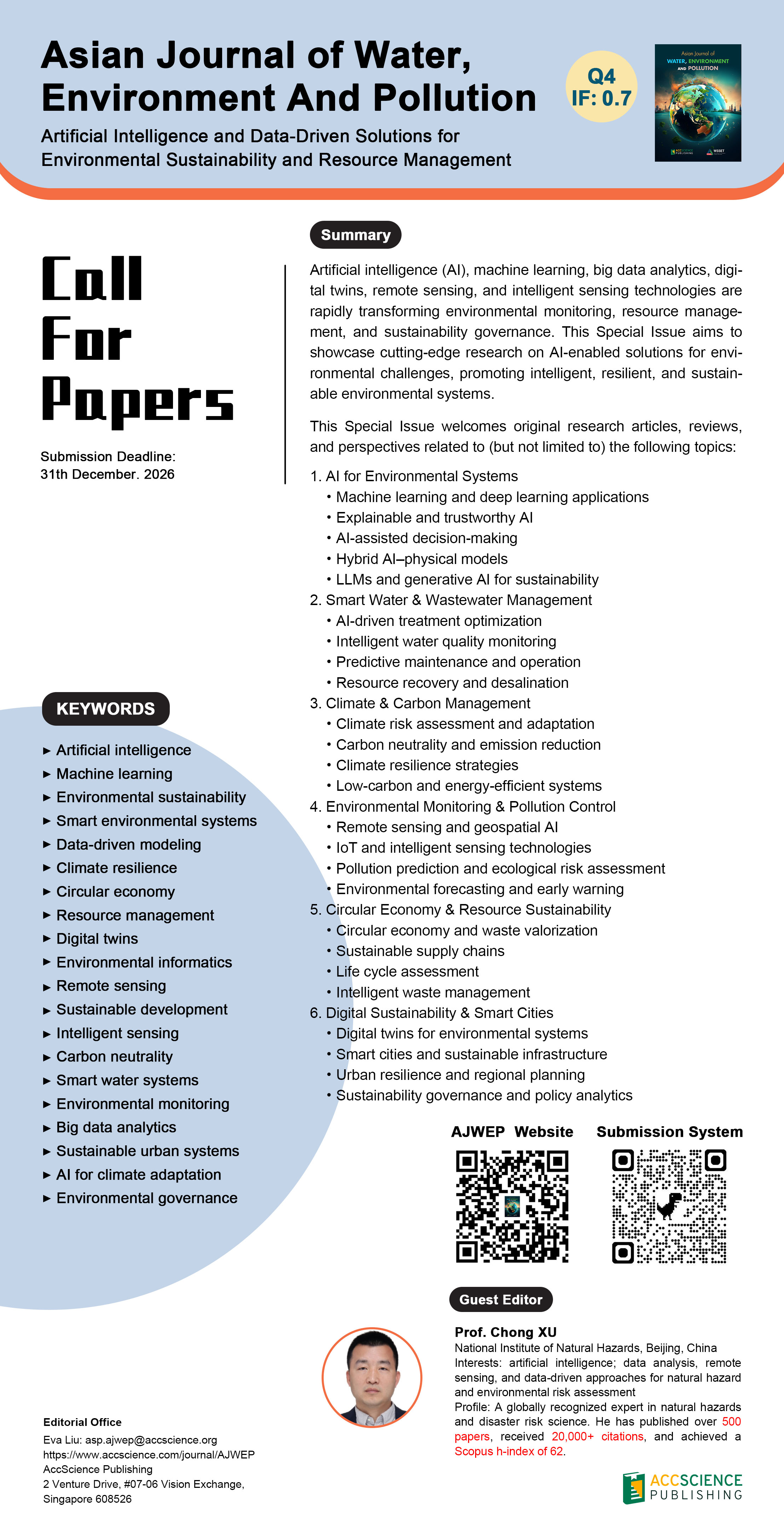
Rapid urbanization, industrial transformation, climate change, and increasing pressure on natural resources have created unprecedented challenges for global environmental sustainability and resource management. At the same time, the rapid advancement of artificial intelligence (AI), machine learning, big data analytics, digital twins, remote sensing, and intelligent sensing technologies is transforming the ways environmental systems are monitored, modeled, optimized, and governed.
AI-driven approaches are increasingly being applied to complex environmental and resource-related problems, including water and wastewater treatment optimization, pollution prediction and control, climate risk assessment, ecosystem monitoring, renewable energy integration, carbon management, circular economy strategies, and sustainable urban systems. Emerging digital technologies also provide new opportunities for enhancing environmental resilience, improving decision-making efficiency, and accelerating sustainable development transitions at regional and global scales.
Despite the growing body of research, significant challenges remain in integrating AI and data-driven methodologies into practical environmental applications, particularly regarding model reliability, explainability, scalability, uncertainty management, interdisciplinary integration, and policy implementation. There is therefore an urgent need to bridge advanced computational technologies with environmental science, engineering, and sustainability governance.
This Special Issue aims to provide an international platform for cutting-edge research and interdisciplinary discussions on AI-enabled environmental sustainability and intelligent resource management systems. Contributions addressing both theoretical innovation and real-world applications are highly encouraged.
Scope and Topics
This Special Issue welcomes original research articles, reviews, and perspectives related to (but not limited to) the following topics:
Artificial Intelligence for Environmental Systems
- Machine learning and deep learning for environmental prediction and assessment
- Explainable AI and trustworthy AI in environmental applications
- AI-assisted environmental decision-making systems
- Hybrid AI-physical modeling approaches
- Large language models (LLMs) and generative AI for sustainability research
Smart Water and Wastewater Management
- AI-driven optimization of water and wastewater treatment processes
- Intelligent monitoring of water quality and distribution systems
- Predictive maintenance and operational optimization in treatment facilities
- Smart desalination and resource recovery systems
Climate and Carbon Management
- AI for climate risk assessment and adaptation
- Carbon footprint prediction and carbon neutrality pathways
- Data-driven climate resilience strategies
- AI-enabled energy efficiency and low-carbon systems
Environmental Monitoring and Pollution Control
- Remote sensing and geospatial AI for environmental monitoring
- Intelligent sensing technologies and IoT applications
- AI for air pollution, emerging contaminants, and ecological risk assessment
- Real-time environmental forecasting and early warning systems
Sustainable Resource and Circular Economy Systems
- AI-assisted circular economy and waste valorization
- Smart resource allocation and sustainable supply chains
- Data-driven environmental life cycle assessment
- Intelligent solid waste management systems
Digital Sustainability and Smart Cities
- Digital twins for environmental and urban systems
- Smart cities and sustainable infrastructure
- Urban resilience and sustainable regional planning
- AI-driven sustainability governance and policy analysis
Interdisciplinary and Emerging Applications
- AI for biodiversity and ecosystem management
- Environmental informatics and big data analytics
- Human–AI collaboration for sustainability transitions
Ethical, social, and governance challenges of AI in environmental systems