


Department of Management, Information and Production Engineering, University of Bergamo, 24129 Bergamo, Italyecodesign; environmental impact valuation; circular economy; life cycle assessment; sustainable design; industrial ecology; sustainability in the health sector; virtual prototyping
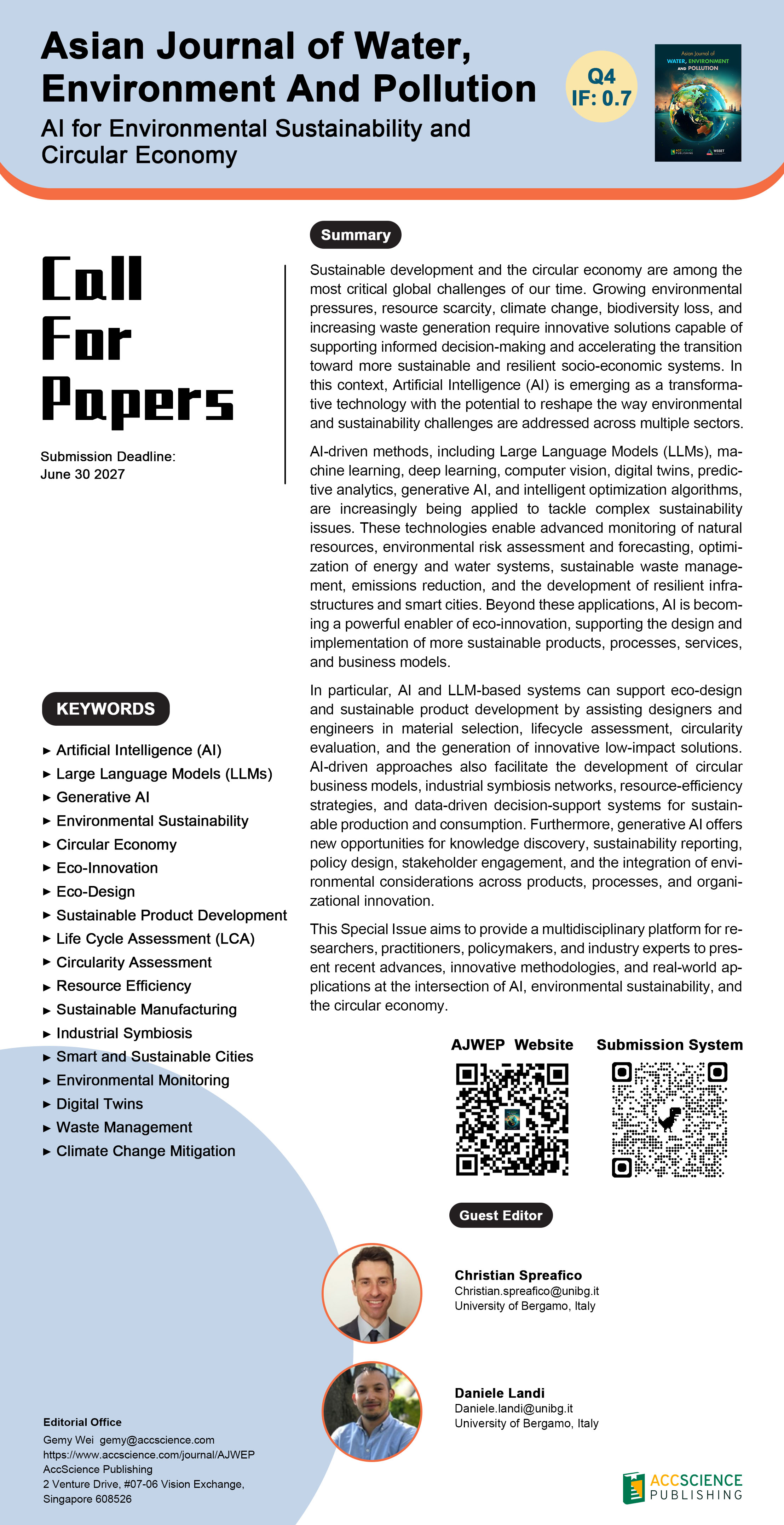
Sustainable development and the circular economy are among the most critical global challenges of our time. Growing environmental pressures, resource scarcity, climate change, biodiversity loss, and increasing waste generation require innovative solutions capable of supporting informed decision-making and accelerating the transition toward more sustainable and resilient socio-economic systems. In this context, Artificial Intelligence (AI) is emerging as a transformative technology with the potential to reshape the way environmental and sustainability challenges are addressed across multiple sectors.
AI-driven methods, including Large Language Models (LLMs), machine learning, deep learning, computer vision, digital twins, predictive analytics, generative AI, and intelligent optimization algorithms, are increasingly being applied to tackle complex sustainability issues. These technologies enable advanced monitoring of natural resources, environmental risk assessment and forecasting, optimization of energy and water systems, sustainable waste management, emissions reduction, and the development of resilient infrastructures and smart cities. Beyond these applications, AI is becoming a powerful enabler of eco-innovation, supporting the design and implementation of more sustainable products, processes, services, and business models.
In particular, AI and LLM-based systems can support eco-design and sustainable product development by assisting designers and engineers in material selection, lifecycle assessment, circularity evaluation, and the generation of innovative low-impact solutions. AI-driven approaches also facilitate the development of circular business models, industrial symbiosis networks, resource-efficiency strategies, and data-driven decision-support systems for sustainable production and consumption. Furthermore, generative AI offers new opportunities for knowledge discovery, sustainability reporting, policy design, stakeholder engagement, and the integration of environmental considerations across products, processes, and organizational innovation.
This Special Issue aims to provide a multidisciplinary platform for researchers, practitioners, policymakers, and industry experts to present recent advances, innovative methodologies, and real-world applications at the intersection of AI, environmental sustainability, and the circular economy.