

Land cover change and dry-season thermal patterns across the urbanizing areas in southeastern Vietnam

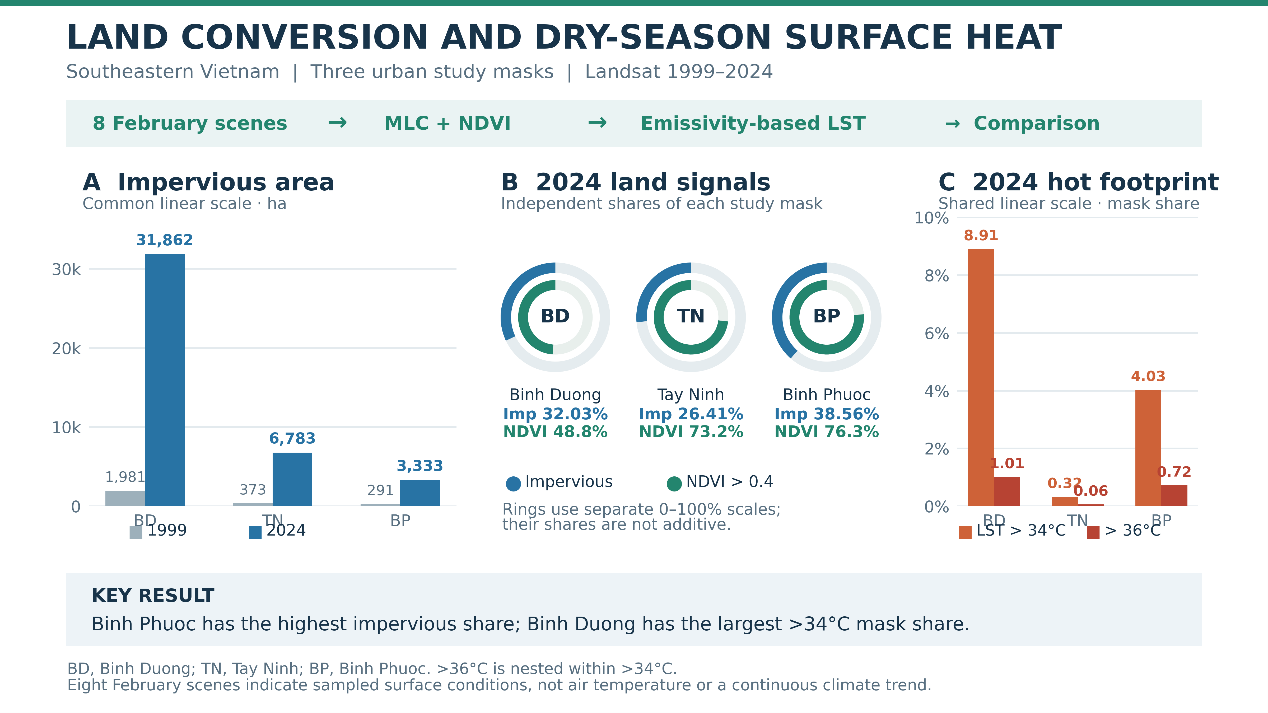
Industrial urbanization is altering land cover and surface thermal conditions in southeastern Vietnam, but comparisons among secondary urban areas remain limited. This study compares impervious-surface expansion, vegetation indices, and February land surface temperature (LST) in selected urban areas of Binh Duong, Tay Ninh, and Binh Phuoc from 1999–2024. Eight Landsat scenes acquired in February between 1999 and 2024 were selected, comprising four Landsat 5 Thematic Mapper scenes and four Landsat 8 Operational Land Imager and Thermal Infrared Sensor scenes. Maximum likelihood classification was used to map land cover, while sensor-specific radiometric calibration and normalized difference vegetation index (NDVI)-based emissivity correction, using fixed NDVI endpoints of 0.2 and 0.5, were used to determine LST. Endpoint area statistics were subsequently calculated. Impervious area increased from 1,981 to 31,862 ha in Binh Duong, from 373 to 6,783 ha in Tay Ninh, and from 291 to 3,333 ha in Binh Phuoc. Endpoint-average net gains were 1,195, 256, and 122 ha per year. In 2024, mapped LST above 34 °C occupied 8,857, 81, and 348 ha in Binh Duong, Tay Ninh, and Binh Phuoc, respectively. Normalizing by the stated study extents yields high-temperature area shares of 8.91%, 0.32%, and 4.03%, distinguishing absolute high-temperature area from its relative coverage within each study mask. Land with NDVI > 0.4 covered 48,585, 18,802, and 6,593 ha, but these threshold areas are not equivalent to mutually exclusive vegetated land-cover classes. The results suggest contrasting corridor-led and clustered development patterns, and identify locations for further thermal assessment. Incomplete independent validation and unresolved atmospheric and emissivity uncertainties limit causal attribution and absolute-temperature interpretation. The comparison serves as a dry-season surface diagnostic rather than a continuous climatic trend or a measure of human heat exposure.
- Mohamed A, Lorestani N, Shabani F. Impact of urbanization on land surface temperature: a global perspective. Curr Res Environ Sustain. 2025;10:100315. doi: 10.1016/j.crsust.2025.100315
- Sinha S, Banerjee A. A systematic review of land use and land cover changes and their influence on urban heat island dynamics. Discov Geosci. 2025;3(1):253. doi: 10.1007/s44288-025-00359-4
- Halefom A, He Y, Nemoto T, et al. The impact of urbanization-induced land use change on land surface temperature. Remote Sens (Basel). 2024;16(23):4502. doi: 10.3390/rs16234502
- Khan MS, Ullah S, Chen L. Variations in surface urban heat island and urban cool island intensity: a review across major climate zones. Chin Geogr Sci. 2023;33(6):983-1000. doi: 10.1007/s11769-023-1375-8
- Nguyen KA, Thai MT, Melkamu T, Le TV, Liou YA. Quantifying the cooling intensity of urban green spaces (UGSs) on land surface temperature (LST) in Hanoi metropolitan area, Vietnam. City Environ Interact. 2025;28:100264. doi: 10.1016/j.cacint.2025.100264
- Wang N, Chen J, He T, et al. Understanding the differences in the effect of urbanization on land surface temperature and air temperature in China: insights from heatwave and non-heatwave conditions. Environ Res Lett. 2023;18(10):104038. doi: 10.1088/1748-9326/acfc58
- Mishra VK, Verma KK, Pant T, Upadhyay GM, Singh PS, Soni PK. Analysis of urbanization impact on land surface temperature variability by using Landsat imagery. SN Comput Sci. 2024;5(7):863. doi: 10.1007/s42979-024-03226-0
- United States Geological Survey. Landsat 5. Landsat Missions. Accessed September 4, 2026. https://www.usgs.gov/landsat-missions/landsat-5
- United States Geological Survey. Landsat 8. Landsat Missions. Accessed September 4, 2026. https://www.usgs.gov/landsat-missions/landsat-8
- Singh P, Verma P, Chaudhuri AS, Singh VK, Rai PK. Evaluating the relationship between urban heat island and temporal change in land use, NDVI and NDBI: a case study of Bhopal city, India. Int J Environ Sci Technol. 2024;21(3):3061-3072. doi: 10.1007/s13762-023-05141-y
- Kadhum SA, Awad A, Abed SA, Janaydeh M, Al-Khayat A, Al-Hemoud A. Land surface temperature and NDVI patterns in the petroleum and non-petroleum regions in Southern Iraq (Al-Basra). Environ Dev Sustain. 2024;28(2):4427-4451. doi: 10.1007/s10668-024-05145-9
- Adeyeri OE, Folorunsho AH, Ayegbusi KI, et al. Land surface dynamics and meteorological forcings modulate land surface temperature characteristics. Sustain Cities Soc. 2024;101:105072. doi: 10.1016/j.scs.2023.105072
- Moyo B, Schröder D, Moreri K. Cloud-computing trend analysis of urbanization impacts on land surface temperature and electricity demand in Gaborone, Botswana. Remote Sens Earth Syst Sci. 2025;8(1):283-306. doi: 10.1007/s41976-024-00171-7
- Tanoori G, Soltani A, Modiri A. Machine learning for urban heat island (UHI) analysis: predicting land surface temperature (LST) in urban environments. Urban Clim. 2024;55:101962. doi: 10.1016/j.uclim.2024.101962
- Mallick J, Alqadhi S. Explainable artificial intelligence models for proposing mitigation strategies to combat urbanization impact on land surface temperature dynamics in Saudi Arabia. Urban Clim. 2025;59:102259. doi: 10.1016/j.uclim.2024.102259
- Rahmani N, Sharifi A. Urban heat dynamics in Local Climate Zones (LCZs): a systematic review. Build Environ. 2025;267:112225. doi: 10.1016/j.buildenv.2024.112225
- Bobáľová H, Opravil Š. Improving Landsat land surface temperature estimation in Google Earth Engine using NDVI-based emissivity. Adv Space Res. 2026;77(3):3281-3299. doi: 10.1016/j.asr.2025.11.085
- Hurduc A, Ermida SL, DaCamara CC. On the suitability of different satellite land surface temperature products to study surface urban heat islands. Remote Sens (Basel). 2024;16(20):3765. doi: 10.3390/rs16203765
- Altıner F, Bingöl F. Spatio-temporal assessment of land surface temperature, vegetation cover, and built-up areas using LST, NDVI, and NDBI in Balıkesir, Türkiye (1985-2025). Sustainability. 2025;17(20):9245. doi: 10.3390/su17209245
- Pagkalinawan H, Delina LL, Macagba SFA. Gridded dataset on land surface temperature and selected environmental and socioeconomic features in Southeast Asian metropolises. Data Brief. 2024;57:110848. doi: 10.1016/j.dib.2024.110848
- Thien BB, Phuong VT, Huong DTV. Investigating land cover changes and their impact on land surface temperature in Tay Ninh province, Vietnam. Environ Monit Assess. 2024;197(1):75. doi: 10.1007/s10661-024-13519-9
- Veettil BK, Costi J, Teck V, Puri V. Land surface temperature evolution in rapidly urbanizing areas of Southeast Asia: studies from Vietnam and Cambodia. PLoS One. 2025;20(10):e0328750. doi: 10.1371/journal.pone.0328750
- Dibaba WT. Urbanization-induced land use/land cover change and its impact on surface temperature and heat fluxes over two major cities in Western Ethiopia. Environ Monit Assess. 2023;195(9):1083. doi: 10.1007/s10661-023-11698-5
- Isinkaralar O, Isinkaralar K, Yilmaz D, Öztürk S. Multi-dimensional analysis of land use/land cover and urbanization on seasonal variation of land surface temperature in İzmir, Türkiye. Landsc Ecol Eng. 2025;21(1):133-150. doi: 10.1007/s11355-024-00628-3
- Khan D, Bano S, Khan N. Spatio-temporal analysis of urbanization effects: unravelling land use and land cover dynamics and their influence on land surface temperature in Aligarh City. Geol Ecol Landsc. 2025;9(4):1326-1350. doi: 10.1080/24749508.2024.2409488
- Olofsson P, Foody GM, Herold M, Stehman SV, Woodcock CE, Wulder MA. Good practices for estimating area and assessing accuracy of land change. Remote Sens Environ. 2014;148:42-57. doi: 10.1016/j.rse.2014.02.015
- Chander G, Markham BL, Helder DL. Summary of current radiometric calibration coefficients for Landsat MSS, TM, ETM+, and EO-1 ALI sensors. Remote Sens Environ. 2009;113(5):893-903. doi: 10.1016/j.rse.2009.01.007
- United States Geological Survey. Using the USGS Landsat Level-1 Data Product. Landsat Missions. Accessed September 4, 2026. https://www.usgs.gov/landsat-missions/using-usgs-landsat-level-1-data-product
- Sobrino JA, Jiménez-Muñoz JC, Paolini L. Land surface temperature retrieval from LANDSAT TM 5. Remote Sens Environ. 2004;90(4):434-440. doi: 10.1016/j.rse.2004.02.003
- United States Geological Survey. Landsat Collection 2 Surface Temperature. Landsat Missions. Accessed September 4, 2026. https://www.usgs.gov/landsat-missions/landsat-collection-2-surface-temperature
- Suthar G, Singh S, Kaul N, Khandelwal S. Understanding the multifaceted influence of urbanization, spectral indices, and air pollutants on land surface temperature variability in Hyderabad, India. J Clean Prod. 2024;470:143284. doi: 10.1016/j.jclepro.2024.143284
- Mahata B, Sankar Sahu S, Sardar A, Laxmikanta R, Maity M. Spatiotemporal dynamics of land use/land cover (LULC) changes and its impact on land surface temperature: a case study in New Town Kolkata, eastern India. Reg Sustain. 2024;5(2):100138. doi: 10.1016/j.regsus.2024.100138
- Keerthi Naidu BN, Chundeli FA. Assessing LULC changes and LST through NDVI and NDBI spatial indicators: a case of Bengaluru, India. GeoJournal. 2023;88(4):4335-4350. doi: 10.1007/s10708-023-10862-1
- Patra PK, Behera D, Chettry V, Jena KM, Goswami S, Jothimani M. Geospatial analysis of unplanned urbanization: impact on land surface temperature and habitat suitability in Cuttack, India. Discov Sustain. 2025;6(1):118. doi: 10.1007/s43621-025-00920-8
- Tahir Z, Haseeb M, Mahmood SA, Hassan NE, Dogar MM, Hassan SZ. From green to grey: assessing the impact of urbanization on land surface temperature and thermal comfort in Multan City. Earth Syst Environ. 2025;9(2):777-800. doi: 10.1007/s41748-025-00598-y
- Thangaraj K, Karthikeyan S, Kulandaisamy P, et al. Impacts of rapid urbanization on land surface temperature and environmental degradation in Madurai, India: a decadal analysis (2013-2023). Theor Appl Climatol. 2025;156(4):212. doi: 10.1007/s00704-025-05442-x
- Ullah S, Qiao X, Tariq A. Impact assessment of planned and unplanned urbanization on land surface temperature in Afghanistan using machine learning algorithms: a path toward sustainability. Sci Rep. 2025;15(1):3092. doi: 10.1038/s41598-025-87234-x
- Sandoval S, Escobar-Flores JG, Badar Munir M. Urbanization and its impacts on land surface temperature and sea surface temperature in a tourist region in Mexico from 1990 to 2020. Remote Sens Appl Soc Environ. 2023;32:101046. doi: 10.1016/j.rsase.2023.101046
- Ullah W, Ahmad K, Ullah S, et al. Analysis of the relationship among land surface temperature (LST), land use land cover (LULC), and normalized difference vegetation index (NDVI) with topographic elements in the lower Himalayan region. Heliyon. 2023;9(2):e13322. doi: 10.1016/j.heliyon.2023.e13322
- Rezapouraghdam H, Hidalgo-García D. Impacts of urbanization on land surface temperature and vegetation cover in a semi-arid city: the case of Maragheh. Earth Syst Environ. 2026;10(5):6217-6242. doi: 10.1007/s41748-025-00951-1