
Seasonal dynamics of phytoplankton communities in relation to physicochemical variables in Karna and Khajjiar Lakes, India

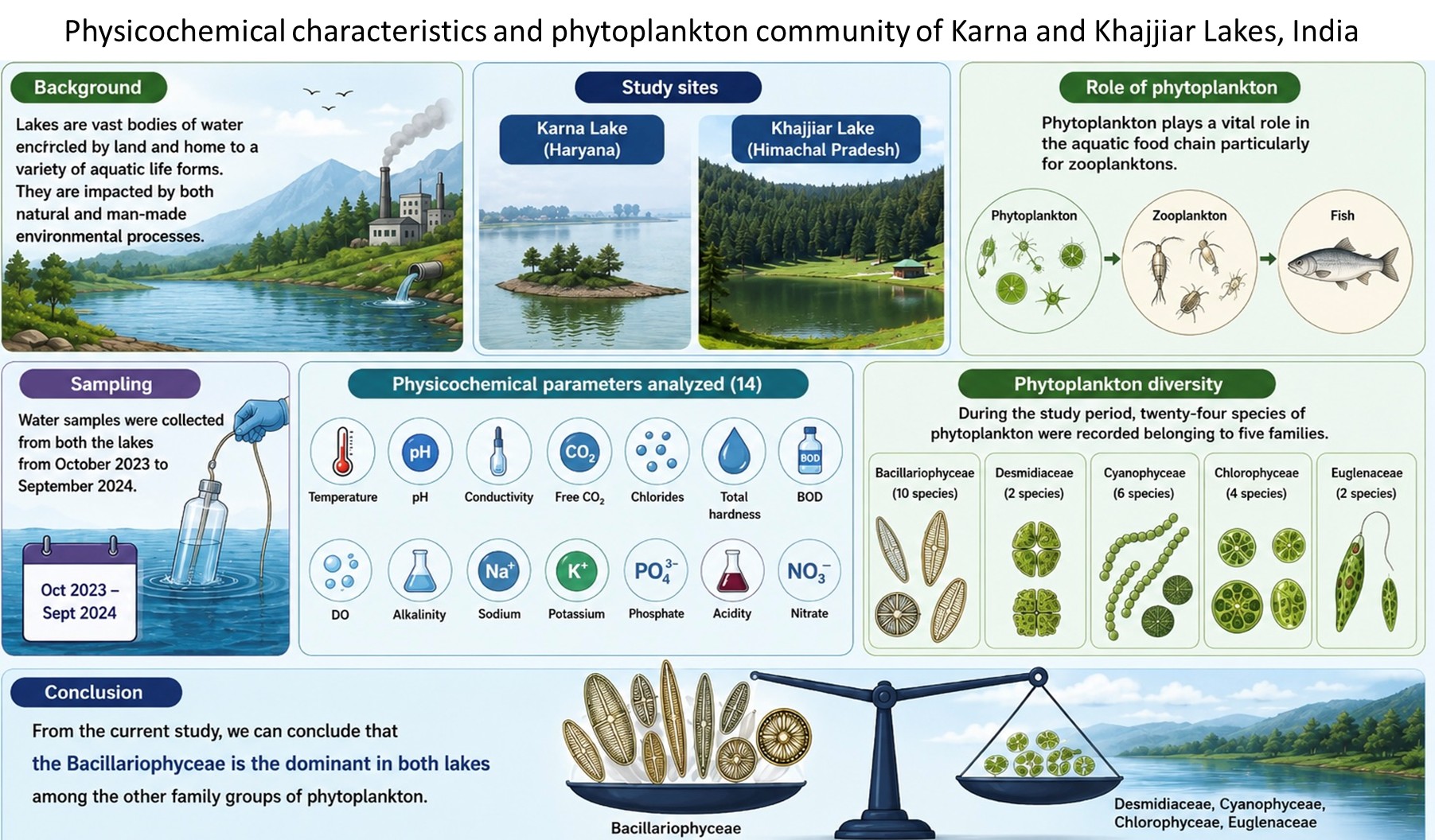
Lakes are vast bodies of water that are encircled by land and home to a variety of aquatic life forms. They are impacted by both natural and man-made environmental processes. The present research aimed to determine the physicochemical properties and phytoplankton community in Karna Lake (Haryana) and Khajjiar Lake (Himachal Pradesh). Phytoplankton plays a vital role in the aquatic food chain, particularly for zooplankton. Water samples were collected from both lakes, i.e., from October 2023 to September 2024. Temperature, pH, conductivity, free carbon dioxide, chlorides, total hardness, biochemical oxygen demand, dissolved oxygen, alkalinity, sodium, potassium, phosphate, acidity, nitrate, were analyzed for both lakes. The physicochemical analysis indicated significant geographical and seasonal variations between the sampling sites. The water temperature fluctuated from 12.14 ± 4.21 °C to 20.05 ± 7.53 °C, and the pH remained slightly alkaline (7.23 ± 1.02 to 8.08 ± 0.03). Conductivity readings ranged from 266.17 ± 35.27 μS/cm to 413.50 ± 54.18 μS/cm, with greater values seen in Karna Lake. Dissolved oxygen concentrations ranged from 6.01 ± 2.32 mg/L to 9.26 ± 2.16 mg/L, while biological oxygen demand was 1.32 ± 1.66 mg/L to 3.59 ± 1.74 mg/L. Karna Lake had greater levels of nitrate (1.8 ± 0.389 mg/L) and phosphate (0.61 ± 0.41 mg/L), indicating nutrient enrichment. Statistical investigations revealed that conductivity, nitrate, phosphate, temperature, and biological oxygen demand were the most important environmental variables impacting phytoplankton dispersal. During the study period, 24 phytoplankton species were recorded by family, including Bacillariophyceae (10 species), Desmidiaceae (2 species), Cyanophyceae (6 species), Chlorophyceae (4 species), and Euglenaceae (2 species). The work emphasizes the ecological significance of phytoplankton as bioindicators of freshwater ecosystem variability and provides baseline limnological data for future monitoring and protection of lake ecosystems.
- Kumar R, Goyal MK, Surampalli RY, Zhang TC. River pollution in India: exploring regulatory and remedial paths. Clean Technol Environ Policy. 2024;26(9):2777–2799. doi: 10.1007/s10098-024-02763-9
- Bijay-Singh, Craswell E. Fertilizers and nitrate pollution of surface and ground water: an increasingly pervasive global problem. SN Appl Sci. 2021;3(4):518. doi: 10.1007/s42452-021-04521-8
- Erel R, Yalin D, Kushmaro-Bier A, Li Q, Gérard F, Toren N. Soil properties and growing duration determine phosphorus phyto-availability dynamics of polyphosphate versus orthophosphate fertilizers. Plant Soil. 2023;485(1-2):299– 315. doi: 10.1007/s11104-022-05830-6
- Jahan S. The Role of Phytoplanktons in the Environment and in Human Life, a Review. Bas J Sci. 2023;41(2):392–411. doi: 10.29072/basjs.20230212
- Chandel P, Mahajan D, Thakur K, et al. A review on plankton as a bioindicator: A promising tool for monitoring water quality. World Water Policy. 2024;10(1):213–232. doi: 10.1002/wwp2.12137
- Dalu T, Mwedzi T, Wasserman RJ. Phytoplankton dynamics. Fundamentals of Tropical Freshwater Wetlands. Amsterdam , Netherlands: Elsevier; 2022:p. 189–219. doi: 10.1016/B978-0-12-822362-8.00005-0
- Gouda SA, Hesham H, Taha A. Bioindicators: A Promising Tool for Detecting and Evaluating Water Pollution. Egypt J Aquat Biol Fish. 2024;28(4):1209–1235. doi: 10.21608/ejabf.2024.374025
- Sumudumali RGI, Jayawardana JMCK. A Review of Biological Monitoring of Aquatic Ecosystems Approaches: with Special Reference to Macroinvertebrates and Pesticide Pollution. Environ Manage. 2021;67(2):263–276. doi: 10.1007/s00267-020-01423-0
- Lata S, Siddharth. Sustainable and eco-friendly approach for controlling industrial wastewater quality imparting succour in water-energy nexus system. Energy Nexus. 2021;3:100020. doi: 10.1016/j.nexus.2021.100020
- Kotlia BS, Kholia N, Porinchu D, et al. Mid-late holocene climatic reconstruction using core sediments from Khajjiar lake, Himachal Pradesh, India. Quat Sci Adv. 2024;13:100154. doi: 10.1016/j.qsa.2023.100154
- American Public Health Association, American Water Works Association, Water Environment Federation. Standard Methods for the Examination of Water and Wastewater. 21st ed. District of Columbia, WA: American Public Health Association; 2005.
- Liu Z, Dong Y, Li QP, Wu Z, Ge Z, Ma M. Temporal change of plankton size structure preserved by Lugol’s solution: a FlowCAM study. J Oceanol Limnol. 2023;41(1):290–299. doi: 10.1007/s00343-021-1155-1
- Ail SKS, Devadas D, Sudhan C, et al. Plankton Diversity and Dominance in Three Undrainable Village Pond Aquaculture Systems. In: Proceedings of the National Academy of Sciences, India Section B: Biological Sciences. Springer Nature; 2021;91(2):391–396. doi: 10.1007/s40011-021-01224-3
- Ali SA, Raju HM, Kassab G. Seasonal Species Diversity and Dominance of Phytoplankton in Different types of tropical Domestic Sewage Oxidation Ponds. Ecol Environ Conserv. 2023;29:S356–363. doi: 10.53550/EEC.2023.v29i01s.0515
- Woolway RI, Sharma S, Smol JP. Lakes in Hot Water: The Impacts of a Changing Climate on Aquatic Ecosystems. Bioscience. 2022;72(11):1050–1061. doi: 10.1093/biosci/biac052
- Sahu N, Sridhar S. Algal Biotechnology. Boca Raton, FL: CRC Press; 2024. doi: 10.1201/9781003219156
- Wu Z, Wang C, Jiang H, Li K, Yang X, Huang W. Sediment pH structures the potential of the lake’s internal P pollution involved in different types of P reactivation. J Clean Prod. 2022;352:131576. doi: 10.1016/j.jclepro.2022.131576
- Akinnawo SO. Eutrophication: Causes, consequences, physical, chemical and biological techniques for mitigation strategies. Environ Challs. 2023;12:100733. doi: 10.1016/j.envc.2023.100733
- Baattrup-Pedersen A, Johnsen TJ, Larsen SE, Riis T. Alkalinity and diatom assemblages in lowland streams: How to separate alkalinity from inorganic phosphorus in ecological assessments? Sci Total Environ. 2022;823:153829. doi: 10.1016/j.scitotenv.2022.153829
- Giwa SO, Sharifpur M, Meyer JP, Wongwises S, Mahian O. Experimental measurement of viscosity and electrical conductivity of water-based γ-Al2O3/MWCNT hybrid nanofluids with various particle mass ratios. J Therm Anal Calorim. 2021;143(2):1037–1050. doi: 10.1007/s10973-020-10041-1
- Malba Alapure G, Narayan Walse P, Sugdeo Rajankar O, Murlidhar Shinde B. Phytoplankton analysis and assessment of reservoir water quality at Rena Medium Reservoir, Godavari Basin, India. J Integr Sci Technol. 2024;12(3). doi: 10.62110/sciencein.jist.2024.v12.784
- Maddah HA. Regression-based analytical models for dissolved oxygen in wastewater. Environ Monit Assess. 2023;195(11):1346. doi: 10.1007/s10661-023-11954-8
- Maansi, Jindal R, Wats M. Evaluation of surface water quality using water quality indices (WQIs) in Lake Sukhna, Chandigarh, India. Appl Water Sci. 2022;12(1):2. doi: 10.1007/s13201-021-01534-x
- Yan Z, Kamanmalek S, Alamdari N, Nikoo MR. Comprehensive Insights into Harmful Algal Blooms: A Review of Chemical, Physical, Biological, and Climatological Influencers with Predictive Modeling Approaches. J Environ Eng. 2024;150. doi: 10.1061/JOEEDU.EEENG-7549
- Bai X, Zhou Y, Ye W, Zhao H, Wang J, Li W. Response of organic phosphorus in lake water to environmental factors: A simulative study. Sci Total Environ. 2021;785:147275. doi: 10.1016/j.scitotenv.2021.147275
- Xu X, Wu C, Xie D, Ma J. Sources, Migration, Transformation, and Environmental Effects of Organic Carbon in Eutrophic Lakes: A Critical Review. Int J Environ Res Public Health. 2023;20(1):860. doi: 10.3390/ijerph20010860
- Dara SR. An Overview of the Use of Natural Indicators in Acid-Base Titrations. UPI Journal of Pharmaceutical, Medical and Health Sciences. 2024;29–35. doi: 10.37022/jpmhs.v4i2.103
- Cao H, Zhang K, Deng D, et al. Environmental heterogeneity affecting spatial distribution of phytoplankton community structure and functional groups in a large eutrophic lake, Lake Chaohu, China. Environ Sci Pollut Res. 2023;30(32):79001–79014. doi: 10.1007/s11356-023-28043-5
- Meng Z, Chen K, Hu F, Liu L, Yang D, Li X. Environmental and spatial factors play different roles in phytoplankton community assembly in different hydrological seasons in Lake Wuchang, China. Front Ecol Evol. 2023;11. doi: 10.3389/fevo.2023.1154695
- Hipsey MR, Carey CC, Brookes JD, et al. Integrating phytoplankton phenology, traits, and model‐data fusion to advance bloom prediction. Limnol Oceanogr Lett. 2025;10(6):815–834. doi: 10.1002/lol2.70052
- Liberatore L, Titocci J, Semeraro T, Monti F, Scardia Scardia AM, Basset A. Large-Scale Niche Analysis of Phytoplankton Cell Shapes and Their Spatial Distribution in Transitional Water Ecosystems in the Framework of Global Warming. Water (Basel). 2026;18(5):553. doi: 10.3390/w18050553
- Palanivel P, Rajendran PJ, Thajuddin F, Elumalai A, Dharumadurai D, Muralitharan G. Correlating the Water Quality Parameters on Algal Diversity through Multivariate Statistical Analysis and Identifying the Bioindicator of Water Pollution in the Freshwater Ecosystems of Dakshina, Karnataka. Water Air Soil Pollut. 2026;237(3):168. doi: 10.1007/s11270-025-08867-2
- Inelova Z, Akmukhanova N, Zayadan B, et al. Ecological Assessment of Lake Alakol’s Coastal Waters using Algae- Based Indicators. ES Energy Environ. 2026. doi: 10.30919/ee2125
- Zhang M, Leppäranta M, Heikkilä M, et al. The thermal structure of small and shallow Arctic Fennoscandian lakes. Arct Antarct Alp Res. 2025;57(1). doi: 10.1080/15230430.2024.2433829
- Thoppil PG, Wallcraft AJ, Jensen TG. Winter Convective Mixing in the Northern Arabian Sea during Contrasting Monsoons. J Phys Oceanogr. 2022;52(3):313–327. doi: 10.1175/JPO-D-21-0144.1
- Omoregie AI, Silini MOE, Wong LS, Rajasekar A. Nitrogen Eutrophication in Chinese Aquatic Ecosystems: Drivers, Impacts, and Mitigation Strategies. Nitrogen. 2025;6(4):92. doi: 10.3390/nitrogen6040092
- Mathew MM, Khatana K, Vats V, et al. Biological Approaches Integrating Algae and Bacteria for the Degradation of Wastewater Contaminants—A Review. Front Microbiol. 2022;12. doi: 10.3389/fmicb.2021.801051
- Aragaw TA, Bogale FM. Role of coagulation/flocculation as a pretreatment option to reduce colloidal/bio-colloidal fouling in tertiary filtration of textile wastewater: A review and future outlooks. Front Environ Sci. 2023;11. doi: 10.3389/fenvs.2023.1142227
- El Alouani M, Saufi H, Aouan B, et al. A Comprehensive Review on Green Synthesis and Characterization of Plant- Based Nanoparticles for Water Treatment Applications: Adsorption and Photodegradation of Organic and Inorganic Pollutants. Sustainability. 2026;18(6):2721. doi: 10.3390/su18062721
- Kober UA, Barikbin H, Seo Y, Lapitsky Y. Algaecide- Releasing Buoys for Sustained Harmful Algal Bloom Control. ACS ES&T Water. 2026;6(3):1716–1730. doi: 10.1021/acsestwater.5c01257
- Khattak W, Anas M, Hakki E, Fahad S. Cyanobacterial Bloom Impacts on Aquatic Food Webs and Ecosystem Services. In: Fahad, S, Saud, S, Song, J, Nawaz, T, Zhou, R. Cyanobacterial Blooms: Ecology, Evolution and Biogeochemical Impacts. Cham, Switzerland: Springer Nature; 2026:217-250. doi: 10.1007/978-3-032-06042-6_10
- Balouch H, Sadvakasova AK, Kossalbayev BD, et al. Phyto- Algal Consortia as a Complementary System for Wastewater Treatment and Biorefinery. Plants. 2025;14(19):3069. doi: 10.3390/plants14193069
- Abata OE, Adesorioye KC, Babaniyi EE, Adebomi JI. Constructed Wetlands for Wastewater Treatment and Role of Wetlands in Water Quality Improvement and Filtration. In: Babaniyi, BR, Aransiola, SA, Babaniyi, EE, Maddela, NR. Wetland Ecosystems: Conservation Strategies, Policy Management and Applications. Cham, Switzerland: Springer Nature; 2025:297-323. doi: 10.1007/978-3-031-91982-4_14