
Toward carbon neutrality: The impact of the opening of high-speed rail on urban green total factor energy efficiency in China

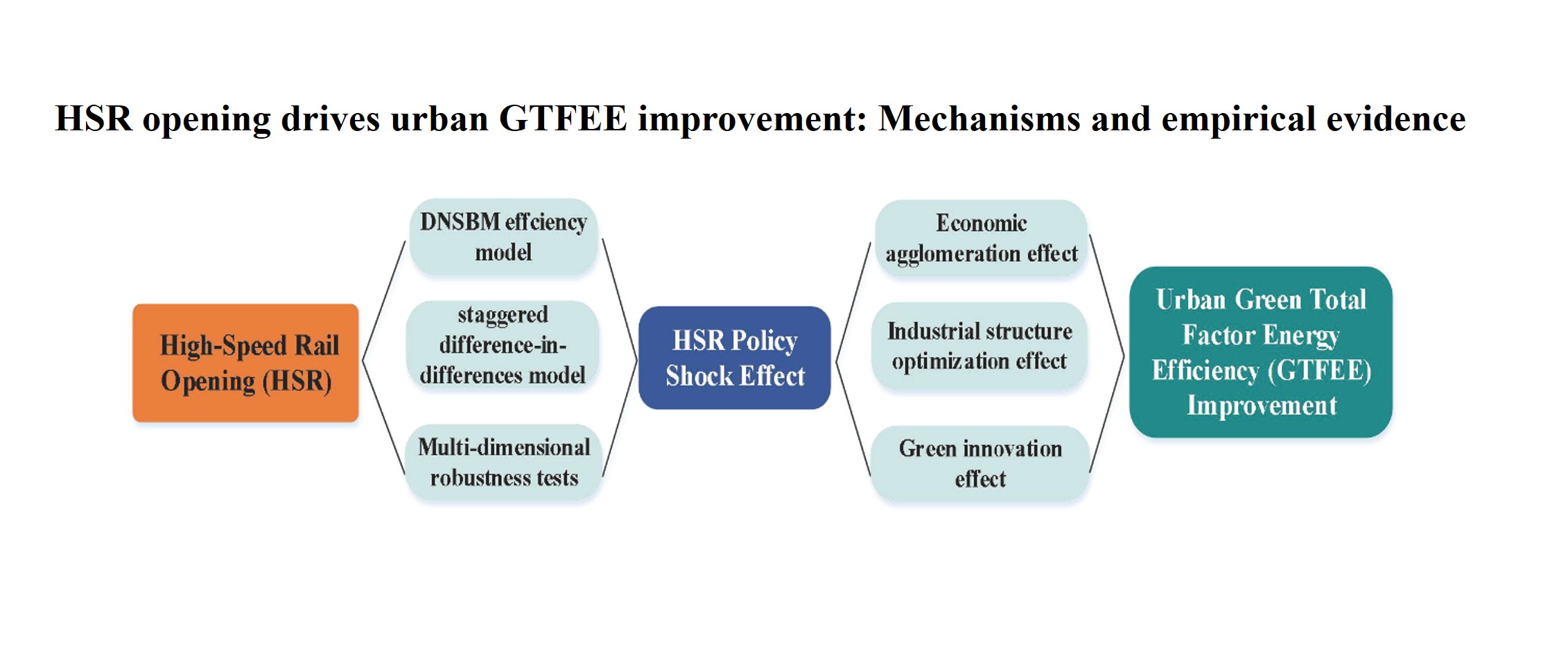
As a key low-carbon-oriented transport infrastructure, the opening of high-speed rail (HSR) has been widely recognized as a critical enabler to support China’s national carbon peaking and carbon neutrality strategic targets. This study employs the dynamic network slacks-based measure (DNSBM) framework to estimate urban green total factor energy efficiency (GTFEE), accounting for both internal production linkages and cross-period production inertia. Our causal identification based on the time-varying staggered difference-in-differences (DID) model revealed that HSR opening exerts a significant positive impact on urban GTFEE, and this core conclusion remained consistent across several robustness checks, including propensity score matching DID estimation, counterfactual placebo test, exclusion of concurrent policy shocks, and alternative measurement of core variables. Heterogeneity tests further indicated that the GTFEE improvement effect of HSR opening is particularly pronounced in three subgroups: smart-city pilot cities, high-innovation-level cities, and cities with advanced industrial structures. Mediating mechanism analysis verified that HSR opening promotes urban low-carbon transformation through three core transmission paths: stimulating economic agglomeration, driving industrial structure optimization, and enhancing green innovation capacity. Furthermore, the Goodman–Bacon decomposition test for heterogeneous treatment effects confirmed that the potential estimation bias of staggered DID is negligible in this study, further supporting the reliability of our baseline estimation results.
- Song M, Zhang G, Zeng W, Liu J, Fang K. Railway Transportation and Environmental Efficiency In China. Transp Res D Transp Environ. 2016;48:488-498. doi: 10.1016/j.trd.2015.07.003
- Dalkic G, Balaban O, Tuydes-Yaman H, Celikkol-Kocak T. An Assessment of the CO2 Emissions Reduction in High Speed Rail Lines: Two Case Studies from Turkey. J Clean Prod. 2017;165:746-761. doi: 10.1016/j.jclepro.2017.07.045
- Chen Z, Xue J, Rose AZ, Haynes KE. The Impact of High- Speed Rail Investment on Economic and Environmental Change in China: A Dynamic CGE Analysis. Transp Res A Policy Pract. 2016;92:232-245. doi: 10.1016/j.tra.2016.08.006
- Ke X, Chen H, Hong Y, Hsiao C. Do China’s High-Speed- Rail Projects Promote Local Economy? New Evidence from a Panel Data Approach. China Econ Rev. 2017;44(3):203- 226. doi: 10.1016/j.chieco.2017.02.008
- He Y, Lv B, Yu D. How Does Spatial Proximity to the High-Speed Railway System Affect Inter-City Market Segmentation in China: A Spatial Panel Analysis. Eurasian Geogr Econ. 2022;63(1):55-81. doi: 10.1080/15387216.2020.1828122
- Wang J, Cai S. The Construction of High-Speed Railway and Urban Innovation Capacity: Based on the Perspective of Knowledge Spillover. China Econ Rev. 2020;63(10):1-20. doi: 10.1016/j.chieco.2020.101539
- Schloetzer JD. Process Integration and Information Sharing in Supply Chains. Account Rev. 2012;87(3):1005-1032. doi: 10.2308/accr-10216
- Guirao B, Campa JL, Casado-Sanz N. Labour Mobility between Cities and Metropolitan Integration: The Role of High Speed Rail Commuting in Spain. Cities. 2018;78:140- 154.doi: 10.1016/j.cities.2018.02.008
- Zhang F, Wang F, Ou J, Yao SJ. Role of High-Speed Rail on Social Fixed Assets Investments in China. J Chin Econ Bus Stud. 2019;17(3):221-244. doi: 10.1080/14765284.2019.1663697
- Knaap T, Oosterhaven J. Measuring the Welfare Effects of Infrastructure: A Simple Spatial Equilibrium Evaluation of Dutch Railway Proposals. Res Transp Econ. 2011;31(1):19- 28. doi: 10.1016/j.retrec.2010.11.004
- Zhou R, Yu Y, Wang Z, Dong L, Luo X. The Spatially Differentiated Impact of High-Speed Railway on Accessibility and Socio-Economic Development of Developing Regions: A Study in Southwest China. Socioecon Plann Sci. 2024;95:102037. doi: 10.1016/j.seps.2024.102037
- Hall P. Magic Carpets and Seamless Webs: Opportunities and Constraints for High-Speed Trains in Europe. Built Environ. 2009;35(1):59-69. doi: 10.2148/benv.35.1.59
- Yue Y, Wang T, Liang S, et al. Life Cycle Assessment of High Speed Rail in China. Transp Res D Transp Environ. 2015;41:367-376. doi: 10.1016/j.trd.2015.10.005
- Lin Y, Qin Y, Wu J, Xu M. Impact of High-Speed Rail on Road Traffic and Greenhouse Gas Emissions. Nat Clim Change. 2021;11:952-957. doi: 10.1038/s41558-021-01190-8
- Wang X, Xie Z, Zhang XB, Huang YP. Roads to Innovation: Firm-Level Evidence from People’s Republic of China (PRC). China Econ Rev. 2018;49:154-170. doi: 10.1016/j.chieco.2017.12.012
- Guo H, Chen C, Dong X, Jiang C. The Evolution of Transport Networks and the Regional Water Environment: The Case of Chinese High-Speed Rail. Reg Stud. 2021;55(6):1084-1110. doi: 10.1080/00343404.2020.1862783
- Luo Z, Wan GH, Wang C, Zhang X. Urban Pollution and Road Infrastructure: A Case Study of China. China Econ Rev. 2018;49:171-183. doi: 10.1016/j.chieco.2017.04.008
- Banker RD, Charnes A, Cooper WW. Some Models for Estimating Technical and Scale Inefficiencies in Data Envelopment Analysis. Manage Sci. 1984;30(9):1078-1092. doi: 10.1287/mnsc.30.9.1078
- Tone K. A Slacks-Based Measure of Efficiency in Data Envelopment Analysis. Eur J Oper Res. 2001;130(3):498-509. doi: 10.1016/S0377-2217(99)00407-5
- Yang J, Xiong G, Shi D. Innovation and Sustainable: Can Innovative City Improve Energy Efficiency? Sustain Cities Soc. 2022;80:103761. doi: 10.1016/j.scs.2022.103761
- Stucki T. Which Firms Benefit from Investments in Green Energy Technologies? The Effect of Energy Costs. Res Policy. 2019;48(3):546-555. doi: 10.1016/j.respol.2018.09.010
- Wu H, Han MY. Technology-Driven Energy Revolution: The Impact of Digital Technology on Energy Efficiency and Its Mechanism. Front Energy Res. 2023;11:1242580. doi: 10.3389/fenrg.2023.1242580
- Peng H, Lu Y, Wang Q. How Does Heterogeneous Industrial Agglomeration Affect the Total Factor Energy Efficiency of China’s Digital Economy. Energy. 2023;268:126654. doi: 10.1016/j.energy.2023.126654
- Yu YT, Zhang N. Does Smart City Policy Improve Energy Efficiency? Evidence from a Quasi-Natural Experiment in China. J Clean Prod. 2019;229:501-512. doi: 10.1016/j.jclepro.2019.04.316
- Cheng J, Yi J, Dai S, Xiong Y. Can Low-Carbon City Construction Facilitate Green Growth? Evidence from China’s Pilot Low-Carbon City Initiative. J Clean Prod. 2019;231:1158-1170. doi: 10.1016/j.jclepro.2019.05.327
- Wang Z, Feng C, Zhang B. An Empirical Analysis of China’s Energy Efficiency from Both Static and Dynamic Perspectives. Energy. 2014;74:322-330. doi: 10.1016/j.energy.2014.06.082
- Zhu M, Han Z. Industrial Upgrading, Total Factor Energy Efficiency and Regional Carbon Emission Reduction in China. J Resour Ecol. 2023;14(3):445-453. doi: 10.5814/j.issn.1674-764x.2023.03.002
- Yu B. Urban Spatial Structure and Total-Factor Energy Efficiency in Chinese Provinces. Ecol Indic. 2021;126:107662. doi: 10.1016/j.ecolind.2021.107662
- Chen Y, Lin B. Understanding the Green Total Factor Energy Efficiency Gap Between Regional Manufacturing- Insight from Infrastructure Development. Energy. 2021;237(3):121553. doi: 10.1016/j.energy.2021.121553
- Zhang BB, Yu L, Sun CW. How Does Urban Environmental Legislation Guide the Green Transition of Enterprises? Based on the Perspective of Enterprises’ Green Total Factor Productivity. Energy Econ. 2022;110:106032. doi: 10.1016/j.eneco.2022.106032
- Zhang BB, Yu L, Sun CW. How do the National Eco- Industrial Demonstration Parks Affect Urban Total Factor Energy Efficiency? Evidence from a Quasi-Natural Experiment. Energy Econ. 2023;126:107018. doi: 10.1016/j.eneco.2023.107018
- Chen Z, Haynes KE. Impact of High Speed Rail on Housing Values: An Observation from the Beijing-Shanghai Line. J Transp Geogr. 2015;43:91-100. doi: 10.1016/j.jtrangeo.2015.01.012
- Huang Y, Wang Y. How Does High-Speed Railway Affect Green Innovation Efficiency? A Perspective of Innovation Factor Mobility. J Clean Prod. 2020;265:121623. doi: 10.1016/j.jclepro.2020.121623
- Dong X, Zheng S, Kahn ME. The Role of Transportation Speed in Facilitating High Skilled Teamwork Across Cities. J Urban Econ. 2020;115:103212. doi: 10.1016/j.jue.2019.103212
- Shaw SL, Fang ZX, Lu SW, Tao R. Impacts of High Speed Rail on Railroad Network Accessibility in China. J Transp Geogr. 2014;40:112-122. doi: 10.1016/j.jtrangeo.2014.03.010
- Shao S, Tian Z, Yang L. High Speed Rail and Urban Service Industry Agglomeration: Evidence from China’s Yangtze River Delta Region. J Transp Geogr. 2017;64:174-183. doi: 10.1016/j.jtrangeo.2017.08.019
- Biasi B, Sarsons H. Flexible Wages, Bargaining, and the Gender Gap. Q J Econ. 2022;137(1):215-266. doi: 10.1093/qje/qjab026
- Liu Q, Lu Y. Firm Investment and Exporting: Evidence from China’s Value-Added Tax Reform. J Int Econ. 2015;97(2):392- 403. doi: 10.1016/j.jinteco.2015.07.003
- Yu L, Zhang BB, Yan ZJ, Cao LJ. How Do Financing Constraints Enhance Pollutant Emissions Intensity at Enterprises? Evidence from Microscopic Data at the Enterprise Level in China. Environ Impact Assess Rev. 2022;96:106811. doi: 10.1016/j.eiar.2022.106811
- Institute of Scientific and Technical Information of China, National School of Development, Peking University. 2017 China Urban and Industrial Innovation Capacity Report. Beijing, China: Scientific and Technical Documentation Press; 2017.
- Goodman-Bacon A. Difference-in-differences with Variation in Treatment Timing. J Econom. 2021;225(2):254- 277. doi: 10.1016/j.jeconom.2021.03.014
- Sun L, Abraham S. Estimating Dynamic Treatment Effects in Event Studies with Heterogeneous Treatment Effects. J Econom. 2021;225(2):175-199. doi: 10.1016/j.jeconom.2020.09.006