

Spatiotemporal dynamics of benthic macrofaunal assemblages and environmental drivers in the Nan’ou River Basin, China

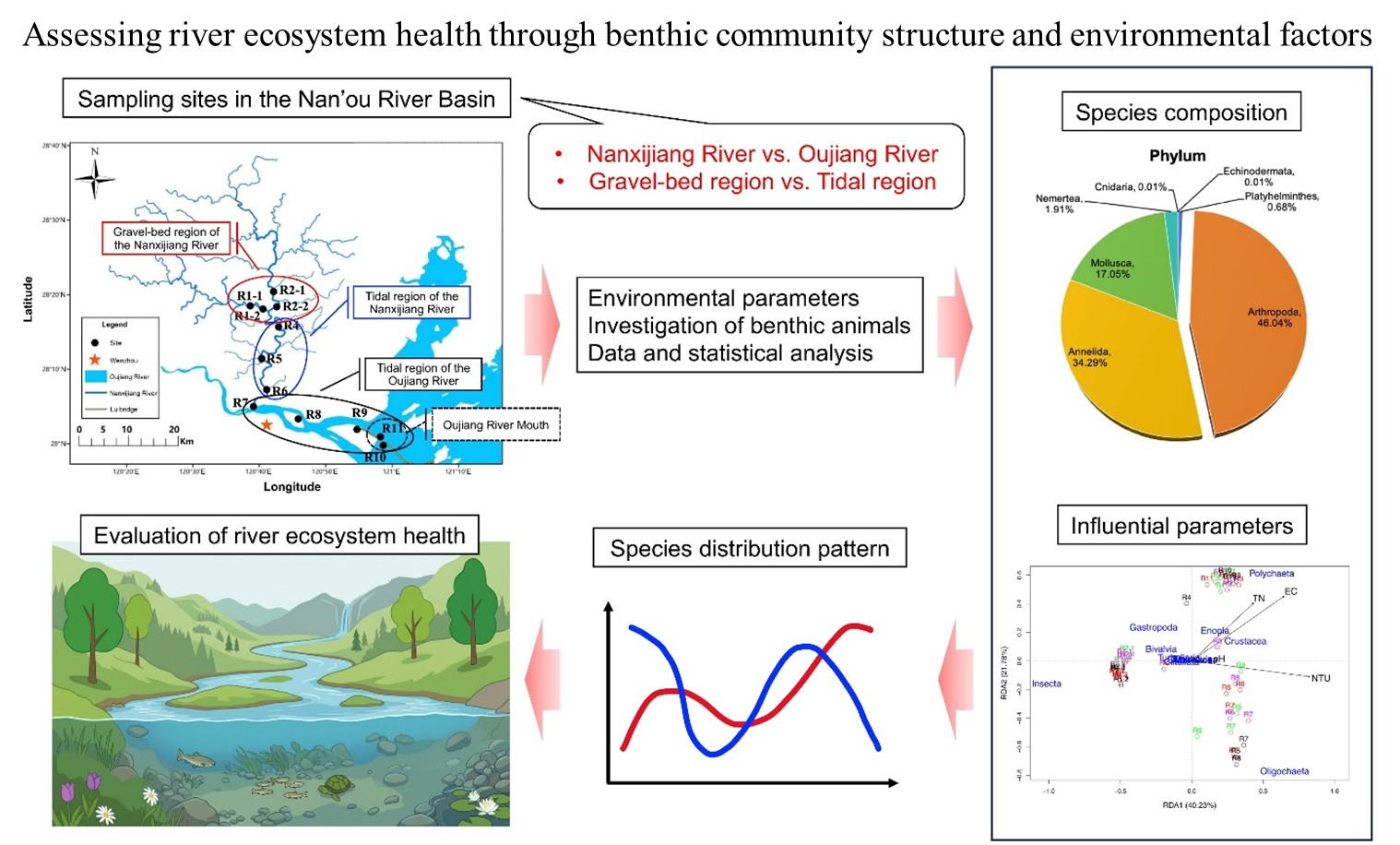
Macrobenthos, which are critical for ecological health through nutrient cycling, water quality maintenance, and food web dynamics, inhabit the bottoms of freshwater basins. This study investigated spatiotemporal dynamics of macrobenthos communities in the Nan’ou River Basin, covering the Nanxijiang and Oujiang Rivers in China, from 2021 to 2023, to assess river ecological health and resilience. A total of seven phyla, 12 classes, and 32 families of benthic macroinvertebrates were identified, with Arthropoda, Annelida, and Mollusca collectively dominating (97.38% of benthic composition), forming a typical riverine assemblage. Key findings revealed that spatial environmental gradients, particularly habitat heterogeneity (the gravel bed of the Nanxijiang River versus the tidal regions of both the Nanxijiang and Oujiang Rivers), exerted far stronger influence on community structure and biodiversity distribution than seasonal variation. Pielou’s evenness index remained relatively high despite fluctuating species richness, indicating a comparatively balanced and equitable community. Redundancy analysis identified total nitrogen, electrical conductivity, and turbidity as the primary drivers shaping benthic distribution, highlighting the significant roles of nutrient enrichment and sediment conditions, largely linked to anthropogenic pressures. These results highlight that habitat-specific conditions and anthropogenic factors predominantly shape benthic biodiversity in this basin, providing a critical scientific baseline for understanding its ecological dynamics and underscoring the need for further investigation into sources of organic pollution through monitoring of bioaccumulation in benthic organisms and trophic transfer in food webs.
- Arthington AH, Naiman RJ, McClain ME, Nilsson C. Preserving the biodiversity and ecological services of rivers: new challenges and research opportunities. Freshwater Biol. 2010;55(1):1-16. doi: 10.1111/j.1365-2427.2009.02340.x
- Dudgeon D. The ecology of tropical Asian rivers and streams in relation to biodiversity conservation. Annu Rev Ecol Evol Syst. 2000;31(1):239-263. doi: 10.1146/annurev.ecolsys.31.1.239
- Singh R, Tiwari AK, Singh GS. Managing riparian zones for river health improvement: an integrated approach. Landsc Ecol Eng. 2021;17(2):195-223. doi: 10.1007/s11355-020-00436-5
- Nilsson C, Renöfält BM. Linking flow regime and water quality in rivers: a challenge to adaptive catchment management. Ecol Soc. 2008;13(2):18. doi: 10.5751/ES-02588-130218
- Hauer FR, Locke H, Dreitz VJ, et al. Gravel-bed river floodplains are the ecological nexus of glaciated mountain landscapes. Sci Adv. 2016;2(6):e1600026. doi: 10.1126/sciadv.1600026
- Chang C, Ye H, Miki T, et al. Long-term warming weakens stabilizing effects of biodiversity in aquatic ecosystems. bioRxiv. Preprint posted online January 7, 2020. doi: 10.1101/2020.01.06.896746
- Herman PMJ, Middelburg JJ, Van de Koppel J, Heip CHR. Ecology of estuarine macrobenthos. In: Nedwell DB, Raffaelli DG, eds. Advances in Ecological Research. Vol 29. San Diego, DC, USA: Elsevier Academic Press; 1999:195- 240. doi: 10.1016/S0065-2504(08)60194-4
- Covich AP, Palmer MA, Crowl TA. The role of benthic invertebrate species in freshwater ecosystems: Zoobenthic species influence energy flows and nutrient cycling. BioScience. 1999;49(2):119-127. doi: 10.2307/1313537
- Wallace JB, Webster JR. The role of macroinvertebrates in stream ecosystem function. Annu Rev Entomol. 1996;41(1):115-139. doi: 10.1146/annurev.en.41.010196.000555
- Harris PT. Anthropogenic threats to benthic habitats. In: Harris PT, Baker E, eds. Seafloor Geomorphology as Benthic Habitat. 2nd ed. San Diego, DC, USA: Elsevier; 2020:35-61. doi: 10.1016/B978-0-12-814960-7.00003-8
- Li P, Li D, Sun X, Chu Z, Xia T, Zheng B. Application of ecological restoration technologies for the improvement of biodiversity and ecosystem in the river. Water. 2022;14(9):1402. doi: 10.3390/w14091402
- Hao A, Kobayashi S, Chen F, et al. Exploring invertebrate indicators of ecosystem health by focusing on the flow transitional zones in a large, shallow eutrophic lake. Environ Sci Pollut Res. 2023;30(34):82717-82731. doi: 10.1007/s11356-023-28045-3
- Wang S, Huang W, Xu S, Wan Z. Water pollution characteristics and water quality evaluation of Oujiang Estuary (2014-2018). Pol J Environ Stud. 2023;32(6):5403- 5410. doi: 10.15244/pjoes/169395
- Che J, Yu S, Zhang X, et al. Pollution characteristics, sources and potential ecological risk of heavy metals in surface sediment from the Lower Ou River. Ecol Sci. 2017;36:176- 184. doi: 10.14108/j.cnki.1008-8873.2017.04.024
- Zhang B, Zhang Z, Chen F, He K. Study on the morphological evolution of the Oujiang estuary, China, in the 21st century. J Mar Sci Eng. 2023;11(2):378. doi: 10.3390/jmse11020378
- Hua L, Hu J, Li Y, et al. Effects of cascading dams on water quality and macroinvertebrates in the Oujiang River, China. Water Resour. 2024;51(5):860-871. doi: 10.1134/S0097807823603114
- Hao A, Iseri Y, Yan Z, Liu X, Zhao M. Germination of phytoplankton resting cells in surface sediments collected from the tributary and littoral zones of Lake Taihu, China. Harmful Algae. 2025;142:102780. doi: 10.1016/j.hal.2024.102780
- Magurran AE. Measuring Biological Diversity. Oxford, UK: Blackwell Publishing; 2004:1-215. Available from: https:// www.perlego.com/book/1006601/measuring-biological-diversity-pdf [Last accessed on May 26, 2026].
- Shannon CE, Weaver W. A Mathematical Theory of Communication. Urbana, IL, USA: University of Illinois Press; 1964:1-125. Available from: https://pure.mpg.de/rest/ items/item_2383164_3/component/file_2383163/content [Last accessed on May 26, 2026].
- Pielou EC. The measurement of diversity in different types of biological collections. J Theor Biol. 1966;13:131-144. doi: 10.1016/0022-5193(66)90013-0
- Quinn GP, Keough MJ. Experimental Design and Data Analysis for Biologists. Cambridge University Press; 2002:1- 537. doi: 10.1017/CBO9780511806384.002
- Zuur AF, Ieno EN, Smith GM. Principal component analysis and redundancy analysis. In: Analysing Ecological Data. Statistics for Biology and Health. New York, NY. USA: Springer; 2007. doi: 10.1007/978-0-387-45972-1_12
- MathWorks. MATLAB (The Language of Technical Computing), Version 9.11.0 (R2021b). Natick, MA, USA: MathWorks; 2021. Available from: https://www.mathworks. com/products/new_products/release2021b.html [Last accessed on May 26, 2026].
- R Core Team. R: a Language and Environment for Statistical Computing. R Foundation for Statistical Computing; , Vienna, Austria. Version 1.4.1717. 2021. Available from: https://cran.r-project.org/doc/manuals/r-release/ fullrefman.pdf [Last accessed on May 26, 2026].
- Saeedi H, Warren D, Brandt A. The environmental drivers of benthic fauna diversity and community composition. Front Mar Sci. 2022;9:804019. doi: 10.3389/fmars.2022.804019
- Basset A, Galuppo N, Sabetta L. Environmental heterogeneity and benthic macroinvertebrate guilds in Italian lagoons. Transit Waters Bull. 2006;1:48-63. doi: 10.1285/I1825226XV1
- Saeedi H, Simões M, Brandt A. Endemicity and community composition of marine species along the NW Pacific and the adjacent Arctic Ocean. Prog Oceanogr. 2019;178:102199. doi: 10.1016/j.pocean.2019.102199
- Barbosa FAR, Callisto M, Galdean N. The diversity of benthic macroinvertebrates as an indicator of water quality and ecosystem health: a case study for Brazil. Aquat Ecosyst Health Manag. 2001;4(1):51-59. doi: 10.1080/146349801753569270
- Zhang W, Shen J, Wang J. Linking pollution to biodiversity and ecosystem multifunctionality across benthic-pelagic habitats of a large eutrophic lake: A whole-ecosystem perspective. Environ Pollut. 2021;285:117501. doi: 10.1016/j.envpol.2021.117501
- Le Hir M, Hily C. Macrofaunal diversity and habitat structure in intertidal boulder fields. Biodivers Conserv. 2005;14(1):233-250. doi: 10.1007/s10531-005-5046-0
- Post AL, Lavoie C, Domack EW, Leventer A, Shevenell A, Fraser AD. Environmental drivers of benthic communities and habitat heterogeneity on an East Antarctic shelf. Antarct Sci. 2016;29(1):17-32. doi: 10.1017/S0954102016000468
- Stanford JA, Ward JV. The hyporheic habitat of river ecosystems. Nature. 1988;335(6185):64-66. doi: 10.1038/335064a0
- Verdonschot PFM. Beyond masses and blooms: the indicative value of oligochaetes. Hydrobiologia. 2006;564(1):127-142. doi: 10.1007/s10750-005-1714-z
- Korn H. Studien zur Ökologie der Oligochaeten in der oberen Donau unter Berücksichtigung der Abwassereinwirkungen. Arch Hydrobiol. 1963;1(2):131-182.
- Uzunov Y. Aquatic Oligochaeta: a supplement to the list of limnosaprobic bioindicators. Proc Bulg Acad Sci. 1979;32:1101-1103. Available from: http://pascal-francis.inist.fr/vibad/index.php?action=getRecordDetail &idt=PASCALZOOLINEINRA8050350823 [Last accessed on May 26, 2026].
- Jabłońska A. Oligochaete communities of highly degraded urban streams in Poland, Central Europe. North-West J Zool. 2014;10:74-82. Available from: https://www.researchgate.net/publication/267324139_Oligochaete_communities_ of_highly_degraded_urban_streams_in_Poland_Central_Europe [Last accessed on May 26, 2026].
- Tubić B, Andjus S, Zorić K, et al. Aquatic insects (Ephemeroptera, Plecoptera and Trichoptera) metric as an important tool in water quality assessment in hilly and mountain streams. Water. 2024;16(6):849. doi: 10.3390/w16060849
- Cai Y, Gong Z, Qin B. Community structure and diversity of macrozoobenthos in Lake Taihu, a large shallow eutrophic lake in China. Biodivers Sci. 2010;18(1):50-59. doi: 10.3724/SP.J.1003.2010.050
- Mohamamad A, Jalal KCA. Macrobenthic diversity and community composition in the Pahang Estuary, Malaysia. J Coast Res. 2018;82:206-211. doi: 10.2112/SI82-030.1
- Gudimov A. An environmental engineering approach to wastewater treatment with bivalves in the coastal zone. IOP Conf Ser Earth Environ Sci. 2021;938(1):012021. doi: 10.1088/1755-1315/938/1/012021
- Shafiullah M, Altaf J, Qureshi NA, et al. Some morphometric records on Sinanodonta woodiana and Lamellidens marginalis (Mollusca: Bivalvia) from central reaches of Indus River, Pakistan. Pak J Agric Sci. 2021;58:967-973. doi: 10.21162/PAKJAS/21.303
- Schöne BR, Young H, Vonhof H, Harland J. Shells of Littorina littorea (Gastropoda) an archive for palaeoclimate and seasonal shellfish collection in medieval and early modern Orkney? Philos Trans R Soc B. 2025;380(1930):20240039. doi: 10.1098/rstb.2024.0039
- Zhu J, Jing K, Gan X, Ma Z. Food supply in intertidal area for shorebirds during stopover at Chongming Dongtan, China. Acta Ecol Sin. 2007;27(6):2149-2159. doi: 10.1016/S1872-2032(07)60045-6
- Blicher ME, Rysgaard S, Sejr MK. Seasonal growth variation in Chlamys islandica (Bivalvia) from sub-Arctic Greenland is linked to food availability and temperature. Mar Ecol Prog Ser. 2010;407:71-86. doi: 10.3354/meps08536
- Ballesta-Artero I, Janssen R, van der Meer J, Witbaard R. Interactive effects of temperature and food availability on the growth of Arctica islandica (Bivalvia) juveniles. Mar Environ Res. 2018;133:67-77. doi: 10.1016/j.marenvres.2017.12.004
- Sugihara G, May R, Ye H, et al. Detecting causality in complex ecosystems. Science. 2012;338(6106):496-500. doi: 10.1126/science.1227079
- Sugihara G, May RM. Nonlinear forecasting as a way of distinguishing chaos from measurement error in time series. Nature. 1990;344(6268):734-741. doi: 10.1038/344734a0
- Qu X, Peng W, Liu Y, et al. Networks and ordination analyses reveal the stream community structures of fish, macroinvertebrate and benthic algae, and their responses to nutrient enrichment. Ecol Indic. 2019;101:501-511. doi: 10.1016/j.ecolind.2019.01.030
- Yang Y, Yi Y, Zhou Y, Wang X, Zhang S, Yang Z. Spatio-temporal variations of benthic macroinvertebrates and the driving environmental variables in a shallow lake. Ecol Indic. 2020;110:105948. doi: 10.1016/j.ecolind.2019.105948
- Oremo J, Orata F, Owino J, Shivoga W. Assessment of heavy metals in benthic macroinvertebrates, water and sediments in River Isiukhu, Kenya. Environ Monit Assess. 2019;191(11):646. doi: 10.1007/s10661-019-7858-5
- Karadede-Akin H, Ünlü E. Heavy metal concentrations in water, sediment, fish and some benthic organisms from Tigris River, Turkey. Environ Monit Assess. 2007;131(1- 3):323-337. doi: 10.1007/s10661-006-9478-0
- Myslinski E, Ginsburg W. Macroinvertebrates as indicators of pollution. J Am Water Works Assoc. 1977;69:538-544. doi: 10.1007/s10201-019-00574-2
- Lukhabi DK, Mensah PK, Asare NK, Akwetey MFA, Faseyi CA. Benthic macroinvertebrates as indicators of water quality: A case study of estuarine ecosystems along the coast of Ghana. Heliyon. 2024;10(7):e28018. doi: 10.1016/j.heliyon.2024.e28018