
Insights into development trends for photocatalytic degradation of PFAS: A bibliometric time-series perspective

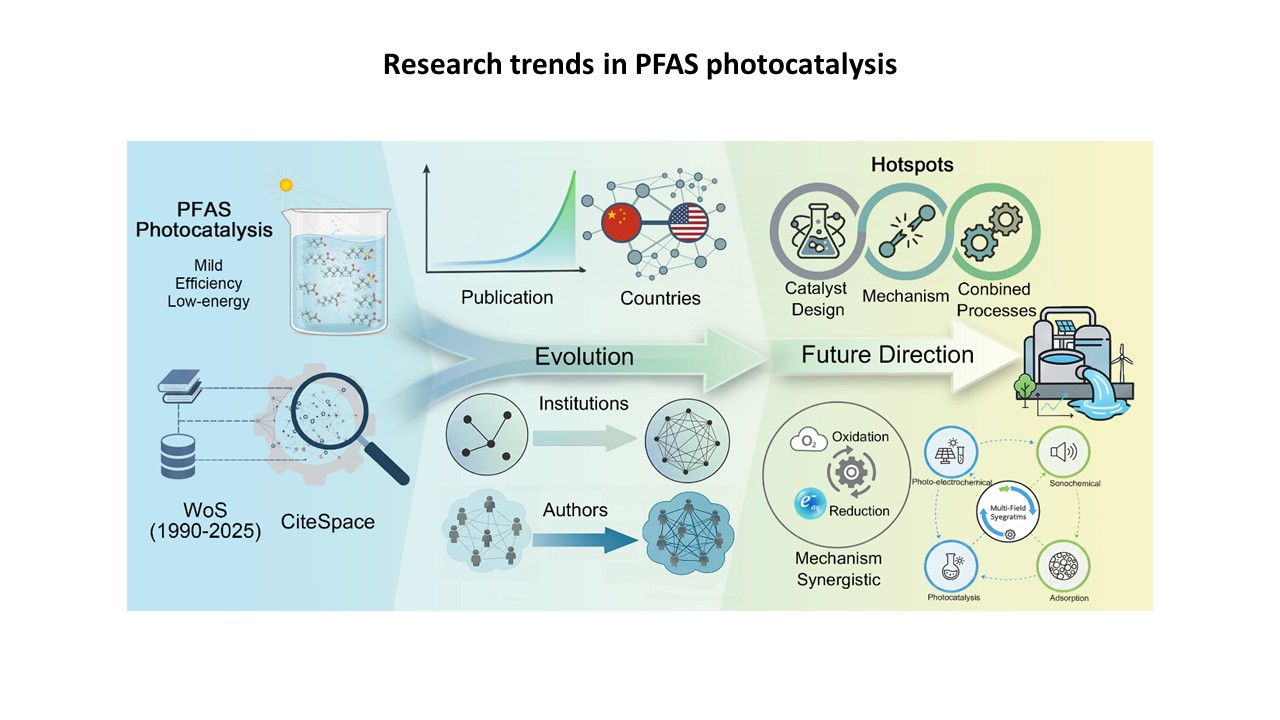
Photocatalytic degradation has attracted increasing attention for the remediation of per- and polyfluoroalkyl substances (PFAS) because of its mild operating conditions, high treatment efficiency and relatively low energy demand. Based on literature indexed in the Web of Science from 1999 to 2025, this study used CiteSpace to analyze research output, collaboration networks, high impact journals and keyword evolution, and to identify the scientific contributions of countries, regions, institutions and leading researchers. The analysis shows the development pattern and major hotspots of photocatalytic degradation of PFAS. The field has gone from slow growth before 2010 to rapid expansion since 2020. Both China and the United States lead the global output in publications, with Chinese institutions at the collaboration core, although isolated nodes still limit full integration. Keyword analysis indicates research hotspots in catalyst design, reaction mechanisms and combined processes with other technologies. The field is shifting from studies on single target compounds to system-scale remediation of contaminant classes, and from mainly oxidative pathways to reductive and synergistic mechanisms. These trends emphasize process integration and practical application, while also pointing to frontier topics, knowledge gaps and directions for future research.
- Higgins CP, Field JA, Criddle CS, Luthy RG. Quantitative determination of perfluorochemicals in sediments and domestic sludge. Environ Sci Technol. 2005;39(11):3946-3956. doi: 10.1021/es048245p
- Kim SK, Kannan K. Perfluorinated acids in air, rain, snow, surface runoff, and lakes: relative importance of pathways to contamination of urban lakes. Environ Sci Technol. 2007;41(24):8328-8334. doi: 10.1021/es072107t
- Sun H, Li F, Zhang T, et al. Perfluorinated compounds in surface waters and WWTPs in Shenyang, China: mass flows and source analysis. Water Res. 2011;45(15):4483-4490. doi: 10.1016/j.watres.2011.05.036
- Houtz EF, Higgins CP, Field JA, Sedlak DL. Persistence of perfluoroalkyl acid precursors in AFFF-impacted groundwater and soil. Environ Sci Technol. 2013;47(15):8187-8195. doi: 10.1021/es4018877
- Kotthoff M, Müller J, Jürling H, Schlummer M, Fiedler D. Perfluoroalkyl and polyfluoroalkyl substances in consumer products. Environ Sci Pollut Res Int. 2015;22(19):14546-14559. doi: 10.1007/s11356-015-4202-7
- Lewis RC, Johns LE, Meeker JD. Serum biomarkers of exposure to perfluoroalkyl substances in relation to serum testosterone and measures of thyroid function among adults and adolescents from NHANES 2011-2012. Int J Environ Res Public Health. 2015;12(6):6098-6114. doi: 10.3390/ijerph120606098
- Giesy JP, Kannan K. Global distribution of perfluorooctane sulfonate in wildlife. Environ Sci Technol. 2001;35(7):1339-1342. doi: 10.1021/es001834k
- Neuwald IJ, Hübner D, Wiegand HL, et al. Ultra-short-chain PFASs in the sources of German drinking water: prevalent, overlooked, difficult to remove, and unregulated. Environ Sci Technol. 2022;56(10):6380-6390. doi: 10.1021/acs.est.1c07949
- Yan H, Cousins IT, Zhang C, Zhou Q. Perfluoroalkyl acids in municipal landfill leachates from China: occurrence, fate during leachate treatment and potential impact on groundwater. Sci Total Environ. 2015;524-525:23-31. doi: 10.1016/j.scitotenv.2015.03.111
- Na S, Hai R, Wang X, Li N. Trends and levels of perfluorinated compounds in soil and sediment surrounding a cluster of metal plating industries. Soil Sediment Contam. 2021;30(4):423-435. doi: 10.1080/15320383.2020.1863908
- Yadav S, Ibrar I, Al-Juboori RA, et al. Updated review on emerging technologies for PFAS contaminated water treatment. Chem Eng Res Des. 2022;182:667-700. doi: 10.1016/j.cherd.2022.04.009
- Arvaniti OS, Stasinakis AS, Barceló D. Review on the occurrence, fate and removal of perfluorinated compounds during wastewater treatment. Sci Total Environ. 2015;524-525:81-92. doi: 10.1016/j.scitotenv.2015.04.023
- Cordner A, Goldenman G, Birnbaum LS, et al. The true cost of PFAS and the benefits of acting now. Environ Sci Technol. 2021;55(14):9630-9633. doi: 10.1021/acs.est.1c03565
- Dolbier WR Jr. Fluorine chemistry at the millennium. J Fluor Chem. 2005;126(2):157-163. doi: 10.1016/j.jfluchem.2004.09.033
- Deng S, Yu Q, Huang J, Yu G. Removal of perfluorooctane sulfonate from wastewater by anion exchange resins: effects of resin properties and solution chemistry. Water Res. 2010;44(18):5188-5195. doi: 10.1016/j.watres.2010.06.038
- Klamerth N, Malato S, Agüera A, Fernández-Alba AR. Photo-Fenton and modified photo-Fenton at neutral pH for the treatment of emerging contaminants in wastewater treatment plant effluents: a comparison. Water Res. 2013;47(2):833-840. doi: 10.1016/j.watres.2012.11.008
- Huang J, Wang X, Pan Z, Li X, Ling Y, Li L. Efficient degradation of perfluorooctanoic acid (PFOA) by photocatalytic ozonation. Chem Eng J. 2016;296:329-334. doi: 10.1016/j.cej.2016.03.116
- Qu Y, Zhang C, Li F, Chen J, Zhou Q. Photo-reductive defluorination of perfluorooctanoic acid in water. Water Res. 2010;44(9):2939-2947. doi: 10.1016/j.watres.2010.02.019
- Huang S, Jaffé PR. Defluorination of perfluorooctanoic acid (PFOA) and perfluorooctane sulfonate (PFOS) by Acidimicrobium sp. strain A6. Environ Sci Technol. 2019;53(19):11410-11419. doi: 10.1021/acs.est.9b04047
- Yang B, Han Y, Yu G, et al. Efficient removal of perfluoroalkyl acids (PFAAs) from aqueous solution by electrocoagulation using iron electrode. Chem Eng J. 2016;303:384-390. doi: 10.1016/j.cej.2016.06.011
- Niu J, Wang C, Shang E. Removal of perfluorinated compounds from wastewaters by electrochemical methods: a general review. Sci Sin Technol. 2017;47(12):1233-1255. doi: 10.1360/N092017-00116
- Tonks L, Langmuir I. Oscillations in ionized gases. Phys Rev. 1929;33(2):195-210. doi: 10.1103/PhysRev.33.195
- Hori H, Nagaoka Y, Yamamoto A, et al. Efficient decomposition of environmentally persistent perfluorooctanesulfonate and related fluorochemicals using zerovalent iron in subcritical water. Environ Sci Technol. 2006;40(3):1049-1054. doi: 10.1021/es0517419
- Liu X, Wei W, Xu J, Wang D, Song L, Ni BJ. Photochemical decomposition of perfluorochemicals in contaminated water. Water Res. 2020;186:116311. doi: 10.1016/j.watres.2020.116311
- Gao Y, Ge L, Shi S, et al. Global trends and future prospects of e-waste research: a bibliometric analysis. Environ Sci Pollut Res Int. 2019;26(17):17809-17820. doi: 10.1007/s11356-019-05071-8
- Chen P, Li J, Wang HY, Zheng RL, Sun GX. Evaluation of bioaugmentation and biostimulation on arsenic remediation in soil through biovolatilization. Environ Sci Pollut Res Int. 2017;24(27):21739-21749. doi: 10.1007/s11356-017-9816-5
- Xia M, Chen B, Fan G, et al. The shifting research landscape for PAH bioremediation in water environment: a bibliometric analysis on three decades of development. Environ Sci Pollut Res Int. 2023;30(27):69711-69726. doi: 10.1007/s11356-023-27404-4
- Zhang L, Thijs B, Glänzel W. What does scientometrics share with other “metrics” sciences? J Am Soc Inf Sci Technol. 2013;64(7):1515-1518. doi: 10.1002/asi.22834
- Moed HF. New developments in the use of citation analysis in research evaluation. Arch Immunol Ther Exp. 2009;57(1):13-18. doi: 10.1007/s00005-009-0001-5
- Peritz BC, Bar-Ilan J. The sources used by bibliometrics-scientometrics as reflected in references. Scientometrics. 2002;54(2):269-284. doi: 10.1023/a:1016018013096
- Moral-Muñoz JA, Herrera-Viedma E, Santisteban-Espejo A, Cobo MJ. Software tools for conducting bibliometric analysis in science: an up-to-date review. Prof Inf. 2020;29(1): e290103. doi: 10.3145/epi.2020.ene.03
- Lyu P, Liu X, Yao T. A bibliometric analysis of literature on bibliometrics in recent half-century. J Inf Sci. 2026;52(2):324-344. doi: 10.1177/01655515231191233
- Donthu N, Kumar S, Mukherjee D, Pandey N, Lim WM. How to conduct a bibliometric analysis: an overview and guidelines. J Bus Res. 2021;133:285-296. doi: 10.1016/j.jbusres.2021.04.070
- Mongeon P, Paul-Hus A. The journal coverage of Web of Science and Scopus: a comparative analysis. Scientometrics. 2016;106(1):213-228. doi: 10.1007/s11192-015-1765-5
- Martín-Martín A, Orduna-Malea E, Thelwall M, Delgado López-Cózar E. Google Scholar, Web of Science, and Scopus: a systematic comparison of citations in 252 subject categories. J Informetr. 2018;12(4):1160-1177. doi: 10.1016/j.joi.2018.09.002
- Zhu J, Liu W. A tale of two databases: the use of Web of Science and Scopus in academic papers. Scientometrics. 2020;123(1):321-335. doi: 10.1007/s11192-020-03387-8
- Clemente DH, Hsuan J, de Carvalho MM. The intersection between business model and modularity: an overview of the literature. Braz J Oper Prod Manag. 2019;16(3):387-397. doi: 10.14488/BJOPM.2019.v16.n3.a3
- Van Eck NJ, Waltman L. VOS: A new method for visualizing similarities between objects. In: Decker R, Lenz HJ, eds. Advances in Data Analysis. Studies in Classification, Data Analysis, and Knowledge Organization. Springer; 2007:299-306. doi: 10.1007/978-3-540-70981-7_34
- Rabbani MRA, Bashar A, Atif M, Jreisat A, Zulfikar Z, Naseem Y. Text mining and visual analytics in research: exploring the innovative tools. In: Proceedings of the 2021 International Conference on Decision Aid Sciences and Application (DASA). IEEE; 2021:1087-1091. doi: 10.1109/DASA53625.2021.9682360
- AlRyalat SAS, Malkawi LW, Momani SM. Comparing bibliometric analysis using PubMed, Scopus, and Web of Science databases. J Vis Exp. 2019;(152):58494. doi: 10.3791/58494
- Martín-Martín A, Thelwall M, Orduna-Malea E, Delgado López-Cózar E. Google Scholar, Microsoft Academic, Scopus, Dimensions, Web of Science, and OpenCitations’ COCI: a multidisciplinary comparison of coverage via citations. Scientometrics. 2021;126(1):871-906. doi: 10.1007/s11192-020-03690-4
- Li C, Huang G, Cheng G, Zheng M, Zhou N. Nanomaterials in the environment: research hotspots and trends. Int J Environ Res Public Health. 2019;16(24):5138. doi: 10.3390/ijerph16245138
- Li Y, Xu Z, Wang X, Wang X. A bibliometric analysis on deep learning during 2007-2019. Int J Mach Learn Cybern. 2020;11(12):2807-2826. doi: 10.1007/s13042-020-01152-0
- Zhu JJ, Dressel W, Pacion K, Ren ZJ. ES&T in the 21st century: a data-driven analysis of research topics, interconnections, and trends in the past 20 years. Environ Sci Technol. 2021;55(6):3453-3464. doi: 10.1021/acs.est.0c07551
- Nohara K, Toma M, Kutsuna S, Takeuchi K, Ibusuki T. Photocatalytic degradation of some methyl perfluoroalkyl ethers on TiO2 particles in air: the dependence on the dark-adsorption, the products, and the implication for a possible tropospheric sink. Environ Sci Technol. 1999;33(7):1071-1076. doi: 10.1021/es980370b
- US Environmental Protection Agency. Perfluoroalkyl sulfonates; significant new use rule. Fed Regist. 2002;67(236):72854-72867. Available from: https://www.federalregister.gov/documents/2002/12/09/02-31011/perfluoroalkyl-sulfonates-significant-new-use-rule [Last accessed on May 28, 2026].
- Paul AG, Jones KC, Sweetman AJ. A first global production, emission, and environmental inventory for perfluorooctane sulfonate. Environ Sci Technol. 2009;43(2):386-392. doi: 10.1021/es802216n
- Chen K, Berg N, Gschwind R, König B. Selective single C(sp3)–F bond cleavage in trifluoromethylarenes: Merging visible-light catalysis with Lewis acid activation. J Am Chem Soc. 2017;139(51):18444-18447. doi: 10.1021/jacs.7b10755
- Bao Y, Deng S, Jiang X, et al. Degradation of PFOA substitute: GenX (HFPO-DA ammonium salt): oxidation with UV/persulfate or reduction with UV/sulfite? Environ Sci Technol. 2018;52(20):11728-11734. doi: 10.1021/acs.est.8b02172
- Trojanowicz M, Bojanowska-Czajka A, Bartosiewicz I, Kulisa K. Advanced oxidation/reduction processes treatment for aqueous perfluorooctanoate (PFOA) and perfluorooctanesulfonate (PFOS): a review of recent advances. Chem Eng J. 2018;336:170-199. doi: 10.1016/j.cej.2017.10.153
- Liu K, Liang J, Zhang N, et al. Global perspectives for biochar application in the remediation of heavy metal-contaminated soil: a bibliometric analysis over the past three decades. Int J Phytoremediation. 2023;25(8):1052-1066. doi: 10.1080/15226514.2022.2128038
- Fonseca BPFE, Sampaio RB, Fonseca MVA, Zicker F. Co-authorship network analysis in health research: method and potential use. Health Res Policy Syst. 2016;14(1):34. doi: 10.1186/s12961-016-0104-5
- Morel CM, Serruya SJ, Penna GO, Guimarães R. Co-authorship network analysis: a powerful tool for strategic planning of research, development and capacity building programs on neglected diseases. PLoS Negl Trop Dis. 2009;3(8):e501. doi: 10.1371/journal.pntd.0000501
- Higaki A, Uetani T, Ikeda S, Yamaguchi O. Co-authorship network analysis in cardiovascular research utilizing machine learning (2009-2019). Int J Med Inform. 2020;143:104274. doi: 10.1016/j.ijmedinf.2020.104274
- Li Z, Zhang P, Li J, Shao T, Jin L. Synthesis of In2O3-graphene composites and their photocatalytic performance towards perfluorooctanoic acid decomposition. J Photochem Photobiol A Chem. 2013;271:111-116. doi: 10.1016/j.jphotochem.2013.08.012
- Wang Y, Zhang P. Photocatalytic decomposition of perfluorooctanoic acid (PFOA) by TiO2 in the presence of oxalic acid. J Hazard Mater. 2011;192(3):1869-1875. doi: 10.1016/j.jhazmat.2011.07.026
- Yang P, Luo S, Liu Q, et al. Rape straw biochar-assisted preparation of flower-like BiOCl with enriched oxygen vacancies for efficient photocatalytic CO2 reduction and pollutants degradation. J Phys Chem Solids. 2025;196:112400. doi: 10.1016/j.jpcs.2024.112400
- Li H, Luo R, Zhong J, et al. In-situ construction of h-BN/BiOCl heterojunctions with rich oxygen vacancies for rapid photocatalytic removal of typical contaminants. Colloids Surf A Physicochem Eng Asp. 2023;659:130756. doi: 10.1016/j.colsurfa.2022.130756
- Barata-Vallejo S, Bonesi SM, Postigo A. Photocatalytic fluoroalkylation reactions of organic compounds. Org Biomol Chem. 2015;13(46):11153-11183. doi: 10.1039/c5ob01486g
- Torviso MR, Mansilla DS, Garcia S, et al. Late-stage electron-catalyzed perfluoroalkylation of coumarin derivatives: thermal fluoroalkyl radical production from sodium perfluoroalkyl sulfinate salts. J Fluor Chem. 2017;197:42-48. doi: 10.1016/j.jfluchem.2017.03.005
- Su Y, Kuijpers KPL, König NJ, Shang M, Hessel V, Noël T. A mechanistic investigation of the visible-light photocatalytic trifluoromethylation of heterocycles using CF3I in flow. Chem Eur J. 2016;22(35):12295-12300. doi: 10.1002/chem.201602596
- Straathof NJW, Gemoets HPL, Wang X, Schouten JC, Hessel V, Noël T. Rapid trifluoromethylation and perfluoroalkylation of five-membered heterocycles by photoredox catalysis in continuous flow. Chem Sus Chem. 2014;7(6):1612-1617. doi: 10.1002/cssc.201301282
- Davtalab M, Byčenkienė S, Uogintė I. Global research hotspots and trends on microplastics: a bibliometric analysis. Environ Sci Pollut Res Int. 2023;30(49):107403-107418. doi: 10.1007/s11356-023-27647-1