

From oral and intestinal organoids to an integrated oral–gut organoid-on-a-chip

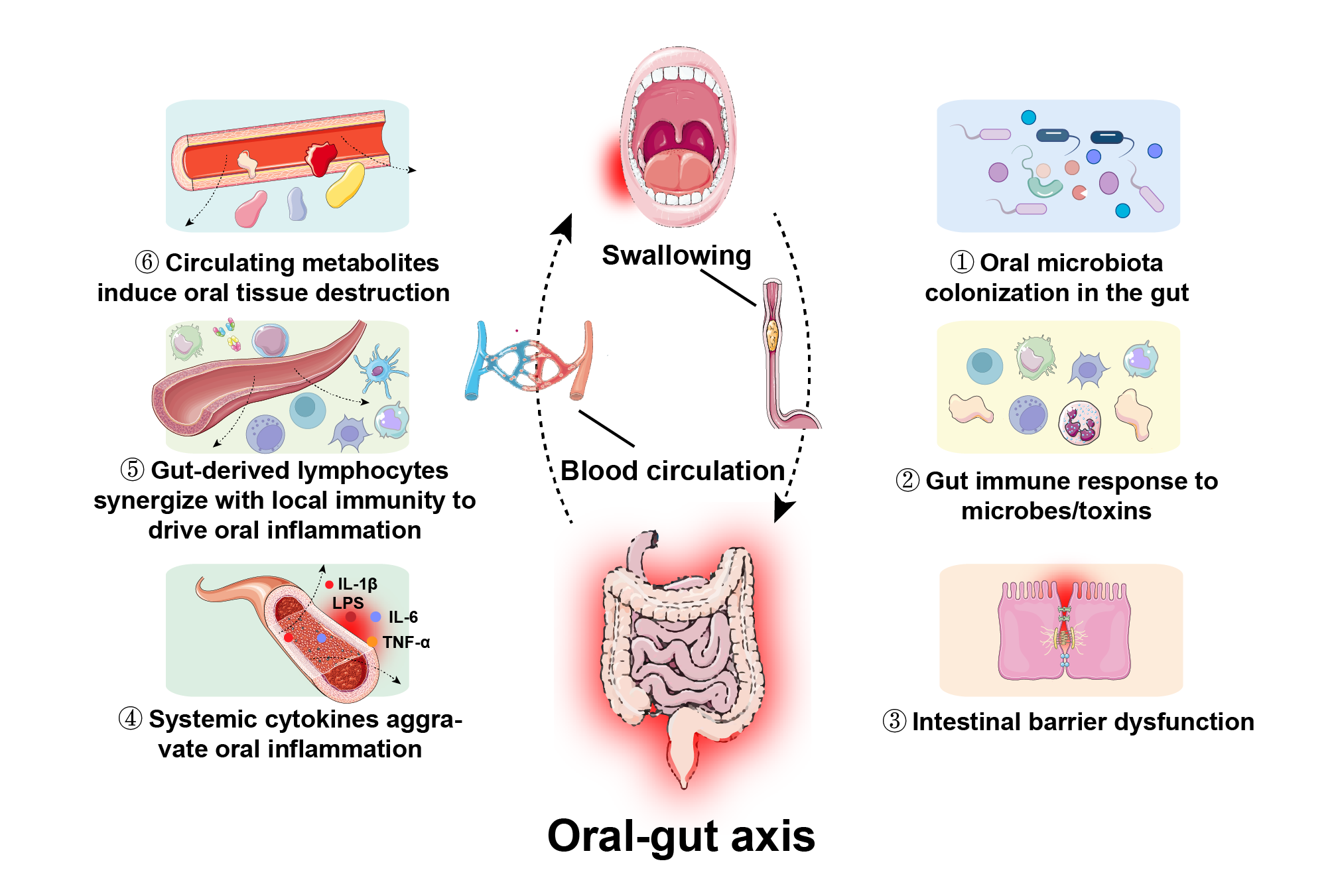
Research on the oral–gut axis has progressed from association studies to mechanistic understanding. However, the pathways by which oral-derived microorganisms, metabolites, and inflammatory signals traverse gastrointestinal barriers and affect intestinal homeostasis remain poorly defined. A major reason is the lack of controllable, human-relevant in vitro models. Existing approaches, including animal models, two-dimensional cultures, and conventional organoids, have major limitations, such as interspecies differences, simplified architecture, incomplete niche representation, and insufficient inter-organ connectivity. Various organoid-on-a-chip systems have been experimentally validated for modeling tissue-specific processes under controlled conditions, yet an integrated platform that connects the oral cavity and the intestine has not been realized. This review outlines key requirements for recapitulating oral–gut axis pathogenesis in vitro, including human-relevant cellular composition, long-term coculture, niche reconstruction, and inter-organ transport. We then examine the technological advances of intestinal organoid-on-a-chip platforms, focusing on anaerobic control, epithelial barrier reconstruction, real-time monitoring, and immune cell integration. We also summarize advances in oral organoid models for mucosal simulation, microbial coculture, and vascularization. Building on these advances, we discuss design principles from multi-organ systems—modular integration, fluidic coupling, functional scaling, and physiologically based pharmacokinetic and pharmacokinetic/pharmacodynamic-assisted design—that can guide oral–gut integration. We further identify key challenges in constructing such systems, including oxygen gradient control, gastric acid barrier reconstruction, and modeling of dynamic processes such as microbial translocation and rhythmic transport. Addressing these challenges will be essential for establishing a robust platform. Together, these considerations provide a rationale and design basis for future efforts to develop an integrated oral–gut organoid-on-a-chip platform that would enable modeling of bidirectional interactions between oral and intestinal pathologies.
- She YY, Kong XB, Ge YP, et al. Periodontitis and inflammatory bowel disease: a meta-analysis. BMC Oral Health. 2020;20(1):67. doi: 10.1186/s12903-020-1053-5
- Naghsh N, Karimi F, Tarrahi MJ, Rahimi A. Evaluation of the association between periodontitis and inflammatory bowel disease: A systematic review and Meta-analysis. BMC Gastroenterol. 2025;25(1):594. doi: 10.1186/s12876-025-04181-7
- Wu Y, Ji D, Chen X, Wang L, Ye F. Association Between Intestinal Diseases and Periodontitis: A Systematic Review and Meta-Analysis. Oral Dis. 2025;31(6):1603-1625. doi: 10.1111/odi.15260
- Li W, Xu J, Zhang R, et al. Is periodontal disease a risk indicator for colorectal cancer? A systematic review and meta-analysis. J Clin Periodontol. 2021;48(3):336-347. doi: 10.1111/jcpe.13402
- Duan C, Wan W, Tureke M, et al. Periodontal Disease and Incidence of Cancers: A Systematic Review and Meta-analysis of Cohort Studies. Int Dent J. 2026;76(3):109527. doi: 10.1016/j.identj.2026.109527
- Lee SY, Kim KH. Association of oral disease with cancer incidence and mortality among adults in South Korea: A nationwide retrospective cohort study. Sci Prog. 2025;108(2):368504251345632. doi: 10.1177/00368504251345632
- Wang Q, Gu WJ, Ning FL, et al. Association between Periodontal Diseases and the Risk of Site-Specific Gastrointestinal Cancers: A Systematic Review and Meta-Analysis. J Dent Res. 2024;103(10):962-972. doi: 10.1177/00220345241263768
- Klimesova K, Jiraskova Zakostelska Z, Tlaskalova-Hogenova H. Oral Bacterial and Fungal Microbiome Impacts Colorectal Carcinogenesis. Front Microbiol. 2018;9:774. doi: 10.3389/fmicb.2018.00774
- Schmidt TS, Hayward MR, Coelho LP, et al. Extensive transmission of microbes along the gastrointestinal tract. eLife. 2019;8:e42693. doi: 10.7554/eLife.42693
- Xu Q, Wang W, Li Y, et al. The oral-gut microbiota axis: a link in cardiometabolic diseases. npj Biofilms Microbiomes. 2025;11(1):11. doi: 10.1038/s41522-025-00646-5
- Li C, Fan Y, Chen X. Oral microbiota-driven immune modulation along the oral-gut axis: from local signals to systemic inflammation. npj Biofilms Microbiomes. 2026;12(1):46. doi: 10.1038/s41522-026-00912-0
- Harrandah AM. The Oral-Gut-Systemic Axis: Emerging Insights into Periodontitis, Microbiota Dysbiosis, and Systemic Disease Interplay. Diagnostics. 2025;15(21):2784. doi: 10.3390/diagnostics15212784
- Kunath BJ, De Rudder C, Laczny CC, Letellier E, Wilmes P. The oral-gut microbiome axis in health and disease. Nat Rev Microbiol. 2024;22(12):791-805. doi: 10.1038/s41579-024-01075-5
- Ebihara S, Kamada N. The Oral-Gut Axis: Bidirectional Interactions Between Microbiome and Diseases. J Periodontal Res. 2026. doi: 10.1111/jre.70116
- Gibbons DL, Spencer J. Mouse and human intestinal immunity: same ballpark, different players; different rules, same score. Mucosal Immunol. 2011;4(2):148-157. doi: 10.1038/mi.2010.85
- Nagpal R, Wang S, Solberg Woods LC, et al. Comparative Microbiome Signatures and Short-Chain Fatty Acids in Mouse, Rat, Non-human Primate, and Human Feces. Front Microbiol. 2018;9:2897. doi: 10.3389/fmicb.2018.02897
- Nguyen TLA, Vieira-Silva S, Liston A, Raes J. How informative is the mouse for human gut microbiota research? Dis Model Mech. 2015;8(1):1-16. doi: 10.1242/dmm.017400
- Gopinath D, Pandiar D, Li Z, Panda S. Rodent models for oral microbiome research: considerations and challenges- a mini review. Front Oral Health. 2024;5:1439091. doi: 10.3389/froh.2024.1439091
- McCafferty J, Mühlbauer M, Gharaibeh RZ, et al. Stochastic changes over time and not founder effects drive cage effects in microbial community assembly in a mouse model. ISME J. 2013;7(11):2116-2125. doi: 10.1038/ismej.2013.106
- Lv C, Wang Z, Li Z, Shi X, Xiao M, Xu Y. Formation, architecture, and persistence of oral biofilms: recent scientific discoveries and new strategies for their regulation. Front Microbiol. 2025;16. doi: 10.3389/fmicb.2025.1602962
- Li B, Ge Y, Cheng L, et al. Oral bacteria colonize and compete with gut microbiota in gnotobiotic mice. Int J Oral Sci. 2019;11(1):10. doi: 10.1038/s41368-018-0043-9
- Li Y, Cao W, Gao NL, Zhao XM, Chen WH. Consistent Alterations of Human Fecal Microbes After Transplantation into Germ-free Mice. Genom Proteom Bioinform. 2022;20(2):382-393. doi: 10.1016/j.gpb.2020.06.024
- Gagnon M, Zihler Berner A, Chervet N, Chassard C, Lacroix C. Comparison of the Caco-2, HT-29 and the mucus-secreting HT29-MTX intestinal cell models to investigate Salmonella adhesion and invasion. J Microbiol Methods. 2013;94(3):274-279. doi: 10.1016/j.mimet.2013.06.027
- Shang L, Deng D, Krom BP, Gibbs S. Oral host-microbe interactions investigated in 3D organotypic models. Crit Rev Microbiol. 2024;50(4):397-416. doi: 10.1080/1040841X.2023.2211665
- Shin W, Wu A, Massidda MW, et al. A Robust Longitudinal Co-culture of Obligate Anaerobic Gut Microbiome With Human Intestinal Epithelium in an Anoxic-Oxic Interface-on-a-Chip. Front Bioeng Biotechnol. 2019;7:13. doi: 10.3389/fbioe.2019.00013
- Ashammakhi N, Nasiri R, Roberto De Barros N, et al. Gut-on-a-chip: Current Progress and Future Opportunities. Biomaterials. 2020;255:120196. doi: 10.1016/j.biomaterials.2020.120196
- Charoensri T, Kulthong K, Pormrungruang P, et al. Enterocyte Culture on a Hybrid Transwell-Inserted Gut-on-a-Chip for Liquid–Liquid and Air–Liquid Interface Conditions. ACS Omega. 2025;10(45):53865-53873. doi: 10.1021/acsomega.5c03215
- Min S, Kim S, Cho SW. Gastrointestinal tract modeling using organoids engineered with cellular and microbiota niches. Exp Mol Med. 2020;52(2):227-237. doi: 10.1038/s12276-020-0386-0
- Owusu EK, Sinzinkayo D, Wang Y, Liu N, Yue T. A closed-loop microfluidic platform for enhanced gut organoid maturation via physicochemical control and morphodynamic feedback. Gene. 2026;991:150074. doi: 10.1016/j.gene.2026.150074
- Hu W, Wang Y, Han J, et al. Microfluidic organ-on-a-chip models for the gut-liver axis: from structural mimicry to functional insights. Biomater Sci. 2025;13(7):1624-1656. doi: 10.1039/d4bm01273a
- Kim J, Koo BK, Knoblich JA. Human organoids: model systems for human biology and medicine. Nat Rev Mol Cell Biol. 2020;21(10):571-584. doi: 10.1038/s41580-020-0259-3
- Puschhof J, Pleguezuelos-Manzano C, Clevers H. Organoids and organs-on-chips: Insights into human gut-microbe interactions. Cell Host Microbe. 2021;29(6):867-878. doi: 10.1016/j.chom.2021.04.002
- Kumar S, Sarkar B. From rodents to chips: preclinical models of inflammatory bowel disease with emphasis on host-microbiome interactions. Am J Physiol -Gastrointest Liver Physiol. 2026;330(4):G397-G413. doi: 10.1152/ajpgi.00345.2025
- Azzolino D, Carnevale-Schianca M, Santacroce L, et al. The Oral-Gut Microbiota Axis Across the Lifespan: New Insights on a Forgotten Interaction. Nutrients. 2025;17(15):2538. doi: 10.3390/nu17152538
- Arimatsu K, Yamada H, Miyazawa H, et al. Oral pathobiont induces systemic inflammation and metabolic changes associated with alteration of gut microbiota. Sci Rep. 2014;4:4828. doi: 10.1038/srep04828
- Nakajima M, Arimatsu K, Kato T, et al. Oral Administration of P. gingivalis Induces Dysbiosis of Gut Microbiota and Impaired Barrier Function Leading to Dissemination of Enterobacteria to the Liver. PLoS ONE. 2015;10(7):e0134234. doi: 10.1371/journal.pone.0134234
- Huo T, Huang X, Liao J, Zhang H, Hu L, Xie M. The bidirectional effects and mechanisms of the oral and gut microbiomes: a narrative review. Front Immunol. 2026;17:1697413. doi: 10.3389/fimmu.2026.1697413
- Imai J, Kitamoto S, Kamada N. The pathogenic oral-gut-liver axis: new understandings and clinical implications. Expert Rev Clin Immunol. 2021;17(7):727-736. doi: 10.1080/1744666X.2021.1935877
- Gan G, Chen R, Zheng P, et al. Oral pathogens meet the gut microbiome: new mechanistic insights on systemic disease. Front Cell Infect Microbiol. 2025;15:1673512. doi: 10.3389/fcimb.2025.1673512
- Kim R, Attayek PJ, Wang Y, et al. An in vitro intestinal platform with a self-sustaining oxygen gradient to study the human gut/microbiome interface. Biofabrication. 2019;12(1):015006. doi: 10.1088/1758-5090/ab446e
- Grant J, Lee E, Almeida M, et al. Establishment of physiologically relevant oxygen gradients in microfluidic organ chips. Lab Chip. 2022;22(8):1584-1593. doi: 10.1039/d2lc00069e
- Jalili-Firoozinezhad S, Gazzaniga FS, Calamari EL, et al. A complex human gut microbiome cultured in an anaerobic intestine-on-a-chip. Nat Biomed Eng. 2019;3(7):520-531. doi: 10.1038/s41551-019-0397-0
- Jalili-Firoozinezhad S, Bein A, Gazzaniga FS, Fadel CW, Novak R, Ingber DE. Establishment of a Modular Anaerobic Human Intestine Chip. Methods Mol Biol. 2022;2373:69-85. doi: 10.1007/978-1-0716-1693-2_5
- Villegas-Novoa C, Wang Y, Sims CE, Allbritton NL. Creation of a spatially complex mucus bilayer on an in vitro colon model. Sci Rep. 2024;14(1):16849. doi: 10.1038/s41598-024-67591-9
- Wang Y, Kim R, Sims CE, Allbritton NL. Building a Thick Mucus Hydrogel Layer to Improve the Physiological Relevance of In Vitro Primary Colonic Epithelial Models. Cell Mol Gastroenterol Hepatol. 2019;8(4):653-655.e5. doi: 10.1016/j.jcmgh.2019.07.009
- Ouahoud S, Giugliano FP, Muncan V. Monitoring Intestinal Organoid-Derived Monolayer Barrier Functions with Electric Cell-Substrate Impedance Sensing (ECIS). Bio Protoc. 2024;14(5):e4947. doi: 10.21769/BioProtoc.4947
- Ahn J, Jung KB, Kwon O, et al. Impedance Measurement System for Assessing the Barrier Integrity of Three-Dimensional Human Intestinal Organoids. Anal Chem. 2021;93(25):8826-8834. doi: 10.1021/acs.analchem.1c00655
- Lucchetti M, Werr G, Johansson S, et al. Integration of multiple flexible electrodes for real-time detection of barrier formation with spatial resolution in a gut-on-chip system. Microsyst Nanoeng. 2024;10:18. doi: 10.1038/s41378-023-00640-x
- Jones CG, Chen C. A customizable continuous and near real-time TEER platform to study anti-cancer drug toxicity in barrier tissues. J Pharm Anal. 2025;15(12):101266. doi: 10.1016/j.jpha.2025.101266
- Lin M, Hartl K, Heuberger J, et al. Establishment of gastrointestinal assembloids to study the interplay between epithelial crypts and their mesenchymal niche. Nat Commun. 2023;14(1):3025. doi: 10.1038/s41467-023-38780-3
- Eicher AK, Kechele DO, Sundaram N, et al. Functional human gastrointestinal organoids can be engineered from three primary germ layers derived separately from pluripotent stem cells. Cell Stem Cell. 2022;29(1):36-51.e6. doi: 10.1016/j.stem.2021.10.010
- Childs CJ, Poling HM, Chen K, et al. Coordinated differentiation of human intestinal organoids with functional enteric neurons and vasculature. Cell Stem Cell. 2025;32(4):640-651.e9. doi: 10.1016/j.stem.2025.02.007
- Ding X, Xu N, Zhang W, Wang P. Integrated microfluidic three-organ chip for real-time toxicity analysis of fluorotelomer alcohols in the gut-vascular-nerve axis. Lab Chip. 2025;25(23):6170-6176. doi: 10.1039/d5lc00631g
- Guzauskiene J, Valentelyte D, Butaite G, et al. Modeling gut inflammation using intestinal organoids: Advances, challenges, and future perspectives. Best Pract Res Clin Gastroenterol. 2025;78:102048. doi: 10.1016/j.bpg.2025.102048
- Kakni P, Truckenmüller R, Habibović P, van Griensven M, Giselbrecht S. A Microwell-Based Intestinal Organoid-Macrophage Co-Culture System to Study Intestinal Inflammation. Int J Mol Sci. 2022;23(23):15364. doi: 10.3390/ijms232315364
- Recaldin T, Steinacher L, Gjeta B, et al. Human organoids with an autologous tissue-resident immune compartment. Nature. 2024;633(8028):165-173. doi: 10.1038/s41586-024-07791-5
- Pavlidis P, Tsakmaki A, Treveil A, et al. Cytokine responsive networks in human colonic epithelial organoids unveil a molecular classification of inflammatory bowel disease. Cell Rep. 2022;40(13). doi: 10.1016/j.celrep.2022.111439
- Gjorevski N, Nikolaev M, Brown TE, et al. Tissue geometry drives deterministic organoid patterning. Science. 2022;375(6576):eaaw9021. doi: 10.1126/science.aaw9021
- Wang Y, Kim R, Gunasekara DB, et al. Formation of Human Colonic Crypt Array by Application of Chemical Gradients Across a Shaped Epithelial Monolayer. Cell Mol Gastroenterol Hepatol. 2018;5(2):113-130. doi: 10.1016/j.jcmgh.2017.10.007
- Torras N, Zabalo J, Abril E, Carré A, García-Díaz M, Martínez E. A bioprinted 3D gut model with crypt-villus structures to mimic the intestinal epithelial-stromal microenvironment. Biomater Adv. 2023;153:213534. doi: 10.1016/j.bioadv.2023.213534
- Shin W, Hinojosa CD, Ingber DE, Kim HJ. Human Intestinal Morphogenesis Controlled by Transepithelial Morphogen Gradient and Flow-Dependent Physical Cues in a Microengineered Gut-on-a-Chip. iScience. 2019;15:391-406. doi: 10.1016/j.isci.2019.04.037
- Durczak PM, Fair KL, Jinks N, Cuevas Ocaña S, Sainz Zuñiga CB, Hannan NRF. Generation of hiPSC-Derived Intestinal Organoids for Developmental and Disease Modelling Applications. J Vis Exp. 2024;(205). doi: 10.3791/61199
- Atwa A, Wadan AHS, Hallool SI, et al. Organoid Models of the Oral Mucosa for Precision Medicine. Tissue Eng Part B Rev. 2026. doi: 10.1177/19373368261420588
- Zhong C, Wang S, Yan K, Zhao Y, Yang H, Yu J. Integrating organoids and organ-on-a-chip in dental research. Biomaterials. 2026;330:124065. doi: 10.1016/j.biomaterials.2026.124065
- Driehuis E, Oosterom N, Heil SG, et al. Patient-derived oral mucosa organoids as an in vitro model for methotrexate induced toxicity in pediatric acute lymphoblastic leukemia. PLoS ONE. 2020;15(5):e0231588. doi: 10.1371/journal.pone.0231588
- Liu L, Liu J, Yuan Y, Zhao H. A simplified 3D oral epithelial model using an air-liquid interface culture system. Oral Sci Homeost Med. 2026;2(2):9610045. doi: 10.26599/oshm.2026.9610045
- Gan J, Meng W, Yang D, Feng X, Zhu G. Comparative analysis of patient-derived organoids among oral squamous cell carcinoma and mucosa identifies the distinct features. Arch Oral Biol. 2026;184:106520. doi: 10.1016/j.archoralbio.2026.106520
- Lu EMC, Hobbs C, Ghuman M, Hughes FJ. Development of an in vitro model of the dentogingival junction using 3D organotypic constructs. J Periodontal Res. 2021;56(1):147-153. doi: 10.1111/jre.12804
- Muniraj G, Tan RHS, Dai Y, Wu R, Alberti M, Sriram G. Microphysiological Modeling of Gingival Tissues and Host-Material Interactions Using Gingiva-on-Chip. Adv Healthc Mater. 2023;12(32):2301472. doi: 10.1002/adhm.202301472
- Zhao C, Meng C, Cui N, Sha J, Sun L, Zhu D. Organoid Models for Salivary Gland Biology and Regenerative Medicine. Stem Cells Int. 2021;2021(1):9922597. doi: 10.1155/2021/9922597
- Yoon YJ, Kim D, Tak KY, et al. Salivary gland organoid culture maintains distinct glandular properties of murine and human major salivary glands. Nat Commun. 2022;13(1):3291. doi: 10.1038/s41467-022-30934-z
- Zhang X, Chai Y, Qiu J, et al. Functional human salivary gland organoids for tissue regeneration in chemically defined culture systems. CR Med. 2026;7(2):102612. doi: 10.1016/j.xcrm.2026.102612
- Nivet C, Custovic I, Avoscan L, et al. Development of New Models of Oral Mucosa to Investigate the Impact of the Structure of Transmembrane Mucin-1 on the Mucosal Pellicle Formation and Its Physicochemical Properties. Biomedicines. 2024;12(1):139. doi: 10.3390/biomedicines12010139
- Adelfio M, Martin-Moldes Z, Erndt-Marino J, et al. Three-Dimensional Humanized Model of the Periodontal Gingival Pocket to Study Oral Microbiome. Adv Sci. 2023;10(12):2205473. doi: 10.1002/advs.202205473
- Makkar H, Zhou Y, Tan KS, Lim CT, Sriram G. Modeling Crevicular Fluid Flow and Host-Oral Microbiome Interactions in a Gingival Crevice-on-Chip. Adv Healthc Mater. 2023;12(6):2202376. doi: 10.1002/adhm.202202376
- Pang Z, Cady NM, Cen L, Schmidt TM, He X, Li J. Physiologically relevant coculture model for oral microbial-host interactions. Int J Oral Sci. 2025;17(1):42. doi: 10.1038/s41368-025-00365-9
- Sriram G, Makkar H. Microfluidic organ-on-chip systems for periodontal research: advances and future directions. Front Bioeng Biotechnol. 2025;12:1490453. doi: 10.3389/fbioe.2024.1490453
- Makkar H, Atkuru S, Tang YL, et al. Differential immune responses of 3D gingival and periodontal connective tissue equivalents to microbial colonization. J Tissue Eng. 2022;13:20417314221111650. doi: 10.1177/20417314221111650
- Makkar H, Sriram G. Advances in modeling periodontal host–microbe interactions: insights from organotypic and organ-on-chip systems. Lab Chip. 2025;25(5):1342-1371. doi: 10.1039/d4lc00871e
- Makkar H, Lim CT, Tan KS, Sriram G. Modeling periodontal host-microbe interactions using vascularized gingival connective tissue equivalents. Biofabrication. 2023;15(4). doi: 10.1088/1758-5090/ace935
- Van Roy Z, Kielian T. Immune-based strategies for the treatment of biofilm infections. Biofilm. 2025;9:100264. doi: 10.1016/j.bioflm.2025.100264
- Prado MM, Figueiredo N, Pimenta ADL, et al. Recent Updates on Microbial Biofilms in Periodontitis: An Analysis of In Vitro Biofilm Models. In: Santi-Rocca J, ed. Periodontitis. Vol 1373. Advances in Experimental Medicine and Biology. Cham, Switzerland: Springer International Publishing; 2022:159-174. doi: 10.1007/978-3-030-96881-6_8
- Gould SJ, Foey AD, Salih VM. An organotypic oral mucosal infection model to study host-pathogen interactions. J Tissue Eng. 2023;14:20417314231197310. doi: 10.1177/20417314231197310
- Tanaka J, Senpuku H, Ogawa M, et al. Human induced pluripotent stem cell-derived salivary gland organoids model SARS-CoV-2 infection and replication. Nat Cell Biol. 2022;24(11):1595-1605. doi: 10.1038/s41556-022-01007-6
- Gao Q, Wang J, Zhang H, Wang J, Jing Y, Su J. Organoid Vascularization: Strategies and Applications. Adv Healthc Mater. 2025;14(20):2500301. doi: 10.1002/adhm.202500301
- Sasaki N, Takeuchi H, Kitano S, Irie S, Amano A, Matsusaki M. Dynamic analysis of Porphyromonas gingivalis invasion into blood capillaries during the infection process in host tissues using a vascularized three-dimensional human gingival model. Biomater Sci. 2021;9(19):6574-6583. doi: 10.1039/d1bm00831e
- Farrugia C, Stafford GP, Gains AF, Cutts AR, Murdoch C. Fusobacterium nucleatum mediates endothelial damage and increased permeability following single species and polymicrobial infection. J Periodontol. 2022;93(9):1421-1433. doi: 10.1002/JPER.21-0671
- Sun X, Gao J, Meng X, Lu X, Zhang L, Chen R. Polarized Macrophages in Periodontitis: Characteristics, Function, and Molecular Signaling. Front Immunol. 2021;12:763334-. doi: 10.3389/fimmu.2021.763334
- Yin L, Li X, Hou J. Macrophages in periodontitis: A dynamic shift between tissue destruction and repair. Jpn Dent Sci Rev. 2022;58:336-347. doi: 10.1016/j.jdsr.2022.10.002
- Ollington B, Colley HE, Murdoch C. Immunoresponsive Tissue-Engineered Oral Mucosal Equivalents Containing Macrophages. Tissue Eng Part C Methods. 2021;27(8):462-471. doi: 10.1089/ten.tec.2021.0124
- Gard AL, Luu RJ, Maloney R, et al. A high-throughput, 28-day, microfluidic model of gingival tissue inflammation and recovery. Commun Biol. 2023;6(1):92. doi: 10.1038/s42003-023-04434-9
- Svanberg S, Hirth E, Mitsiadis TA, Dittrich PS. “Periodontal ligament‐on‐chip” as a Novel Tool for Studies on the Physiology and Pathology of Periodontal Tissues. Adv Healthc Mater. 2024;13(32):2303942. doi: 10.1002/adhm.202303942
- Zhu W, Qu X, Zhu J, et al. Direct 3D bioprinting of prevascularized tissue constructs with complex microarchitecture. Biomaterials. 2017;124:106-115. doi: 10.1016/j.biomaterials.2017.01.042
- Smirani R, Médina C, Becker J, et al. In vivo vessel connection of pre-vascularised 3D-bioprinted gingival connective tissue substitutes. Biofabrication. 2025;17(2):025009. doi: 10.1088/1758-5090/adac90
- Kim YG, Lee S, Oh H, et al. Oral Mucosa-on-a-Chip for Modeling Chemotherapy-Induced Mucositis and Evaluating Drug Efficacy. Adv Funct Mater. 2026;36(32):e21887. doi: 10.1002/adfm.202521887
- Hu Q, Acharya A, Shum HC, Leung WK, Pelekos G. Gum-on-a-Chip Exploring Host-Microbe Interactions: Periodontal Disease Modeling and Drug Discovery. J Tissue Eng. 2025;16:20417314251314356. doi: 10.1177/20417314251314356
- Van Os L, Engelhardt B, Guenat OT. Integration of immune cells in organs-on-chips: a tutorial. Front Bioeng Biotechnol. 2023;11:1191104. doi: 10.3389/fbioe.2023.1191104
- Malik M, Yang Y, Fathi P, Mahler GJ, Esch MB. Critical Considerations for the Design of Multi-Organ Microphysiological Systems (MPS). Front Cell Dev Biol. 2021;9:721338. doi: 10.3389/fcell.2021.721338
- Tang Y, Chen H, Zhao Z, et al. Microbiota‐gut‐brain axis multi‐organ chip construction and applications in drug evaluation. iMetaOmics. 2025;2(4):e70065. doi: 10.1002/imo2.70065
- Moysidou CM, Owens RM. Advances in modelling the human microbiome–gut–brain axis in vitro. Biochem Soc Trans. 2021;49(1):187-201. doi: 10.1042/BST20200338
- Wang W, Cui J, Guo Y, Kang X, Liu H, Hao Z. A microfluidic chip recapitulating the human neurovascular unit with a functional blood–brain barrier for modeling gut–brain interactions. Lab Chip. 2025;25(24):6504-6516. doi: 10.1039/D5LC00937E
- Boeri L, Izzo L, Sardelli L, Tunesi M, Albani D, Giordano C. Advanced Organ-on-a-Chip Devices to Investigate Liver Multi-Organ Communication: Focus on Gut, Microbiota and Brain. Bioengineering. 2019;6(4):91. doi: 10.3390/bioengineering6040091
- Abokor FA, Al Yazeedi S, Baher JZ, Cheung C, Sin DD, Osei ET. Exploring Multi-Organ Crosstalk via the TissUse HUMIMIC Chip System: Lessons Learnt So Far. Biotechnol Bioeng. 2025;122(11):2951-2966. doi: 10.1002/bit.70031
- Sung JH. A body-on-a-chip (BOC) system for studying gut-liver interaction. Methods Cell Biol. 2020;158:1-10. doi: 10.1016/bs.mcb.2020.01.003
- Calero V, Rodrigues PM, Dias T, et al. A miniaturised semi-dynamic in-vitro model of human digestion. Sci Rep. 2024;14(1):11923. doi: 10.1038/s41598-024-54612-w
- Minekus M, Alminger M, Alvito P, et al. A standardised static in vitro digestion method suitable for food - an international consensus. Food Funct. 2014;5(6):1113-1124. doi: 10.1039/c3fo60702j
- Duijsens D, Verkempinck SHE, Grauwet T. Impact of the stepwise implementation of INFOGEST semi-dynamic conditions on in vitro starch and protein digestion: A case study on lentil cotyledon cells. Food Res Int. 2024;197(Pt 1):115214. doi: 10.1016/j.foodres.2024.115214
- Bein A, Shin W, Jalili-Firoozinezhad S, et al. Microfluidic Organ-on-a-Chip Models of Human Intestine. Cell Mol Gastroenterol Hepatol. 2018;5(4):659-668. doi: 10.1016/j.jcmgh.2017.12.010
- Mackie A, Mulet-Cabero AI, Torcello-Gómez A. Simulating human digestion: developing our knowledge to create healthier and more sustainable foods. Food Funct. 2020;11(11):9397-9431. doi: 10.1039/d0fo01981j
- Kim HJ, Huh D, Hamilton G, Ingber DE. Human gut-on-a-chip inhabited by microbial flora that experiences intestinal peristalsis-like motions and flow. Lab Chip. 2012;12(12):2165-2174. doi: 10.1039/c2lc40074j
- Ballerini M, Galiè S, Tyagi P, et al. A gut-on-a-chip incorporating human faecal samples and peristalsis predicts responses to immune checkpoint inhibitors for melanoma. Nat Biomed Eng. 2025;9(6):967-984. doi: 10.1038/s41551-024-01318-z
- Lee J, Menon NV, Truong HD, Lim CT. Dynamics of Spatial Organization of Bacterial Communities in a Tunable Flow Gut Microbiome‐on‐a‐Chip. Small. 2025;21(20):2410258. doi: 10.1002/smll.202410258
- Jang M, Kim H. From Single- to Multi-organ-on-a-Chip System for Studying Metabolic Diseases. BioChip J. 2023;17(2):133-146. doi: 10.1007/s13206-023-00098-z
- Gaudreau LI, Stewart EJ. Vasculature-on-a-chip technologies as platforms for advanced studies of bacterial infections. Biomicrofluidics. 2024;18(2):021503. doi: 10.1063/5.0179281
- Spadoni I, Zagato E, Bertocchi A, et al. A gut-vascular barrier controls the systemic dissemination of bacteria. Science. 2015;350(6262):830-834. doi: 10.1126/science.aad0135
- Mouries J, Brescia P, Silvestri A, et al. Microbiota-driven gut vascular barrier disruption is a prerequisite for non-alcoholic steatohepatitis development. J Hepatol. 2019;71(6):1216-1228. doi: 10.1016/j.jhep.2019.08.005
- Zhang Y, Lu SM, Zhuang JJ, Liang LG. Advances in gut-brain organ chips. Cell Prolif. 2024;57(9):e13724. doi: 10.1111/cpr.13724
- Kim R, Sung JH. Recent Advances in Gut- and Gut-Organ-Axis-on-a-Chip Models. Adv Healthc Mater. 2024;13(21):e2302777. doi: 10.1002/adhm.202302777
- Lee DW, Ha SK, Choi I, Sung JH. 3D gut-liver chip with a PK model for prediction of first-pass metabolism. Biomed Microdevices. 2017;19(4):100. doi: 10.1007/s10544-017-0242-8
- Lee Y, Kim MH, Alves DR, et al. Gut-Kidney Axis on Chip for Studying Effects of Antibiotics on Risk of Hemolytic Uremic Syndrome by Shiga Toxin-Producing Escherichia coli. Toxins. 2021;13(11):775. doi: 10.3390/toxins13110775
- Trapecar M, Communal C, Velazquez J, et al. Gut-Liver Physiomimetics Reveal Paradoxical Modulation of IBD-Related Inflammation by Short-Chain Fatty Acids. Cell Syst. 2020;10(3):223-239.e9. doi: 10.1016/j.cels.2020.02.008
- Yang J, Imamura S, Hirai Y, Tsuchiya T, Tabata O, Kamei KI. Gut-liver-axis microphysiological system for studying cellular fluidic shear stress and inter-tissue interaction. Biomicrofluidics. 2022;16(4):044113. doi: 10.1063/5.0088232
- Trapecar M, Wogram E, Svoboda D, et al. Human physiomimetic model integrating microphysiological systems of the gut, liver, and brain for studies of neurodegenerative diseases. Sci Adv. 2021;7(5):eabd1707. doi: 10.1126/sciadv.abd1707
- Abaci HE, Shuler ML. Human-on-a-chip design strategies and principles for physiologically based pharmacokinetics/pharmacodynamics modeling. Integr Biol. 2015;7(4):383-391. doi: 10.1039/c4ib00292j
- Maguire TJ, Novik E, Chao P, et al. Design and application of microfluidic systems for in vitro pharmacokinetic evaluation of drug candidates. Curr Drug Metab. 2009;10(10):1192-1199. doi: 10.2174/138920009790820093
- Milani N, Parrott N, Galetin A, Fowler S, Gertz M. In silico modeling and simulation of organ-on-a-chip systems to support data analysis and a priori experimental design. CPT Pharmacomet Syst Pharmacol. 2024;13(4):524-543. doi: 10.1002/psp4.13110
- Isoherranen N, Madabushi R, Huang SM. Emerging Role of Organ-on-a-Chip Technologies in Quantitative Clinical Pharmacology Evaluation. Clin Transl Sci. 2019;12(2):113-121. doi: 10.1111/cts.12627
- Vasconez Martinez MG, Frauenlob M, Rothbauer M. An update on microfluidic multi-organ-on-a-chip systems for reproducing drug pharmacokinetics: the current state-of-the-art. Expert Opin Drug Metab Toxicol. 2024;20(6):459-471. doi: 10.1080/17425255.2024.2362183
- Keuper-Navis M, Walles M, Poller B, et al. The application of organ-on-chip models for the prediction of human pharmacokinetic profiles during drug development. Pharmacol Res. 2023;195:106853. doi: 10.1016/j.phrs.2023.106853
- McAleer CW, Pointon A, Long CJ, et al. On the potential of in vitro organ-chip models to define temporal pharmacokinetic-pharmacodynamic relationships. Sci Rep. 2019;9(1):9619. doi: 10.1038/s41598-019-45656-4
- Prantil-Baun R, Novak R, Das D, Somayaji MR, Przekwas A, Ingber DE. Physiologically Based Pharmacokinetic and Pharmacodynamic Analysis Enabled by Microfluidically Linked Organs-on-Chips. Annu Rev Pharmacol Toxicol. 2018;58:37-64. doi: 10.1146/annurev-pharmtox-010716-104748
- Chai D, Wang Q, Yong Q, et al. Multidimensional development of gut-on-a-chip technology: from fabrication processes, models, gut microbiome to gut-organ axis. J Pharm Biomed Anal. 2026;271:117322. doi: 10.1016/j.jpba.2025.117322
- Edington CD, Chen WLK, Geishecker E, et al. Interconnected Microphysiological Systems for Quantitative Biology and Pharmacology Studies. Sci Rep. 2018;8(1):4530. doi: 10.1038/s41598-018-22749-0
- Guo Y, Chen X, Gong P, Li G, Yao W, Yang W. The Gut-Organ-Axis Concept: Advances the Application of Gut-on-Chip Technology. Int J Mol Sci. 2023;24(4):4089. doi: 10.3390/ijms24044089
- Juguilon C, Khosravi R, Radisic M, Wu JC. In Vitro Modeling of Interorgan Crosstalk: Multi-Organ-on-a-Chip for Studying Cardiovascular-Kidney-Metabolic Syndrome. Circ Res. 2025;136(11):1476-1493. doi: 10.1161/CIRCRESAHA.125.325497
- Trapecar M. Multiorgan microphysiological systems as tools to interrogate interorgan crosstalk and complex diseases. FEBS Lett. 2022;596(5):681-695. doi: 10.1002/1873-3468.14260
- Moradali MF, Davey ME. Metabolic plasticity enables lifestyle transitions of Porphyromonas gingivalis. npj Biofilms Microbiomes. 2021;7:46. doi: 10.1038/s41522-021-00217-4
- Xia M, Lei L, Zhao L, et al. The dynamic oral–gastric microbial axis connects oral and gastric health: current evidence and disputes. npj Biofilms Microbiomes. 2025;11(1):1. doi: 10.1038/s41522-024-00623-4